A Guide to Tianjin (天津): China’s Treaty-Port City of Comedy and Cuisine
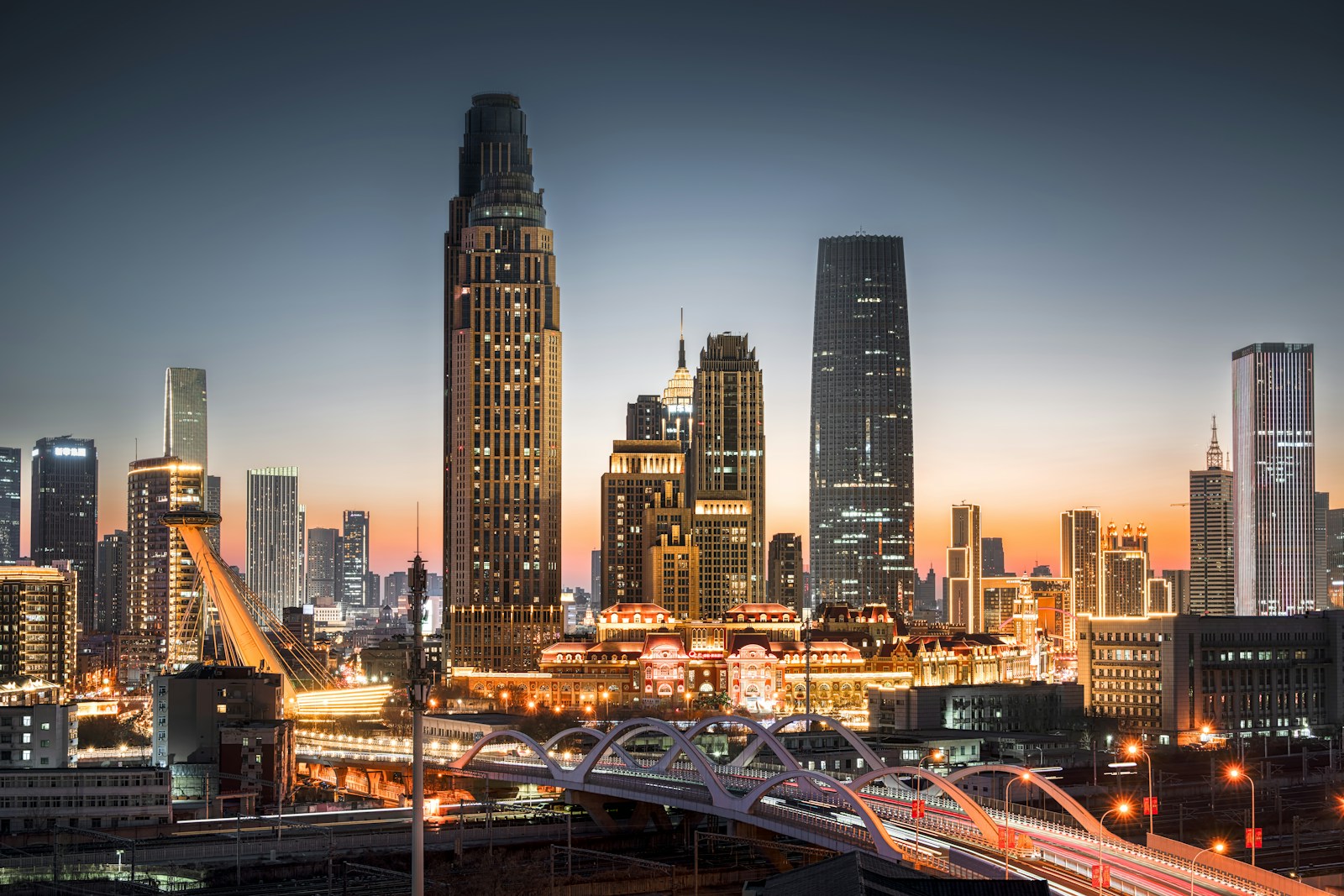
Where the Hai River winds toward the Bohai Sea, an hour’s drive from the capital, stands Tianjin (天津 Tiānjīn) — a directly-governed municipality of some 13 million people and the great port of northern China. Its name means “the Heavenly Ford”, and for six centuries it has guarded the approach to Beijing: first along the Grand Canal, later as the treaty port where nine foreign powers built their own quarters beside the river.
The result is one of China’s most characterful cities — a place of European mansions and Italianate squares, of fast-talking comedians and irresistible street food. For Mandarin learners, Tianjin is welcoming and easy: the local dialect gives the city its quick, comic warmth, but Standard Mandarin (Pǔtōnghuà) is understood everywhere. This guide covers Tianjin’s history and concessions, the dialect and crosstalk, the food, the headline sights, the people and the economy, and what to know before you go.
A brief history of Tianjin
Tianjin began as a garrison and a crossing. In 1404, early in the Ming dynasty, the Yongle Emperor fortified this marshy junction where the Grand Canal meets the Hai River and gave it the name Tianjin — “the Heavenly Ford” — said to mark the spot where he had crossed the water on his march to seize the throne. Its position made it the indispensable trans-shipment point for the grain and salt that fed the imperial capital just upstream.
Its modern character was forged in the nineteenth century. After the Second Opium War, Tianjin was opened as a treaty port under the 1860 Convention of Peking, and over the following decades it accumulated nine foreign concessions — British, French, German, Japanese, Italian, Russian, Austro-Hungarian, Belgian and more — each building its own quarter of banks, churches and garden villas. No other Chinese city collected so many; the legacy is an extraordinary open-air museum of world architecture. You can read more about the foreign concessions in Tianjin and how they shaped the city.
That concession era also made Tianjin a refuge for the famous and the falling: the last emperor Puyi sheltered here after his abdication, and reformers, warlords and writers all kept residences along its leafy avenues. In 1949 the city was incorporated into the new republic, and today it is a directly-governed municipality and one of China’s busiest ports — the maritime gateway of the capital region.
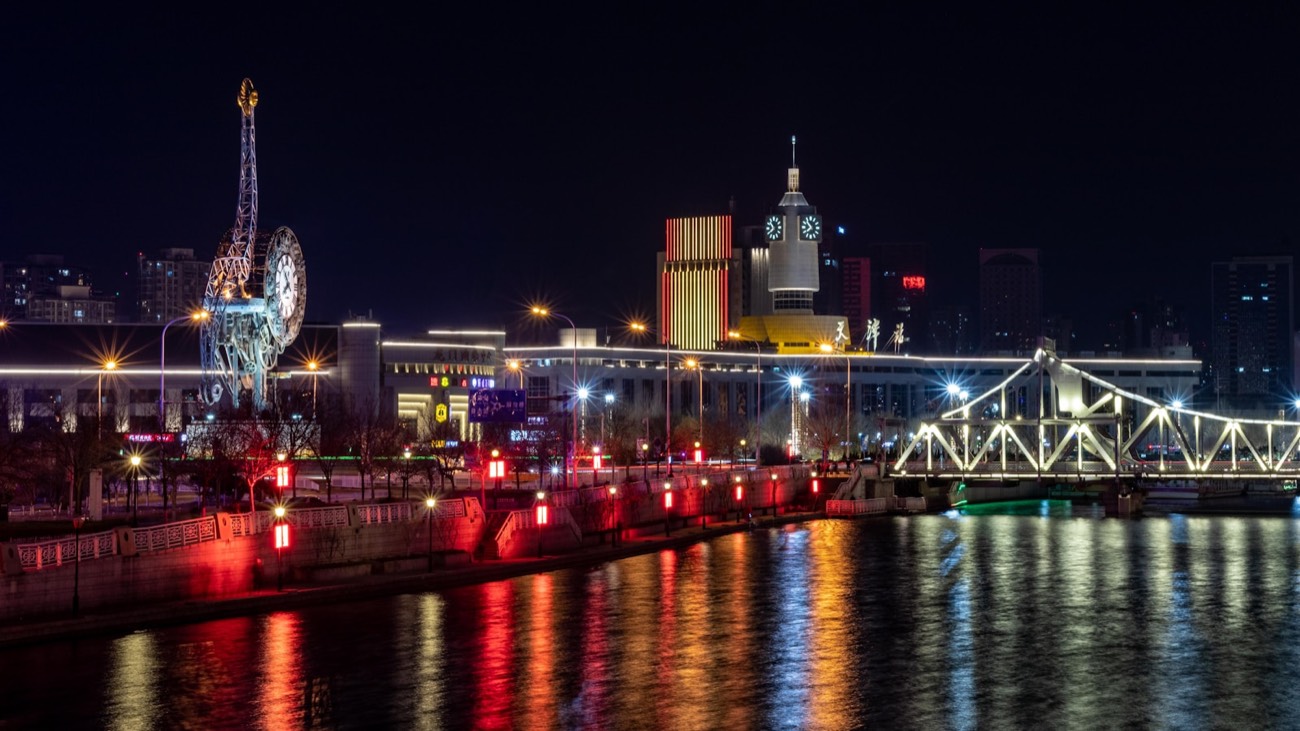
The Tianjin dialect and the home of crosstalk
Tianjin has its own distinct way of speaking — the Tianjin dialect (天津话), a variety of northern Mandarin famous for its sing-song, down-sloping melody and its quick, self-deprecating wit. Tianjinese are reputed across China to be natural comedians, and the dialect’s very rhythm seems built for a punchline.
That is no accident. Tianjin is, alongside Beijing, the great heartland of 相声 (xiàngsheng) — the traditional two-person comic crosstalk that is one of China’s best-loved performing arts. The city produced legendary masters such as Ma Sanli (马三立), celebrated for his deadpan, slow-burn delivery, while the contemporary star Guo Degang (郭德纲) — a Tianjin native — sparked a nationwide revival of the form.
For visitors and learners the practical picture is simple: Standard Mandarin (Pǔtōnghuà) is taught in every school and understood by everyone. Because the dialect is still a form of Mandarin, you can usually follow the gist while picking up an ear for one of China’s most characterful accents — and catching a crosstalk show is a genuinely fun way to train your listening.
Six Tianjin words worth knowing
Tianjin dialect is a distinct northern Mandarin with its own unmistakable melody and a famous reputation for humour — this is the home of 相声 (crosstalk), China’s beloved comic double-act tradition. Barely an hour from Beijing, it sounds surprisingly different, full of quick-witted, self-deprecating wit. Standard Mandarin is understood everywhere; tap 🔊 for the Standard Mandarin reading of each character.
Phrases worth knowing in Tianjin
Six phrases for the port city — Standard Mandarin you’ll actually use, with a little local flavour. Tap 🔊 for native audio.
Tianjin food: street snacks and Goubuli buns
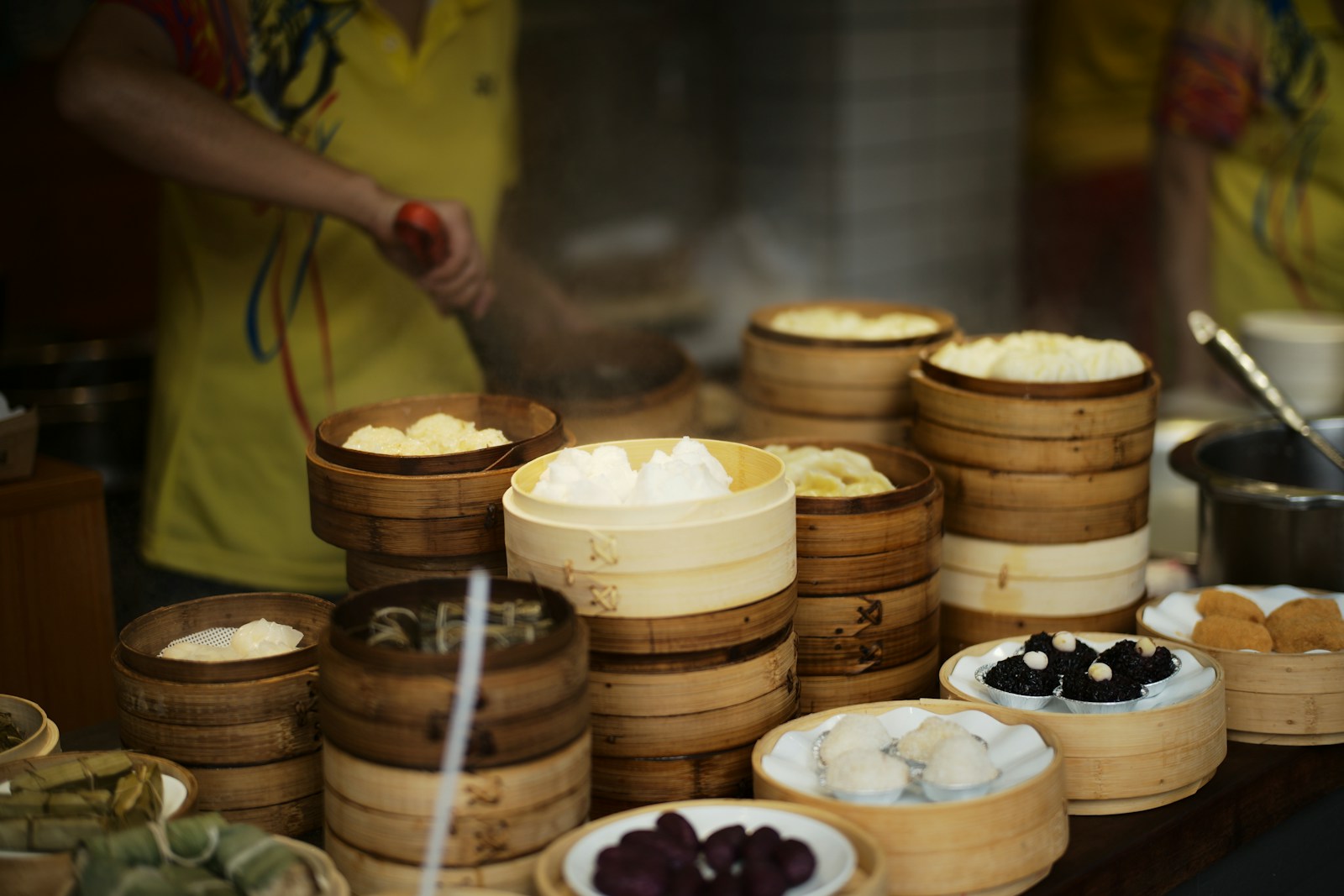
Tianjin is one of China’s great snacking cities, and its reputation rests not on banquets but on street food — cheap, savoury and brilliant, eaten on the go. Breakfast is a religion here: a hot jianbing guozi crepe folded around a crisp cracker, a bowl of silky guoba cai, or a basket of the city’s celebrated steamed buns.
The most famous name of all is Goubuli (狗不理), the soup-filled baozi brand founded in 1858 and prized for its delicate, eighteen-pleat buns. Add the sweet, sesame-studded mahua dough twists and the crisp Erduoyan fried cakes, and you have a city built for grazing. Come hungry.
Say the menu
Tap 🔊 to hear each dish in Mandarin:
Iconic attractions in and around Tianjin
Six Tianjin landmarks worth building a trip around — from a wheel on a bridge to whole quarters of borrowed Europe:
Five Great Avenues 五大道
A leafy grid of five avenues in the former British concession, lined with more than two thousand garden villas in British, French, Italian, German and Spanish styles. Nicknamed the ‘‘Expo of World Architecture’’, it is best explored on foot or by horse-drawn carriage.
Italian Style Town 意式风情区
Built on the former Italian concession, this is the largest quarter of Italian architecture preserved outside Italy — piazzas, fountains and Mediterranean facades, including the villa where the reformer Liang Qichao wrote in his ‘Ice-Drinker’s Studio’.
Ancient Culture Street 古文化街
A reconstructed Qing-style pedestrian street of folk-craft shops and snack stalls, centred on the Tianhou Temple (天后宫) to Mazu, goddess of the sea. The place to find Yangliuqing New Year prints and painted clay figurines.
Tianjin Eye 天津之眼
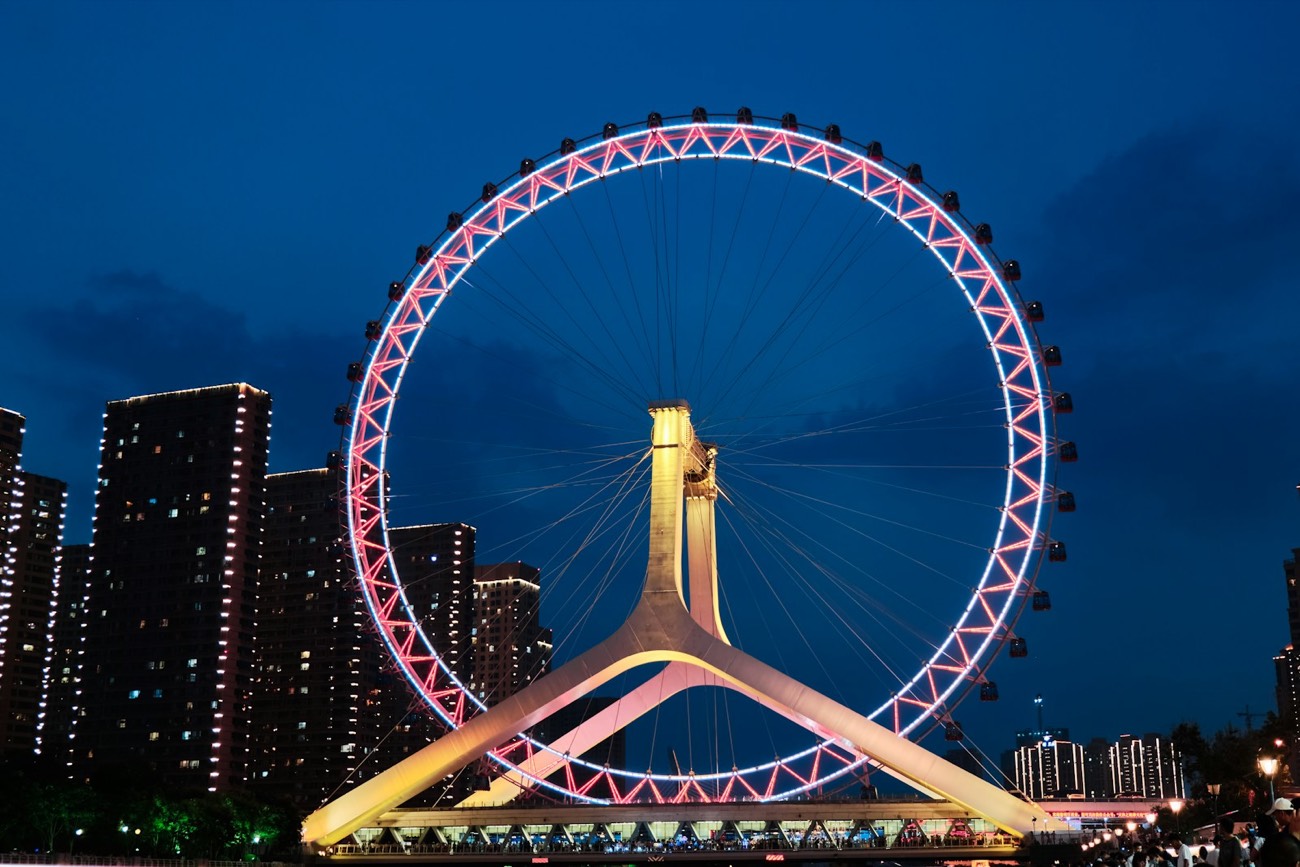
A roughly 120-metre Ferris wheel mounted directly on the Yongle Bridge over the Hai River — the only Ferris wheel in the world built across a working bridge. Its glass capsules give sweeping night-time views along the lit river.
Porcelain House 瓋房子
A former French-concession mansion encrusted by a collector in millions of pieces of antique porcelain, shards and ancient vases, with a porcelain dragon coiling around the roof — one of China’s most surreal private museums.
Binhai Library 滨海图书馆
A jaw-dropping modern library in the Binhai district whose floor-to-ceiling terraced ‘bookshelf’ walls ripple around a giant mirrored sphere nicknamed ‘The Eye’. It became a global design sensation the moment it opened.
Famous people connected to Tianjin
A wartime emperor, two comic geniuses and a legendary fighter — Tianjin’s concession-era streets and stages drew a remarkable cast:
Ma Sanli (马三立)
A revered master of 相声 (crosstalk) who spent his long career in Tianjin and helped define the city’s deadpan, slow-burn comic style.
Guo Degang (郭德纲)
Born in Tianjin, he is the most famous contemporary crosstalk performer and founder of the Deyunshe troupe, credited with reviving the art for new audiences.
Puyi (瀦仪)
China’s last emperor lived in the Jingyuan villa in Tianjin’s former Japanese concession from 1929 to 1931, before leaving to become puppet ruler of Manchukuo.
Liang Qichao (梁启超)
The pioneering reformer and journalist settled in Tianjin’s Italian concession, designing his own villa and writing many late works in its ‘Ice-Drinker’s Studio’.
Huo Yuanjia (霍元甲)
The legendary martial artist and co-founder of the Chin Woo Athletic Association was born in Jinghai district, where a memorial hall now stands.
Zhang Xueliang (張学良)
The Manchurian warlord behind the 1936 Xi’an Incident kept a mansion in Tianjin’s former concession area, which survives today as a heritage site.
Tianjin’s modern economy
Tianjin is the maritime and industrial gateway of northern China — the capital region’s seaport and a heavyweight manufacturing base, woven ever more tightly into the Beijing–Tianjin–Hebei (Jing-Jin-Ji) megaregion.
Gateway of the north
The Port of Tianjin is northern China’s largest artificial harbour and one of the world’s ten busiest container ports, handling well over twenty million containers a year as the sea outlet for Beijing and the interior.
Manufacturing & aerospace
The coastal Binhai New Area concentrates petrochemicals, vehicles, electronics and aerospace — including a major Airbus assembly line — making Tianjin one of China’s key advanced-manufacturing hubs.
Half an hour from Beijing
High-speed trains link the two cities in about thirty minutes, and Tianjin anchors the southern flank of the Jing-Jin-Ji integration plan — one of the country’s great regional growth strategies.
Binhai New Area
The Binhai New Area is one of China’s flagship development zones — a free-trade zone and finance, shipping and advanced-manufacturing hub that has reshaped Tianjin’s economy this century.
Why Tianjin matters for Mandarin learners
Mandarin is your everyday language here. Across Tianjin, Standard Mandarin is the shared tongue of transport, hotels, restaurants and business — so the Chinese you’ve studied works from the moment you step off the train.
It’s a brilliant ear-training ground. The Tianjin dialect is a characterful but largely intelligible variety of northern Mandarin, ideal for getting used to real-world accents — and as the home of crosstalk, the city offers an endless supply of fast, idiomatic, pun-rich listening practice.
The vocabulary of food and travel comes alive. Breakfast orders, prices, directions, river and rail — the high-frequency Mandarin you most need is in constant, friendly use in Tianjin’s markets and snack streets.
It’s the easiest of day trips. Just thirty minutes from Beijing by high-speed rail, Tianjin is the perfect place for a student in the capital to test their Mandarin in a warm, unhurried, genuinely fun city.
Visiting Tianjin — practical notes
Getting there: the easiest approach is the high-speed train from Beijing, which takes only about thirty minutes; Tianjin Binhai International Airport adds direct flights across China and beyond.
Getting around: the metro is clean and expanding, and the historic core around the Hai River, the Italian Style Town and the Ancient Culture Street is wonderfully walkable. A river cruise is the classic way to see the bridges and concession facades lit up at night.
When to come: spring and autumn are the most comfortable seasons. Summers are hot and humid, and winters are cold and dry — this is the north — so pack accordingly.
Eat the city: start the day with a jianbing guozi from a street cart, try a basket of Goubuli buns, and pick up a box of Eighteenth Street mahua to take home.
A day or two in Tianjin: the Five Great Avenues and Italian Style Town by day; the Tianjin Eye and the riverfront by night; and a wander through the Ancient Culture Street for handicrafts and snacks — an easy, rewarding escape from the capital.
Test your Tianjin knowledge
1. Tianjin is best described as China’s:
2. Tianjin stands on the banks of the:
3. Tianjin is the heartland of which art form?
4. After 1860, Tianjin’s cityscape was shaped by:
5. Tianjin’s most famous steamed buns are:
6. Tianjin’s famous twisted fried-dough snack is called:
FAQs
Start your Mandarin journey
Want to learn the Standard Mandarin spoken across Tianjin and the rest of China? Online 1-on-1 lessons with a native speaker.