A Guide to Beijing (北京): China’s Capital City
A brief history of Beijing
Beijing has served as China’s capital for nearly eight centuries — far longer than most learners realise. According to the Wikipedia history of Beijing, the area has been inhabited for over 3,000 years, but the city was first established as a unified national capital under the Yuan dynasty in 1271, when Kublai Khan rebuilt it as Dadu (大都, “Great Capital”) .
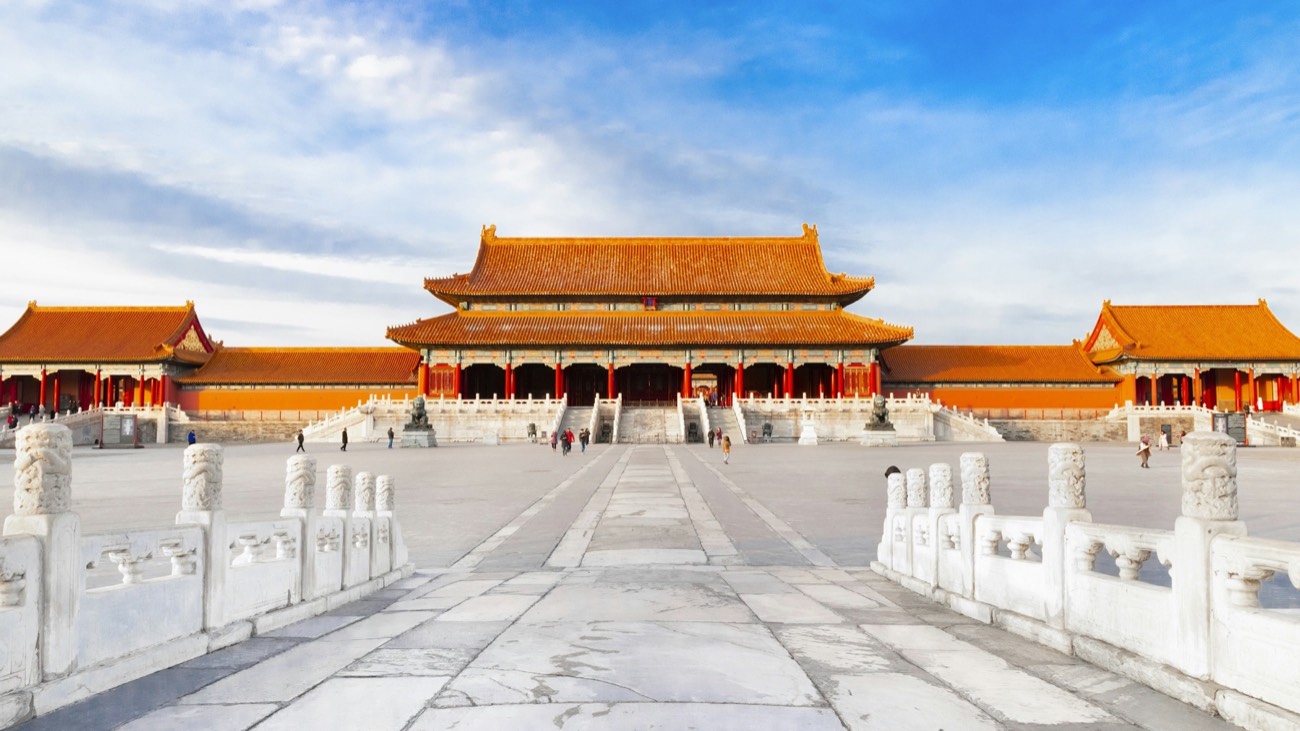
Under the Ming dynasty, the city was renamed Beijing (“Northern Capital”) in 1403, and the Forbidden City was constructed between 1406 and 1420 — a UNESCO-listed palace complex per the UNESCO World Heritage entry. For 492 years, twenty-four emperors of the Ming and Qing dynasties ruled China from inside its 980 buildings.
Walk through Beijing today and you’ll feel eight centuries of layered history — Yuan-era street grids, Ming walls and palaces, Qing gardens, and 21st-century CBD towers.
The Qing dynasty (1644–1912) kept Beijing as the capital and expanded its cultural footprint with the Summer Palace, the Temple of Heaven complex, and the imperial gardens at Yuanmingyuan. After the fall of the empire, Beijing remained the political heart of China through the Republican period and — after a brief interlude when Nanjing was the Nationalist capital — was reaffirmed as the capital of the People’s Republic in 1949.
To understand how Beijing’s dynastic history fits into the broader story of imperial China, see our guide to the major Chinese dynasties.
The Beijing dialect and Standard Mandarin
For Mandarin learners, this is the most important section of the guide. Beijinghua is the historical basis for Standard Mandarin , the form of Chinese taught in classrooms around the world.
That said, the two aren’t identical. Beijinghua is famous for its heavy use of erhua (儿化音 ér huà yīn) — the curled-tongue “r” suffix that turns 哪 (nǎ, “which”) into 哪儿 (nǎr, “where”). Beijing locals add it to far more words than Mandarin courses ever teach, and string together phrases with a relaxed, casual rhythm that can sound mumbled to outsiders.
The practical good news for learners: the Standard Mandarin you’ve studied is intelligible everywhere in Beijing, and once you’ve trained your ear to a bit of erhua, you’ll follow Beijing locals fine. For a wider lens on how Mandarin sits among China’s other tongues, see our guide to languages and dialects in China.
Six Beijing words worth knowing
Although Standard Mandarin is built on Beijing speech, the real Beijing dialect goes a good deal further — with heavy 儿化 (the rolled er-suffix), a rich vein of old slang, and a famously courteous register topped by the polite 您. That old-Beijing flavour still lives in the hutongs, where locals natter and take their evening 遛弯儿. Tap 🔊 for the Standard Mandarin reading of the characters.
Quirky Beijing dialect phrases worth knowing
Six distinctly Beijing phrases — tap 🔊 on any to hear the pronunciation.
Beijing’s intensifier of choice. The 儿 is the giveaway — pure Beijing.
The character 甭 is a contraction of 不用 (“no need to”) — efficient, very Beijing.
Classic Beijing male-friend address — sits somewhere between “bro”, “mate” and “dude”.
The quintessential Beijing pastime — an unhurried evening walk around the neighbourhood.
Shooting the breeze — a Beijing taxi driver’s political analysis in action.
Beijing’s casual drinking invitation — softer and more local than the formal 干杯.
Beijing cuisine: more than Peking duck
Beijing food has a distinctive northern character — rich, hearty, built around wheat noodles, roasted meats and fermented sauces rather than the rice-and-seafood palette of southern China. The city’s status as imperial capital pulled in cooking traditions from across the empire, but the dishes Beijing locals eat day-to-day are unmistakably Beijing. For a wider lens on regional Chinese food, see our regional Chinese cuisine guide.
Peking duck
北京烤鸭 · Běijīng kǎoyāThe city’s signature dish — air-dried duck, roasted glassy-crisp in a wood-fired oven, eaten in thin pancakes with hoisin and spring onion. Quanjude, Da Dong and Siji Minfu are the famous names.
Zhajiangmian
炸酱面 · ZhájiàngmiànBeijing’s signature noodle dish — hand-pulled wheat noodles topped with fermented soybean-pork sauce and a halo of fresh vegetable garnishes.
Lamb hotpot
涮羊肉 · Shuàn yángròuThe Beijing version uses a tall copper pot with plain broth, paper-thin lamb slices and sesame dipping sauces — Mongolian roots, Beijing refinement.
Jianbing
煎饼 · JiānbǐngBeijing’s most popular street breakfast — a savoury crepe with egg, fried wonton, scallions and chilli sauce, folded in seconds and eaten on the run.
Iconic attractions & cultural landmarks
Beijing’s landmarks span a millennium of architecture and culture — from imperial palaces and temples to hutong alleyways and 21st-century CBD towers. Five anchors worth planning your trip around:
Forbidden City 故宫
The world’s largest preserved palace complex — over 980 buildings and 9,000 rooms, home to 24 emperors across 492 years. Plan at least half a day; advance booking required.
Great Wall 长城
Multiple sections accessible from Beijing — Badaling (crowded but easy), Mutianyu (cleaner, with a cable car), and Jinshanling or Simatai (for serious hikers wanting unrestored wall).
Tiananmen Square 天安门广场
One of the largest urban squares in the world — flanked by the Forbidden City, the Great Hall of the People, and the National Museum of China.
Summer Palace 颐和园
A vast Qing-era imperial garden complex centred on Kunming Lake, rebuilt by the Empress Dowager Cixi. UNESCO listed; allow a full day.
Hutongs 胡同
Beijing’s old single-storey alleyway neighbourhoods — courtyard homes, tea houses, hidden bars. Nanluoguxiang and Wudaoying are the famous walking routes; quieter ones surround the Drum and Bell Towers.
Temple of Heaven 天坛
The Ming-era complex where emperors prayed for good harvests, its circular Hall of Prayer a masterpiece of timber engineering set in a vast park. At dawn it fills with locals doing tai chi, dancing and singing.
Famous people from Beijing
Six figures, all Beijing-born, whose work shaped Chinese culture worldwide.
Mei Lanfang (梅兰芳)
Reshaped dan-role portrayal and brought Peking opera to international audiences in the US, Europe and the Soviet Union.
Lao She (老舍)
Author of Rickshaw Boy and Teahouse — the foremost chronicler of working-class old Beijing life.
Chen Kaige (陈凯歌)
Director of Farewell My Concubine — winner of the Palme d’Or at Cannes in 1993, the first for a Chinese film.
Jet Li (李连杰)
Six-time national wushu champion turned international film star — Hero, Once Upon a Time in China, Hollywood crossovers.
Faye Wong (王菲)
One of the bestselling Chinese-language artists of all time; starred in Wong Kar-wai’s Chungking Express.
Zhang Ziyi (章子怡)
Crouching Tiger Hidden Dragon, Memoirs of a Geisha, House of Flying Daggers — one of China’s most internationally recognised film stars.
Beijing’s modern economy & global role
Beijing is China’s political, financial and tech capital — a city where the levers of national power, the country’s biggest banks and its most ambitious start-ups all sit within a 30-kilometre radius.
China’s banking capital
Home to the People’s Bank of China, all the major state-owned banks, and the Beijing Stock Exchange (launched 2021).
Zhongguancun · 中关村
“China’s Silicon Valley” — home to Baidu, Lenovo, Xiaomi and a generation of AI start-ups, all clustered around Tsinghua University.
Tsinghua & Peking University
China’s two most prestigious universities — both consistently ranked in the world’s top 20, a magnet for international researchers and graduate students.
National capital
State Council, NPC, all key ministries, and 170+ foreign embassies — the city where every China-related diplomatic decision is made.
Why Beijing matters for Mandarin learners
Learning Mandarin = learning Beijing
The Standard Mandarin you learn in any structured course is, at its foundation, a refined version of how Beijing locals speak. Once you’ve built basic conversational confidence, you’ll be intelligible in Beijing immediately — and conversely, the accents you hear most often in Chinese films, TV news and pop songs are the accents you’re already training your ear to.
If you’re weighing Mandarin against Cantonese or wondering whether to learn the simplified or traditional script, see our Mandarin vs Cantonese guide. And for the bigger-picture question of getting started as an adult learner, our guide to learning Mandarin as an adult walks through what’s actually involved.
Visiting Beijing — practical notes
Best time
Spring (Apr–May) and autumn (Sep–Oct) — mildest temperatures and clearest air.
Getting around
Extensive subway with bilingual signage; Didi for ride-share. Avoid driving.
Visa
240-hour transit visa-free entry for many nationalities (as of 2026).
Language
Standard Mandarin universal; English limited outside major tourist sites and hotels.
Useful Mandarin phrases — tap to hear
- 你好 (nǐhǎo)Hello
- 谢谢 (xièxie)Thank you
- 多少钱? (duōshao qián?)How much?
- 我要这个 (wǒ yào zhège)I want this
For a more complete travel-phrase guide, see our essential Mandarin phrases for travelling to China.
Test your Beijing knowledge
1. Which dynasty established Beijing as the unified national capital?
2. The Beijing phrase 倍儿好 (bèir hǎo) means:
3. What’s the relationship between Beijinghua and Standard Mandarin?
4. Beijing’s great imperial palace complex is called:
Frequently asked questions
Start your Mandarin journey
Want to learn the Standard Mandarin spoken across Beijing and the rest of China? Online 1-on-1 lessons with a native speaker.