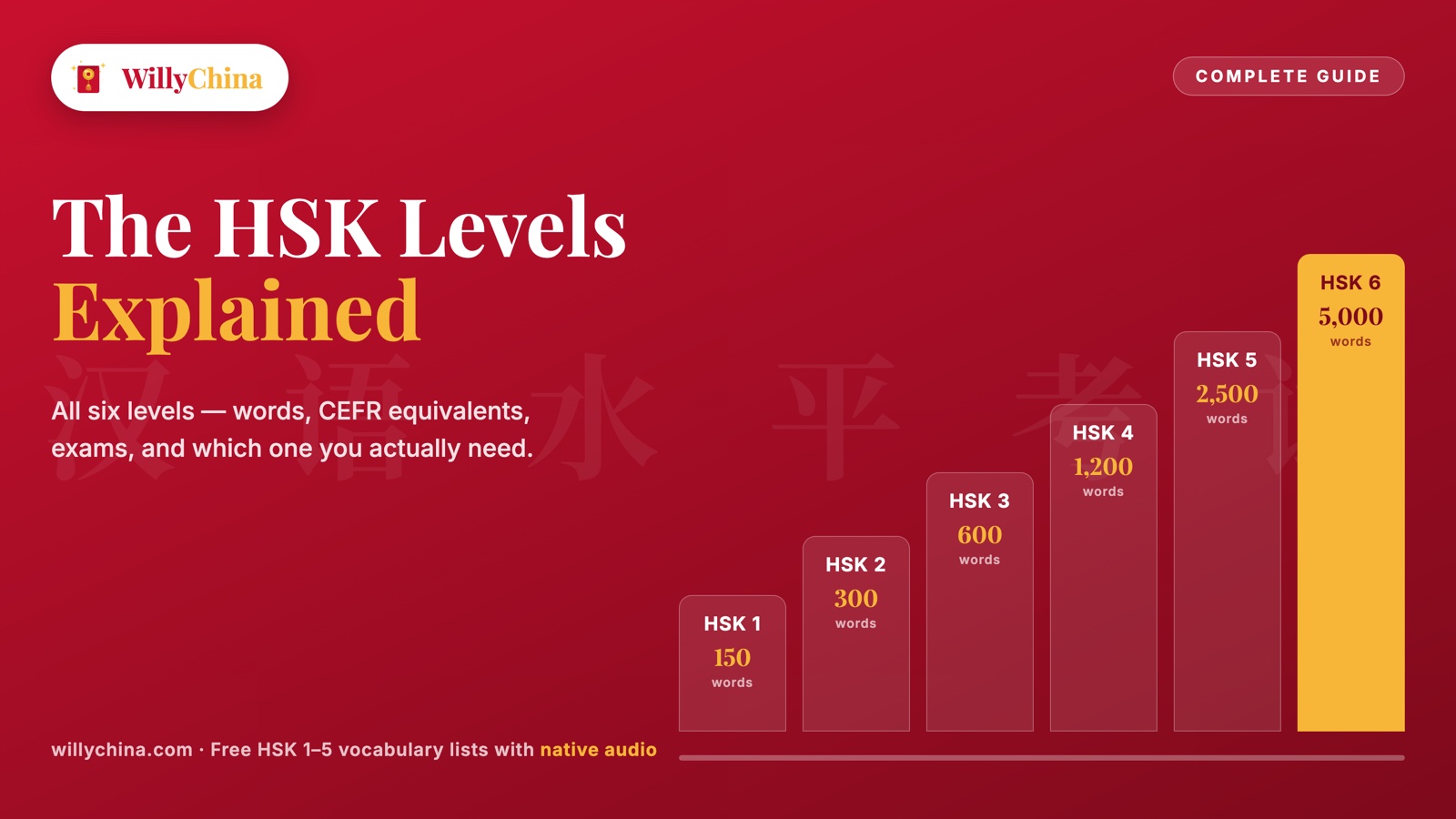
The HSK Levels, Explained
All six levels of China’s official Mandarin exam — how many words each takes, how they map to CEFR, what the tests involve, and which level you actually need.
What are the HSK levels? The HSK (Hanyu Shuiping Kaoshi, 汉语水平考试) is China’s official Mandarin proficiency exam, and its six levels are the world’s standard roadmap for learning Chinese — from HSK 1 (150 words) to HSK 6 (around 5,000).
What is the HSK?
HSK stands for Hanyu Shuiping Kaoshi — literally “Chinese proficiency test”. It’s administered worldwide by Chinese Testing International and is the credential Chinese universities, scholarship bodies and employers recognise. But even if you never sit an exam, the levels matter: they define which words to learn in which order, which is why nearly every serious textbook, course and app is built around them.
One housekeeping note: this guide follows the HSK 2.0 standard — six levels, used by test centres and textbooks worldwide. The newer HSK 3.0 standard (2021) reorganises proficiency into nine bands — and since 1 July 2026 the exams have used it worldwide. Our new HSK 3.0 word lists — Band 1, Band 2 and Band 3 — already cover the first two levels of the nine-band system. The six-level system below remains the roadmap that textbooks, courses and vocabulary lists follow through the transition, and HSK 2.0 certificates keep their validity.
The six levels, one by one
Every level links to its free vocabulary list with native audio.
HSK 1
Greetings, numbers, very basic needs. Pinyin printed on the exam.
HSK 1 Vocab List →HSK 2
Simple, direct exchanges about daily life and familiar topics.
HSK 2 Vocab List →HSK 3
Everyday independence — travel, study, work small-talk. Writing begins.
HSK 3 Vocab List →HSK 4
Wide-ranging conversation with native speakers. University entry level.
HSK 4 Vocab List →HSK 5
Newspapers, films and structured talks. Competitive uni programmes.
HSK 5 Vocab List →HSK 6
Near-native reading, fluent written expression. The 2.0 summit.
HSK Prep Course →Who runs the HSK — and why that matters
The HSK is China’s official state proficiency exam, developed under the Ministry of Education’s language bodies (the Center for Language Education and Cooperation, successor to the organisation long known as Hanban) and delivered worldwide by Chinese Testing International. The first version emerged from Beijing Language and Culture University research in the 1980s and went international in the early 1990s; the six-level structure most learners know arrived in 2010, and the nine-band HSK 3.0 standard published in 2021 reaches exam halls in July 2026.
Why this matters to you: official status is the entire value of the certificate. Chinese universities, scholarship bodies (including the Chinese Government Scholarship), employers and visa categories all reference HSK scores precisely because the standard is state-maintained and centrally administered — a tutor’s assessment or an app streak can’t substitute. It also means there is exactly one authoritative source for rules, dates and fees: chinesetest.cn, not third-party prep sites.
The levels at a glance
| Level | New words | Total | CEFR (approx.) | What you can do |
|---|---|---|---|---|
| HSK 1 | 150 | 150 | A1 | Greetings, numbers, very basic needs |
| HSK 2 | 150 | 300 | A1–A2 | Simple, direct exchanges about daily life and familiar topics |
| HSK 3 | 300 | 600 | B1 | Everyday independence — travel, study, work small-talk |
| HSK 4 | ~600 | ~1,200 | B2 | Wide-ranging conversation with native speakers |
| HSK 5 | ~1,300 | ~2,500 | C1 | Newspapers, films and structured talks |
| HSK 6 | ~2,500 | ~5,000 | C1–C2 | Near-native reading, fluent written expression |
Word counts follow the official HSK 2.0 specification; published lists vary by a word or two where duplicates are merged. CEFR mappings are honest approximations — Hanban’s own mapping is more generous than most European assessments, so treat HSK 4 as “solid B2 conversation” rather than a legal equivalence.
What each exam actually tests
The word counts tell you the size of each level; here’s what sitting it actually feels like, and the single study priority that moves the needle at each rung.
HSK 1 — proving the sounds stuck
Pictures, recordings and pinyin support everywhere: the exam checks that 150 words exist in your ear, not just your notebook. Most candidates pass comfortably; the real test is whether your tones survived first contact. Study priority: listen daily from day one — our HSK 1 list with native audio exists for exactly this.
HSK 2 — following real exchanges
Still pinyin-supported, but the recordings become two-turn dialogues with context to track. The trap is vocabulary that looks familiar but won’t surface at speed. Study priority: speed of recall — drill the 300 cumulative words until answers arrive in under a second.
HSK 3 — the pinyin safety net disappears
Characters only, writing section introduced, and topics leave the survival zone. This is the level that exposes anyone who postponed reading practice. Study priority: character reading speed — re-read simple texts until your eyes stop translating and start recognising.
HSK 4 — the credibility threshold
Double the vocabulary, abstract topics, jumbled-sentence ordering, and the first level universities take seriously for admissions. Listening turns conversational-fast. Study priority: output under pressure — weekly speaking and writing with correction, because passive recognition stops being enough.
HSK 5 — comfort becomes competence
News-register reading, single-play audio, short essays. The gap between “passed HSK 4” and “comfortable at HSK 5” is the largest on the ladder — vocabulary roughly doubles again to 2,500. Study priority: volume — graded readers, podcasts and the HSK 5 list worked in daily circuits.
HSK 6 — the summit, honestly assessed
Five thousand words, idiom-dense passages, and the summary-writing task that intimidates even strong candidates. Worth stating plainly: many successful careers in China run perfectly well on HSK 5. Sit HSK 6 when a scholarship, degree programme or personal summit demands it. Study priority: structured writing practice with a teacher who corrects ruthlessly.
Which HSK level do you actually need?
Travel and daily life — HSK 3 is the practical sweet spot; HSK 4 makes it comfortable. University in Mandarin — HSK 4 minimum for most degree programmes, HSK 5 for competitive ones; check your university’s exact score requirement. Work in a Chinese-speaking environment — HSK 4–5 depending on the role, though spoken fluency matters more than the certificate. No exam plans at all — follow the levels anyway: they’re the best-sequenced word lists in existence.
Not sure where you currently sit? Our free Mandarin level test places you on the HSK ladder in about ten minutes.
Exam format and scoring
HSK 1–2 test listening and reading only, with pinyin support, scored out of 200 (120 passes). HSK 3–6 add writing and drop the pinyin, scored out of 300 (180 is the accepted benchmark). Sittings run from about 40 minutes at HSK 1 to about 140 minutes at HSK 6. Results don’t expire, but universities generally accept scores no older than two years.
If you have an exam date booked, vocabulary alone won’t carry you — listening speed, reading pace and (from HSK 3 up) writing technique decide marks. That’s what our 1-on-1 HSK Preparation course drills, with mock papers and timing strategy.
How to prepare: the routine that survives real life
Whatever the level, preparation that works tends to look the same — a small daily core with weekly correction, not heroic weekends. The version we set for students:
Daily (25–30 minutes): ten minutes of vocabulary with audio — say each word aloud after the recording, never silently; ten minutes of reading at or just below your level so your character recognition compounds; five to ten minutes of listening at natural speed, even when it stings. All five of our free word lists are built for exactly this circuit, with native audio on every entry.
Weekly: one live conversation with correction — this is the single highest-leverage hour in the schedule, because it converts recognition into recall and catches the errors that fossilise when you study alone. From HSK 3, add one timed writing exercise; from HSK 4, make every second week a timed mock section so the exam’s clock becomes familiar rather than frightening.
The month before the exam: shift from learning to rehearsal — full mock papers under real conditions, error-log review, and no new vocabulary in the final week. Technique stops being a detail at this point: knowing the question formats is worth real marks, which is what our test-day guide and the HSK Preparation course are for.
Reading your score like an admissions officer
Passing and qualifying are different games. HSK 1–2 report out of 200 with 120 as the pass line; HSK 3–6 report out of 300, where 180 is the accepted benchmark. But institutions read the number, not the word “pass”: competitive degree programmes taught in Chinese commonly want HSK 4 at 210–240 or HSK 5, top-tier universities and scholarship schemes often look for HSK 5 at 210+ — and some add section minimums, so a brilliant reading score can’t fully carry a weak listening one. Always check your target institution’s current published requirement rather than aiming for the bare benchmark.
Scores are typically treated as valid for two years for admissions purposes, which sets your booking strategy: sit the exam inside the two years before your application lands, not the moment you feel ready. And if you’re between levels, remember the maths from our timeline guide — a higher level at the benchmark usually beats a lower level with a perfect score.
Three myths worth retiring
“You must pass every level in order.” You register for whichever level you like — most learners sit HSK 3 or 4 as their first exam ever. “HSK 6 means native-level fluency.” It doesn’t; it certifies advanced academic comprehension, and plenty of HSK 6 holders still find a Chengdu taxi conversation humbling — fluency comes from speaking hours, not certificates. “The certificate expires after two years.” The certificate itself doesn’t expire; institutions simply prefer results from the last two years as evidence of current level. The distinction matters when an employer asks for “any HSK 5” versus a university that wants recent proof.
FAQs
Keep building
Grammar, settled
了, the three de, measure words — with audio examples.
Open the Grammar Library →