A Guide to Hunan (湖南): Avatar Mountains, Fiery Xiang Cuisine & Revolutionary Roots
Wrapped around the southern shore of Dongting Lake and threaded by the Xiang River, Hunan (湖南 Húnán) takes its name from its position — hú nán means “south of the lake”. It is a province of dramatic contrasts: subtropical mountains that pierce the cloud, a capital obsessed with food and television, and a chilli-soaked cuisine that travellers either fall for completely or never forget. This is also the China that produced Mao Zedong — a landscape whose fierce, independent character its people wear with open pride.
For Mandarin learners, Hunan offers something few provinces can: the thrill of a genuinely different China. The scenery behind Avatar, a riverside Miao town out of a scroll painting, street food that has its own television channel, and a regional dialect so distinctive it has spawned a thousand affectionate jokes. This Hunan province guide covers the history, the language landscape, the food, four cities worth your time, and why a province known for spice and revolution rewards anyone learning the language.
A brief history of Hunan
Long before it answered to a Chinese emperor, the land south of Dongting Lake belonged to the Kingdom of Chu (楚国) — the great southern rival of the Yellow River states, famed for its shamanic religion, bronze artistry and lyrical poetry. The poet-statesman Qu Yuan (屈原), exiled from the Chu court, drowned himself in Hunan’s Miluo River (汨罗江) in 278 BC. The dragon-boat races and sticky-rice zòngzi eaten across China every Dragon Boat Festival began here, as offerings to his memory.
In 1972, archaeologists outside Changsha opened the Mawangdui tombs (马王堆) and found one of the wonders of Chinese archaeology: the 2,100-year-old body of Lady Dai, so perfectly preserved that her skin was still soft, alongside silk paintings, lacquerware and medical texts that rewrote what we knew of the early Han. A few kilometres away, the Yuelu Academy (岳麓书院), founded in 976, became one of imperial China’s four great centres of Confucian learning — and it still teaches today, a thousand years on.
Hunan’s modern reputation, though, was forged in iron. The scholar-general Zeng Guofan raised his Xiang Army here to crush the Taiping Rebellion in the 1860s, and the province’s tradition of tough, principled soldier-statesmen never faded. It reached its apex in the twentieth century: Mao Zedong was born in the Hunan village of Shaoshan in 1893, and an extraordinary share of the Communist revolution’s leadership — Liu Shaoqi, Peng Dehuai, Hu Yaobang — came from the same fiercely independent province. Hunanese pride in this history is unmistakable, and it shapes how the place sees itself to this day.
Xiang Chinese and Southwestern Mandarin
The native speech of most of Hunan is Xiang Chinese (湘语 Xiāngyǔ), one of the ten primary branches of the Chinese language family and quite distinct from Mandarin. Linguists divide it into Old Xiang (spoken around Shuangfeng and Loudi in the centre, conservative enough to keep voiced consonants Mandarin lost long ago) and New Xiang (spoken in Changsha and the north, heavily reshaped by centuries of Mandarin contact). A Beijing visitor dropped into a rapid Changsha conversation will catch fragments at best.
Hunan’s western mountains tell a different story again: there the everyday language is Southwestern Mandarin (西南官话), the same broad variety spoken across Sichuan and Yunnan, alongside the languages of the Tujia and Miao minorities who have farmed these valleys for centuries. It is the Southwestern accent that colours most local Putonghua — and it is famous for it. The classic Hunan features are an n/l merger (so 牛 niú can sound like liú) and an f/h blur (so 湖南 Húnán becomes the gently teased “Fúlán”). It is one of China’s most lovable accents.
For visitors and learners the practical picture is reassuring: Standard Mandarin is universal across Hunan — in schools, on the metro, on the province’s famous television channels — and locals switch to it instantly for an outsider. But few provinces give you a livelier sense of how much variety sits beneath the standard language. Learn to hear past the n/l swap and Hunan Mandarin quickly becomes easy to follow.
Six Xiang words worth knowing
Xiang is so distinct from Mandarin that a visitor rarely catches a word — but a handful of local terms carry the whole flavour of the place. Tap 🔊 to hear the Standard Mandarin reading of each (a Changsha local would give them a blunter, earthier swing):
Phrases worth knowing in Hunan
Six Mandarin phrases that earn their keep on the mountain trails, along the Tuojiang River and — above all — at the table. Tap 🔊 for native audio.
Xiang cuisine: chilli, smoke and fire
Xiang cuisine (湘菜 Xiāng cài) is one of China’s Eight Great Culinary Traditions, and the one that wears its heat most proudly. Where Sichuan numbs the tongue with peppercorns, Hunan attacks it with raw, fresh and fermented red chilli — a cleaner, drier, more direct burn that many Chinese diners insist is the spicier of the two. This is food of conviction.
But heat is only the headline. Xiang cooking is equally defined by its smoked and cured meats (腊味 làwèi) — pork, fish and chicken hung above the kitchen fire through the damp Hunan winter — and by a deep love of sourness, fermentation and the wok’s charred edge. The result is bold, rustic and unapologetic, a world away from the delicate sweetness of the lower Yangtze.
Say the menu
Tap 🔊 to hear each dish in Mandarin:
Notable cities of Hunan
Hunan’s highlights spread from the capital in the east to the mountains of the far west — a little more spread out than a single province usually is, and all the more rewarding for it. Five very different places worth your time:
Changsha长沙
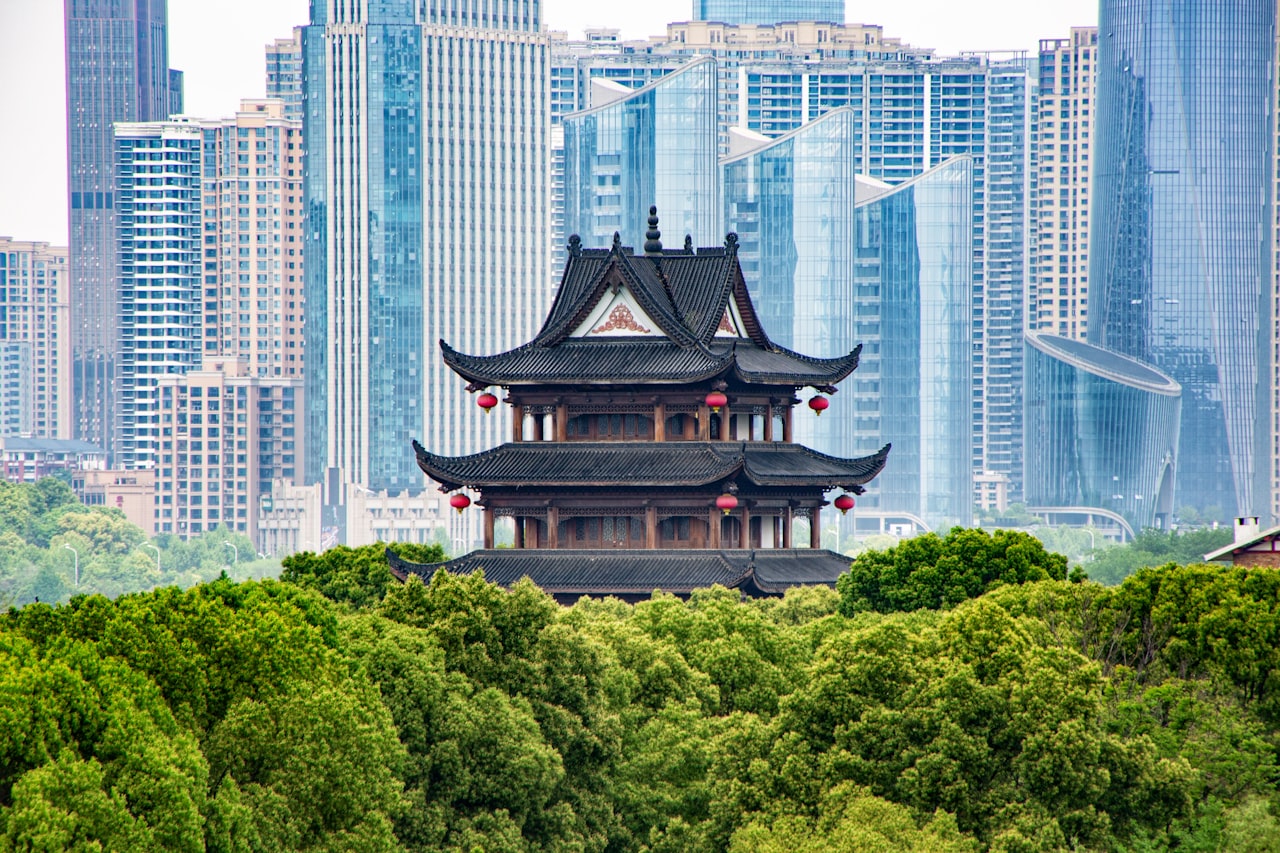
Changsha is one of China’s great eating cities — a UNESCO City of Gastronomy where the night markets run until dawn and queues for milk tea and stinky tofu stretch around the block. It is also the home of Hunan Satellite TV, the variety-show juggernaut that made the city a magnet for young China. Behind the neon sits real depth: the 2,100-year-old Mawangdui treasures in the Hunan Museum, the thousand-year-old Yuelu Academy on its wooded mountain, and Orange Isle (橘子洲), the long river island where a young Mao once swam and where a colossal stone bust of him now watches the Xiang.
For learners, Changsha is rewarding precisely because it is not a polished tourist set-piece. This is a confident, fast-talking, food-obsessed city that rewards anyone willing to order in Mandarin and join the queue.
Deep-dive guide coming soon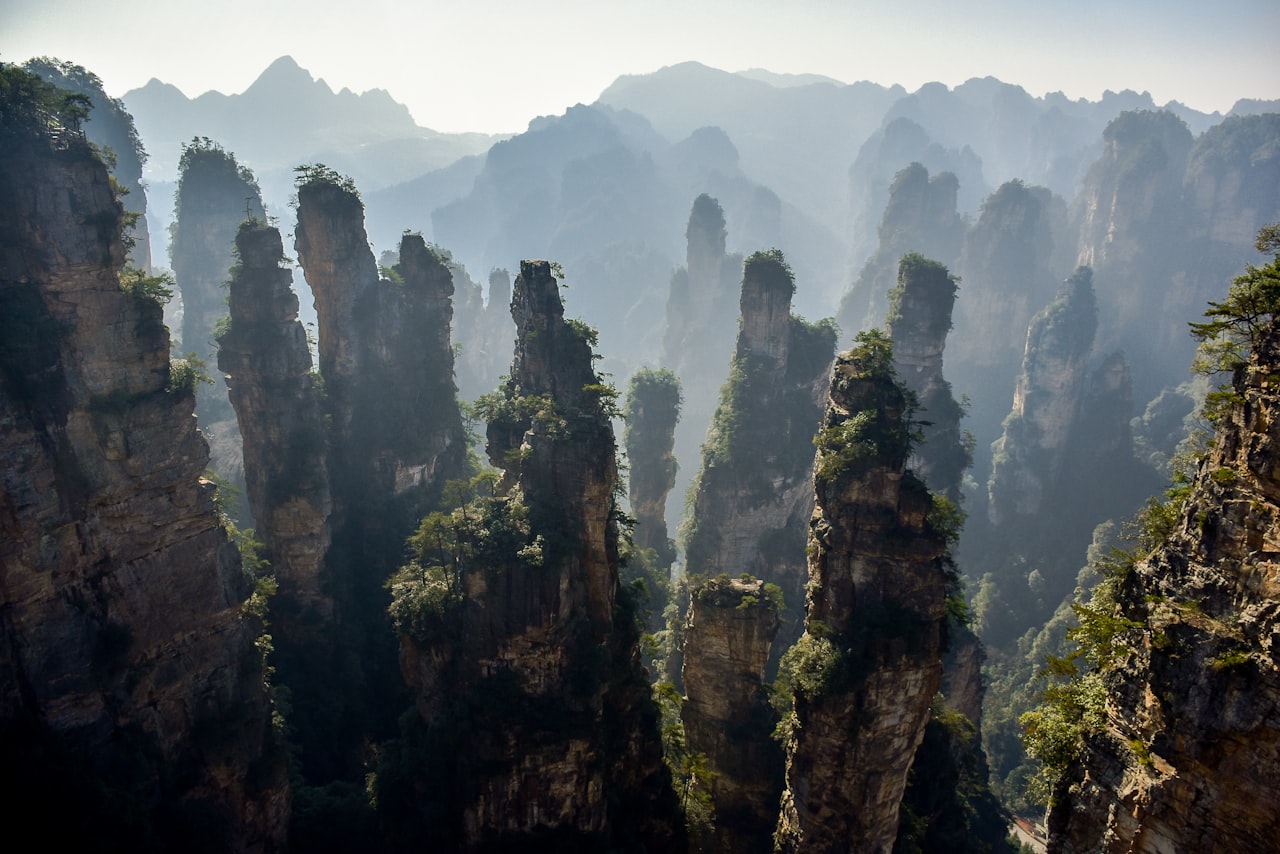
Zhangjiajie张家界
Zhangjiajie is why many travellers come to Hunan at all. Its Wulingyuan scenic area — a UNESCO World Heritage Site — is a forest of more than 3,000 quartz-sandstone pillars rising sheer from the subtropical mist, the landscape that James Cameron’s team cited as inspiration for the floating Hallelujah Mountains of Avatar. The world’s highest outdoor lift, the Bailong Elevator, climbs 326 metres up a cliff face to reach them.
Nearby Tianmen Mountain adds a 7.5-kilometre cableway, a cliff-edge glass skywalk and the vast natural arch of Heaven’s Gate, reached by 999 steps. It is spectacular, busy and best given two or three unhurried days.
Deep-dive guide coming soon
Yueyang岳阳
Yueyang guards the point where the Yangtze spills into Dongting Lake, China’s second-largest freshwater lake. Its crown is the Yueyang Tower (岳阳楼), a wooden landmark first raised in the Tang dynasty and immortalised in Fan Zhongyan’s celebrated 1046 essay — the source of the line every Chinese student learns: “be first to bear the world’s hardships, last to enjoy its comforts.”
Offshore lies Junshan Island, famous for its silver-needle tea, while the lake itself draws migrating birds to its wetlands each winter. For learners, Yueyang is a chance to stand inside a poem you may already have read in class.
Deep-dive guide coming soon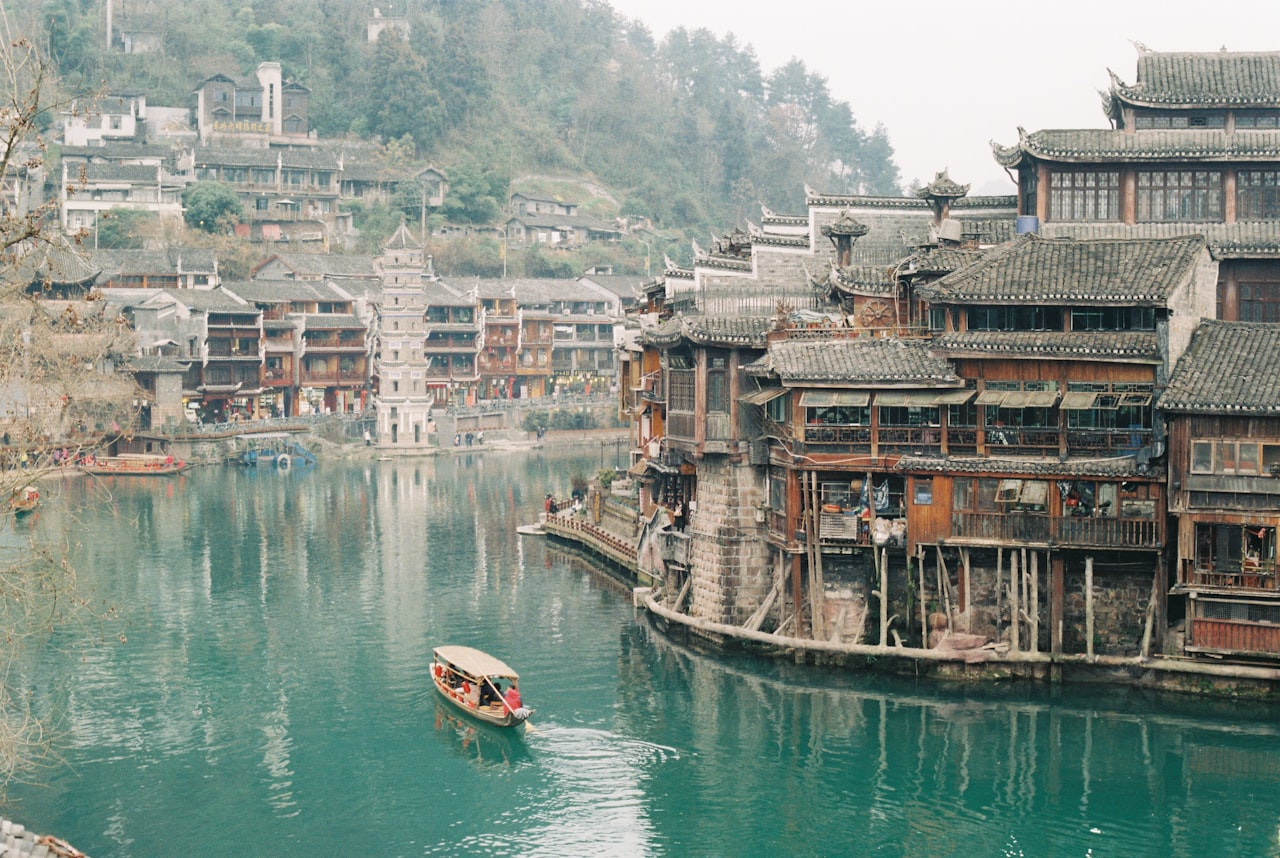
Fenghuang凤凰
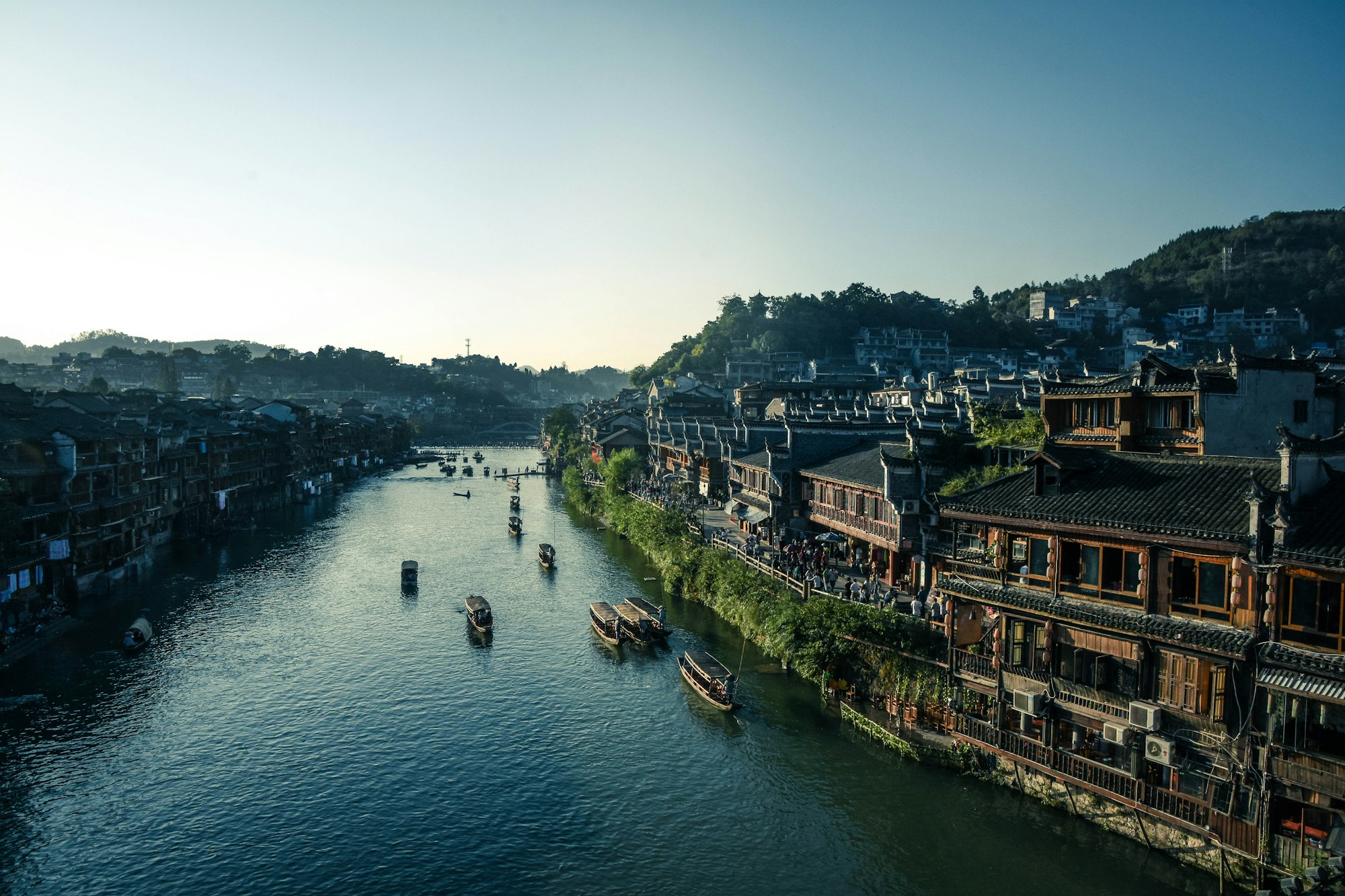
Fenghuang — “Phoenix” — is the most photographed old town in China for good reason: wooden stilt houses (吊脚楼 diàojiǎolóu) lean out over the green Tuojiang River, hung with red lanterns and crossed by stepping-stone weirs and the covered Hong Bridge. It sits in Xiangxi, Hunan’s mountainous west, heartland of the Miao and Tujia peoples, whose silver headdresses and batik fill the lanes.
The town was the home of Shen Congwen, one of modern China’s finest writers, whose novel Border Town (边城) is set in exactly this misted river country. Stay overnight: Fenghuang belongs to whoever is still there once the day-trippers leave.
Deep-dive guide coming soon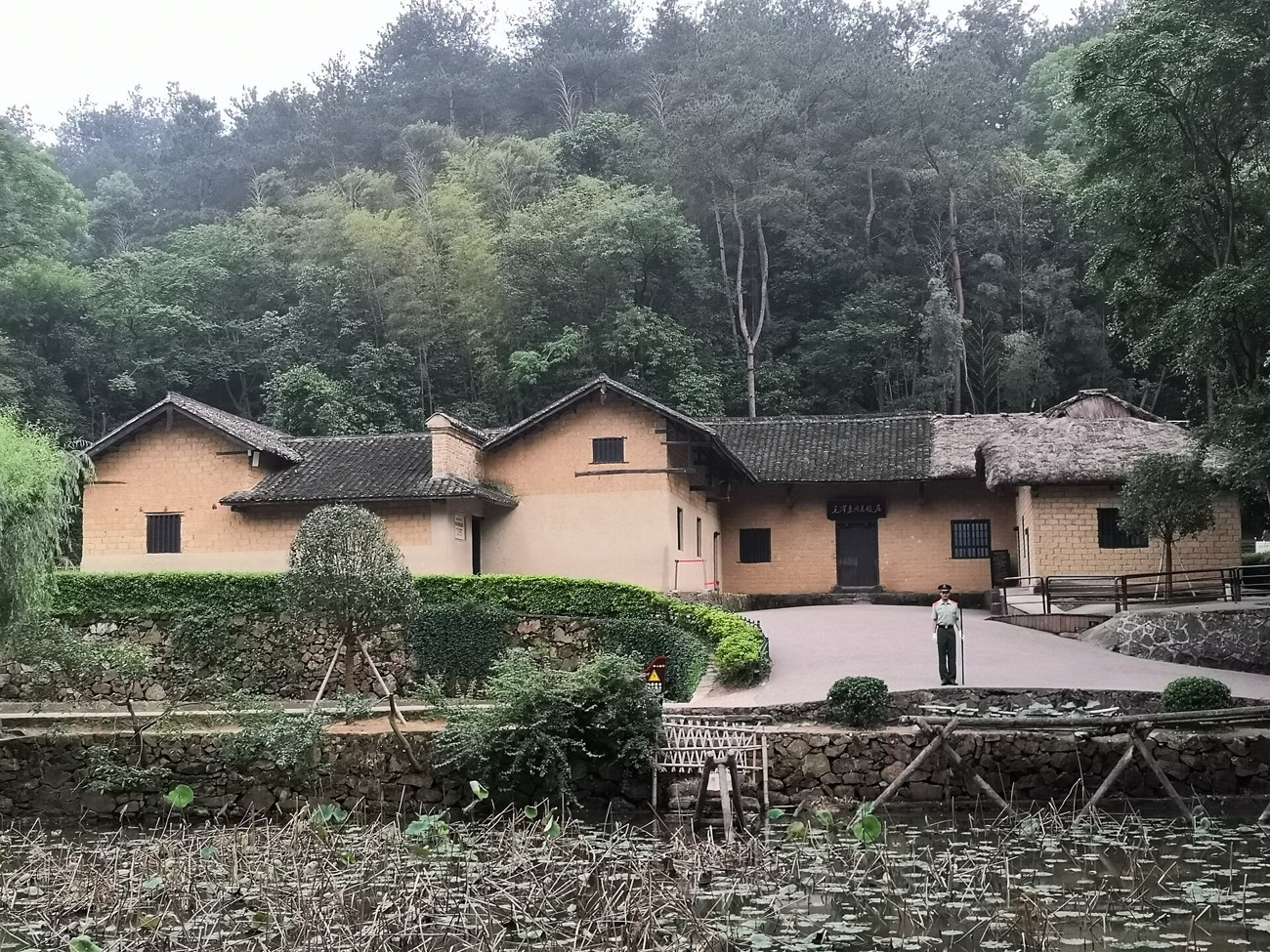
Shaoshan韶山
A quiet town of paddy fields and low green hills west of Xiangtan, Shaoshan is the birthplace of Mao Zedong and one of China’s most visited ‘red tourism’ sites. His preserved childhood home — a yellow adobe farmhouse beside a lotus pond — draws millions who come to trace the beginnings of modern China.
Around it spread a memorial museum, a bronze statue square and the family ancestral hall, set among the same terraced fields the young Mao once worked. It makes an easy, atmospheric day trip from Changsha.
Deep-dive guide coming soonIconic attractions across Hunan
Six Hunan landmarks worth building a trip around — from the province’s UNESCO-listed pillars to the museum that rewrote the early Han:
Wulingyuan / Zhangjiajie 武陵源
A UNESCO World Heritage Site since 1992: over 3,000 sandstone-quartzite pillars, deep ravines and the cliff-top walkways that inspired Avatar. The Bailong Elevator and the Tianzi Mountain cable car save the legs; allow at least two days.
Tianmen Mountain 天门山
Reached by one of the world’s longest passenger cableways, this peak above Zhangjiajie city pairs a cliff-hugging glass skywalk with Heaven’s Gate — a 130-metre natural arch climbed by 999 steps. Vertiginous and unforgettable.
Fenghuang Ancient Town 凤凰古城
A riverside town of Ming and Qing stilt houses in Hunan’s Miao-and-Tujia west, strung along the Tuojiang. Best at dawn or after dark, when the lanterns light the water and the crowds thin.
Yuelu Academy & Orange Isle 岳麓书院 · 橘子洲
In Changsha: a thousand-year-old Confucian academy on a wooded mountain, paired with the long river island where Mao wrote his famous 1925 poem. Together they hold the city’s scholarly and revolutionary soul.
Mawangdui & the Hunan Museum 马王堆 · 湖南博物院
Home to the astonishing Han-dynasty finds of the Mawangdui tombs — including the 2,100-year-old preserved body of Lady Dai and the world’s oldest surviving figured silks. One of China’s essential museums, and free to enter.
Mount Heng (Nanyue) 南岳衡山
The southern peak of China’s Five Great Mountains, rising in central Hunan near Hengyang — a thousand-year pilgrimage site layering Taoist and Buddhist temples up forested slopes, famous for its sea of clouds and the grand Nanyue Temple at its foot.
Famous figures of Hunan
A province of revolutionaries, painters and writers whose fierce independence left a mark far beyond its mountains:
Mao Zedong (毛泽东)
Born in the Hunan village of Shaoshan, Mao trained as a teacher in Changsha and swam the Xiang off Orange Isle before leading the Communist revolution that founded the People’s Republic in 1949. No figure is more bound up with Hunan’s sense of itself.
Qi Baishi (齐白石)
From a carpenter’s family in Xiangtan, Qi Baishi became one of the twentieth century’s most beloved Chinese painters, famous for his lively shrimp, crabs and flowers rendered in a few effortless strokes of ink.
Shen Congwen (沈从文)
Raised in Fenghuang, Shen Congwen drew on the rivers and peoples of western Hunan for Border Town (边城) and was twice a serious contender for the Nobel Prize in Literature.
Zeng Guofan (曾国藩)
The Hunanese scholar-official who raised the Xiang Army to defeat the Taiping Rebellion and became a model of Confucian self-discipline — his letters are still read in China as a manual for self-cultivation.
Lei Feng (雷锋)
A soldier from Wangcheng near Changsha whose diary of quiet good deeds was turned, after his early death, into one of China’s most enduring models of selfless service — still invoked every March.
Zhou Dunyi (周敦颐)
The Song-dynasty thinker from Yongzhou whose short essay “On the Love of the Lotus” every Chinese student still reads. A founding figure of Neo-Confucianism, he reshaped Chinese philosophy for centuries.
Hunan’s modern economy & global role
Hunan sits in the upper-middle tier of China’s provincial economies, and its strengths are unusually distinctive. Where coastal provinces trade and assemble, inland Hunan builds — heavy machinery, rolling stock and the science of food — while also exporting something more surprising: the country’s dominant popular culture.
Construction equipment capital
Changsha is the headquarters of Sany, Zoomlion and Sunward — three of the world’s largest makers of cranes, excavators and concrete pumps. The city builds a remarkable share of the machines that build the rest of the world.
Locomotives & television
Zhuzhou is a global centre for electric locomotives and rail traction through CRRC, while Changsha’s Hunan Broadcasting System (Mango TV) is the most-watched entertainment network in the country — an unusual pairing of heavy industry and pop culture.
The home of hybrid rice
Hunan is a leading rice province and the base of the late Yuan Longping, the agronomist whose hybrid-rice breakthroughs at Changsha helped feed hundreds of millions. Agricultural science remains a point of provincial pride.
The world’s fireworks capital
Liuyang, just east of Changsha, makes the great majority of the world’s fireworks and firecrackers — a craft refined here over a thousand years and still lighting up celebrations from Sydney to Shanghai.
Why Hunan matters for Mandarin learners
It teaches you to hear real, accented Mandarin. Textbook audio is clean; the world is not. Hunan’s soft Southwestern accent — the famous n/l and f/h blur — is a perfect, friendly training ground for the listening flexibility you need everywhere in China. Learn to follow a Changsha food vendor and the evening news will never trouble you again.
The food culture is a vocabulary goldmine. Nowhere makes you learn the language of flavour faster than Hunan: 辣 (spicy), 麻 (numbing), 香 (fragrant), 鲜 (savoury-fresh), 酸 (sour). Ordering here — and negotiating just how much chilli you can take — turns an abstract word list into muscle memory.
It connects your Mandarin to modern Chinese history. So much of the twentieth-century vocabulary learners eventually meet — revolution, reform, the founding generation — traces back to this one province. Standing on Orange Isle or in Shaoshan gives that language a place and a face.
Tourism Mandarin gets a spectacular classroom. Zhangjiajie and Fenghuang draw visitors from across China, so the practical Mandarin of tickets, trails, transport and bargaining is in constant use around you — the most useful phrasebook there is, spoken live.
Visiting Hunan — practical notes
Getting there: Changsha Huanghua International Airport is the province’s main gateway, and the city is a major high-speed-rail junction where the Beijing–Guangzhou and Shanghai–Kunming lines cross — Changsha is around 2.5 hours from Guangzhou and under 5 from Shanghai. Zhangjiajie has its own airport and a high-speed line that has cut the trip from Changsha to roughly 1.5 hours.
Getting around: Changsha has a clean modern metro, including a line to the airport and a maglev. Reaching the far west takes more planning: Fenghuang has no train station of its own and is usually approached via Jishou (about 30 minutes away) or as a side-trip from Zhangjiajie. Allow generous travel time between the eastern cities and the western mountains.
When to come: Spring (April to May) and autumn (September to October) are ideal — mild, clearer skies and the mountains at their best. Summers are genuinely hot and humid (Changsha is one of China’s “furnace” cities), though that is also peak season for crayfish and night markets. Winters are damp and cool, and the Wulingyuan pillars wrapped in mist are magical.
A word on the chilli: Hunan restaurants assume you want heat. “微辣” (wēi là, mildly spicy) or “不要辣” (búyào là, no chilli) are phrases worth learning before you sit down — though the kitchen may quietly regard the request as a personal challenge.
One week in Hunan: Two nights in Changsha (Hunan Museum, Yuelu Mountain, Orange Isle, the night-market food), three nights around Zhangjiajie and Tianmen Mountain, then two nights in Fenghuang for the riverside old town — with Yueyang an easy stop on the train if you approach from the north.