“Quiet Night Thoughts” — by Li Bai (李白 Lǐ Bái), Tang dynasty · China’s best-loved poem
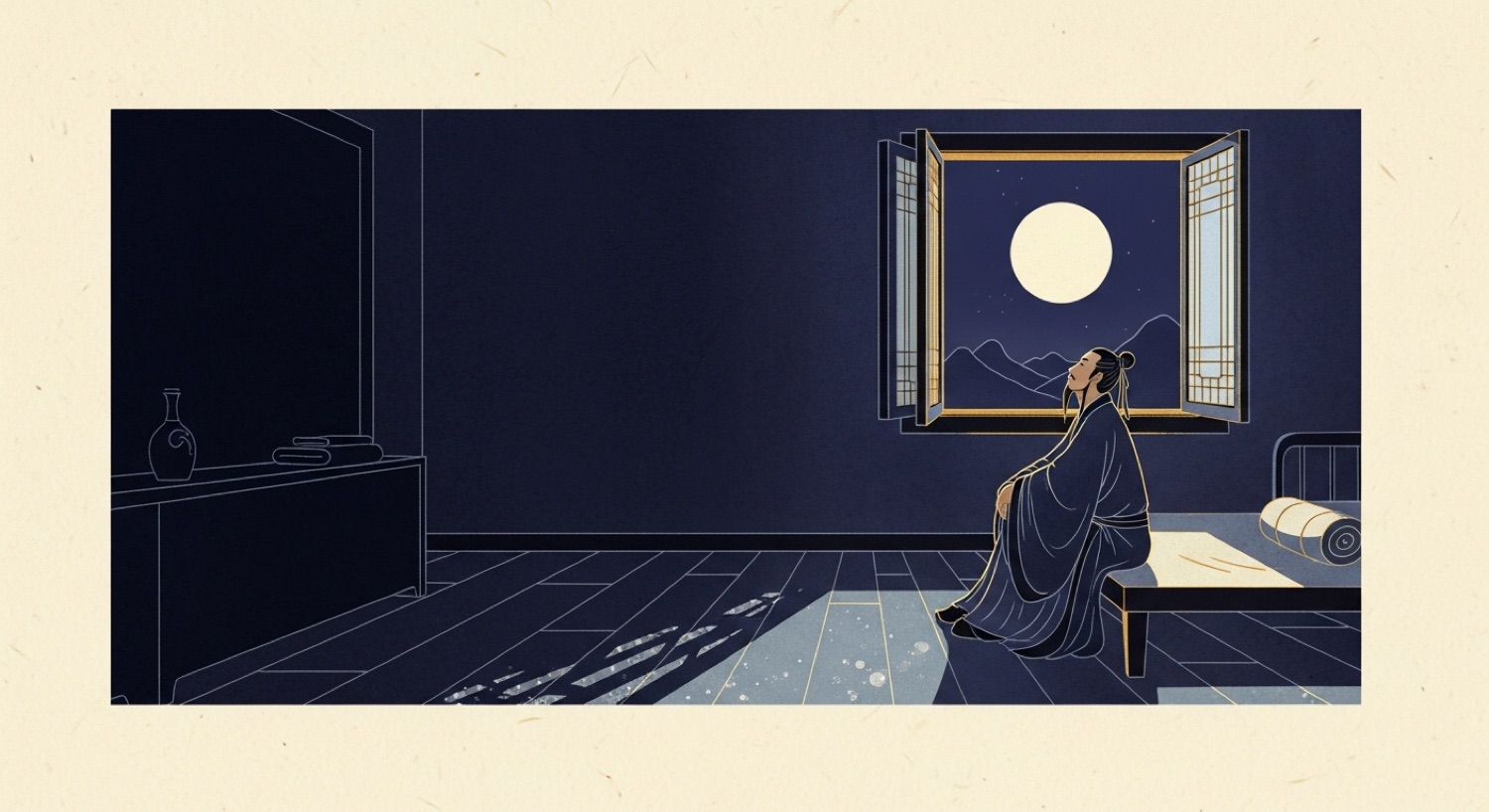
“He raises his head to the moon, and lowers it to think of home.”
- Poet
- 李白 (Lǐ Bái) · 701–762
- Dynasty
- Tang · 8th century
- Form
- 五言绝句 (wǔyán juéjù) · 5-char quatrain
- Theme
- Homesickness 思乡 (sīxiāng)
- Length
- 4 lines · 20 characters
- Fame
- China’s most-memorised poem
静夜思, line by line
Just twenty characters — and every Chinese child knows them by heart. Tap the speaker to hear each line read aloud.
How to recite 静夜思
Five-character lines are almost always read with a short pause after the second character — a 2–3 rhythm. Once you feel that break, the poem stops being a row of characters and starts sounding like a poem.
A whole ache of homesickness, in four lines
A traveller lies awake far from home. Moonlight pools on the floor so brightly that, half-asleep, he mistakes it for frost. He lifts his eyes to the moon — and something turns. In China the full moon is the great symbol of reunion and family, the same moon shining on everyone you love, wherever they are. So the simple act of looking up at it, then bowing his head, becomes the most quietly devastating gesture in Chinese poetry: up to the moon, down to the memory of home.
That is the genius of it. There is no clever imagery, no rare word — just a lonely room, a bright moon, and a longing anyone who has ever been far from home understands instantly. It is why, twelve hundred years on, it is still the first poem Chinese children learn.
A little secret about the poem: the version everyone recites today (床前明月光 … 举头望明月) was smoothed into shape in the Ming and Qing dynasties. Li Bai’s likely original, preserved in Song-dynasty editions, reads 床前看月光 … 举头望山月 (“the moon over the mountains”) — with two different characters. Most native speakers have never noticed they’re reciting a later edit.
五言绝句: twenty characters, nothing wasted
五言绝句 (wǔyán juéjù), the “five-character quatrain”, is the tightest of the major classical forms: four lines, five characters each, twenty characters in total. There is no room for a weak word — which is why the form was prized, and why this is the poem every Chinese child meets first.
- Characters
- 20 — 4 lines × 5
- Rhyme
- Lines 1, 2 & 4 (-ang)
- Reading rhythm
- 2 – 3 per line
The discipline is what gives it the punch: a scene in line one, a doubt in line two, a movement upward in line three, a movement downward in line four. Twenty characters, and a complete emotional arc.
The mirror at the heart of the poem
The last two lines are a near-perfect antithesis — the device classical poets called 对仗 (duìzhàng). Every element in line three has its opposite in line four.
举 (raise) against 低 (lower); 望 (to gaze at something present) against 思 (to long for something absent); the moon in front of him against the home behind him. The poem never uses the word “lonely”. The two gestures say it instead.
The opening pulls the same quiet trick. Moonlight pooled on the floor is mistaken for 霜 (frost) — and frost brings cold, lateness in the year, and time passing. In three characters Li Bai puts you in a chilly room at an unfamiliar hour without naming a single feeling.
The key characters
Tap any character to hear it.
A young poet, far from home
静夜思 is traditionally dated to around 726 CE, when Li Bai was in his mid-twenties and travelling in the south, a long way from the Sichuan of his childhood. Tang-era travel meant months on the road and letters that might never arrive — a night in an unfamiliar inn was a real separation, not a weekend away.
That ordinariness is the point. He is not writing about exile or catastrophe, just a man who wakes, sees light on the floor, and is ambushed by missing home. It is why the poem has outlived almost every grander thing written in its century.
The version you know is not quite the original
The text memorised today was standardised in the Ming dynasty. Earlier Song-dynasty editions read differently in two places:
Changing both to 明月 tightened the echo between the two halves of the poem — arguably an improvement, and certainly easier to remember.
Li Bai, the “Immortal of Poetry”
Li Bai (李白, 701–762) is, with Du Fu, one of the two greatest poets of the Tang dynasty — China’s golden age of verse — and perhaps the most beloved poet in all of Chinese history. Nicknamed the “Immortal of Poetry” (诗仙, Shīxiān), he was a wanderer, a heavy drinker and a romantic, whose roughly a thousand surviving poems overflow with moonlight, wine, rivers and a restless love of freedom.
Legend even claims he died reaching from a boat to embrace the moon’s reflection in the water — a fittingly poetic end for the man who gave us the most famous moon poem ever written.
Where you’ll meet 静夜思 today
This is usually the first poem a Chinese child learns by heart, often before starting school. You will hear it at Mid-Autumn Festival, when the full moon and family reunion are the whole point of the holiday; you will find it in primary-school readers, on calligraphy scrolls, and quoted — usually just the last line — whenever somebody is a long way from home.
For a learner it is an unusually good investment: twenty characters, nearly all of them high-frequency, and instant recognition from any Chinese speaker you meet.
How to memorise it
- Learn it as two halves. Lines 1–2 set the scene, lines 3–4 turn it. People who forget the poem almost always lose the middle.
- Say it on the 2–3 beat from your very first attempt — rhythm fixes word order in memory far better than repetition does.
- Anchor the rhyme: 光 · 霜 · 乡. Recall those three sounds and the lines rebuild themselves.
- Use the gestures. Raise your head on 举头, lower it on 低头. It feels silly; it works.
FAQs
Read the classics in the original
Poetry is one of the most beautiful ways into Mandarin. Learn to read and hear it in 1-on-1 online lessons with a native speaker.
Book a Free Intro Call