“Full River Red” — a 词 (cí) lyric of the Southern Song, traditionally attributed to the general Yue Fei (岳飞 Yuè Fēi)
“Do not idle: a young head turns white, and the grieving comes to nothing.”
- Attributed to
- 岳飞 (Yuè Fēi) · 1103–1142
- Dynasty
- Southern Song · 12th c.
- Form
- 词 cí, to the tune 满江红 (Mǎn Jiāng Hóng)
- Theme
- Loss of the north, and resolve
- Length
- 2 stanzas · 93 characters
- Authorship
- Debated — see below
满江红 (Man Jiang Hong), line by line
Ninety-three characters in two stanzas. The first looks inward at a wasted life; the second turns outward, to the war. Tap the speaker to hear each line.
How to recite 满江红 (Man Jiang Hong)
Unlike a regulated 诗 (shī), a 词 has deliberately uneven lines — three characters here, seven there — because it was written to fit a melody. Reading it aloud, you lean into those short bursts and let the seven-character lines run.
A general with nowhere to put his anger
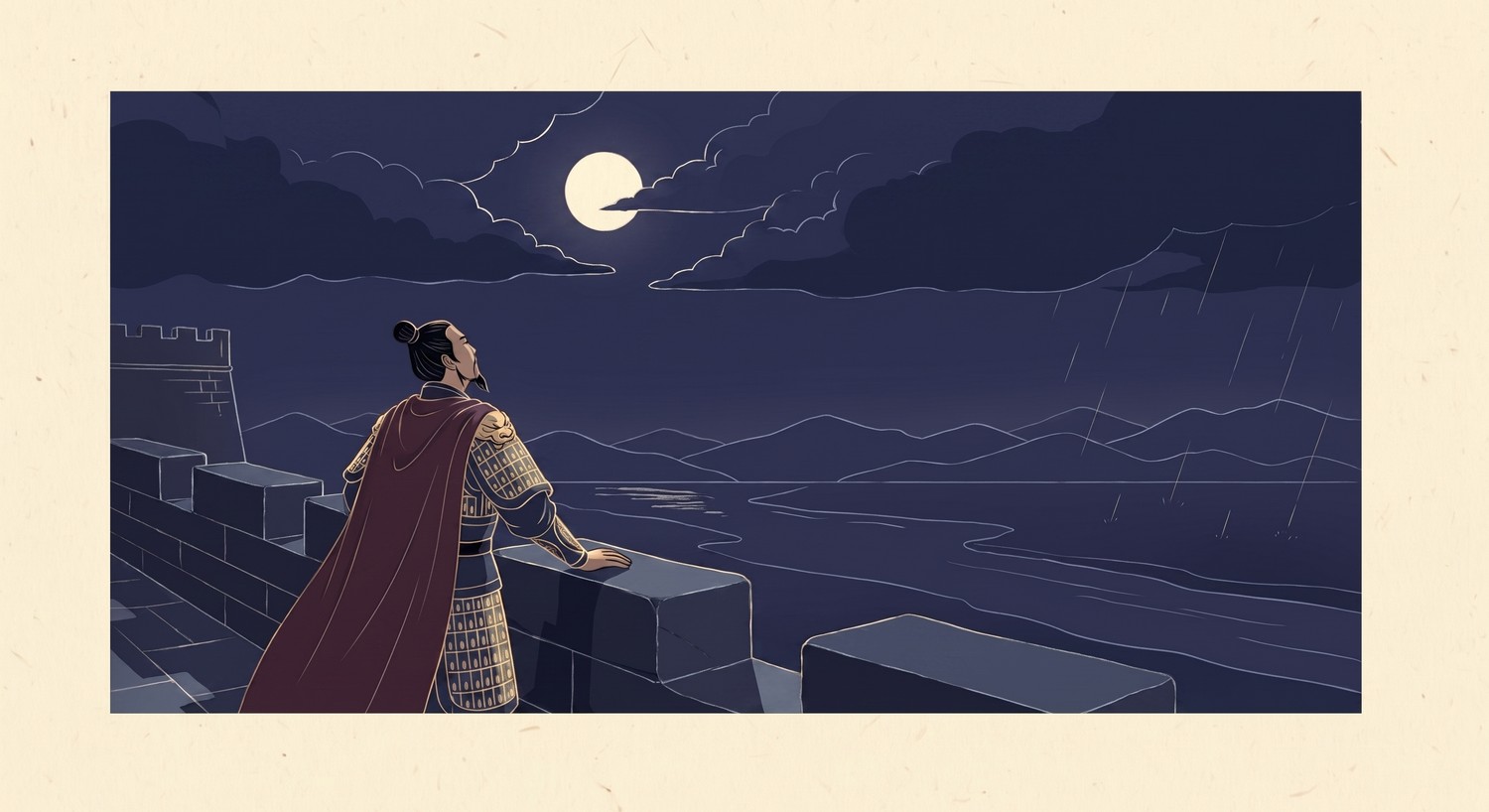
A soldier stands at a parapet as a storm blows itself out. He is furious — the opening idiom 怒发冲冠 literally has his hair pushing his cap off his head — and the fury has nowhere to go. He looks back on his career and calls it 尘与土, dust and earth: thirty years of rank, worth nothing while the north is lost.
Then the poem pivots. 靖康耻,犹未雪 — the shame of 1127, when the Jurchen Jin sacked the Song capital and carried two emperors into captivity, is still not wiped clean. The rest is a vow: break through the pass, take back the land, and report to the throne that it is done.
What makes it endure is not the war but the pressure of unfinished business — the feeling of time running out on something that matters. That is why the middle lines get quoted by people who have never been near a battlefield.
满江红 (Man Jiang Hong) is a tune, not a title
This is the single most useful thing to understand about the poem, and it trips up almost every English reader. 满江红 (Mǎn Jiāng Hóng) is a 词牌 (cípái) — the name of a fixed melodic pattern. Poets wrote new words to old tunes, and the tune name got attached to the result.
So 满江红 tells you nothing about rivers or the colour red in this lyric. It tells you the shape: how many lines, how long each one runs, and where the rhymes must land. Dozens of completely unrelated poems are also called 满江红. To identify this one, you cite it as 满江红·怒发冲冠 — “to the tune Man Jiang Hong: Wrath Bristles Under My Cap”, using its opening words.
Two lines that outlived the poem
The couplet everyone knows is not the violent one. It is the quiet arithmetic in the middle:
Each line sets a hard number against two weightless nouns. A career becomes dust; a lifetime of marching becomes weather. Nothing is explained, and the deflation is total. Then 莫等闲,白了少年头,空悲切 lands the warning — and that line has long since walked out of the poem into ordinary speech, quoted to anyone drifting through their twenties.
The second stanza changes gear completely: short, clipped three-character units — 靖康耻,犹未雪;臣子恨,何时灭 — that read like someone striking a table. Same lyric, different pulse.
Did Yue Fei actually write it?
Probably the most debated attribution in Chinese literature — and worth knowing before you quote it.
The case against Yue Fei is mostly an absence. The lyric does not appear in the collected works of Yue Fei compiled by his own grandson, Yue Ke (1183 – after 1234), who spent years gathering everything his grandfather wrote. It is not quoted in any major Song or Yuan source. It then surfaces, fully formed, in the Ming dynasty — most visibly on a tablet engraved at Yue Fei’s tomb in 1502 by the official Zhao Kuan, at a moment when patriotic feeling against northern raids was running high. Some scholars think Zhao Kuan wrote it himself.
The case for Yue Fei is that transmission gaps are common, that Yue Ke’s collection is demonstrably incomplete, and that the voice fits a serving general better than a Ming bureaucrat.
If you want to weigh the evidence yourself, the Chinese text of Man Jiang Hong is hosted in full on Chinese Wikisource, filed under its opening line 怒发冲冠.
Yue Fei, the general who was killed by his own court
岳飞 (1103–1142) was the Southern Song’s most effective commander against the Jurchen Jin, and its most famous casualty of politics. With the north lost and campaigns going well, he was recalled by a court pursuing peace, imprisoned, and executed at thirty-nine on charges the record itself calls 莫须有 (mò xū yǒu) — “perhaps there is something”. The phrase survives as shorthand for a fabricated accusation.
He was posthumously rehabilitated and became something closer to a saint than a soldier: a temple at his tomb in Hangzhou, iron statues of his accusers kneeling before it, and the four characters 精忠报国 (jīng zhōng bào guó) — “serve the country with utmost loyalty” — attached to his legend. That cult is exactly why a Ming-era lyric would be attributed to him, and why the attribution stuck so hard. For the full military and political record behind Man Jiang Hong, see the documented account of Yue Fei’s campaigns and trial.
Where you’ll meet Man Jiang Hong today
It is standard in Chinese school curricula, so most adults can begin it from memory. 莫等闲,白了少年头 turns up in graduation speeches and on classroom walls. Zhang Yimou’s 2023 thriller Full River Red took its title from the lyric and sent search interest for it sharply up again.
It is also a poem people argue about — over the authorship, and over how its language about northern invaders should read now. Knowing that context is part of knowing the poem.
For learners
- Start with the middle four lines. 三十功名 through 空悲切 is the most quoted and the most useful stretch — and the easiest to say.
- Do not start here. If you are new to classical Chinese, 静夜思 is twenty characters and a far better first poem. Come back to this one.
- Learn 怒发冲冠 as an idiom in its own right — it is still used for towering anger, well outside the poem.
FAQs
Read the classics in the original
Classical Chinese opens up fast with a teacher who can walk you through it line by line. Book a 30-minute intro lesson with a native Mandarin teacher.