Qixi Festival · Chinese Valentine’s Day · the Double Seventh — China’s oldest festival of love
“If two hearts endure, why must they be together night and day?”
- When
- 7th day of the 7th lunar month (late Jul – Aug)
- Also called
- Chinese Valentine’s Day · Double Seventh · 乞巧节
- Greeting
- 七夕快乐 · Qīxī kuàilè
- Symbol
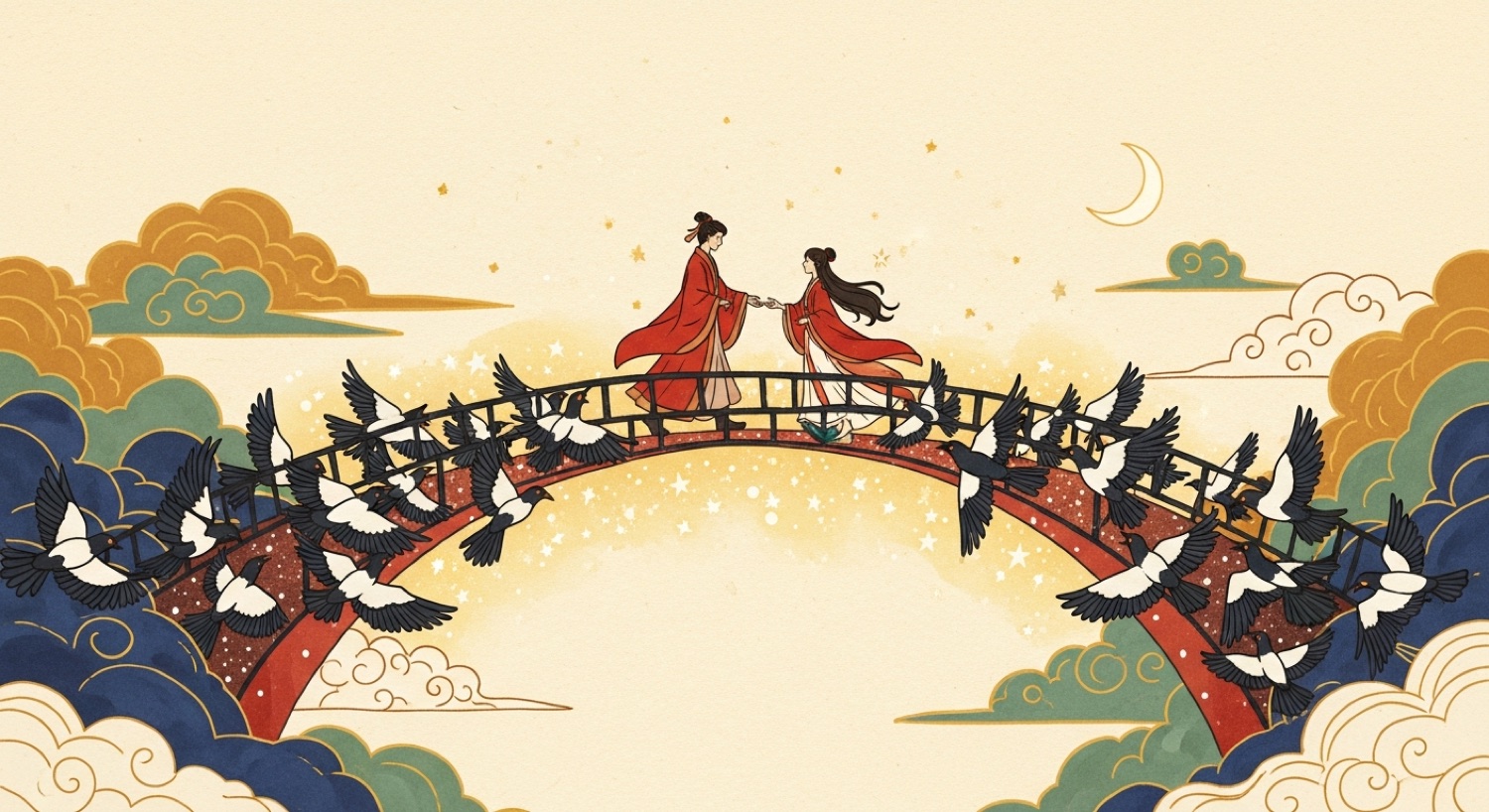
- The magpie bridge 鹊桥
- In the sky
- Vega meets Altair
- Theme
- Love & devotion
China’s oldest love story
Qixi (七夕, Qīxī) — the “Double Seventh” — is often called Chinese Valentine’s Day, and it may be the oldest festival of love in the world, celebrated for over two thousand years. It falls on the seventh night of the seventh lunar month, and it belongs to one story above all: the heartbreaking romance of the Cowherd and the Weaver Girl, two lovers who are allowed to meet just once a year.
Its older name is 乞巧节 (Qǐqiǎo jié, the “Begging for Skills” festival), because for centuries it was a day when young women prayed to the Weaver Girl for nimble fingers and a good marriage. Today it has bloomed into a full day of romance — flowers, gifts and dates — but look up on a clear Qixi night and you can still find the two lovers as stars, on either side of the Milky Way.
The Cowherd & the Weaver Girl
织The Weaver Girl (织女, Zhīnǚ) was a heavenly goddess who wove the drifting clouds of the sky. One day she came down to earth, met a kind, humble cowherd named Niulang (牛郎), and fell in love. They married, had two children, and lived simply and happily — a goddess who had chosen an ordinary human life.
But the Queen Mother of Heaven (王母娘娘) was furious that a celestial weaver had married a mortal. She carried the Weaver Girl back to the sky and, with a stroke of her hairpin, tore a great silver river — the Milky Way (银河) — across the heavens to keep the lovers apart forever.
The magpies of the world could not bear their grief. Once a year, on the seventh night of the seventh month, countless magpies fly up and link their wings into a bridge (鹊桥, quèqiáo) across the Milky Way, so that the Cowherd and the Weaver Girl may cross and be together for a single, precious night before parting again.
“One meeting… outshines the whole mortal world”
The great Song poet Qin Guan (秦观) captured Qixi forever in a ci called 鹊桥仙 (“Immortals at the Magpie Bridge”). Its closing lines are among the most quoted in the Chinese language — a defence of love that endures over love that merely lingers:
金风玉露一相逢,便胜却人间无数。……两情若是久长时,又岂在朝朝暮暮。
“When golden wind meets jade dew — when they meet just once — it outshines countless meetings in the mortal world. … If two hearts are truly steadfast and lasting, why must they be together morning and night?”
— 秦观《鹊桥仙·纤云弄巧》, Northern Song dynasty (c. 1097).Traditions & customs
乞巧 Begging for skills
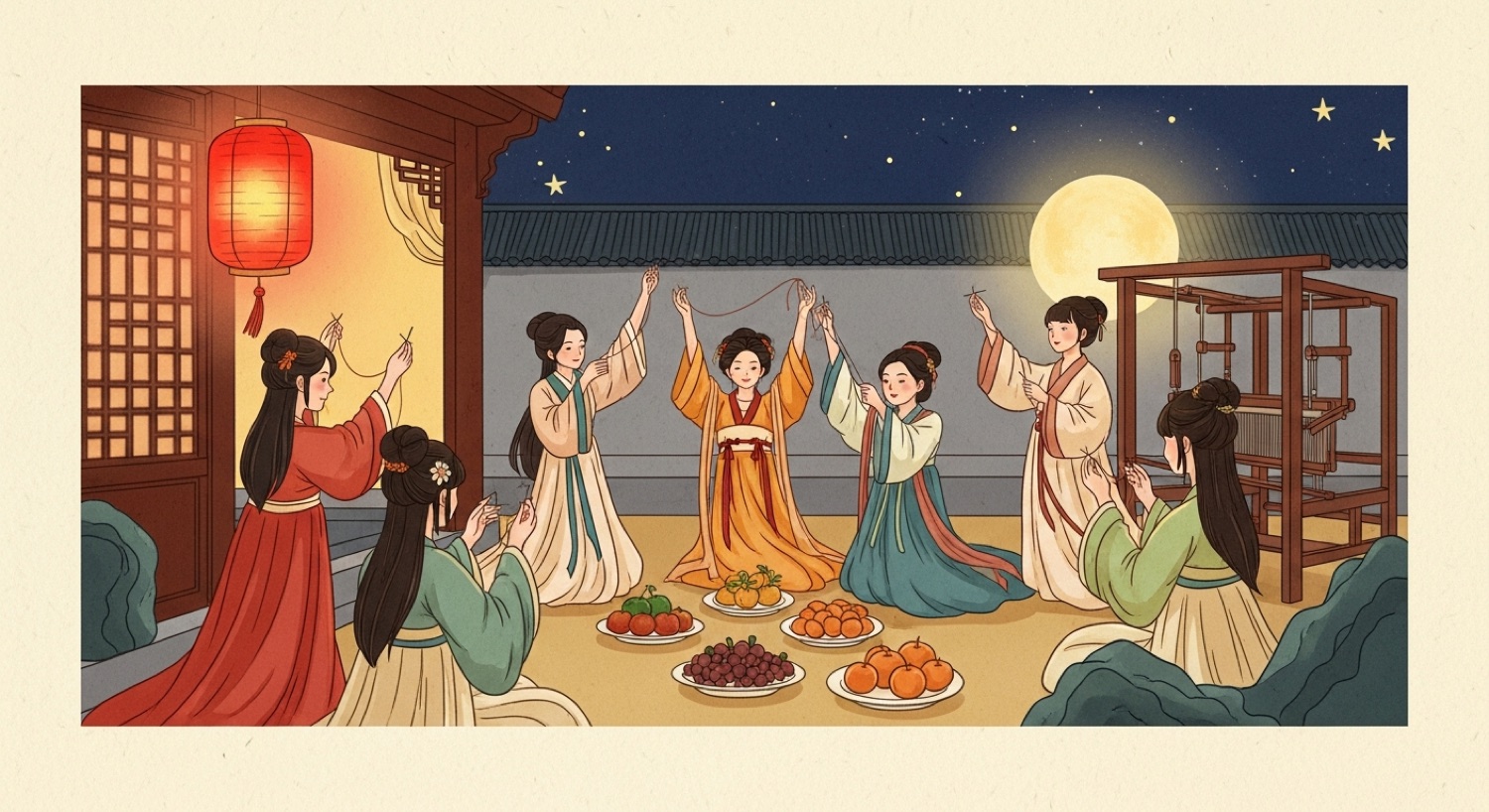
The festival’s oldest heart: young women prayed to the Weaver Girl for skill in weaving and needlework — and for a good husband.
穿针 Threading needles
Girls would race to thread needles by moonlight; the quickest was said to have been granted the Weaver Girl’s dexterity.
拜织女 Honouring Zhinü
Laying out fruit, flowers and incense under the night sky as an offering to the Weaver Girl.
看星 Star-gazing
Finding the two lovers in the sky — Vega and Altair — shining on opposite banks of the Milky Way.
吃巧果 Skill-fruit pastries
Eating 巧果 (qiǎoguǒ), crisp fried sweets made especially for the festival.
❤ Modern romance
Today Qixi is China’s day for lovers — flowers, chocolates, dinners and gifts, just like Valentine’s Day.
Qixi greetings & phrases
The words of the day — tap the speaker to hear each from a native speaker.
七夕快乐
Qīxī kuàilè
“Happy Qixi.”
我爱你
Wǒ ài nǐ
“I love you.” The three words for the day.
两情若是久长时,又岂在朝朝暮暮
Liǎng qíng ruòshì jiǔcháng shí, yòu qǐ zài zhāozhāo mùmù
“If two hearts endure, why must they be together night and day?” — Qin Guan’s immortal line.
Common misunderstandings
- Qixi is not a copy of Western Valentine’s Day — it’s far older, with its own legend, and predates it by roughly two thousand years.
- It began as a women’s festival (乞巧节) about skill and marriage prospects; the full-blown romance we celebrate today is a more modern flowering.
- The two lovers are real stars — Vega (the Weaver Girl, 织女星) and Altair (the Cowherd, 牛郎星) — genuinely on opposite sides of the Milky Way.
- Like all lunar festivals the date moves, but it’s always the 7th of the 7th lunar month — usually in August.
Quick quiz
1. In the legend, what keeps the two lovers apart?
2. How do the Cowherd and Weaver Girl meet each year?
FAQs
Say it in Mandarin
Learn the greetings, the stories and the language of the festivals — in 1-on-1 online lessons with a native speaker.
Book a Free Intro Call