“On the Stork Tower” by 王之涣 (Wáng Zhīhuàn), Tang dynasty: the poem that gave Chinese the phrase 更上一层楼 (gèng shàng yì céng lóu)
“To see a thousand li further, climb one storey higher.”
- Poet
- 王之涣 (Wáng Zhīhuàn) · 688–742
- Dynasty
- Tang · 8th century
- Form
- 五言绝句 (wǔyán juéjù) · 5-character quatrain
- Theme
- Seeing further: 登高望远 (dēng gāo wàng yuǎn)
- Length
- 4 lines · 20 characters
- Place
- The Stork Tower, Shanxi
登鹳雀楼 (Dēng Guànquè Lóu), line by line
Twenty characters: two lines of landscape, then two lines of resolve. Tap the speaker on any line to hear it read at a learner’s pace.
How to recite On the Stork Tower
Every line falls into two beats, then three. Say the first two characters together, pause for a breath, then say the last three.
You may also see a five-character line counted as 2–2–1. That is the same rhythm looked at more closely: the three-beat half often divides again. The main pause still comes after the second character.
On the Stork Tower: a view, then a decision
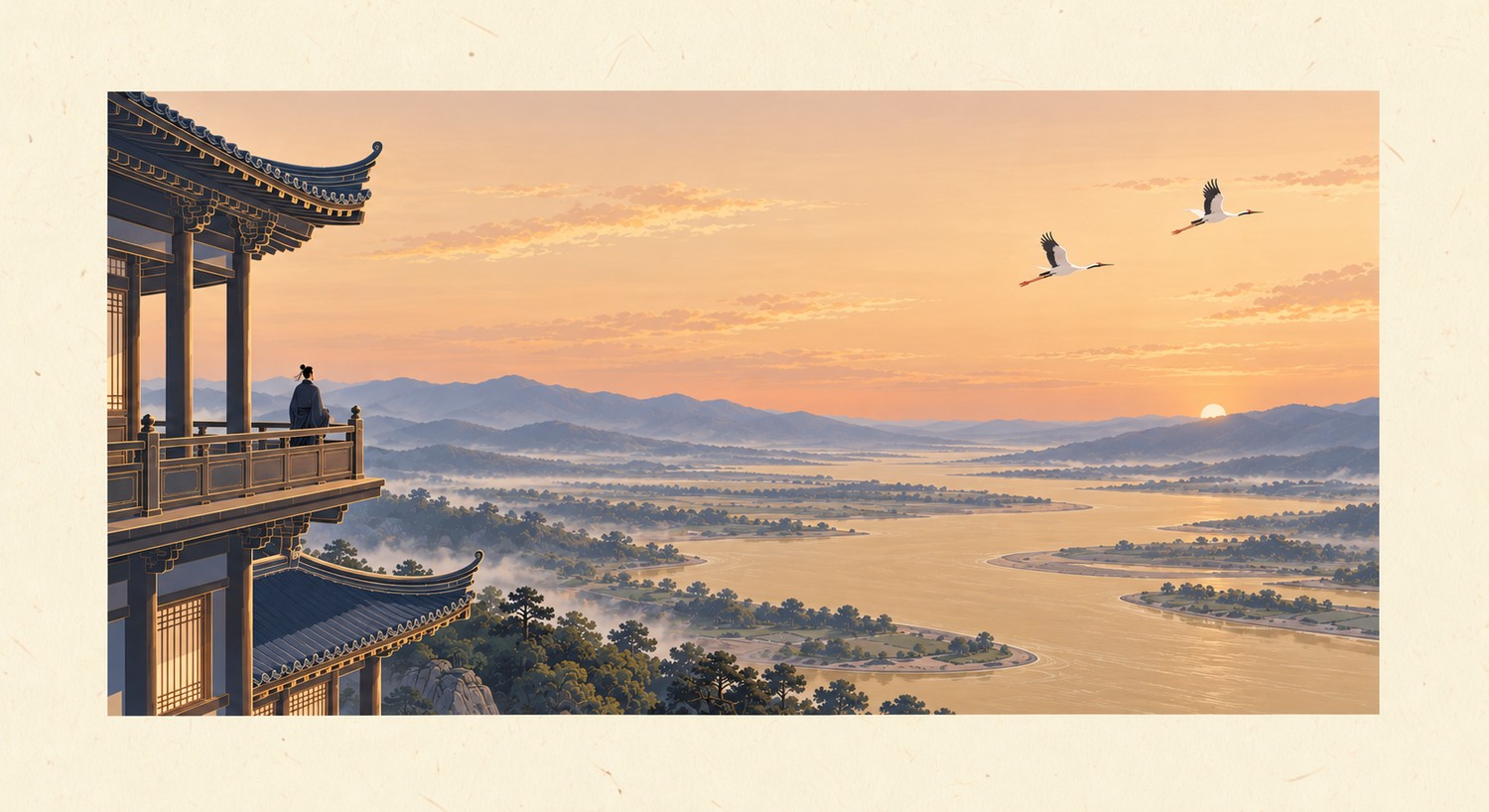
The first half of On the Stork Tower is everything the poet can see from the tower. In the west, the sun sinks behind the hills. Below, the Yellow River runs on towards a sea far out of sight. Neither the sunset nor the sea is close; the poem opens with the widest view it can find.
Then it turns. Line three is not a description at all but a wish: 欲 (yù) means “to want”, and 穷 (qióng) here means “to reach the end of”. The poet wants to see further still. Line four gives the only possible answer, and it is a modest one. Not a mountain, not a journey: just one more flight of stairs.
That is why On the Stork Tower has lasted. It begins as a landscape and ends as advice, and the advice applies to almost anything. If you want a wider view, you have to climb a little higher, and there is always another storey.
五言绝句 (wǔyán juéjù): a quatrain of two matched pairs
On the Stork Tower is a 五言绝句, a “cut-off verse” of four lines with five characters each. It is the same form as 静夜思 (Jìng Yè Sī) and 春晓 (Chūn Xiǎo), the two poems Chinese children usually learn first.
What sets this one apart is its parallelism, 对仗 (duìzhàng). A quatrain does not have to pair its lines at all. This poem pairs both couplets, and the Qing critic 沈德潜 (Shěn Déqián) admired it for having all four lines matched without ever sounding stiff.
For contrast, 满江红 (Mǎn Jiāng Hóng) is a 词 (cí) lyric of ninety-three characters with lines of uneven length. The quatrain gets its force from the opposite: strict length, strict pairing, nothing spare.
Two kinds of matched pair
The first couplet of On the Stork Tower is matched word for word. Read the two lines side by side and every slot has a partner.
White answers yellow, sky answers earth, the sun that stops answers the river that keeps going. One line ends, the other continues, and between them they hold the whole horizon.
The second couplet is matched too, 千里目 (qiān lǐ mù) against 一层楼 (yì céng lóu), a thousand against one. But the two lines also run straight on as a single sentence: if you want this, do that. Chinese critics call this a 流水对 (liúshuǐ duì), a “flowing-water pair”, because the meaning pours from one line into the next. Many readers never notice it is a matched pair at all, which is exactly the point.
The key characters
Tap any character to hear it on its own. All six are still everyday Mandarin, though two of them are used here in an older sense.
The tower, and the question of who wrote it
The Stork Tower, 鹳雀楼 (Guànquè Lóu), stood beside the Yellow River at 蒲州 (Púzhōu), in what is now Yongji in Shanxi province. It was first built in the sixth century, under the Northern Zhou, as a lookout over the river crossing, and it took its name from the storks that perched on it. By the Yuan dynasty only the base remained, and in the Ming the site was buried under silt from the river.
The tower you can visit today is a reconstruction in Tang style. Work began at the end of 1997 and it reopened in 2002, standing 73.9 metres tall. The name board above its entrance was written in August 2001 by 江泽民 (Jiāng Zémín), then China’s head of state.
The poem is traditionally credited to 王之涣 (Wáng Zhīhuàn), and that is how most anthologies print it. But the earliest surviving copy tells a different story. 国秀集 (Guóxiù Jí), an anthology compiled in 744, only two years after Wang Zhihuan died, gives the poem to a scholar named 朱斌 (Zhū Bīn), under the simpler title “Climbing the Tower”, with one character different in the last line:
The name Wang Zhihuan is attached to the poem in 文苑英华 (Wényuàn Yīnghuá), a Song dynasty collection, which also notes a version reading 彻 (chè, right through) for 入 (rù) in line two. The Qing Complete Tang Poems prints it under Wang Zhihuan, with a note that another edition names Zhu Bin. Scholars still disagree, so we say what the evidence allows: the poem is traditionally attributed to Wang Zhihuan. You can read the Qing text for yourself on Chinese Wikisource.
Wang Zhihuan, the poet of On the Stork Tower
王之涣 (Wáng Zhīhuàn, 688–742) came from an old family of Taiyuan in Shanxi. Most of what we know about him comes from his tomb inscription, written by his friend 靳能 (Jìn Néng). It tells us he served as a minor clerk in Hengshui, resigned after being slandered, spent about fifteen years at home, and died in office as a county official in Wen’an in 742. It also says his poems were set to music and known by everyone.
Only six of them survive, all quatrains, and On the Stork Tower is the best known. The other famous one is 凉州词 (Liángzhōu Cí), “Song of Liangzhou”, which opens with the Yellow River again: 黄河远上白云间 (Huáng Hé yuǎn shàng bái yún jiān), “the Yellow River climbs far up among the white clouds”.
A well-loved Tang story, 旗亭画壁 (qítíng huà bì), puts him in a wine house with the poets 王昌龄 (Wáng Chānglíng) and 高适 (Gāo Shì). They bet on whose verses the singers would perform, marking each song on the wall. Wang Changling scored twice and Gao Shi once before the most beautiful singer of the evening stood up and sang “Song of Liangzhou”. It comes from a book of tales, not a history, but it shows how his poems were heard: sung aloud, by people who knew them by heart.
Where you’ll meet On the Stork Tower today
It is one of the first poems taught in Chinese primary schools, and it is in 唐诗三百首 (Tángshī Sānbǎi Shǒu), Three Hundred Tang Poems. But its last line has escaped the poem entirely. 更上一层楼 (gèng shàng yì céng lóu) is an everyday phrase for doing even better: on graduation cards, in speeches, in a teacher’s comment on a good piece of work.
The line has travelled well beyond the classroom. On a visit to Japan in 1992, 江泽民 (Jiāng Zémín), then leader of China’s Communist Party, was asked for an inscription at the broadcaster NHK, and he wrote out the poem’s last two lines. Few Chinese sentences are better suited to a diplomatic occasion: it is modest, hopeful and recognised by everyone who went to school in China.
祝你的中文更上一层楼! (Zhù nǐ de Zhōngwén gèng shàng yì céng lóu!) “May your Chinese go from strength to strength!”
The poem also belongs to an old habit in Chinese culture: climbing somewhere high to look into the distance, 登高 (dēng gāo). It is the central custom of the Double Ninth Festival, and if you have ever climbed a tower or a hill to see the view, you already know the feeling these twenty characters describe.
Chinese has a close cousin of the last line: 百尺竿头,更进一步 (bǎi chǐ gān tóu, gèng jìn yí bù), “at the top of a hundred-foot pole, take one more step”. It comes from a Song-dynasty Buddhist text rather than a poem, but it makes the same point as On the Stork Tower: wherever you have got to, there is further to go.
FAQs
Keep reading
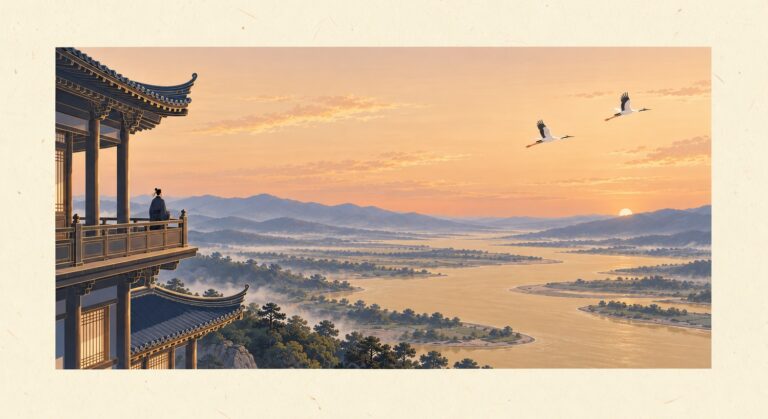 All of them诗词Shī cíEvery poem in the series, line by line, with pinyin and audio.
The same form春晓Chūn XiǎoSpring Dawn: Meng Haoran wakes to birdsong after a night of rain.
The best known静夜思Jìng Yè SīQuiet Night Thoughts: Li Bai, moonlight and a longing for home.
The opposite mood满江红Mǎn Jiāng HóngFull River Red: a general’s lyric of loyalty, anger and loss.
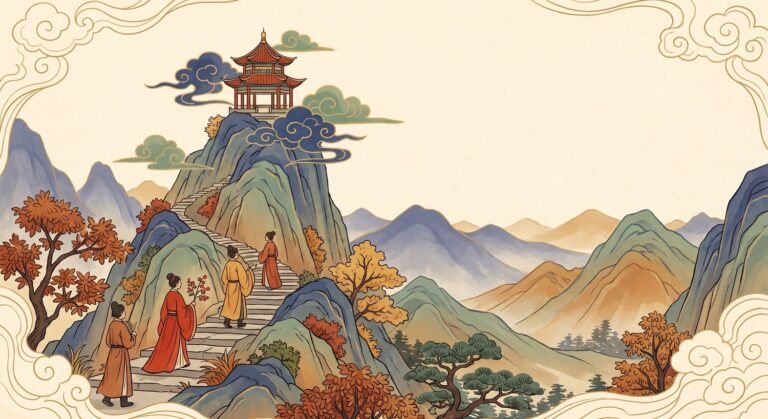 Climbing high重阳节Chóngyáng JiéThe Double Ninth Festival, when families climb high for the view.
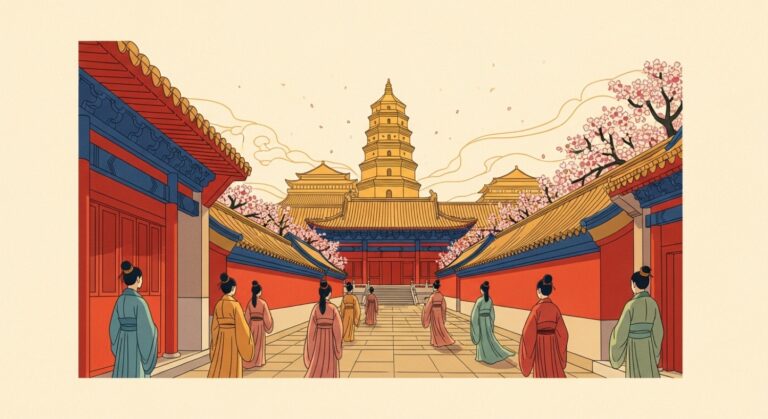 The dynasty唐朝Táng cháoThe Tang dynasty, the golden age of Chinese poetry and its poets.
Read the classics in the original
Poetry is one of the most beautiful ways into Mandarin. We teach it line by line in 1-on-1 online lessons with a native speaker.
Book a Free Intro Call