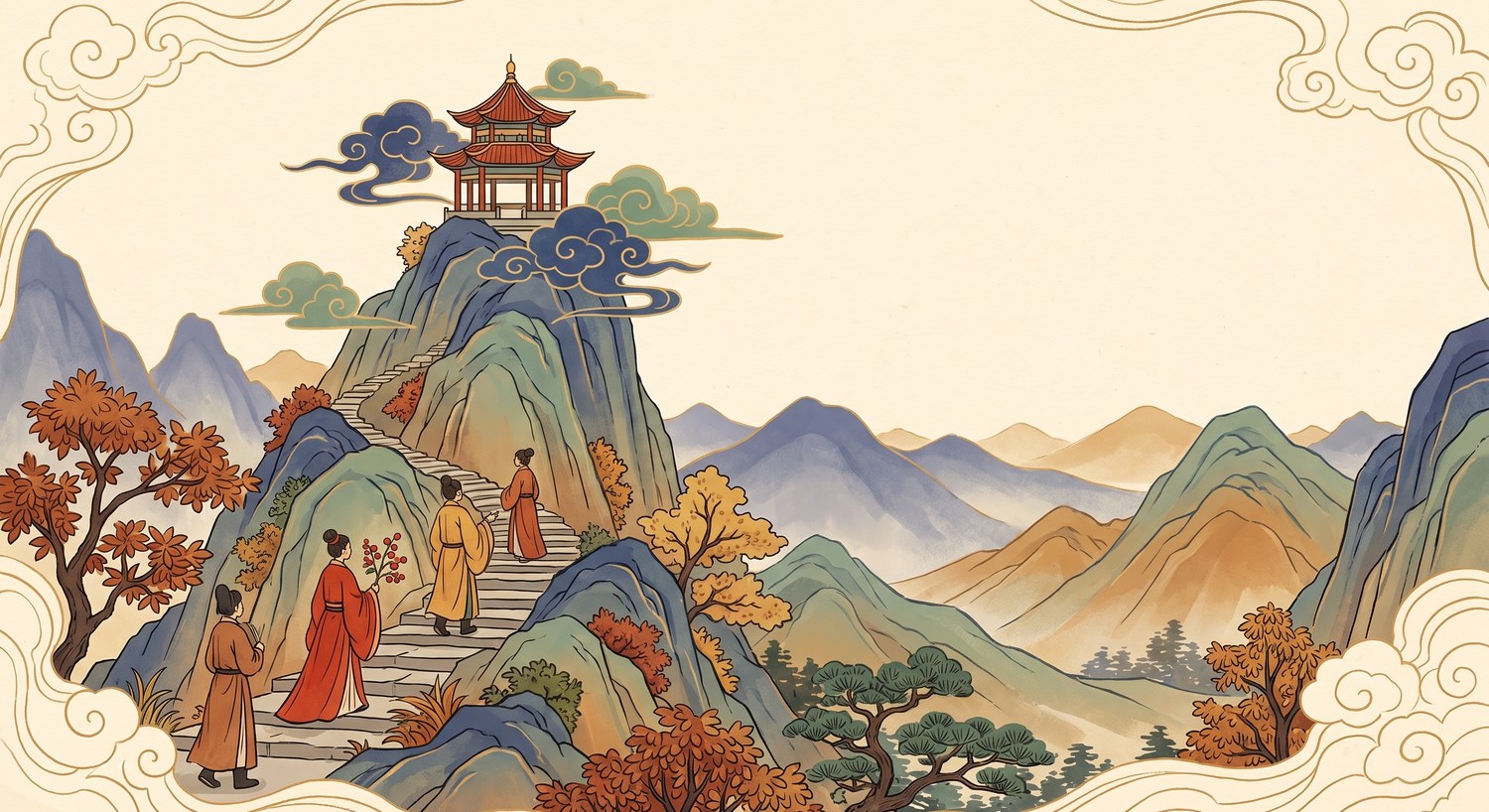
The Double Ninth Festival — a day for climbing hills, drinking chrysanthemum wine, and, since 1989, for honouring the old.
“Every festival, I miss my family twice as much.” — Wang Wei, written for this day
- When
- 9th day of the 9th lunar month (Oct)
- In 2026
- Sunday 18 October
- Also called
- Chongyang · 登高节 (dēnggāo jié, climbing festival) · 菊花节 (júhuā jié)
- Greeting
- 重阳节快乐 (Chóngyáng jié kuàilè)
- Customs
- Climbing high · chrysanthemum wine · dogwood sachets · Double Ninth cake
- Modern name
- Seniors’ Day 老年节 (lǎonián jié)
Why “double ninth”
In the old Chinese numerology of 阴阳 (yīnyáng), odd numbers are yang — bright, active, masculine — and nine is the largest single yang digit there is. The ninth day of the ninth month therefore doubles the strongest yang number in the calendar. That is precisely what 重阳 (chóngyáng) means: double yang.
A doubling that extreme was not read as straightforwardly lucky. Too much of anything tips over, and the ninth of the ninth was treated as a day when the balance ran dangerously high — a day to get out of the house, go up, and take precautions. Almost every custom attached to the festival is, at root, a protective one.
Nine also sounds like 久 (jiǔ), “a long time”, and that pun is why the day drifted over the centuries from warding off harm towards wishing long life — and, eventually, towards the elderly.
Huan Jing and the plague
The story that explains the customs is recorded in 《续齐谐记》 (Xù Qí Xié Jì, “Sequel to Qi’s Records of the Strange”), compiled by Wu Jun 吴均 in the sixth century.
A young man named Huan Jing 桓景 studied under the immortal Fei Changfang 费长房. One day his teacher warned him that disaster would strike his family on the ninth day of the ninth month. He was to take everyone up a high hill, give each of them a sachet of 茱萸 (zhūyú) to wear on the arm, and drink chrysanthemum wine.
Huan Jing did exactly that. When the family came down in the evening, their livestock had died in their place. The plague had come, found the house empty, and taken the animals instead.
“One brother short”
No Chinese festival is more firmly attached to a single poem. Wang Wei 王维 (Wáng Wéi) wrote it at seventeen, living in the capital and away from his family for the first time. Every Chinese schoolchild learns it, and its second line has become the standard way of saying that homesickness gets worse on holidays.
独在异乡为异客,每逢佳节倍思亲。
遥知兄弟登高处,遍插茱萸少一人。
“Alone, a stranger in a strange land — at every festival I think of my family twice as much. From far off I know my brothers are climbing the heights today, each wearing dogwood, and one of them missing.”
The last line is the whole poem. The brothers are on the hill doing the ritual correctly; the dogwood is being worn; the only thing wrong with the picture is a single absence — the poet’s own. He does not say he is sad. He counts.
The Chinese text is hosted in full on Chinese Wikisource, where the editors note a variant on the character 为 (wéi) in the opening line. If you want the poem itself line by line, our Chinese poems library covers the Tang quatrains in this form — including 静夜思 (Jìng Yè Sī), which does something very similar with the moon.
Four customs, all of them old
Climbing high 登高 (dēng gāo)
The defining act of the day. Historically it meant a hill, a pagoda or a city wall; today it can be a park, a lookout or a mountain path, and in autumn the point is as much the view as the ritual. The phrase 登高望远 (dēng gāo wàng yuǎn), “climb high and see far”, has long since detached from the festival and become ordinary encouragement.
Chrysanthemum wine 菊花酒 (júhuā jiǔ)
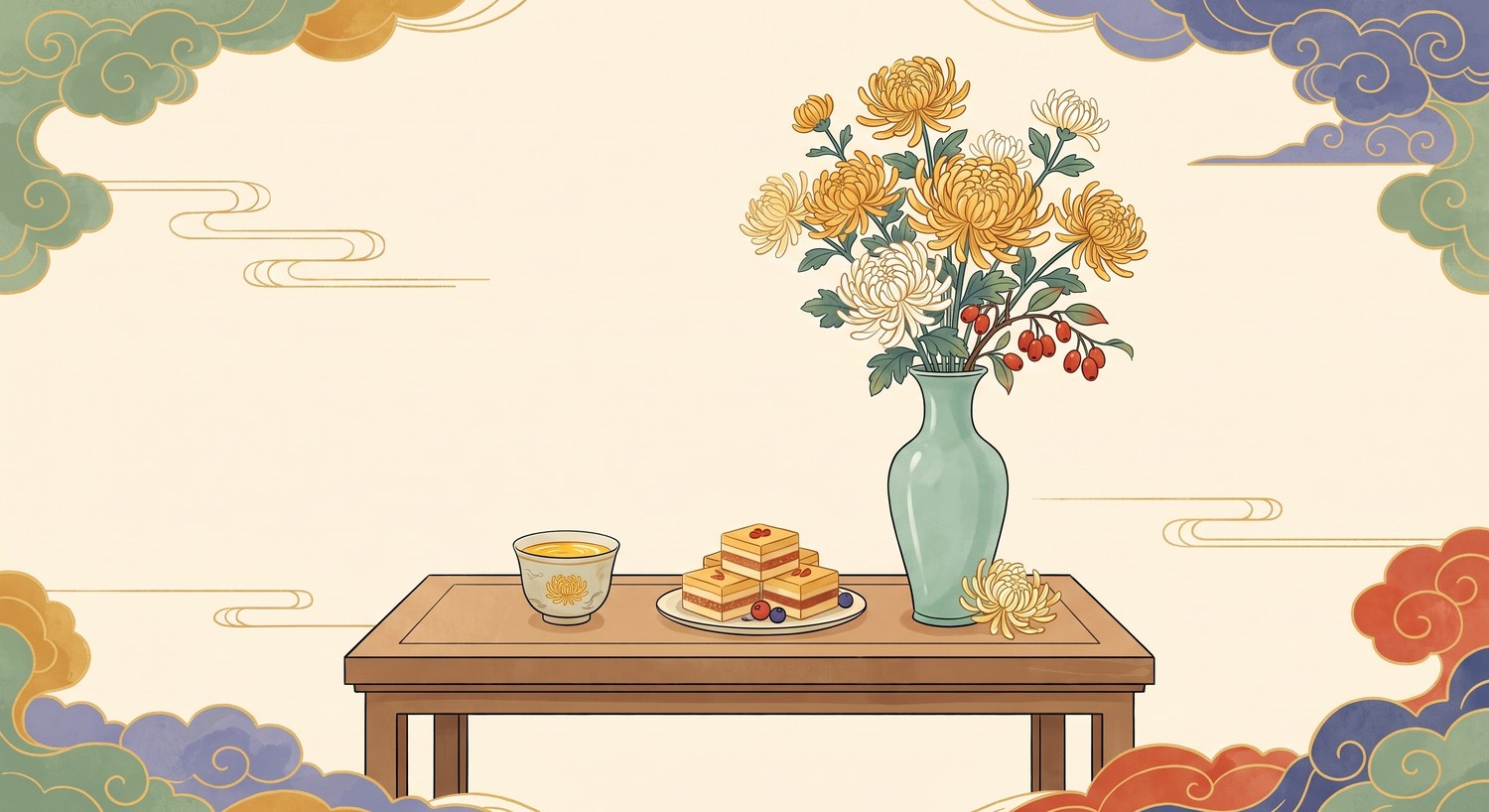
The ninth lunar month is the chrysanthemum’s month — it is one of the few things still flowering when everything else has gone over, which is exactly why it came to stand for endurance and long life. The wine is traditionally brewed with the blossoms and drunk on the ninth; chrysanthemum tea is the modern, sober equivalent.
Dogwood sachets 插茱萸 (chā zhūyú)
Sprigs or small pouches of 茱萸 worn on the arm or tucked into the hair, to drive off illness. Usually translated “dogwood”, though the plant in question is more often evodia — sharply aromatic, and used in Chinese medicine. This is the custom Wang Wei is counting in his last line.
Double Ninth cake 重阳糕 (chóngyáng gāo)
A steamed cake, often layered, sometimes nine layers, sometimes topped with two little sheep — because 羊 (yáng, sheep) sounds like the 阳 (yáng) of the festival’s name. Eating 糕 (gāo, cake) also puns on 高 (gāo, high), so a cake stands in for the climb if you cannot make one.
Seniors’ Day
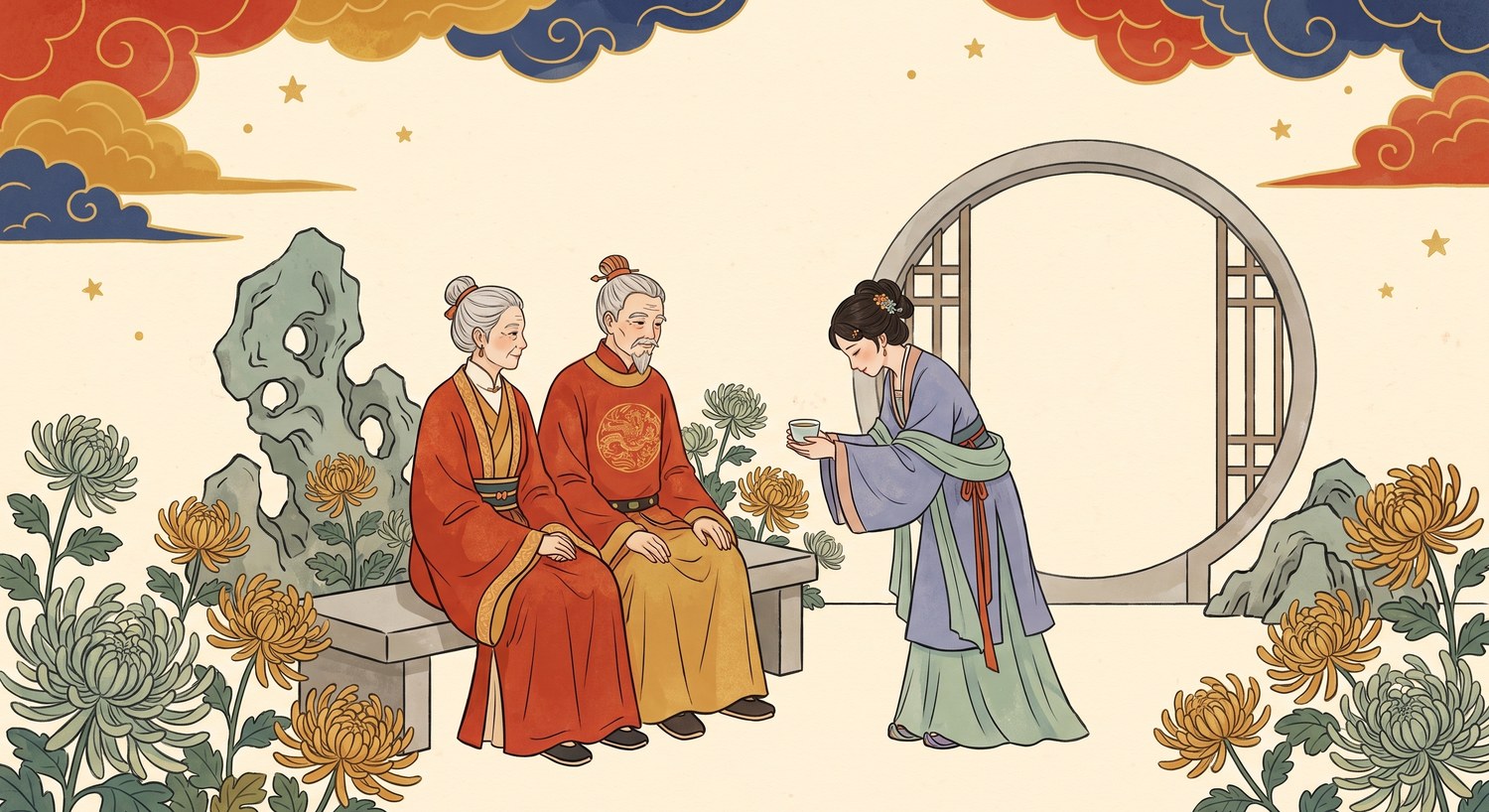
In 1989 the Chinese government designated the Double Ninth as 老人节 (lǎorén jié), a day for the elderly, and in 2013 the revised Law on the Protection of the Rights and Interests of the Elderly wrote 老年节 (lǎonián jié) into statute on the same date.
The choice was not arbitrary. The festival already carried longevity in its bones — the pun on 久 (jiǔ, long-lasting), the chrysanthemum that outlasts the season, the wine drunk for length of life. Attaching Seniors’ Day to it formalised something the day had been drifting towards for centuries.
In practice this is now the most visible part of the festival in mainland China: visits to grandparents, community events for older residents, workplaces organising outings. If you only learn one thing to say on the day, make it a health wish for someone older than you.
Double Ninth greetings & phrases
Tap the speaker to hear each one from a native speaker.
重阳节快乐
Chóngyáng jié kuàilè
“Happy Double Ninth Festival.” The straightforward greeting.
身体健康
Shēntǐ jiànkāng
“Good health.” The wish that actually gets used on the day, especially to older relatives.
福如东海,寿比南山
Fú rú Dōng Hǎi, shòu bǐ Nán Shān
“Fortune as vast as the Eastern Sea, long life as enduring as the Southern Mountain.” Formal, and reserved for elders.
登高望远
Dēng gāo wàng yuǎn
“Climb high, see far.” Literally the festival’s custom; figuratively, take the longer view.
Common misunderstandings
It is not a tomb-sweeping festival. Some southern regions do visit graves on the ninth, but the ancestor-focused festival is Qingming 清明节 (Qīngmíng jié) in spring. Double Ninth is about the living, and increasingly about the old.
重 here is chóng, not zhòng. The character has two readings: zhòng means heavy, chóng means repeated or doubled. The festival is Chóngyáng — doubled yang — and mispronouncing it is the single most common learner error.
It is not a public holiday. Unlike Spring Festival or Mid-Autumn, the Double Ninth is not a mainland public holiday, though many workplaces and communities mark it. In Hong Kong and Macau, by contrast, Chung Yeung is a public holiday.
Nine is not simply lucky here. The doubling was originally felt as excess rather than good fortune — the customs are protective. The cheerful, longevity-focused reading is the later layer.
FAQs
Say it in Mandarin
Learn the greetings, the stories and the language of the festivals — in 1-on-1 online lessons with a native speaker.
Book a Free Intro Call