“Spring Dawn” — by 孟浩然 (Mèng Hàorán), Tang dynasty · learned in Chinese classrooms alongside 静夜思 (Jìng Yè Sī)
“Last night I heard wind and rain. How many blossoms came down?”
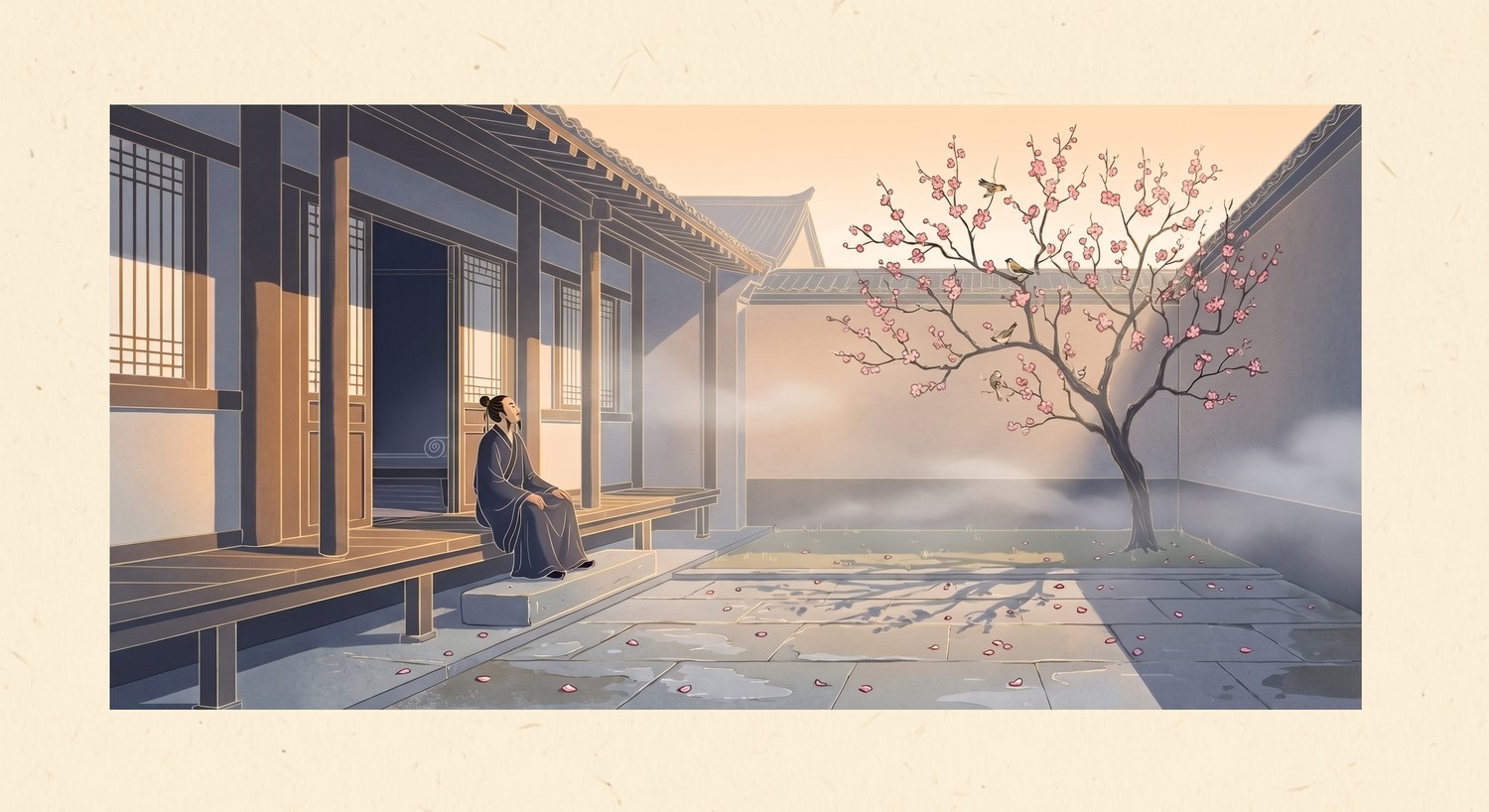
- Poet
- 孟浩然 (Mèng Hàorán) · 689–740
- Dynasty
- Tang · 8th century
- Form
- 五言绝句 (wǔyán juéjù) · 5-char quatrain
- Theme
- Spring and passing time 惜春 (xīchūn)
- Length
- 4 lines · 20 characters
- Fame
- One of the first poems Chinese children learn
春晓 (Spring Dawn), line by line
Twenty characters, and not one of them difficult. Tap the speaker on any line to hear it read at a learner’s pace.
How to recite 春晓 (Spring Dawn)
A five-character line is heard as two beats, then three — not as five separate syllables. Once you feel that pulse the whole poem falls into place.
Spring Dawn: four lines that move through time
Read quickly, Spring Dawn is a pleasant poem about a spring morning. Read slowly, it is doing something more careful: each line sits in a different moment, and the poem travels backwards before it stops.
Line one is now, and it is about absence — the sleeper missed the dawn entirely. Line two is still now, but the world has arrived: birdsong, and not from one direction but 处处 (chùchù), everywhere at once. Line three steps back into the night, to a sound half-heard through sleep. And line four looks at something the poet cannot see from where he is lying: the ground outside, and whatever the storm did to it.
That last line is the whole poem. It is not a statement but a question, and it is never answered. The blossoms have fallen; how many is unknowable and, in a sense, unimportant. What the reader is left holding is the ordinary, unarguable fact that spring is already going — noticed, as it always is, slightly too late.
五言绝句: twenty characters, nothing spare
Spring Dawn is a 五言绝句 (wǔyán juéjù) — a “cut-off verse” of four lines with five characters each. It is the same form as 静夜思, and the two poems are usually taught together for exactly that reason.
The constraint is severe. Twenty characters is roughly a single English sentence, so nothing can be included that is not doing work. There are no adjectives of feeling anywhere in Spring Dawn — no sad, no lovely, no fleeting. The poet gives you sleep, birds, rain and fallen flowers, and lets those four facts carry everything.
Compare with 满江红 (Mǎn Jiāng Hóng), a 词 (cí) lyric of ninety-three characters across two stanzas — nearly five times the length, and a completely different register.
The turn from sound to sight
The poem is built on a single hinge. The first half is entirely heard; the second half is entirely unseen.
The verbs tell the same story. 闻 (to hear) is certain; 知 (to know) is used in a line that is precisely about not knowing. In twenty characters the poem moves from something the body registers without effort to something the mind cannot settle — which is a fairly exact description of waking up.
The key characters
Tap any character to hear it on its own. All five are ordinary modern Mandarin, not classical-only vocabulary.
A poet who never got the job
Meng Haoran belongs to a small group of major Tang poets who never held real office. He sat the imperial examination in his forties and failed, and after that spent most of his life at home in Xiangyang and in retreat on nearby 鹿门山 (Lumen Mountain), writing about fields, rivers, weather and the passing of seasons.
That biography is worth knowing, because it explains the poem’s scale. A court poet writes about empires. Meng Haoran writes about waking up. The subject of 春晓 is so small that it barely qualifies as an event — and the poem’s survival for thirteen centuries is a reasonable argument that the small subject was the right one.
If you want to compare editions, the Chinese text of 春晓 is hosted in full on Chinese Wikisource.
Meng Haoran, the quiet half of a famous pair
孟浩然 (Mèng Hàorán, 689–740) is usually named in the same breath as Wang Wei — together they are 王孟 (Wáng Mèng), the two masters of Tang nature poetry. Li Bai, who was a friend, wrote a poem in his honour that opens by simply saying he loves the man.
His register is deliberately undramatic. Where Li Bai reaches for the moon and the Milky Way, Meng Haoran stays with what is in front of him: a boat, a mountain path, an old friend’s farm, a morning after rain. For a learner this is a gift, because the vocabulary is domestic and the sentences are short.
Where you’ll meet Spring Dawn today
It is one of the first poems taught in mainland Chinese primary schools, and it appears in 唐诗三百首 (Three Hundred Tang Poems), the anthology most Chinese households have owned at some point. Ask an adult to recite a poem and there is a good chance you will get this one or 静夜思 (Jìng Yè Sī).
The phrase 春眠不觉晓 (chūn mián bù jué xiǎo) also survives on its own, used lightly and often self-mockingly by anyone who has overslept — roughly the way an English speaker might say they slept like the dead. Knowing the line means catching the joke.
FAQs
Read the classics in the original
Poetry is one of the most beautiful ways into Mandarin. We teach it line by line in 1-on-1 online lessons with a native speaker.
Book a Free Intro Call