The mindset it mocks: 侥幸 · jiǎoxìng — trusting to luck instead of effort
“He set down his plough to wait for a hare that never came again.”
- Literal
- Guard the stump, waiting for a hare
- Meaning
- To trust to luck instead of effort
- Register
- Everyday, very common
- Level
- Intermediate (HSK 5)
- Source
- 韩非子 · Warring States
- English match
- To wait for a windfall
Luck is not a plan
守株待兔 (shǒu zhū dài tù) literally means “to guard a tree stump, waiting for a hare.” It pictures someone who, having once stumbled on a stroke of luck, sets aside real effort and simply waits for the same windfall to arrive again. It is a gentle mockery of passivity — of trusting to luck over work.
There is a sharper edge beneath it. Han Fei told the story to warn against clinging to a single past experience as though the world will keep repeating it: governing the present by the methods of the ancient sage-kings, he argued, is as foolish as the farmer at his stump. So the idiom also criticises rigid, unadapting thinking.
Break it down
Tap any character to hear it. Pinyin is tone-coloured: 1st · 2nd · 3rd · 4th · neutral.
Note: 株 (zhū) is specifically the stump of a felled tree left in the ground — the same character that today serves as a measure word for plants, as in 一株树 (yì zhū shù, “one tree”). For how characters like these are built, see our guide to how Chinese characters work.
Straight from the source
The idiom comes from the Han Feizi (韩非子), the great Warring States classic of Legalist thought by the philosopher Han Fei (c. 280–233 BCE). He tells this parable in the chapter 五蠹 (“The Five Vermin”), to mock rulers who govern the present with the outdated ways of the ancients. Here is the original, with a translation:
宋人有耕田者,田中有株,兔走触株,折颈而死,因释其耒而守株,冀复得兔。兔不可复得,而身为宋国笑。
“There was a man of Song who tilled his field. In the field stood the stump of a tree. A hare, running, struck the stump, broke its neck and died. So the man set aside his plough and kept watch over the stump, hoping to get another hare. But no second hare could be had — and he became the laughing-stock of the whole state of Song.”
— 《韩非子·五蠹》, by Han Fei, Warring States period, 3rd century BCE.The farmer of Song
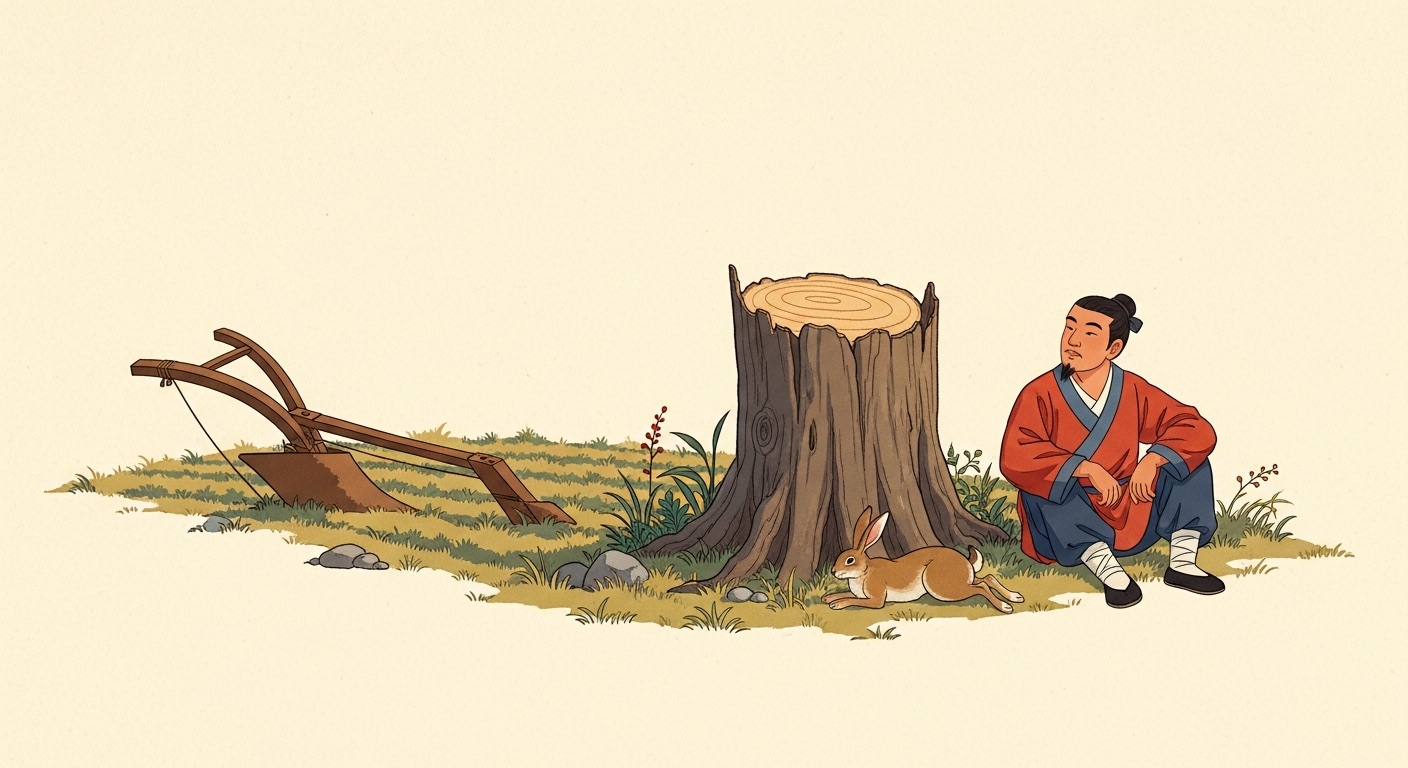
宋In the state of Song, a farmer was working his field. At its edge stood the stump of a felled tree. One day a hare, bolting in a panic, ran headlong into the stump, broke its neck, and lay dead. The farmer carried it home to an easy feast.
From then on, work lost its appeal. He set down his plough, took up a post beside the stump, and waited — certain that another hare would come running to the very same end.
None ever did. His crops withered from neglect, and the farmer became the laughing-stock of the whole state of Song. The stump had given him one hare by pure chance; what he lost, by waiting for a second, was the living his own hands could have made.
How to use 守株待兔 (shǒu zhū dài tù)
Reach for 守株待兔 to criticise someone who waits for luck instead of working for a result — or who keeps repeating a one-off success expecting the same outcome. It’s everyday, a little mocking, and common in both speech and writing.
找工作要主动,不能守株待兔。
Zhǎo gōngzuò yào zhǔdòng, bùnéng shǒu zhū dài tù.
“You have to be proactive in a job hunt — you can’t just wait for luck to drop in your lap.”
生意靠努力,守株待兔是行不通的。
Shēngyì kào nǔlì, shǒu zhū dài tù shì xíng bù tōng de.
“Business runs on effort — waiting for a windfall gets you nowhere.”
他不再学习新技能,只想守株待兔,等好运再来。
Tā bù zài xuéxí xīn jìnéng, zhǐ xiǎng shǒu zhū dài tù, děng hǎoyùn zài lái.
“He’s stopped learning new skills and just waits by the stump, hoping his luck comes back.”
Common mistakes
- It isn’t praise for patience. 守株待兔 is negative — it mocks passive, lazy reliance on luck, not calm perseverance.
- Don’t confuse it with simply “waiting.” The point is refusing to work or adapt, expecting a one-off fluke to repeat.
- 兔 here is tù, “hare/rabbit.” The stump 株 (zhū) is a low, in-ground stump — not a whole tree.
Closest equivalents
English reaches for “trusting to luck” or “waiting for a windfall,” but 守株待兔 carries the whole little fable with it — the abandoned plough, the weed-choked field, the one fluke mistaken for a rule.
Quick quiz
1. When would you naturally say 守株待兔?
2. In the story, why did the farmer become a laughing-stock?
FAQs
More Chinese idioms
Each one carries a story worth knowing — and a lesson that still lands today.
Learn idioms the way natives use them
Go beyond memorising — practise real Mandarin, idioms and all, in 1-on-1 online lessons with a native speaker.
Book a Free Intro Call