沉舟 = sinking your own boats — once the river is behind you, “back” stops being a choice anyone has to make
“Three days’ rations, and nothing to come home to.”
- Literal
- Smash the cauldrons, sink the boats
- Meaning
- Cutting off every retreat so the only way left is forward
- Register
- Literary, very common
- Level
- Upper-intermediate (HSK 6)
- Source
- 史记 · Han dynasty
- English match
- To burn your boats
No way back, and that was the point
破釜沉舟 (pò fǔ chén zhōu) literally means “to smash the cooking pots and sink the boats.” It describes destroying your own means of retreat on purpose, so that going forward is not the brave option but the only one left.
The force of it is in the word own. Nobody trapped this army. The commander did it himself, deliberately, in front of them — and that is what separates 破釜沉舟 from simply being cornered. English reaches for “burn your boats,” which is the same gesture and, as it happens, a much younger phrase.
Break it down
Tap any character to hear it. Pinyin is tone-coloured: 1st · 2nd · 3rd · 4th · neutral.
Note: 舟 is the literary word for a boat — in conversation you would say 船 (chuán). It survives mostly inside set phrases like this one, and as the radical in characters to do with vessels: 航 (to navigate), 般, 舰 (warship). 釜 has fallen out of daily use altogether; the everyday word for a pot is now 锅 (guō). For how radicals carry meaning like this, see our guide to how Chinese characters work.
Straight from the source
This one is recorded history, not fable. Sima Qian (司马迁) set it down in the Shiji (史记, “Records of the Grand Historian”, c. 1st century BCE), in the Annals of Xiang Yu — roughly a century after the battle it describes:
项羽乃悉引兵渡河,皆沉船,破釜甑,烧庐舍,持三日粮,以示士卒必死,无一还心。
“Xiang Yu then led all his troops across the river, sank every boat, broke the cauldrons and the steamers, burned the shelters, and carried three days’ rations — to show the soldiers they must fight to the death, with not one thought of return.”
— 《史记·项羽本纪》, by Sima Qian (Han dynasty).The idiom is not the quotation. Read that sentence again and the four-character phrase 破釜沉舟 is not in it — and it appears nowhere else in the chapter. What Sima Qian wrote was 皆沉船,破釜甑. He sinks 船, the ordinary word for a boat, where the idiom uses the literary 舟. He breaks 釜甑, the cauldrons and the steamers; the idiom keeps only the cauldron. And he adds a third act the idiom drops altogether — 烧庐舍, he burned the shelters too. The tidy four-character form came later, as such forms usually do. What the condensing lost is the detail that makes the decision legible: 持三日粮, three days’ rations. This was not a man setting fire to everything in a passion. It was a calculation about exactly how long his army would need to win.
The general who left his army nothing to come back to
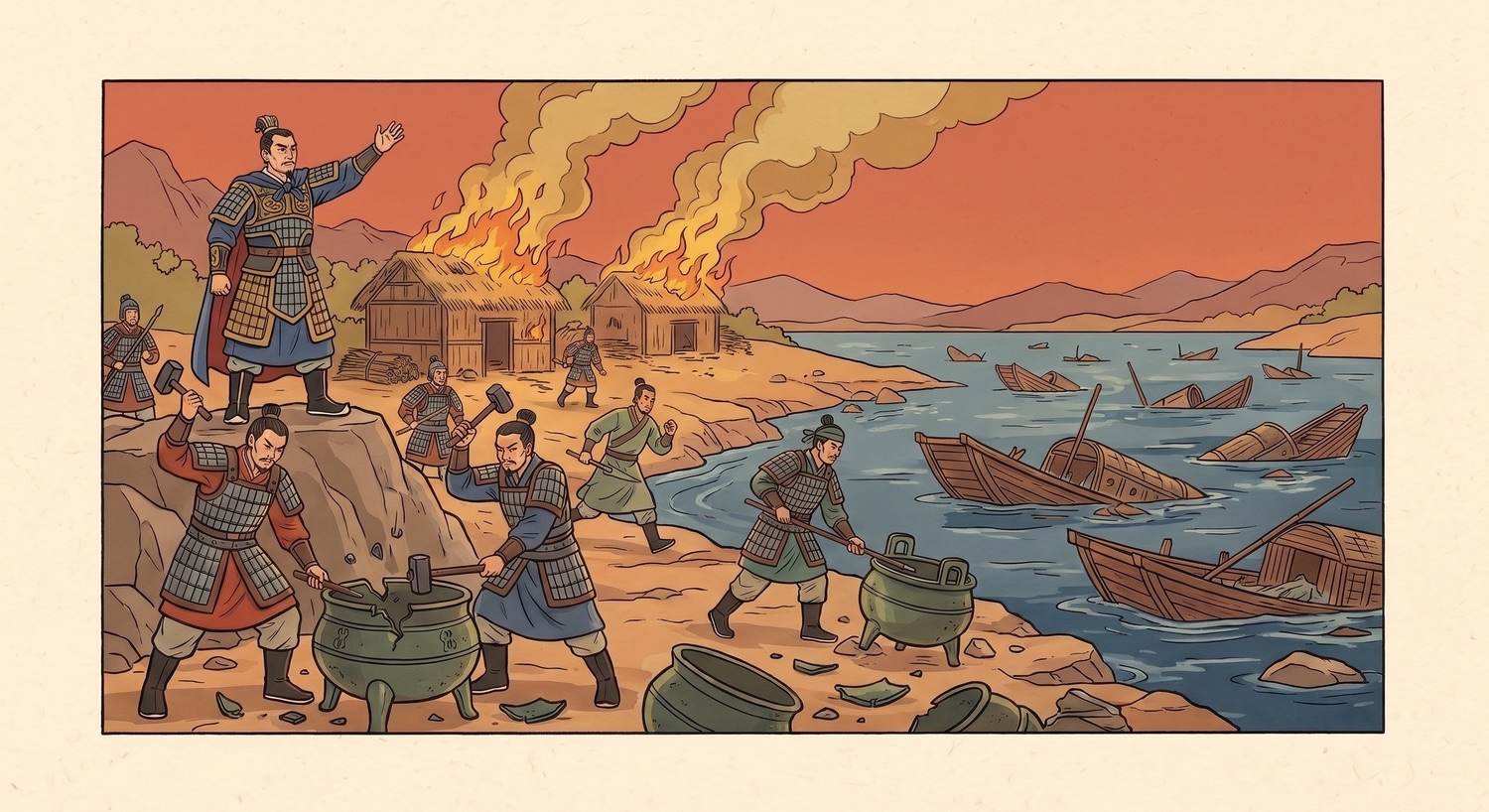
In 207 BC the Qin empire was cracking, and its army had pinned the rebel state of Zhao inside the walled town of Julu. Relief columns arrived from half a dozen kingdoms, looked at the size of the Qin force, built fortified camps at a safe distance, and stopped.
Xiang Yu (项羽) had just killed his own commanding officer for refusing to advance. He took the army across the Zhang River — and then gave the order that has outlived everything else about him. Sink the boats. Break the pots. Burn the shelters. Each man carries three days’ food and nothing more.
It was not theatre. An army that cannot cook cannot besiege, cannot wait, cannot negotiate a slow withdrawal. Three days was the outside limit of what the decision bought them. Inside it, they fought nine engagements, cut the Qin supply road, and broke the army that had unified China.
The line in the Shiji that historians love comes afterwards. The allied generals who had watched the whole thing from their ramparts were summoned to Xiang Yu’s camp gate — and every one of them went in 膝行而前, on their knees, not daring to look up.
How to use 破釜沉舟 (pò fǔ chén zhōu)
Reach for 破釜沉舟 when someone deliberately removes their own fallback — resigning before the new venture is funded, selling the flat to pay for the degree, turning down the safe offer so that it cannot be taken later. It is admiring, with a note of risk, and it is at home in writing and in speech.
他辞掉了稳定的工作,破釜沉舟,全力创业。
Tā cídiào le wěndìng de gōngzuò, pò fǔ chén zhōu, quánlì chuàngyè.
“He quit a secure job, burned his boats, and went all in on the business.”
这次我们破釜沉舟,已经没有退路了。
Zhè cì wǒmen pò fǔ chén zhōu, yǐjīng méiyǒu tuìlù le.
“This time we have committed completely — there is no way back now.”
球队决定破釜沉舟,把所有主力都派上场。
Qiúduì juédìng pò fǔ chén zhōu, bǎ suǒyǒu zhǔlì dōu pài shàngchǎng.
“The team decided to go all in, putting every first-choice player on the field.”
Grammar note: it works as a verb phrase, so it can stand as its own clause (他破釜沉舟) or sit before the main verb, as in all three examples. Its common partner is 没有退路 — “no road back” — which spells out the consequence the idiom only implies.
Common mistakes
- It means cutting off your own retreat by choice. Being trapped by someone else is not 破釜沉舟 — that is closer to 走投无路 (nowhere left to run).
- It is not recklessness. The three days’ rations are the point: this is a calculated commitment with a deadline attached, not a tantrum.
- Don’t use it for small stakes. Deleting a social media app is not 破釜沉舟; it is too heavy a phrase for a light decision, and the mismatch sounds comic.
- The Shiji says 沉船, using 船 for boat; the idiom uses the literary 舟. Both are correct in their place — just don’t write the idiom as 破釜沉船.
Closest equivalents
“Burn your boats” is the near-exact match, and English came to the image separately — most often told of Cortés in 1519, sixteen centuries after Julu. Note the drift in “burn your bridges,” which in everyday English now usually means wrecking a relationship on the way out. That sense is not in 破釜沉舟 at all.
Quick quiz
1. What does 破釜沉舟 describe?
2. What did Xiang Yu’s soldiers carry across the river?
FAQs
More Chinese idioms
Each one carries a story worth knowing — and a lesson that still lands today.
Learn idioms the way natives use them
Go beyond memorising — practise real Mandarin, idioms and all, in 1-on-1 online lessons with a native speaker.
Book a Free Intro Call