Rooted in Zhuangzi’s 井蛙 · jǐng wā, “the well-frog” — one who cannot be told of the sea
“A well-frog cannot be told of the sea.”
- Literal
- The frog at the bottom of the well
- Meaning
- A person of narrow outlook
- Register
- Literary, in common use
- Level
- Intermediate (HSK 5–6)
- Source
- 庄子 · Warring States
- English match
- A frog in a well
The whole sky, in a circle
井底之蛙 (jǐng dǐ zhī wā) literally means “the frog at the bottom of the well.” It describes a person whose view of the world is boxed in by their own narrow experience — who mistakes their small circle of sky for the whole heavens. It’s used, often with a touch of pity or reproach, for someone smug in a limited outlook.
The image comes from Zhuangzi: a frog cannot be told of the sea, because it has only ever known its well. The point isn’t that the frog is stupid — it’s that its horizon is small. The idiom quietly urges us to remember how much lies beyond what we happen to have seen.
Break it down
Tap any character to hear it. Pinyin is tone-coloured: 1st · 2nd · 3rd · 4th · neutral.
Note: 之 (zhī) here is the classical particle that links a modifier to a noun — the literary equivalent of modern 的. So 井底之蛙 reads “the frog of the well-bottom.” For how characters like these are built, see our guide to how Chinese characters work.
Straight from the source
The idiom traces to the Daoist classic Zhuangzi (庄子), in the chapter 秋水 (“Autumn Floods”). There the philosopher shows how every creature’s understanding is bound by its circumstances — and gives us the well-frog who boasts to a great sea-turtle, only to be struck dumb when it hears the vastness of the ocean. Here is the crystallising line:
井蛙不可以语于海者,拘于虚也;夏虫不可以语于冰者,笃于时也。
“You cannot speak of the sea to a well-frog — it is confined to its hole. You cannot speak of ice to a summer insect — it is fixed in its season.”
— 《庄子·秋水》, attributed to Zhuang Zhou, Warring States period, 4th century BCE.The frog and the sea-turtle
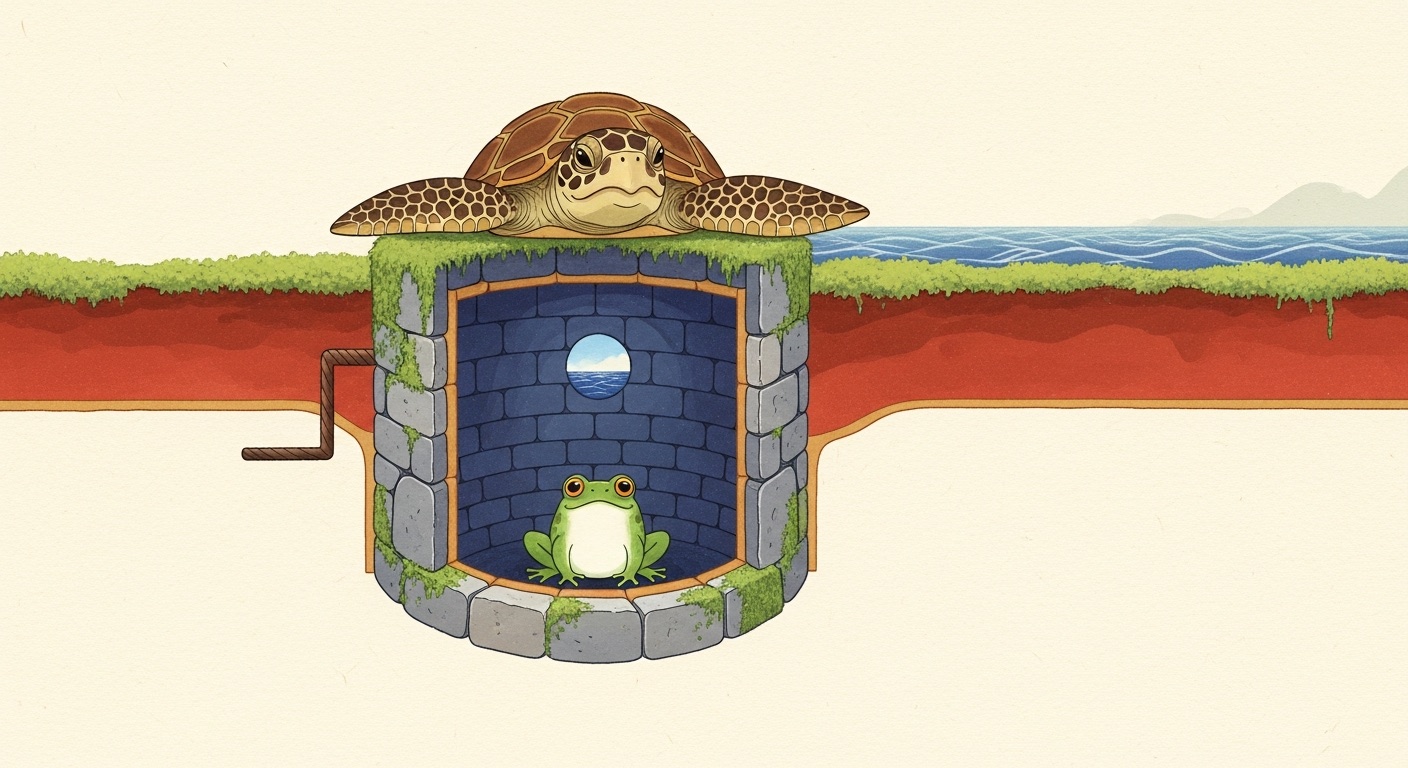
有A frog lived in a shallow, broken-down well, and thought itself the most fortunate creature alive. One day it called up to a great turtle from the Eastern Sea: “How happy I am! I hop along the well’s rim, rest in the cracks of its brickwork, paddle in water up to my chin, and squelch through mud that buries my feet. No crab or tadpole here can match me. This whole well is mine alone — what could be better?”
The turtle of the Eastern Sea moved to climb down for a look. But before it could fit even a foot inside, it was wedged fast. So it drew back and told the frog of the sea instead: of a vastness a thousand miles could not measure, a depth no line could sound; of waters that neither flood nor drought could raise or lower.
When the little frog of the well heard this, it was stunned into silence — and knew, for the first time, how small its world had been.
How to use 井底之蛙 (jǐng dǐ zhī wā)
Reach for 井底之蛙 to describe — or gently warn against being — someone whose confidence outruns their experience, who judges the whole world by their own small corner of it. It’s common in speech and writing, and often turned inward as a note of humility.
别做井底之蛙,多出去看看世界。
Bié zuò jǐng dǐ zhī wā, duō chūqù kànkan shìjiè.
“Don’t be a frog in a well — get out and see more of the world.”
他从没离开过家乡,眼界像个井底之蛙。
Tā cóng méi líkāiguò jiāxiāng, yǎnjiè xiàng ge jǐng dǐ zhī wā.
“He’s never left his hometown; his outlook is that of a frog in a well.”
学得越多,越发现自己曾是井底之蛙。
Xué de yuè duō, yuè fāxiàn zìjǐ céng shì jǐng dǐ zhī wā.
“The more I learn, the more I see that I’d been a frog in a well.”
Common mistakes
- It’s about a narrow outlook, not low intelligence — the frog isn’t stupid, just boxed in by its experience.
- 之 here is the classical particle (= 的), so 井底之蛙 is “the frog of the well bottom” — don’t read 之 as a verb “to go.”
- It carries mild criticism or humility — it isn’t a neutral description, so use it thoughtfully about others.
Closest equivalents
English borrows this very picture — “a frog in a well.” “Can’t see the forest for the trees” is close in spirit, but that’s about missing the whole for the detail; 井底之蛙 is about a horizon that was always too small.
Quick quiz
1. What does 井底之蛙 describe?
2. In the Zhuangzi story, what humbles the well-frog?
FAQs
More Chinese idioms
Each one carries a story worth knowing — and a lesson that still lands today.
Learn idioms the way natives use them
Go beyond memorising — practise real Mandarin, idioms and all, in 1-on-1 online lessons with a native speaker.
Book a Free Intro Call