🏯 New: explore our interactive Chinese history timeline — every major dynasty, tap to expand, plus in-depth guides.
China’s story stretches back more than five thousand years, and few histories have shaped the modern world as profoundly. For Australians curious about our largest trading partner — and one of our closest cultural neighbours in the Asia-Pacific — understanding the major Chinese dynasties is the best way to make sense of contemporary China: its art, politics, cuisine, and, of course, the Mandarin language. This guide walks you through China’s historical timeline from the semi-mythical Xia to the final Qing emperor, pulling out the moments that still echo in daily life today.
A Quick Reference: Chinese Dynasties at a Glance
Before we dive in, here is the Chinese historical timeline in one sweep — handy for students, travellers and anyone brushing up before a trip to Beijing or Xi’an. Read our complete guide to Beijing for the modern city built on these dynastic foundations, or our guide to Shanghai for the city whose modern story is largely post-dynastic. Or for the southern region whose Cantonese culture sat at a deliberate cultural distance from the imperial capitals, our guide to Guangdong. For the western basin that became the Shu Han kingdom and refuge for fleeing Tang emperors, our guide to Sichuan.
People’s Republic of China — 1949 to the present
Xia Dynasty — c. 2070–1600 BCE
Shang Dynasty — c. 1600–1046 BCE
Zhou Dynasty — 1046–256 BCE
Qin Dynasty — 221–206 BCE
Han Dynasty — 206 BCE–220 CE
Three Kingdoms, Jin, Northern & Southern Dynasties — 220–589 CE
Sui Dynasty — 581–618 CE
Tang Dynasty — 618–907 CE
Song Dynasty — 960–1279
Yuan (Mongol) Dynasty — 1271–1368
Ming Dynasty — 1368–1644
Qing Dynasty — 1644–1912
Republic of China — 1912–1949
Before the Dynasties: The Xia (c. 2070–1600 BCE)
The Xia Dynasty is traditionally regarded as China’s first ruling house, although much of what we know about it blurs into legend. Chinese folklore credits Yu the Great with founding the Xia after taming devastating floods along the Yellow River — a story that still shapes Chinese ideas about virtuous leadership. Archaeological sites such as Erlitou in Henan province suggest a genuine Bronze Age culture underpinned the myth, even if the written records only appear much later. For most historians, the Xia is where the history of China formally begins.
The Shang and Zhou: Foundations of Chinese Civilisation (c. 1600–256 BCE)
The Shang Dynasty (c. 1600–1046 BCE) gave us China’s earliest confirmed writing, scratched onto oracle bones used for divination at the royal court. Their bronze ritual vessels are still considered masterpieces of ancient craftsmanship and can be seen in museums from Shanghai to Canberra.
The Zhou Dynasty that followed is the longest ruling in Chinese history. It split into the Western Zhou and Eastern Zhou periods, and the Eastern Zhou further divided into the Spring and Autumn and the Warring States eras. Despite the political chaos, the Zhou produced the foundational thinkers of Chinese civilisation: Confucius, Laozi, Mozi, and the strategists behind The Art of War. The concept of the Mandate of Heaven — the idea that rulers govern only while they remain just — was born here, and it would justify every dynastic change for the next two thousand years.
The Qin and Han: China’s First Empires (221 BCE–220 CE)
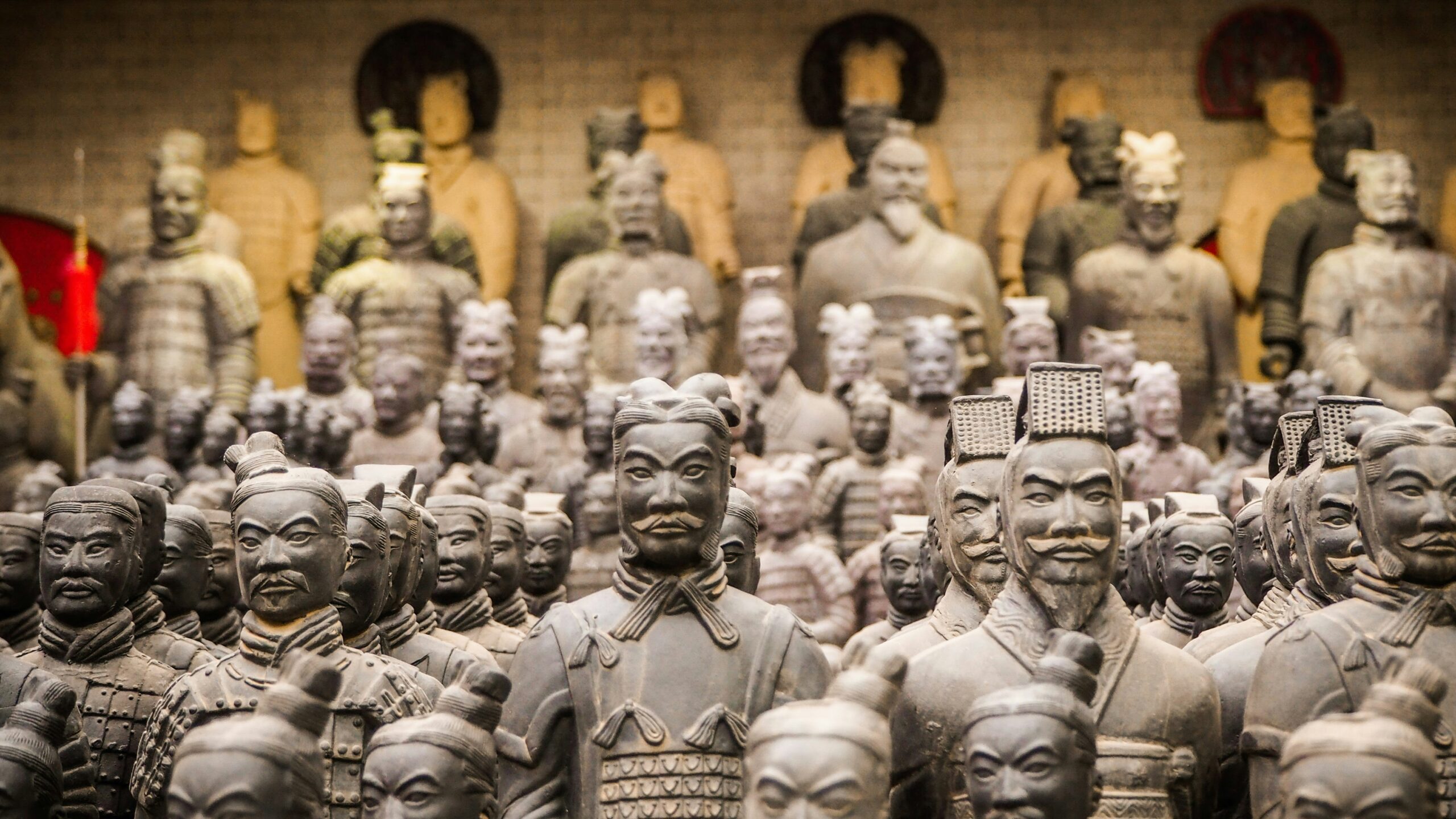
In 221 BCE, Qin Shi Huang crushed his rivals and declared himself the First Emperor of a unified China. The Qin Dynasty lasted only fifteen years, but its impact was enormous: standardised script, currency and measurements, the first sections of the Great Wall of China, and the astonishing Terracotta Army buried outside modern-day Xi’an. Many Australian travellers rank a visit to the Terracotta Warriors among the highlights of any trip to China.
The Han Dynasty (206 BCE–220 CE) that followed defined what it means to be “Chinese”. To this day, the majority ethnic group in China call themselves the Han, and the writing system is known as Hanzi. The Han opened the Silk Road, expanded deep into Central Asia, invented paper, and refined the imperial bureaucracy. Confucianism was formally adopted as state philosophy, shaping East Asian education and government for centuries to come.
Division, Reunion and the Tang Golden Age (220–907 CE)
After the Han collapsed, China fractured into the Three Kingdoms — the setting for perhaps the most beloved historical novel in East Asia, Romance of the Three Kingdoms. Nearly four centuries of disunion followed under the Jin and the Northern and Southern Dynasties. Buddhism spread widely during this turbulent time, leaving behind cave temples at Dunhuang, Yungang and Longmen that still draw travellers from all over the world.
The Sui Dynasty (581–618 CE) reunified the country and built the Grand Canal, still one of the longest artificial waterways on Earth. The Tang Dynasty (618–907 CE) that followed is often called China’s golden age. Chang’an, the Tang capital, was the most cosmopolitan city on the planet — a magnet for merchants, monks and poets from Persia to Japan. The Tang gave us Li Bai and Du Fu, two of the most quoted poets in the Chinese language, whose verses are still memorised by primary school children across China today. If you have ever wondered why Tang poetry keeps popping up in Mandarin textbooks, this is the reason.
Song, Yuan, Ming and Qing: Later Imperial China (960–1912)
The Song Dynasty (960–1279) was a period of extraordinary economic and technological innovation. Gunpowder, the magnetic compass, movable-type printing and the world’s first paper money all emerged under the Song. Song-era landscape painting and celadon porcelain still set the standard for Chinese fine art, and you can see exquisite examples in the Art Gallery of New South Wales and the National Gallery of Victoria.
In 1271 Kublai Khan founded the Yuan Dynasty, making China part of the vast Mongol Empire — the largest contiguous land empire in history. It was under the Yuan that Marco Polo travelled east and brought back tales that astonished medieval Europe. The Ming Dynasty (1368–1644) restored Han Chinese rule and built the Forbidden City in Beijing, arguably the most photographed landmark in China. Admiral Zheng He’s treasure fleets sailed as far as East Africa, decades before the European age of ocean exploration began.
The Qing Dynasty (1644–1912) was founded by the Manchus and became China’s last imperial house. Under emperors such as Kangxi and Qianlong the empire reached its greatest territorial extent, stretching from Taiwan to Xinjiang. The nineteenth century, however, brought the Opium Wars, the Taiping Rebellion and humiliating concessions to foreign powers — events that still shape how Chinese history is taught today. In 1912, the child emperor Puyi abdicated, and more than two thousand years of imperial rule came to an end.
Modern China: From Republic to Today
The Republic of China was declared in 1912 and quickly descended into warlordism, followed by the Japanese invasion and a brutal civil war. The People’s Republic of China was proclaimed on 1 October 1949 with Mao Zedong as its first leader.
Deng Xiaoping’s reforms from 1978 onwards transformed China into the world’s second-largest economy and, of course, Australia’s most important trading partner. Knowing how this modern chapter grew out of the earlier dynasties makes current headlines far easier to interpret.
Why the Chinese Dynasties Matter for Australian Learners
Every brushstroke of Chinese calligraphy, every chengyu (four-character idiom) in modern Mandarin, and every festival you see celebrated in Sydney’s and Melbourne’s Chinatowns traces back to one of these dynasties. Knowing the names Han, Tang, Song, Ming and Qing gives you a map for understanding Chinese films, news headlines and conversations with colleagues from Greater China. It also helps students preparing for HSC Chinese or HSK exams make sense of the cultural references embedded in every text.
Even a few hundred characters will transform these dynasties from foreign names into a living story you can read in the original. Whether you are planning a trip to Xi’an to see the Terracotta Warriors, preparing for a posting in Shanghai, or simply keen to impress your in-laws at Lunar New Year, a structured Mandarin course is the shortest path in.
Frequently Asked Questions About Chinese Dynasties
How many Chinese dynasties were there in total?
Chinese historians usually count thirteen major dynasties, though smaller and overlapping kingdoms push the total higher. The ones in this guide are the dynasties you will meet most often in books, films and Mandarin lessons.
Which Chinese dynasty lasted the longest?
The Zhou Dynasty, at around 790 years, is the longest-ruling house in Chinese history, even though its later centuries were politically fragmented.
Where should I start if I want to learn Mandarin Australia?
Begin with pinyin and the four tones, then move into basic conversation and the most common 500 characters. A structured course with a dedicated tutor — like the one-on-one lessons offered by Willy China — will move you faster than self-study and will give you the cultural context to understand why the dynasties in this article still matter today.
China’s four thousand years of history are too rich to cover in a single article, but the dynasties above are the scaffolding. Learn them once, and every Chinese novel, film and news story suddenly has somewhere to hang.
Further Reading: Chinese History Books Worth Your Time
If this timeline has sparked your curiosity, these books are excellent starting points for going deeper:
The 8th–13th century Nanzhao and Dali Kingdoms of Yunnan are a reminder that Chinese history has always been more than the central plains.
- Wild Swans by Jung Chang — a gripping family saga spanning three generations of Chinese history
- The Silk Roads by Peter Frankopan — China’s place in the story of world civilisation
- China: A History by John Keay — a clear, authoritative single-volume history
- Mao’s Last Dancer by Li Cunxin — a remarkable memoir of life in modern China
This post contains affiliate links. If you purchase through them, I may earn a small commission — at no extra cost to you.
The Han, Tang and Western Xia dynasties left their mark all the way down the Silk Road. For their Gansu chapter — Dunhuang’s Buddhist caves, Jiayuguan’s Ming fortress, the Han Hexi Corridor commanderies — see our complete guide to Gansu.