愚公 = the “Foolish Old Man” — whose stubborn faith outlasted the 智叟, the “Wise Old Man” who mocked him
“The mountains grow no higher — so why should they not be levelled?”
- Literal
- The Foolish Old Man moves the mountains
- Meaning
- Perseverance overcomes any obstacle
- Register
- Literary, very common
- Level
- Intermediate (HSK 5)
- Source
- 列子 · Warring States
- English match
- Faith can move mountains
The patience to move a mountain
愚公移山 (yú gōng yí shān) literally means “the Foolish Old Man moves the mountains.” It stands for dogged, unshakeable perseverance — the resolve to keep chipping away at an obstacle, however impossible it looks, trusting that steady effort will win in the end. To praise someone’s determination, Chinese speakers call it a 愚公移山 spirit.
The name is a wink. The old man is called “foolish,” and a “wise” neighbour laughs at his plan — yet it is the fool’s patience, carried on by his children and theirs, that would wear the mountains down. The idiom celebrates the kind of persistence that looks naive in the moment and visionary in the end.
Break it down
Tap any character to hear it. Pinyin is tone-coloured: 1st · 2nd · 3rd · 4th · neutral.
Note: 愚公 (Yúgōng) is the character’s name — literally “Foolish Old Man” — set against his mocker 智叟 (Zhìsǒu), “Wise Old Man.” The irony is the whole point: the “fool” is the wise one. For how characters like these are built, see our guide to how Chinese characters work.
Straight from the source
The idiom comes from the Daoist classic Liezi (列子), in the chapter 汤问 (“The Questions of Tang”). Two mountains block the old man’s home; when a neighbour mocks his plan to dig them away, the old man gives one of the most quoted answers in Chinese:
虽我之死,有子存焉;子又生孙,孙又生子;子又有子,子又有孙;子子孙孙,无穷匮也,而山不加增,何苦而不平?
“Though I die, my sons remain; my sons beget grandsons, and grandsons beget sons; those sons have sons, and sons have grandsons — generation upon generation, without end. But the mountains grow no higher. Why, then, should they not be levelled?”
— 《列子·汤问》, attributed to Lie Yukou, in the Warring States tradition.The Foolish Old Man and the two mountains
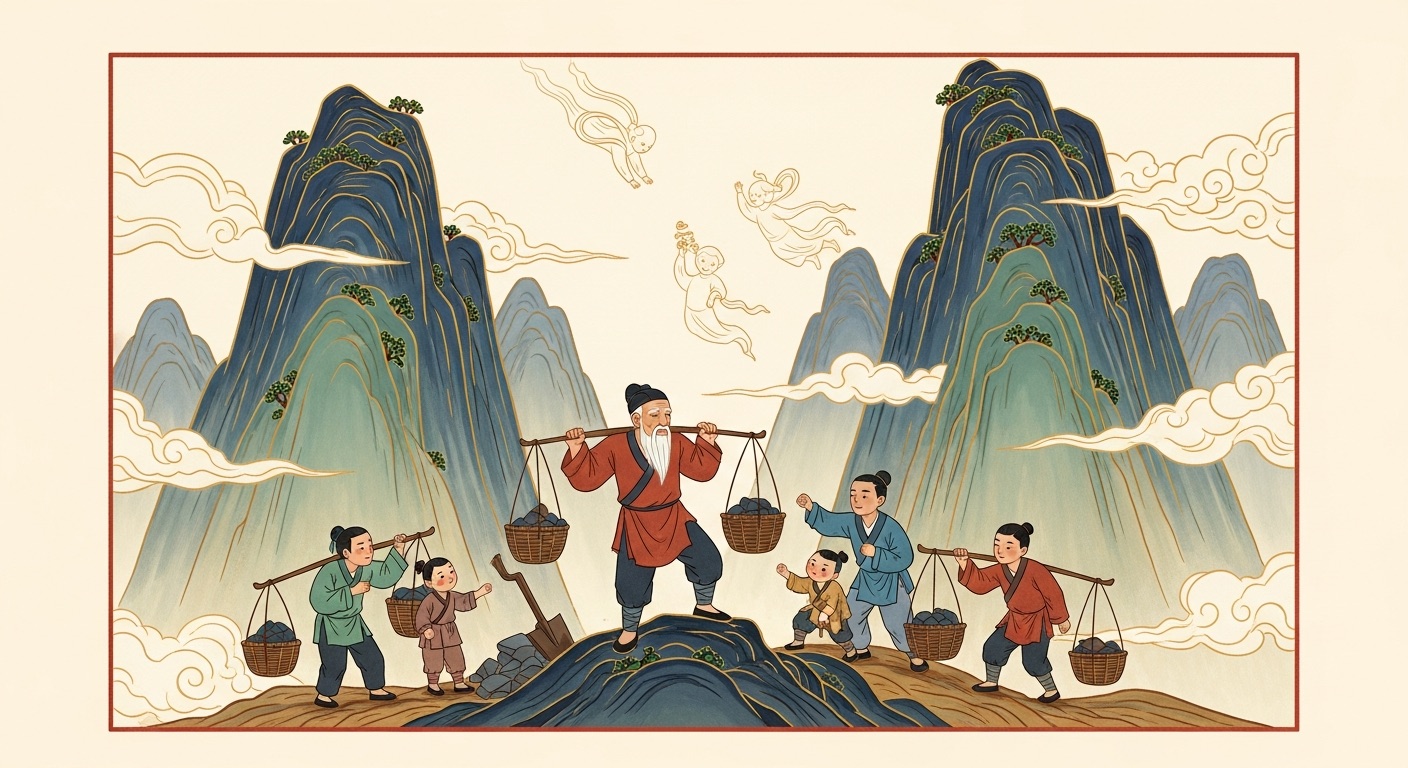
太Taihang and Wangwu, two great mountains, stood squarely before the old man’s house, turning every journey into a long detour. He was nearly ninety — yet he gathered his family and announced a plan: they would level the mountains, carrying the earth and stones all the way to the sea.
His sons and grandsons took up baskets and hoes. A neighbour known as the Wise Old Man laughed at the folly of it: “With your few remaining years and your feeble strength, you couldn’t dent a hillside — how will you ever shift a mountain?”
The Foolish Old Man sighed and replied: “Though I die, my sons live on; they will have sons, and those sons will have sons — generation after generation, without end. But the mountains grow no higher. Why should we not one day level them?” The Wise Old Man had no answer. And the tale ends with the gods, moved by his resolve, sending spirits to carry the two mountains away.
How to use 愚公移山 (yú gōng yí shān)
Reach for 愚公移山 to praise sheer perseverance in the face of a daunting task — or to rally people to keep going when a goal feels impossibly large. It’s warm, admiring, and common in speech, writing and speeches alike, often as 愚公移山的精神 (“the spirit of Yugong moving mountains”).
学好中文需要愚公移山的精神。
Xuéhǎo Zhōngwén xūyào yú gōng yí shān de jīngshén.
“Mastering Chinese takes a ‘move the mountains’ kind of perseverance.”
只要有愚公移山的毅力,再难的事也能成功。
Zhǐyào yǒu yú gōng yí shān de yìlì, zài nán de shì yě néng chénggōng.
“With the determination of Yugong moving mountains, even the hardest task can succeed.”
他们用愚公移山的办法,一点点把荒山变成了果园。
Tāmen yòng yú gōng yí shān de bànfǎ, yìdiǎndiǎn bǎ huāngshān biànchéngle guǒyuán.
“Little by little, with dogged Yugong-like effort, they turned the barren hills into an orchard.”
Common mistakes
- The “foolish” in the name is affectionate irony — the idiom is entirely positive, praising perseverance, not mocking anyone.
- It’s about persistence over time, not brute strength — the heart of it is steady, even generational, effort, not one mighty push.
- Don’t water it down to plain “hard work” — the point is refusing to be beaten by the sheer scale of a task.
Closest equivalents
“Faith can move mountains” is a striking near-match in image. But 愚公移山 adds the generational patience — the readiness to begin something you may not live to finish, trusting others to carry it on.
Quick quiz
1. What does 愚公移山 celebrate?
2. How did the old man answer the neighbour who mocked him?
FAQs
More Chinese idioms
Each one carries a story worth knowing — and a lesson that still lands today.
Learn idioms the way natives use them
Go beyond memorising — practise real Mandarin, idioms and all, in 1-on-1 online lessons with a native speaker.
Book a Free Intro Call