点睛 = “dotting the eye” — the one small touch that makes a painted dragon come alive
“Dot the eyes, and the dragon flies away.”
- Literal
- Dotting the eyes on a painted dragon
- Meaning
- The finishing touch that brings it to life
- Register
- Literary, very common
- Level
- Upper-intermediate (HSK 6)
- Source
- 历代名画记 · Tang dynasty
- English match
- The finishing touch
The one touch that brings it to life
画龙点睛 (huà lóng diǎn jīng) literally means “to dot the eyes on a painted dragon.” It stands for the single, perfectly judged finishing touch that brings a whole work to life — the key sentence in an essay, the last decisive brushstroke, the small detail that suddenly makes everything vivid. When one well-placed touch lifts the ordinary into the unforgettable, Chinese speakers call it 画龙点睛.
The power of the idiom sits in that word “eyes.” A dragon can be painted in flawless detail and still lie flat and lifeless on the wall; it is only the dotting of the eyes that makes it real enough to fly. So 画龙点睛 isn’t about adding more — it’s about the one right thing in the one right place. Fittingly, its mirror image is 画蛇添足 (“adding legs to a snake”), where one touch too many ruins everything.
Break it down
Tap any character to hear it. Pinyin is tone-coloured: 1st · 2nd · 3rd · 4th · neutral.
Watch the eye: 睛 (eye) carries the 目 “eye” radical — don’t confuse it with 晴 (qíng, “fine / sunny,” with the 日 sun) or 精 (jīng, “essence,” with the 米 rice). Only 睛 belongs in this idiom. For how characters like these are built from radicals, see our guide to how Chinese characters work.
Straight from the source
The idiom comes from Lidai Minghua Ji (历代名画记, “Record of Famous Paintings of Successive Dynasties”), written by the Tang scholar Zhang Yanyuan (张彦远) around 847 CE. It records how the great Liang-dynasty painter Zhang Sengyou (张僧繇) painted four dragons at Anle Temple in Jinling — and pointedly left their eyes blank:
又金陵安乐寺四白龙,不点眼睛,每云:“点睛即飞去。”人以为妄诞,固请点之,须臾,雷电破壁,两龙乘云腾去上天,二龙未点眼者见在。
“At Anle Temple in Jinling there were four white dragons, their eyes left undotted. He would always say, ‘Dot the eyes and they will fly away.’ People thought this absurd and pressed him to finish them. In a moment, thunder and lightning split the wall; two of the dragons rode the clouds and rose into the sky, while the two whose eyes were left undotted remained.”
— 《历代名画记》, by Zhang Yanyuan (Tang dynasty), recording the Liang painter Zhang Sengyou.The painter who wouldn’t dot the eyes
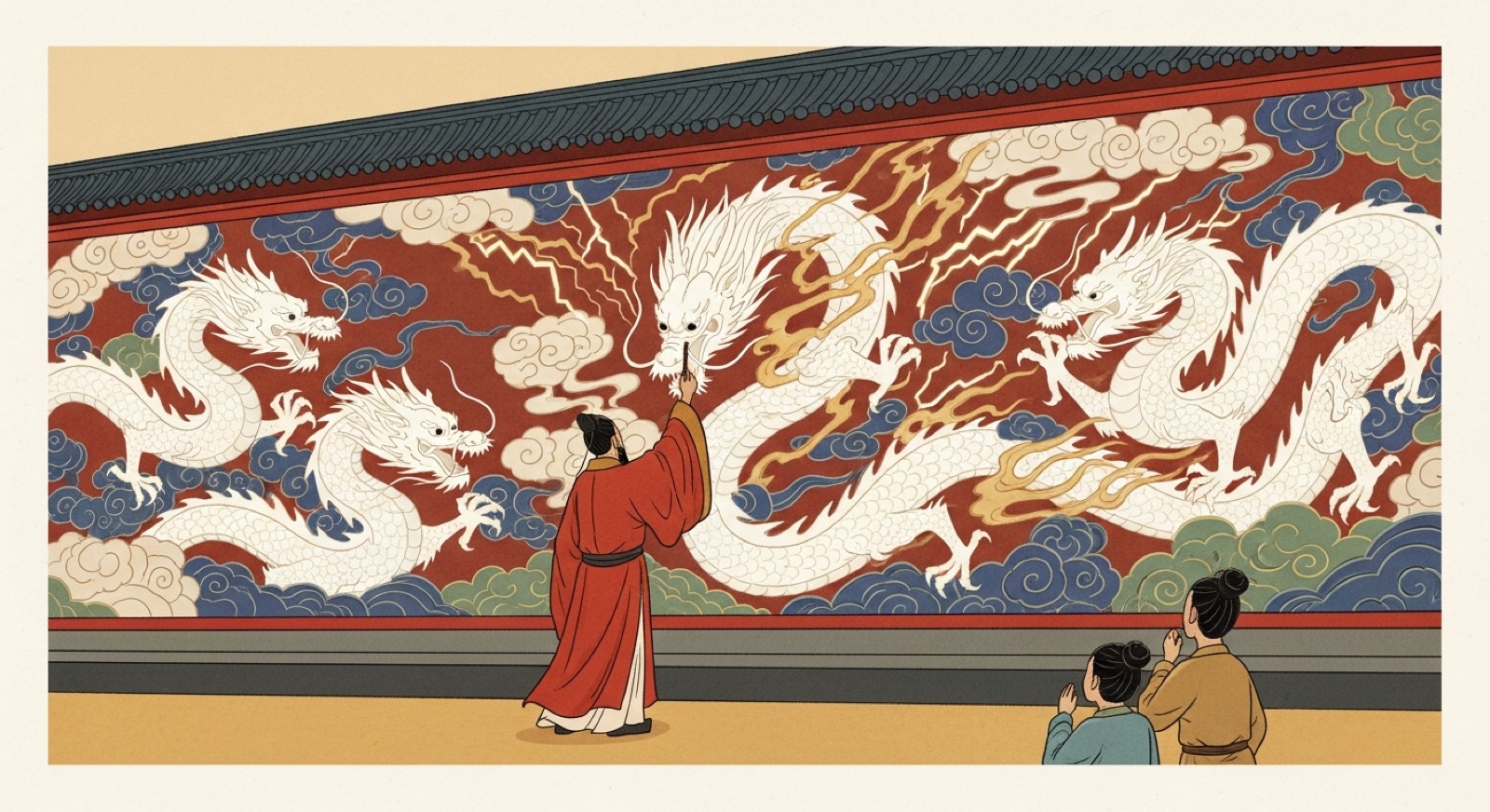
画In the temple of Anle, in the old southern capital of Jinling, the painter Zhang Sengyou was the wonder of his age. Set to decorate a great temple wall, he painted four white dragons so lifelike they seemed to breathe — coiling through cloud, scales catching the light. Yet each dragon’s eyes he left blank.
Visitors were puzzled, then annoyed. Why leave such a masterpiece unfinished? Zhang only shook his head: “If I dot their eyes, they will fly away.” The crowd laughed — a painter’s vanity, surely — and pressed him until, at last, he lifted his brush and touched it to the eyes of two of the dragons.
The sky answered. Thunder cracked, lightning tore the wall open, and the two dragons — eyes now bright and alive — rose on the storm clouds and vanished into the heavens. When the dust settled, only the two eyeless dragons remained on the broken wall, exactly where he had left them. The eyes, it turned out, were never a finishing detail. They were the life itself.
How to use 画龙点睛 (huà lóng diǎn jīng)
Reach for 画龙点睛 to praise a small but decisive finishing touch — a key line, a final stroke, a perfect detail — that lifts a whole piece of work. It’s warm and admiring, common in writing and speech alike, and often appears as 画龙点睛之笔 (“the finishing-touch stroke”) or 起到画龙点睛的作用 (“to serve as the finishing touch”).
这句话是整篇文章的画龙点睛之笔。
Zhè jù huà shì zhěng piān wénzhāng de huà lóng diǎn jīng zhī bǐ.
“This one line is the finishing touch that brings the whole essay to life.”
老师的一句点评,起到了画龙点睛的作用。
Lǎoshī de yī jù diǎnpíng, qǐdàole huà lóng diǎn jīng de zuòyòng.
“The teacher’s single comment served as the perfect finishing touch.”
那抹红色为整个设计画龙点睛。
Nà mǒ hóngsè wèi zhěnggè shèjì huà lóng diǎn jīng.
“That touch of red brought the whole design to life.”
Common mistakes
- 画龙点睛 is always praise — it names the one perfect touch that completes something, not just any addition.
- It’s the opposite of 画蛇添足 (“adding legs to a snake”): 点睛 is the essential touch that brings life; 添足 is the needless touch that spoils.
- Write the eye carefully — 睛 (eye), not 晴 (sunny) or 精 (essence). They sound alike but only 睛 is correct.
- It usually describes a small, decisive part of a larger whole — a line, a stroke, a detail — not one big effort.
Closest equivalents
“The icing on the cake” is close but softer — icing is a pleasant extra. 画龙点睛 is stronger: it’s the touch that makes the whole thing come alive, the difference between a painting and a living dragon.
Quick quiz
1. What does 画龙点睛 describe?
2. In the story, what happened when the painter dotted the dragons’ eyes?
FAQs
More Chinese idioms
Each one carries a story worth knowing — and a lesson that still lands today.
Learn idioms the way natives use them
Go beyond memorising — practise real Mandarin, idioms and all, in 1-on-1 online lessons with a native speaker.
Book a Free Intro Call