Gentle, quick-witted and elegant: the fourth animal of the Chinese zodiac, and the sign of the year that begins on 8 February 2035.
- Recent Rabbit years
- 2011 · 2023 · 2035
- Next Rabbit year begins
- 8 February 2035
- Fixed element
- Wood (yin)
- Best matches
- Goat · Pig · Dog
- Clashes with
- Rooster
- The Rabbit’s hours
- 5 am – 7 am (卯时 mǎoshí)
Are you a Rabbit?
The zodiac year doesn’t start on 1 January. It starts at Chinese New Year, which falls anywhere from 21 January to 20 February. So if you were born in January or February, your birth year alone can’t tell you your animal. Enter your full date of birth for the exact answer.
Every Year of the Rabbit, with exact dates
| Year | Chinese name | Element | Begins | Ends |
|---|---|---|---|---|
| 1927 | 丁卯 dīngmǎo | Fire Rabbit | 2 Feb 1927 | 22 Jan 1928 |
| 1939 | 己卯 jǐmǎo | Earth Rabbit | 19 Feb 1939 | 7 Feb 1940 |
| 1951 | 辛卯 xīnmǎo | Metal Rabbit | 6 Feb 1951 | 26 Jan 1952 |
| 1963 | 癸卯 guǐmǎo | Water Rabbit | 25 Jan 1963 | 12 Feb 1964 |
| 1975 | 乙卯 yǐmǎo | Wood Rabbit | 11 Feb 1975 | 30 Jan 1976 |
| 1987 | 丁卯 dīngmǎo | Fire Rabbit | 29 Jan 1987 | 16 Feb 1988 |
| 1999 | 己卯 jǐmǎo | Earth Rabbit | 16 Feb 1999 | 4 Feb 2000 |
| 2011 | 辛卯 xīnmǎo | Metal Rabbit | 3 Feb 2011 | 22 Jan 2012 |
| 2023 | 癸卯 guǐmǎo | Water Rabbit | 22 Jan 2023 | 9 Feb 2024 |
| 2035 | 乙卯 yǐmǎo | Wood Rabbit | 8 Feb 2035 | 27 Jan 2036 |
| 2047 | 丁卯 dīngmǎo | Fire Rabbit | 26 Jan 2047 | 13 Feb 2048 |
Dates follow the lunar calendar’s New Year, the convention used for the zodiac in everyday Chinese life. Some fortune-tellers instead start the year at 立春 (lìchūn, Start of Spring, around 4 February), so a few early-February birthdays get read differently. In 2035 the two fall four days apart: 立春 on 4 February, New Year on the 8th.
How to write 兔, and the tail that became a dot
兔 (tù) is a picture of a rabbit, and the oldest forms make that plain: long ears at the top, a crouching body and a short tail. The Shuowen Jiezi, China’s first character dictionary, says it “pictures a crouching animal, with its tail behind”. That tail survives today as the little dot at the lower right, traditionally explained as the last trace of the drawing. Leave the dot off and you’ve written 免 (miǎn, “to avoid”), a different character with a different history.
8 strokes · the head first, then the two legs, with the tail dot last
3,000 years of 兔, in four steps
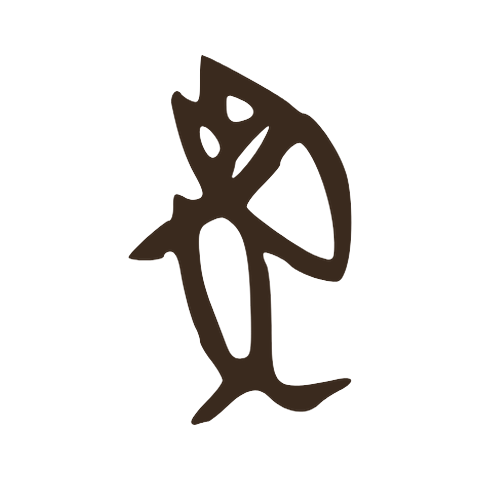 Oracle boneShang dynasty, c. 1250 BCE
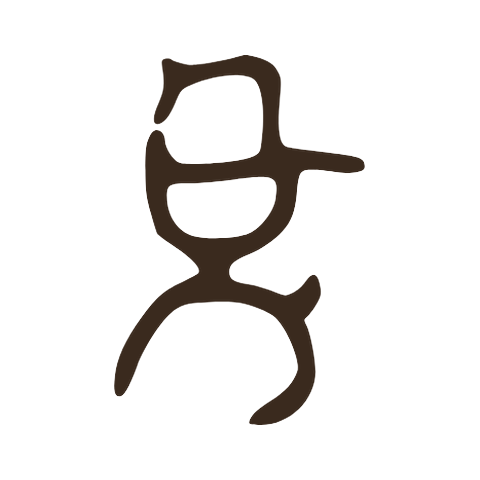 BronzeZhou dynasty, c. 1000 BCE
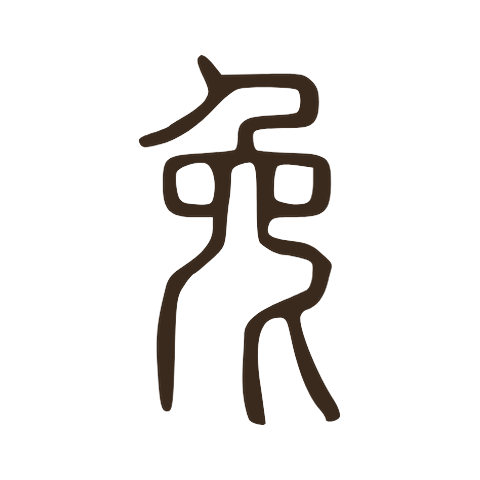 Small sealQin dynasty, 221 BCE
- 兔TodaySame in simplified and traditional
Ancient forms: public-domain drawings from the Ancient Chinese Characters project on Wikimedia Commons.
Six characters that grew from 兔
Most characters that contain 兔 borrow it for its sound. Two of the oldest, though, build their meaning from the rabbit’s nature: a rabbit that gets away, and a rabbit that can’t. Tap the speaker to hear each one.
Want the system behind cards like these? Read how Chinese characters actually work and the stroke order rules, then practise 兔 on the free writing practice board.
Rabbit or hare?
Both, as far as Chinese is concerned. 兔 on its own covers rabbits and hares alike, and in everyday speech it usually takes the noun suffix 子 to become 兔子 (tùzi), just as 桌 becomes 桌子, “table”. The single syllable 兔 lives on in the zodiac, in idioms and in compound words. When speakers need to be precise, they add a word in front.
兔子
tùzi
Rabbit or hare, the everyday word.
野兔
yětù
Hare. Literally “wild 兔“, the long-legged animal of open fields.
小白兔
xiǎo báitù
Little white rabbit, the star of children’s songs.
玉兔
yùtù
The Jade Rabbit, who lives on the moon.
The distinction matters more in English than in Chinese. China’s wild 兔 are hares, while the pet rabbit descends from the European wild rabbit. That’s why older and British sources sometimes say “Year of the Hare”. We use “Rabbit”, the most common choice in English today.
The Rabbit personality
Zodiac personalities are folk tradition, not science, and Chinese people treat them much the way others treat star signs: half seriously, often with a smile. Still, the character traditionally given to people born in the Year of the Rabbit is remarkably consistent across almanacs. It’s the diplomat of the twelve: gentle, careful and quietly clever.
Gentle
wēnróu. Soft-spoken and kind. Rabbits are said to put people at ease and to hate a scene.
Quick-witted
jīling. Alert and nimble. The Art of War advises finishing a campaign “like an escaping hare”, the source of the idiom 动如脱兔, and Rabbits are said to think that fast.
Elegant
yōuyǎ. Refined taste, good manners and a feel for beautiful things, from clothes to a well-kept home.
Patient
yǒu nàixīn. Willing to wait for the right moment, and a careful listener in the meantime.
And the other side
Timid
dǎnxiǎo. Literally “small gall bladder”, the organ Chinese links to courage. Rabbits are said to shy away from risk.
Conflict-avoidant
ài táobì. Faced with a quarrel, a Rabbit would rather slip away than fight it out.
Reserved
nèixiàng. Slow to share what it really thinks, even with friends.
Conservative
bǎoshǒu. Fond of the familiar, and wary of big changes.
Lucky things, by tradition
Almanacs don’t fully agree on the Rabbit’s lucky charms, and we’d rather show you that than pretend otherwise. One surprise: 4, which most Chinese people avoid because 四 (sì) sounds like 死 (sǐ, death), appears as a Rabbit lucky number in every list we checked.
| Lucky | What the sources say | Agreement |
|---|---|---|
| Numbers | 3 and 4, and numbers made of them, such as 34 or 43; some lists add 6 or 9 | Agreed |
| Colours | Red, pink and purple everywhere, plus blue or grey depending on the almanac | Mostly |
| Flowers | Plantain lily (hosta) in most lists, with jasmine, nerve plant or snapdragon depending on the source | Mostly |
| Numbers to avoid | 1, 7 and 8 | Agreed |
Which Rabbit are you? The five elements
Every animal returns once every 12 years, but it pairs with each of the five elements only once every 60. So a 1975 Rabbit and a 2035 Rabbit share both animal and element: both are Wood Rabbits.
乙卯 yǐmǎo · 1975 · 2035
Wood is the Rabbit’s own fixed element, so the Wood Rabbit is said to be the most Rabbit-like of all: clever, quick-witted and good at planning, and deeply attached to the people it loves. 2035 is a Wood Rabbit year, Wood doubled.
丁卯 dīngmǎo · 1927 · 1987 · 2047
The Fire Rabbit is said to be the boldest and most open-minded Rabbit: clever, hard-working and a natural leader. Its traditional caution is impatience when confidence runs ahead of it.
己卯 jǐmǎo · 1939 · 1999
The Earth Rabbit is said to be frank, ambitious and practical, more direct than its gentle cousins. It sets high standards for itself, though it can seem reserved.
辛卯 xīnmǎo · 1951 · 2011
The Metal Rabbit is said to be warm, sincere and kind, a sociable soul who works quietly and dislikes fierce competition. Its traditional weakness is a conservative streak.
癸卯 guǐmǎo · 1963 · 2023
The Water Rabbit is the most adaptable Rabbit: gentle, friendly and quick to settle anywhere. Tradition warns that it leans heavily on the few people it trusts.
Rabbit compatibility
Zodiac compatibility isn’t a list of opinions. It’s geometry. Place the twelve animals around a circle, and the classic matches form fixed shapes: triangles of allies, pairs of secret friends, and opposites that clash. Here is the Rabbit’s position.
- Best: Goat 羊 and Pig 猪The Three Harmonies (三合 sānhé), the green triangle. These three share a gentle, home-loving outlook and are traditionally the happiest pairing for friendship, business or marriage.
- Secret friend: Dog 狗The Six Harmonies (六合 liùhé), the gold line. The loyal Dog gives the cautious Rabbit the security it craves.
- Clash: Rooster 鸡The Six Conflicts (六冲 liùchōng), straight across the circle. The blunt, showy Rooster and the tactful, quiet Rabbit sit opposite each other on the wheel, west facing east.
- Friction: Dragon 龙The Six Harms (六害 liùhài), the dashed line. The forceful Dragon can overwhelm the gentle Rabbit, a milder mismatch that needs patience on both sides.
See the other pairings from each side: the Goat, the Pig, the Dog and the Rooster.
The Rabbit in Chinese culture
玉兔 The Jade Rabbit on the moon
yùtù. Chinese tradition sees a rabbit on the 月亮 (yuèliang, moon). The poet Qu Yuan’s Heavenly Questions already asks about the 顾菟 (gùtù) in the moon’s belly, though scholars debate whether he meant a hare or a toad. By the Han dynasty, tomb carvings show the moon hare pounding the elixir of immortality, and today it keeps the goddess Chang’e company on mooncake boxes every Mid-Autumn Festival.
兔儿爷 Beijing’s Lord Rabbit
tùryé. A clay figure with a rabbit’s head and a human body, dressed in armour or official robes. It is first recorded in late Ming Beijing, when families moulded clay rabbits for the Mid-Autumn moon offerings, and by the Qing it had become a favourite children’s toy. In 2014 it was added to China’s national list of intangible cultural heritage. See more of the city in our Beijing guide.
守株待兔 Waiting by the stump
shǒu zhū dài tù. In the Han Feizi, a farmer from the state of Song sees a hare run into a tree stump and break its neck. He drops his plough and waits by the stump for another, which never comes. It mocks waiting for luck instead of working, and it’s one of the best-known Chinese idioms. Read the full story of 守株待兔.
狡兔三窟 The wily hare’s three burrows
jiǎo tù sān kū. “A cunning hare has three burrows.” In the Strategies of the Warring States, the adviser Feng Xuan tells his lord that one refuge is never enough, then quietly prepares three for him. Today it means always keeping a plan B, a compliment or a jibe depending on the tone.
Famous people born in the Year of the Rabbit
Rabbits are traditionally the diplomats and artists of the zodiac, but this list has its share of record-breakers too. It even includes an uncle and nephew: Francis Ford Coppola and Nicolas Cage are both Rabbits.
- Frank SinatraSinger and actor, United StatesBorn 12 Dec 1915 · Wood Rabbit
- Francis Ford CoppolaFilm director, United StatesBorn 7 Apr 1939 · Earth Rabbit
- StingMusician and songwriter, EnglandBorn 2 Oct 1951 · Metal Rabbit
- Sammo Hung 洪金宝Actor, director and action choreographer, Hong KongBorn 7 Jan 1952 · Metal RabbitBorn 20 days before Chinese New Year 1952, so many lists get this one wrong
- Jet Li 李连杰Martial artist and actor, born in BeijingBorn 26 Apr 1963 · Water Rabbit
- Nicolas CageActor, United StatesBorn 7 Jan 1964 · Water RabbitBorn 37 days before Chinese New Year 1964, so many lists get this one wrong
- David BeckhamFootballer, EnglandBorn 2 May 1975 · Wood Rabbit
- Ding Junhui 丁俊晖Snooker player, JiangsuBorn 1 Apr 1987 · Fire Rabbit
- Lionel MessiFootballer, ArgentinaBorn 24 Jun 1987 · Fire Rabbit
We checked each person’s full date of birth against the exact Chinese New Year date for that year, so January and early-February birthdays are placed correctly.
The Year of the Wood Rabbit, 2035
The Wood Rabbit year, 乙卯年 (yǐmǎo nián), runs from 8 February 2035 to 27 January 2036. Wood is the Rabbit’s own element, so tradition reads 2035 as a doubly gentle year: good for study, careful planning, friendship and making a home. For the festival itself, the fifteen days and the greetings, see our guide to the Spring Festival.
běnmìngnián, “your own zodiac year”. If you were born in a Rabbit year (2023, 2011, 1999, 1987, 1975…), 2035 is your 本命年. Tradition says it’s a year to be careful, so many people wear something red all year round, often red socks, a red string bracelet or red underwear, which shops sell in a rush before every New Year.
Talk about your sign in Mandarin
Asking someone’s zodiac animal is one of the most natural small-talk questions in Chinese, and a polite way to guess an age without asking. Here is the whole conversation.
我属兔
wǒ shǔ tù
“I’m a Rabbit,” literally “I belong to the rabbit”.
你属什么?
nǐ shǔ shénme?
“What’s your zodiac sign?”
你也属兔吗?
nǐ yě shǔ tù ma?
“Are you a Rabbit too?”
今年是我的本命年。
jīnnián shì wǒ de běnmìngnián.
“This year is my zodiac year.”
Common misunderstandings
- “I was born on 10 February 1988, so I’m a Dragon.” Not quite: the Dragon year only began on 17 February 1988, so you’re a Fire Rabbit. Nicolas Cage, born 7 January 1964, is another Rabbit often listed as a Dragon. Check any date with the tool above.
- “The Year of the Cat is a different year.” In Vietnam the Cat takes the Rabbit’s place, but it’s the same year and the same branch, 卯 (mǎo). One popular explanation is that the Vietnamese reading of 卯 sounds like mèo, “cat”, though nobody knows for certain.
- “Rabbit and hare are two different signs.” There’s only one, 兔. Rabbit and hare are both translations of the same character.
- Forgetting the dot. 兔 without its tail dot is 免 (miǎn), as in 免费 miǎnfèi, “free of charge”. One stroke turns a rabbit into a bargain.
Quick quiz
1. What does the dot at the lower right of 兔 traditionally stand for?
2. Which sign is the Rabbit’s Six Harmonies partner?
3. In the Vietnamese zodiac, which animal takes the Rabbit’s place?
FAQs
The Year of the Rabbit comes round every 12 years: 1927, 1939, 1951, 1963, 1975, 1987, 1999, 2011, 2023 and 2035. Each one starts at Chinese New Year rather than on 1 January. The last ran from 22 January 2023 to 9 February 2024, and the next begins on 8 February 2035.
Yes. 2035 is a Wood Rabbit year (乙卯 yǐmǎo). It begins on 8 February 2035 and runs to 27 January 2036. Anyone born between 1 January and 7 February 2035 is still a Tiger, the sign of the year before.
Yes, in Vietnam. The Vietnamese zodiac puts the Cat in the Rabbit’s place, but the years and the earthly branch 卯 (mǎo) are the same. In China and most other countries that use the zodiac, the sign is the Rabbit, 兔 (tù).
Traditionally the Goat and the Pig, which form the Three Harmonies (三合) with the Rabbit, and the Dog, its Six Harmonies (六合) partner. The Rooster is the Rabbit’s clash sign, sitting directly opposite on the zodiac wheel, and some almanacs also warn against the Rat.
The sources agree on 3 and 4 as the Rabbit’s lucky numbers, with 6 or 9 sometimes added, and on 1, 7 and 8 as numbers to avoid. For colours, red, pink and purple appear in every list, with blue or grey added depending on the almanac. These are folk associations, so treat them as tradition rather than rules.
The Rabbit’s fixed element is Wood, and it’s a yin sign. Each Rabbit year also carries a rotating element (Wood, Fire, Earth, Metal or Water), set by the year’s heavenly stem. 2035 is Wood, 2023 was Water and 2011 was Metal.
In the legend of the Great Race, the Jade Emperor ranked the animals by the order they crossed a great river. The Rabbit hopped across from stone to stone, nearly fell behind, and was saved by a floating log that carried it to the far bank in fourth place. In many tellings the Dragon came fifth because it stopped to blow that log ashore. Read the whole story on our Chinese zodiac guide.
Say 我属兔 (wǒ shǔ tù), literally “I belong to the rabbit”. To ask someone else, say 你属什么? (nǐ shǔ shénme?), “What’s your sign?”. It’s a polite, roundabout way to guess someone’s age, since the answer narrows it to every 12 years.
Say “我属兔” like a native
The zodiac is one of the easiest conversations to start in Mandarin. Learn the words, the tones and the stories behind them in 1-on-1 online lessons with a native speaker.
Book a Free Intro Call