Chinese Stroke Order Rules
Stroke order isn’t fussy tradition — it’s what makes your handwriting faster, neater and easier to remember. Learn the eight rules, watch each character draw itself, then trace it yourself and get instant feedback.
In short
Chinese characters are written in a set order, governed by eight simple rules — broadly top to bottom, left to right, and horizontal before vertical, with a few rules for diagonals, enclosures and centres. Follow them and your characters come out faster, more balanced and more legible. Watch each rule’s character animate below — then trace one yourself in the interactive panel.
Why stroke order matters
It’s tempting to dismiss stroke order as a formality, but it does real work. A consistent order makes characters quicker to write and gives them balanced proportions, so your handwriting looks natural rather than cramped. It makes characters easier to remember, because the hand learns a repeatable motion. And it’s what lets handwriting-recognition input on your phone actually read what you write. Learn the rules once and they apply to almost every character you’ll ever meet.
The order isn’t arbitrary, either. It grew out of centuries of brush calligraphy, where the natural flow of the hand and the way wet ink sits on paper made some sequences far smoother than others. The rules you’ll learn here are simply that accumulated wisdom, distilled into a handful of principles you can apply on sight.
First, the basic strokes
Every character — however complex — is assembled from a small set of basic strokes, each drawn in a fixed direction (shown by the arrow):
Almost everything you write is one of these, or a variation built from them — and the directions already point you towards the rules: horizontals go left-to-right, verticals top-to-bottom. The eight rules below tell you which order to draw them in.
The 8 stroke order rules
Each character below animates its strokes in order — tap it to replay.
Top to bottom
Write the upper strokes before the lower ones.
三 → top line firstLeft to right
Work across the character from the left side to the right.
川 → left stroke firstHorizontal before vertical
When strokes cross, draw the horizontal one before the vertical.
十 → 一 then 丨Left-falling before right-falling
The left-slanting stroke (撇) comes before the right-slanting one (捺).
人 → 丿 then ㇏Outside before inside
Draw the outer enclosing strokes before what sits inside them.
月 → frame firstInside before closing the box
For full enclosures, draw the frame, then the inside, then seal the bottom last.
国 → close lastCentre before sides
When a centre stroke is flanked by symmetrical sides, write the middle first.
小 → centre firstMinor strokes last
Small finishing strokes — like a top-right dot — go on at the very end.
我 → dot lastTry it yourself
Reading the rules is one thing; your hand learns by doing. The tracer below lets you watch any character build stroke by stroke, step through it one stroke at a time, or try it — drawing each stroke yourself and getting instant feedback when you get the order right (or wrong). Start with the eight rule characters, or type any character you like.
Trace the strokes
Pick a character, hit Watch to see the order, then Try it and draw each stroke yourself — you’ll get instant feedback.
Interactive stroke data by Hanzi Writer (Make Me a Hanzi project).
How to practise
Watching and tracing on screen builds recognition; pen on paper builds the habit. Trace each character a few times in a grid while naming the rule to yourself, then write it from memory. Our Chinese Writing Practice tool gives you printable grids and animated strokes for any character, so you can drill the order until it’s automatic.
A few habits speed things up. Write slowly and deliberately at first — accuracy now builds the right reflex, and speed comes on its own later. Say the rule aloud as you draw (“horizontal before vertical”) so the logic sticks, not just the shape. And keep each character in a square mental grid, giving every stroke its share of the space. After a week of a few minutes a day, the common strokes stop being decisions and become muscle memory.
Five common mistakes
✕Closing a box too early
In 国, the bottom line is the last stroke — seal the box only after the inside is done.
✕Vertical before horizontal in 十
The horizontal comes first: 一 then 丨. It feels wrong at first, then natural.
✕Right-falling before left-falling
In 人 the left slant (撇) leads, then the right slant (捺) — not the other way round.
✕Doing the dots first
Finishing dots (as in 我) are added last, not up front.
✕Sides before the centre
In 小 the central stroke comes first, then the two sides.
✕Ignoring order because “no one sees it”
Handwriting recognition does — and so does the balance of every character you write.
Quick quiz
Test your stroke order
1. In 十 (ten), which stroke comes first?
2. When is the bottom line of 国 written?
3. In 小 (small), what comes first?
FAQs
Want your handwriting checked?
Book a free 30-minute intro lesson — Will will watch your stroke order and show you exactly what to tidy up.
Book a free intro →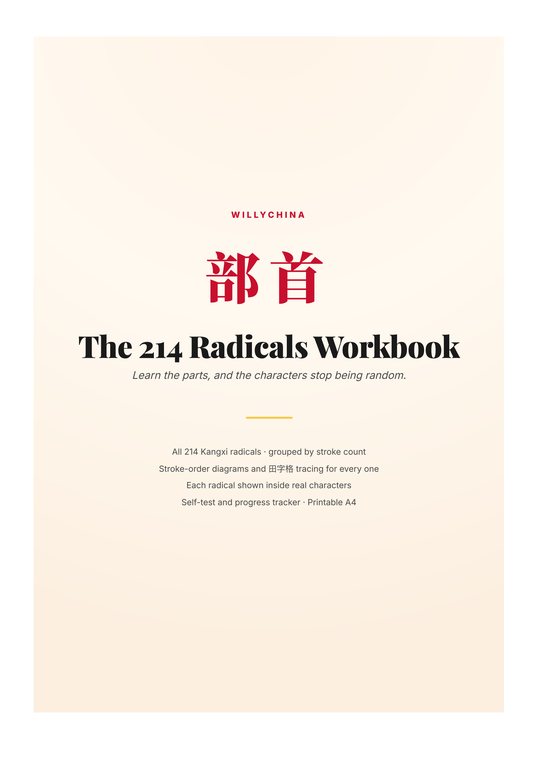
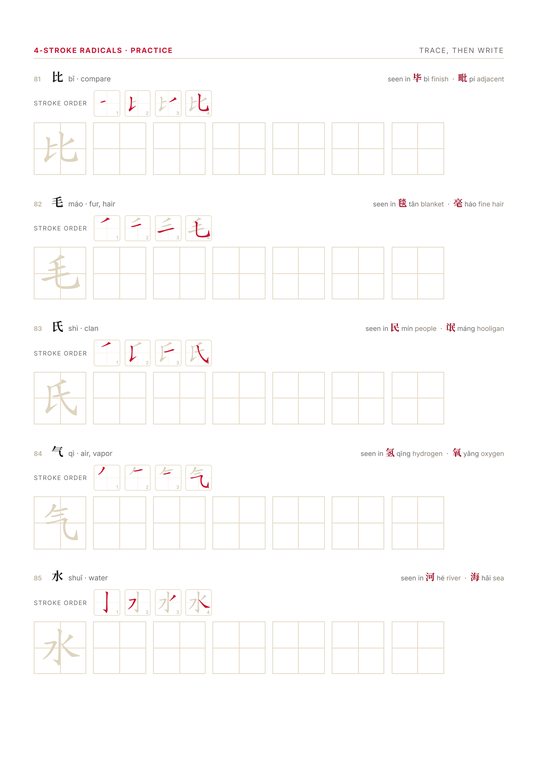
The eight rules are free. This is the practice.
The 214 Radicals Complete Pack
Rules only become habit on paper. The 214 Radicals Complete Pack applies all eight of them to the 214 building blocks: a 69-page workbook with stroke-order diagrams and 田字格 tracing grids, each radical shown inside real characters, plus 830 audio files and three Anki decks.
See what is inside — US$32 →One payment · instant download · yours to keep