尝胆 = tasting bitter gall each day — so the shame of defeat, and the goal ahead, stay sharp
“Have you forgotten the shame of your defeat?”
- Literal
- Sleeping on brushwood, tasting gall
- Meaning
- Enduring hardship to steel yourself for a comeback
- Register
- Literary, very common
- Level
- Upper-intermediate (HSK 6)
- Source
- 史记 · Han dynasty
- English match
- To steel yourself for a comeback
Hardship, harnessed for a comeback
卧薪尝胆 (wò xīn cháng dǎn) literally means “to sleep on brushwood and taste gall.” It describes deliberately enduring hardship — and keeping a past humiliation raw rather than letting it heal — in order to steel your resolve and come back stronger. When someone quietly grinds through years of self-denial towards a hard-won goal, Chinese speakers say they are 卧薪尝胆.
The image is visceral. Instead of resting on a soft bed, you lie on rough firewood; instead of sweet food, you taste bitter gall before every meal — each discomfort a deliberate reminder of what you must not forget and what you are working towards. It isn’t hardship for its own sake; it’s hardship harnessed, turned into fuel for a comeback.
Break it down
Tap any character to hear it. Pinyin is tone-coloured: 1st · 2nd · 3rd · 4th · neutral.
Note: 胆 also means “courage / guts” in everyday Chinese — but here it’s the literal, bitter gall bladder. And don’t confuse 薪 (firewood; also “salary” in modern 薪水) with its homophone 新 (xīn, “new”). For how characters carry meaning through radicals, see our guide to how Chinese characters work.
Straight from the source
The tasting of gall is recorded history. Sima Qian (司马迁) set it down in the Shiji (史记, “Records of the Grand Historian,” c. 1st century BCE). After King Goujian of Yue (越王勾践) was defeated and humiliated by the state of Wu, he refused to let himself forget:
越王勾践反国,乃苦身焦思,置胆于坐,坐卧即仰胆,饮食亦尝胆也。曰:“女忘会稽之耻邪?”
“King Goujian of Yue returned to his state and set himself to bitter toil and anxious thought. He hung a gall bladder above his seat, and looked up to taste it whether sitting or lying down; he tasted the gall at meals too. ‘Have you forgotten,’ he would ask himself, ‘the shame of Kuaiji?’”
— 《史记·越王勾践世家》, by Sima Qian (Han dynasty).The gall is history; the brushwood is legend. Sima Qian records only the tasting of gall (尝胆) — “sleeping on brushwood” (卧薪) appears nowhere in his account. Later writers added it, and the two acts were fused into the four-character idiom we use today: a neat reminder that even famous chengyu can grow in the retelling.
The king who tasted gall for twenty years
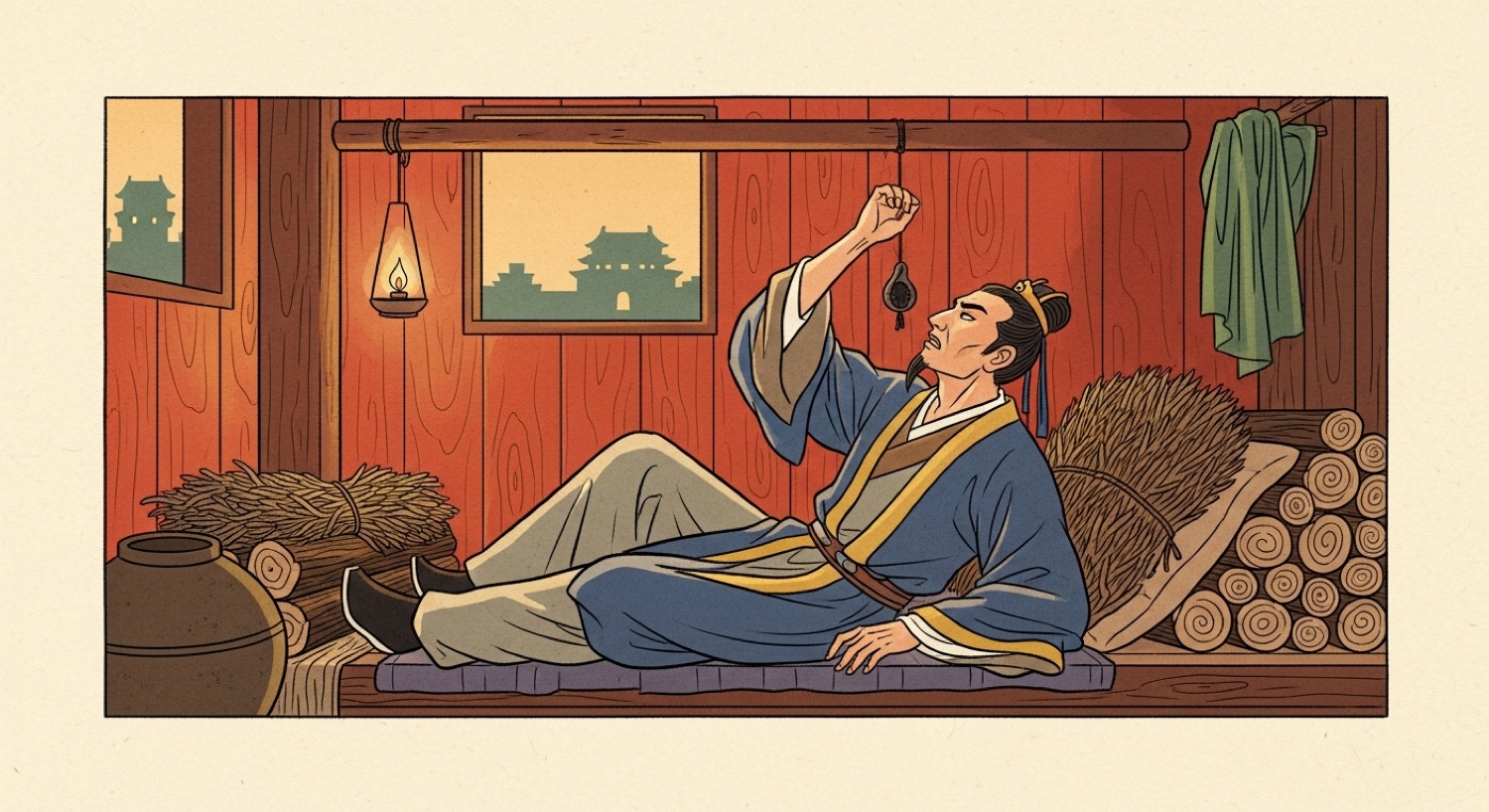
越Goujian, king of Yue, had gambled his kingdom on a war with the neighbouring state of Wu — and lost. Defeated at Kuaiji, he was forced into humiliating servitude before being allowed home at last, to a broken and shrunken kingdom.
Most men would have tried to forget. Goujian did the opposite. He hung a bitter gall bladder above his seat and tasted it before every meal and every sleep, asking himself the same question: “Have you forgotten the shame of Kuaiji?” He gave up the comforts of a king — the soft bed, the rich food — and shared the toil of farming with his people, rebuilding Yue’s strength year by patient year.
It took some twenty years. But the once-defeated king finally led Yue back against Wu and destroyed it, turning the deepest humiliation into one of history’s great comebacks. The gall he tasted every day was the taste of a promise he refused to break.
How to use 卧薪尝胆 (wò xīn cháng dǎn)
Reach for 卧薪尝胆 to praise disciplined, self-denying effort aimed at a comeback — bouncing back from a failure, studying relentlessly towards a goal, or rebuilding after a setback. It’s admiring and a little heroic, common in writing and motivational speech alike.
为了考上理想的大学,他卧薪尝胆,苦读了三年。
Wèile kǎoshàng lǐxiǎng de dàxué, tā wò xīn cháng dǎn, kǔdúle sān nián.
“To get into his dream university, he knuckled down through three hard years of study.”
那家公司破产后卧薪尝胆,几年后终于东山再起。
Nà jiā gōngsī pòchǎn hòu wò xīn cháng dǎn, jǐ nián hòu zhōngyú dōngshān zàiqǐ.
“After going bankrupt, the company endured lean years of hard graft and finally made a comeback.”
输了决赛后,球队决心卧薪尝胆,明年再战。
Shūle juésài hòu, qiúduì juéxīn wò xīn cháng dǎn, míngnián zài zhàn.
“After losing the final, the team resolved to train relentlessly and come back to fight next year.”
Common mistakes
- It means hardship with a purpose — deliberately enduring discomfort to fuel a comeback — not just suffering, poverty or bad luck.
- The gall (尝胆) is real history from the 史记; the brushwood (卧薪) was a later addition. Both now live in the one idiom.
- 胆 here is the literal, bitter gall bladder — not its everyday meaning of “courage.”
- Don’t confuse 薪 (firewood; also “salary”) with its homophone 新 (“new”).
Closest equivalents
There’s no neat English match. “Nurse your wrath to keep it warm” catches the kept-alive grievance — but 卧薪尝胆 is more admiring: disciplined, patient self-denial aimed squarely at a comeback, not just simmering resentment.
Quick quiz
1. What does 卧薪尝胆 describe?
2. Whose story is 卧薪尝胆 traditionally about?
FAQs
More Chinese idioms
Each one carries a story worth knowing — and a lesson that still lands today.
Learn idioms the way natives use them
Go beyond memorising — practise real Mandarin, idioms and all, in 1-on-1 online lessons with a native speaker.
Book a Free Intro Call