Shorthand: 蛇足 · shé zú — “a snake’s feet,” i.e. anything superfluous
“A snake has no feet — how could you give it feet?”
- Literal
- Draw a snake and add feet
- Meaning
- To spoil it by adding what’s needless
- Register
- Everyday, very common
- Level
- Intermediate (HSK 5)
- Source
- 战国策 · Western Han
- English match
- To gild the lily
Knowing when to stop
画蛇添足 (huà shé tiān zú) literally means “to draw a snake and then add feet to it.” It describes spoiling something already complete by tacking on a needless extra — an addition that doesn’t just fail to help, but actively makes things worse. Chinese speakers reach for it to caution against overdoing a good thing.
The sting is in that backfire. It isn’t merely “redundant”: in the original story, the man who added feet to his finished snake lost the very cup of wine he had already won. So 画蛇添足 carries a quiet lesson — knowing when to stop is itself a skill.
Break it down
Tap any character to hear it. Pinyin is tone-coloured: 1st · 2nd · 3rd · 4th · neutral.
Note: 足 (zú) here means “feet,” the body part — the same character you meet in 满足 (mǎnzú, “satisfied”) and 足球 (zúqiú, “football”). For how characters like these are built, see our guide to how Chinese characters work.
Straight from the source
The idiom comes from the Zhanguo Ce (战国策, “Strategies of the Warring States”), a collection of Warring States anecdotes edited by the Han scholar Liu Xiang. In it, the persuader Chen Zhen tells this parable to the Chu general Zhao Yang, to warn him that pressing a victory too far can undo it. Here is the original, with a translation:
楚有祠者,赐其舍人卮酒。舍人相谓曰:「数人饮之不足,一人饮之有余。请画地为蛇,先成者饮酒。」一人蛇先成,引酒且饮之,乃左手持卮,右手画蛇,曰:「吾能为之足。」未成,一人之蛇成,夺其卮曰:「蛇固无足,子安能为之足?」遂饮其酒。为蛇足者,终亡其酒。
“In Chu, a man who had made an offering gave his retainers a single pot of wine. They said to one another, ‘Shared among us it won’t be enough; for one it’s more than enough. Let each draw a snake on the ground — the first to finish drinks it.’ One man’s snake was done first. He took up the wine to drink, and, holding the pot in his left hand, kept drawing with his right: ‘I can even give it feet.’ Before he had finished, another’s snake was done. That man snatched the pot, saying, ‘A snake has no feet — how can you give it feet?’ — and drank the wine. The one who drew feet on his snake lost his wine in the end.”
— 《战国策·齐策二》, compiled by Liu Xiang, Western Han, from Warring States records.The wine and the needless feet
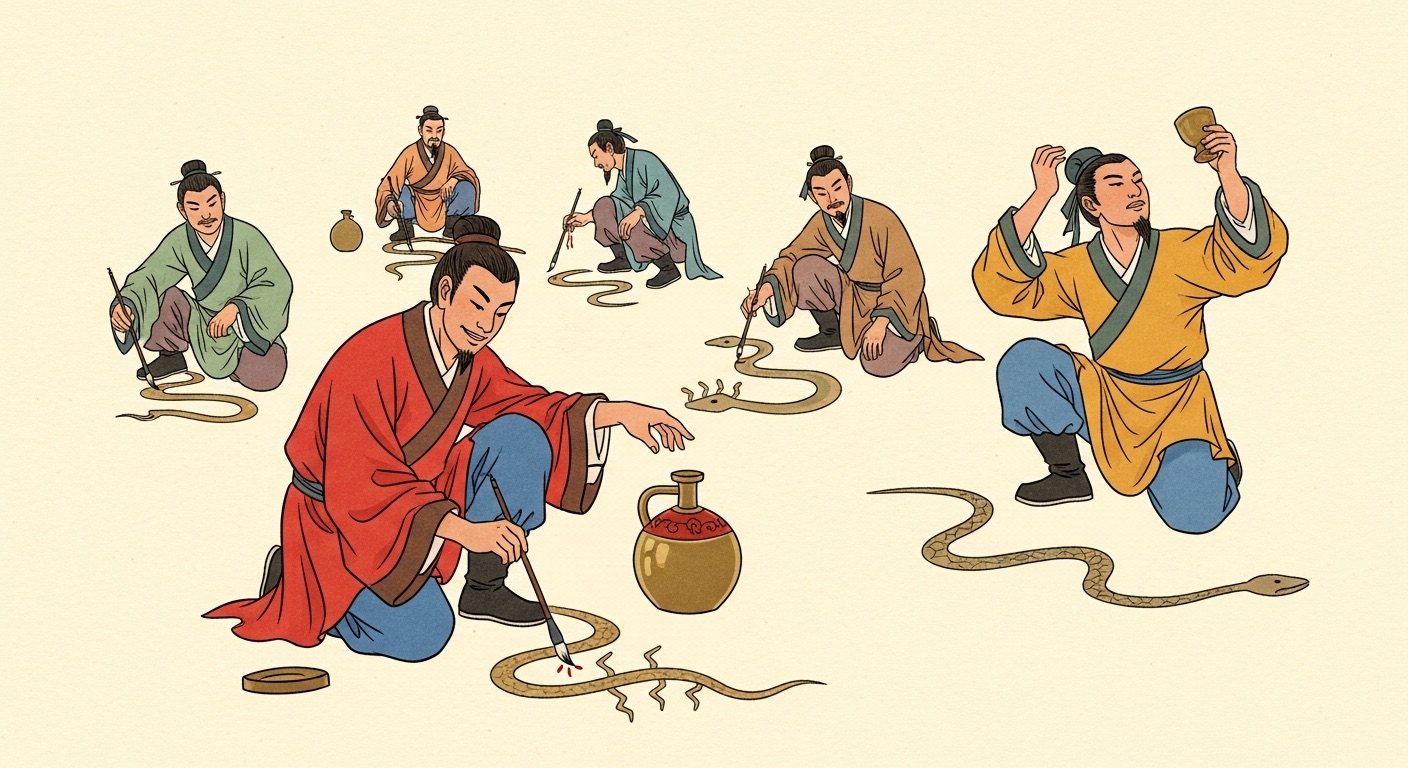
楚In the state of Chu, a man finished a household offering and rewarded his retainers with a single pot of wine. It was too little to share but plenty for one, so they settled on a game: each would draw a snake on the ground, and whoever finished first would drink.
One man raced ahead and finished his snake well before the others. He reached for the wine — but, pleased with himself and seeing the rest still at work, he kept his brush moving. “I can even give it feet,” he boasted, and began adding legs to his snake.
He never finished. Another man completed his own snake, snatched the wine pot, and said, “A snake has no feet — how could you give it feet?” Then he drank the wine down. The man who gave his snake feet lost the cup he had already won — and left us a warning that has lasted more than two thousand years.
How to use 画蛇添足 (huà shé tiān zú)
Reach for 画蛇添足 to warn against a needless addition — an extra sentence, an over-explanation, one decoration too many — that spoils something already complete. It’s everyday, mildly critical, and works in speech and in writing.
你的文章已经很好了,再加这段反而画蛇添足。
Nǐ de wénzhāng yǐjīng hěn hǎo le, zài jiā zhè duàn fǎn’ér huà shé tiān zú.
“Your essay is already great — adding this paragraph just gilds the lily.”
设计已经很完整,别再加装饰了,免得画蛇添足。
Shèjì yǐjīng hěn wánzhěng, bié zài jiā zhuāngshì le, miǎndé huà shé tiān zú.
“The design’s already complete — don’t add more decoration, or you’ll overdo it.”
他解释得太多,画蛇添足,反而让人更糊涂。
Tā jiěshì de tài duō, huà shé tiān zú, fǎn’ér ràng rén gèng hútú.
“He over-explained — a needless flourish that only left everyone more confused.”
Common mistakes
- Don’t use it for a welcome addition that genuinely improves things — that’s 锦上添花 (jǐn shàng tiān huā). 画蛇添足 is specifically an addition that spoils.
- It isn’t about being slow. In the story the loser was actually the fastest — undone by overdoing it, not by lack of speed.
- 足 here is zú, “feet” (the body part) — don’t let the idiom’s image blur with 满足 (mǎnzú, “satisfied”).
Closest equivalents
“Gild the lily” is the closest — adding ornament to something already lovely. But 画蛇添足 sharpens it: the extra effort doesn’t merely waste time, it costs you what you had already won.
Quick quiz
1. When would you naturally say 画蛇添足?
2. In the story, why did the first man lose the wine?
FAQs
More Chinese idioms
Each one carries a story worth knowing — and a lesson that still lands today.
Learn idioms the way natives use them
Go beyond memorising — practise real Mandarin, idioms and all, in 1-on-1 online lessons with a native speaker.
Book a Free Intro Call