Full form: 塞翁失马,焉知非福 · sài wēng shī mǎ, yān zhī fēi fú
“The old man lost his horse — but how could he know it was not a blessing?”
- Literal
- The frontier old man loses his horse
- Meaning
- A blessing in disguise
- Register
- Literary, in common use
- Level
- Advanced (post-HSK 6)
- Source
- 淮南子 · c. 139 BCE
- English match
- Every cloud has a silver lining
A loss today may be a gain tomorrow
塞翁失马 (sài wēng shī mǎ) teaches that fortune and misfortune are woven together — a setback can quietly turn into a blessing, and good luck can carry the seed of trouble. When something goes wrong, a Chinese speaker offers it as gentle reassurance: don’t despair, this may yet turn out for the best.
It carries a distinctly Daoist worldview — the same idea Laozi captured in 祸兮福之所倚 (“misfortune is what fortune leans upon”). Rather than judging a single event as purely good or bad, it invites a longer, calmer view of how life unfolds.
Break it down
Tap any character to hear it. Pinyin is tone-coloured: 1st · 2nd · 3rd · 4th · neutral.
Watch the reading: 塞 has three pronunciations — sāi (to stuff), sè (to block), and here sài, meaning a frontier pass. In this idiom it is always sài. For how characters like these are built, see our guide to how Chinese characters work.
Straight from the source
The idiom comes from a single passage in the Huainanzi, a Daoist-leaning compendium presented to the Western Han court around 139 BCE. Here is the original, with a translation:
近塞上之人有善术者,马无故亡而入胡,人皆吊之。其父曰:「此何遽不为福乎!」居数月,其马将胡骏马而归……居一年,胡人大入塞,丁壮者引弦而战,近塞之人,死者十九,此独以跛之故,父子相保。故福之为祸,祸之为福,化不可极,深不可测也。
“A man skilled in reading fortune lived near the frontier. His horse ran off, for no reason, into the land of the nomads, and his neighbours consoled him. ‘How do you know this is not a blessing?’ he said. Months later the horse returned, leading a fine nomad steed… A year on, the nomads swept across the border. Every able-bodied man drew his bow, and of those near the frontier nine in ten died. This man’s son alone, being lame, was spared — and father and son were kept safe. So fortune becomes disaster, and disaster fortune; the changes have no end, and their depth cannot be fathomed.”
— 《淮南子·人间训》, compiled under Liu An (Prince of Huainan), Western Han, c. 139 BCE.The old man of the frontier
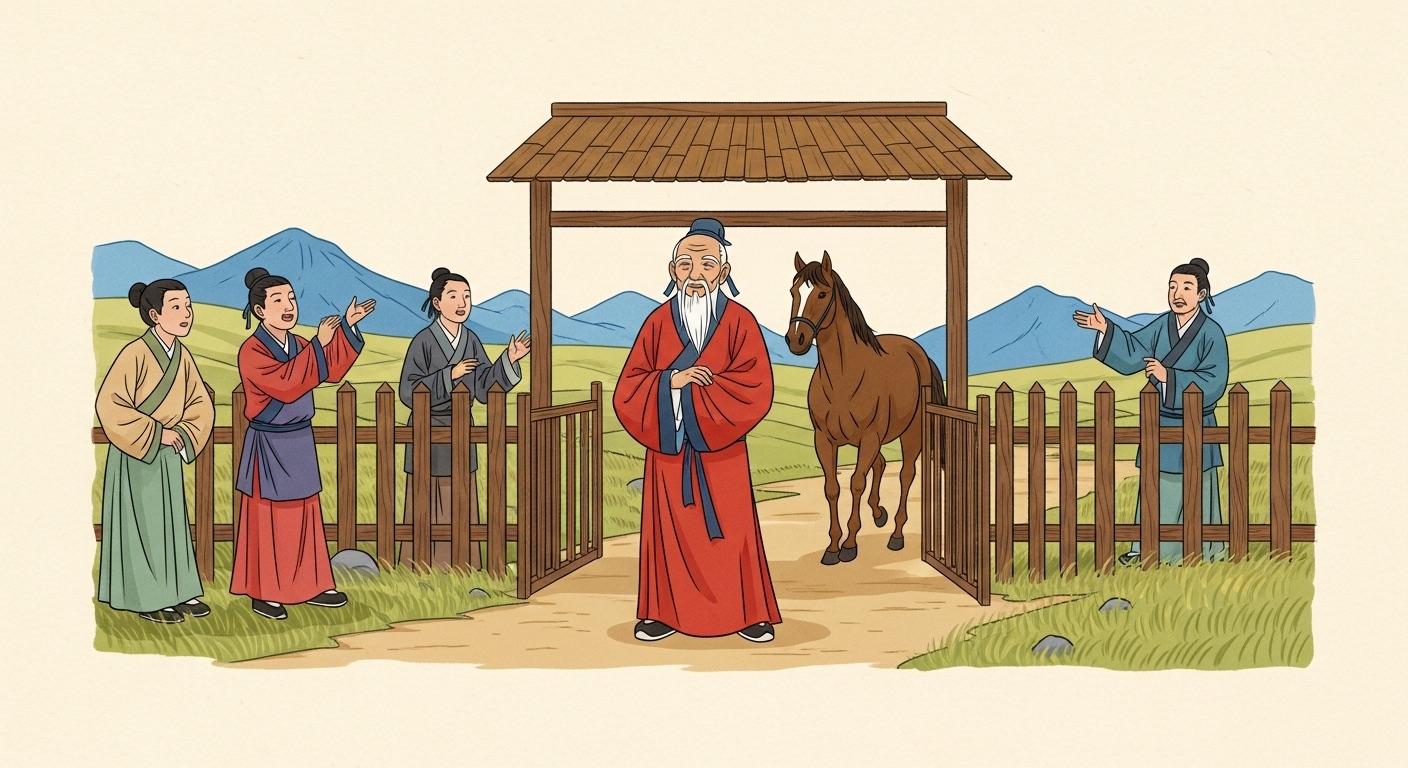
近Near the northern frontier lived an old man skilled in reading fortune. One day, for no reason, his horse wandered off into the lands of the nomads. His neighbours came to console him, but the old man only said, “How do you know this is not a blessing?”
Months later the lost horse returned — and brought with it a fine nomad steed. The neighbours came to congratulate him. “How do you know this is not a disaster?” he replied. His house was now rich in good horses, and his son, who loved to ride, was thrown and broke his hip. Again the neighbours offered sympathy; again the old man asked, “How do you know this is not a blessing?”
A year later the nomads poured across the border. Every able-bodied man took up his bow — and nine in ten died in the fighting. But the son, lamed by his fall, was spared the draft. Father and son survived together. So it is that misfortune breeds fortune, and fortune breeds misfortune, in a chain no one can see to its end.
How to use 塞翁失马 (sài wēng shī mǎ)
Reach for 塞翁失马 to comfort someone after a setback, or to reflect on how a past misfortune led somewhere good. It’s warm, a little philosophical, and common in both speech and writing. The full couplet 塞翁失马,焉知非福 adds emphasis; the four-character form alone is enough in casual use.
别难过,塞翁失马,焉知非福。
Bié nánguò, sài wēng shī mǎ, yān zhī fēi fú.
“Don’t be upset — it might just be a blessing in disguise.”
他丢了工作,却因此创业成功,真是塞翁失马。
Tā diūle gōngzuò, què yīncǐ chuàngyè chénggōng, zhēnshì sài wēng shī mǎ.
“He lost his job, but it led him to build a thriving business — truly a blessing in disguise.”
这次失败也许是塞翁失马,说不定会带来新的机会。
Zhè cì shībài yěxǔ shì sài wēng shī mǎ, shuōbudìng huì dàilái xīn de jīhuì.
“This failure may be a blessing in disguise — it could well open a new door.”
Common mistakes
- Don’t use it to celebrate plain good luck — it’s for reassurance after a setback, or reflection that a setback turned out well.
- Pronounce 塞 as sài, not sāi (“to stuff”) or sè (“to block”).
- It isn’t fatalism or resignation — it’s perspective: the idea that no outcome is final.
Closest equivalents
The English proverbs capture the optimism, but 塞翁失马 goes further — it also warns that good luck can turn, a nuance the story’s broken-hip twist makes vivid.
Quick quiz
1. When would you naturally say 塞翁失马?
2. How is 塞 pronounced in this idiom?
FAQs
More Chinese idioms
Each one carries a story worth knowing — and a lesson that still lands today.
Learn idioms the way natives use them
Go beyond memorising — practise real Mandarin, idioms and all, in 1-on-1 online lessons with a native speaker.
Book a Free Intro Call