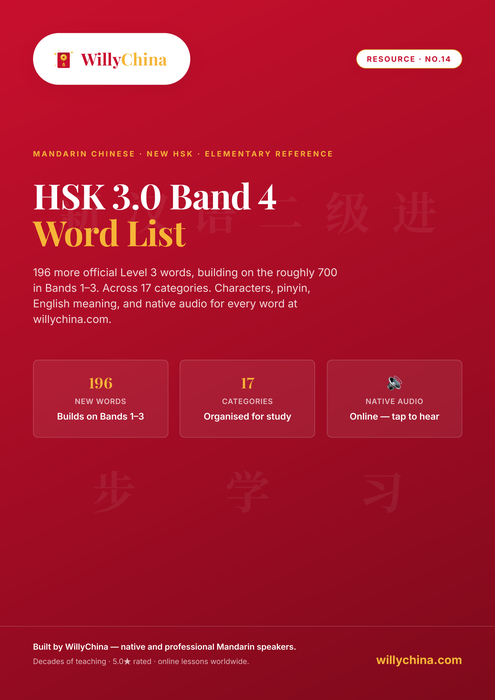
HSK 3.0 Band 4 Word List — PDF + Native Audio
196 official HSK 3.0 Level 3 words, the more common half of what remains after Bands 1–3, organised by category with characters, pinyin, English meaning and native pronunciation for every word. Tap any word below to hear it.
⬇ Download PDF (7 pages)Free — tell us where to send it and it’s yours. Want to practise it rather than just read it? HSK 3.0 Band 4 Complete Pack adds a tracing workbook, native audio for every entry and Anki decks — US$32, one payment.
- All 196 new HSK 3.0 Band 4 words
- Organised across 17 categories for structured study
- Character + pinyin + English meaning for each word
- Search + filter by category on the page
- Native pronunciation audio for every word
The word list above is free. This is the practice.
HSK 3.0 Band 4 Complete Pack
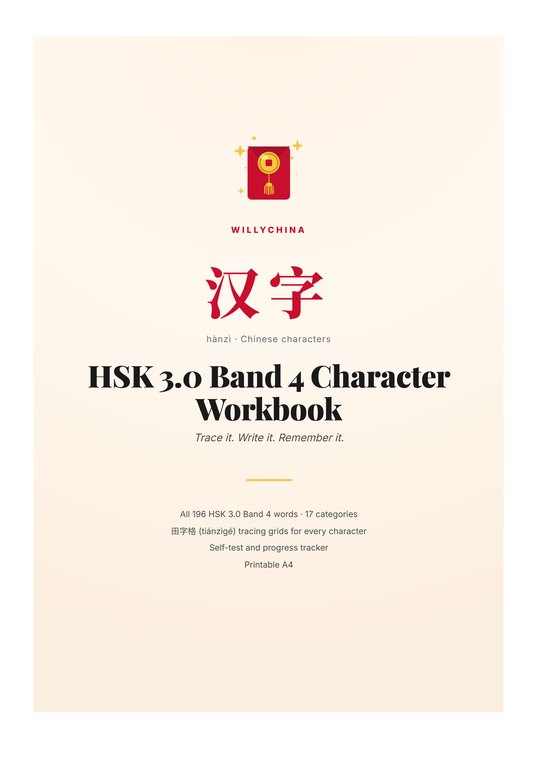
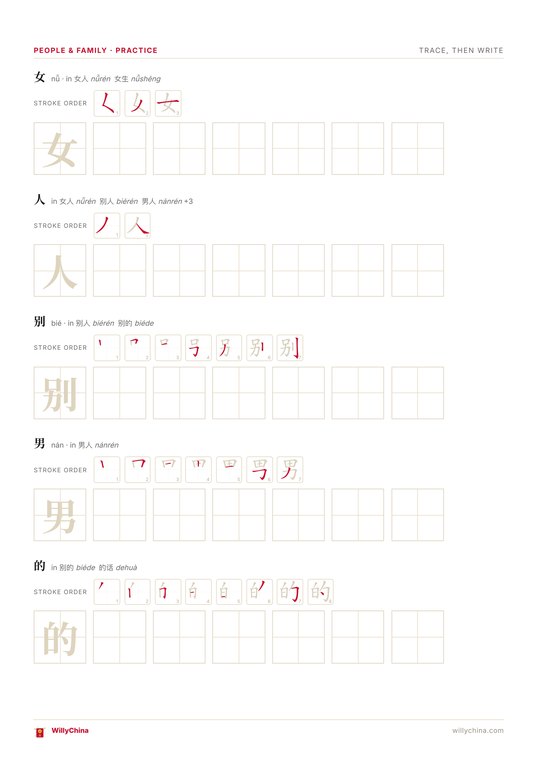
A 81-page character workbook with 田字格 (tiánzìgé) tracing grids for every character in the 196 Band 4 words, 392 audio files at natural and slow speed, and Anki flashcards in both directions.
See what is inside — US$32One payment · instant download · yours to keep
Tap any word to hear it spoken
Search by character, pinyin or English meaning. Filter by category. Tap any card to hear native Mandarin pronunciation.
No words match your search. Try a different term or clear filters.
What is HSK 3.0 Band 4?
Band 4 is where everyday Mandarin fills out. Two grammar words that learners meet in almost every textbook dialogue arrive here: 把 (bǎ), which moves the object in front of the verb, and 被 (bèi), which marks the passive. Around them sit the verbs of ordinary life, such as 需要 (xūyào, to need), 解决 (jiějué, to solve) and 照顾 (zhàogù, to look after), and the adverbs that make you sound natural, such as 其实 (qíshí, actually), 终于 (zhōngyú, at last) and 马上 (mǎshàng, right away).
Every word on this page is on the official Level 3 list in the HSK 3.0 syllabus. We took the Level 3 words that Bands 1–3 had not yet covered, ranked them by how often they appear in real Chinese, and put the more common half here. Band 5 holds the rest, so the two lists together complete Level 3.
You get all 196 words in three forms: an A4 PDF organised by category for printing and offline study, the search-and-filter grid above for quick lookup, and native Mandarin audio for every word (Microsoft Xiaoxiao, slowed slightly for clarity).
How to use this Band 4 word list
Don’t try to learn all 196 words in one sitting. What makes vocabulary stick is spaced repetition, audio and sentence context, not cramming. Here’s a routine that works for this list:
- Print the PDF and keep it where you’ll see it. Five minutes of glancing at a category while the kettle boils adds up over a fortnight.
- Drill with the grid above. Filter by one category, tap each word, and say it aloud before the audio finishes. Ten minutes a day beats an hour once a week.
- Learn 把 (bǎ) and 被 (bèi) with whole sentences. 我把门关了 (wǒ bǎ mén guān le, I closed the door) and 门被风吹开了 (mén bèi fēng chuī kāi le, the door was blown open by the wind) teach the pattern better than any gloss.
- Start with the verbs: Everyday Verbs (28 words) is the biggest category, and verbs carry every sentence you’ll build.
- Learn the compass as a set. 东 (dōng, east), 南 (nán, south), 西 (xī, west) and 北 (běi, north) are all on this list; learn them together, and notice that Chinese says 东南 (dōngnán) for “southeast”, east first.
- Pair opposites: 容易 (róngyì, easy) with 难 (nán, difficult), 干净 (gānjìng, clean) with the 脏 (zāng, dirty) you’ll meet in Band 5. Pairs are easier to remember than single words.
If you’re preparing for the new Level 3 exam, remember it tests more than vocabulary: from Level 3 it adds a compulsory speaking test, and the written paper includes handwriting. Our 1-on-1 HSK Preparation course follows the new format. If you simply want to speak, our Basics course puts these words to work in conversation from the first lesson.
The 17 categories in this Band 4 word list
This list groups the 196 words into 17 categories, from people and places to the grammar words that hold sentences together. Most categories are small enough for a single sitting.
- People & Family (11) — 女人 (nǚrén), 别人 (biérén), 男人 (nánrén) — who’s who, plus 结婚 (jiéhūn, to get married) and 出生 (chūshēng, to be born).
- Time & Dates (6) — 最后 (zuìhòu), 久 (jiǔ), 刚才 (gāngcái) — placing events in time.
- Numbers & Measure Words (12) — 种 (zhǒng), 张 (zhāng), 双 (shuāng) — measure words for kinds, flat things, pairs, floors and money.
- Food & Drink (3) — 鸡 (jī), 饿 (è), 糖 (táng) — hunger, chicken and sweets.
- Places & Getting Around (18) — 中 (zhōng), 地方 (dìfang), 城市 (chéngshì) — the city, the compass and getting around.
- School & Work (6) — 会议 (huìyì), 办公室 (bàngōngshì), 司机 (sījī) — the office and the people in it.
- Body & Health (3) — 病人 (bìngrén), 腿 (tuǐ), 头发 (tóufa) — health basics.
- Hobbies, Sport & Leisure (5) — 比赛 (bǐsài), 游戏 (yóuxì), 表演 (biǎoyǎn) — games, matches and performances.
- Nature, Animals & Weather (10) — 马 (mǎ), 山 (shān), 牛 (niú) — animals, mountains, rivers and weather.
- Things & Objects (9) — 声 (shēng), 电 (diàn), 鞋 (xié) — everyday things, from paper to websites.
- Everyday Verbs (28) — 用 (yòng), 需要 (xūyào), 起 (qǐ) — the biggest group: the actions of ordinary days.
- Thinking & Feeling (16) — 担心 (dānxīn), 了解 (liǎojiě), 决定 (juédìng) — deciding, choosing, worrying and understanding.
- Speaking & Communication (7) — 同意 (tóngyì), 回答 (huídá), 听说 (tīngshuō) — agreeing, answering and chatting.
- Adjectives & Descriptions (21) — 一样 (yīyàng), 重要 (zhòngyào), 老 (lǎo) — describing people, things and situations.
- Adverbs & Degree (19) — 只是 (zhǐshì), 先 (xiān), 总 (zǒng) — how often, how much and how sure.
- Connectives & Grammar Words (13) — 把 (bǎ), 被 (bèi), 可 (kě) — the grammar words, including 把 (bǎ) and 被 (bèi).
- Ideas, Society & Abstract Words (9) — 世界 (shìjiè), 关系 (guānxì), 国家 (guójiā) — the nouns of bigger conversations.

Preparing for the new Level 3 exam?
Bands 4 and 5 give you the rest of the official Level 3 vocabulary, but the exam also tests listening, reading, handwriting and, from Level 3, speaking. Our 1-on-1 HSK Preparation course drills those skills with mock papers and pacing technique.
Book a free HSK consultationA two-week study plan
Here’s a two-week plan for the whole Band 4 list at about 14 words a day, 15–20 minutes a session.
- Week 1: Everyday Verbs (28) + Connectives & Grammar Words (13) + Adverbs & Degree (19) + Thinking & Feeling (16) — 76 words. The working core: verbs, grammar words, adverbs and the verbs of thinking. These turn up in nearly every sentence.
- Week 2: Adjectives & Descriptions (21) + Places & Getting Around (18) + Numbers & Measure Words (12) + People & Family (11) + Nature, Animals & Weather (10) + Things & Objects (9) + Ideas, Society & Abstract Words (9) + Speaking & Communication (7) + Time & Dates (6) + School & Work (6) + Hobbies, Sport & Leisure (5) + Body & Health (3) + Food & Drink (3) — 120 words. Descriptions, places and the concrete nouns. Then filter “All” in the grid and say every word before the audio plays.
After a fortnight you’ll have met every Band 4 word with native audio. Band 5 finishes Level 3 with the remaining official words. The HSK levels guide shows the whole ladder.
FAQs
Sources: word list from the official HSK 3.0 (November 2025) syllabus via Chinese Testing International; English glosses adapted from CC-CEDICT (CC BY-SA 4.0).
Want a teacher for your next 200 words?
Vocabulary lists are a foundation — but you need real practice with feedback. Book a free 30-minute intro lesson.
Book a Free Intro LessonWant a teacher, not just a PDF?
Practise this with a native speaker
The list gets you the words. Saying them out loud to someone who corrects your tones is what makes them stick. Tell us where you’re up to and we’ll suggest a starting point — free, no obligation.
Thanks — that’s in. We’ll be in touch within 24 hours.
Free PDF
Where should I send it?
Tell us a little about you and the PDF is yours — it lands in your inbox straight away.
All fields are required. I’ll send new resources now and then, the odd note on learning Mandarin properly, and occasionally news about my workbooks. Unsubscribe any time. Privacy policy
Sent. Check your inbox — your download is starting now.
Before you go
You’ve got the reference. The HSK 3.0 Band 4 Complete Pack is the practice — a 81-page workbook with stroke order and tracing for every character in the 196 Band 4 words, 392 audio files (natural + slow), and two Anki decks.
See what’s inside — US$32One payment. Yours to keep.