HSK 3.0 Is Here. Here’s What Changed.
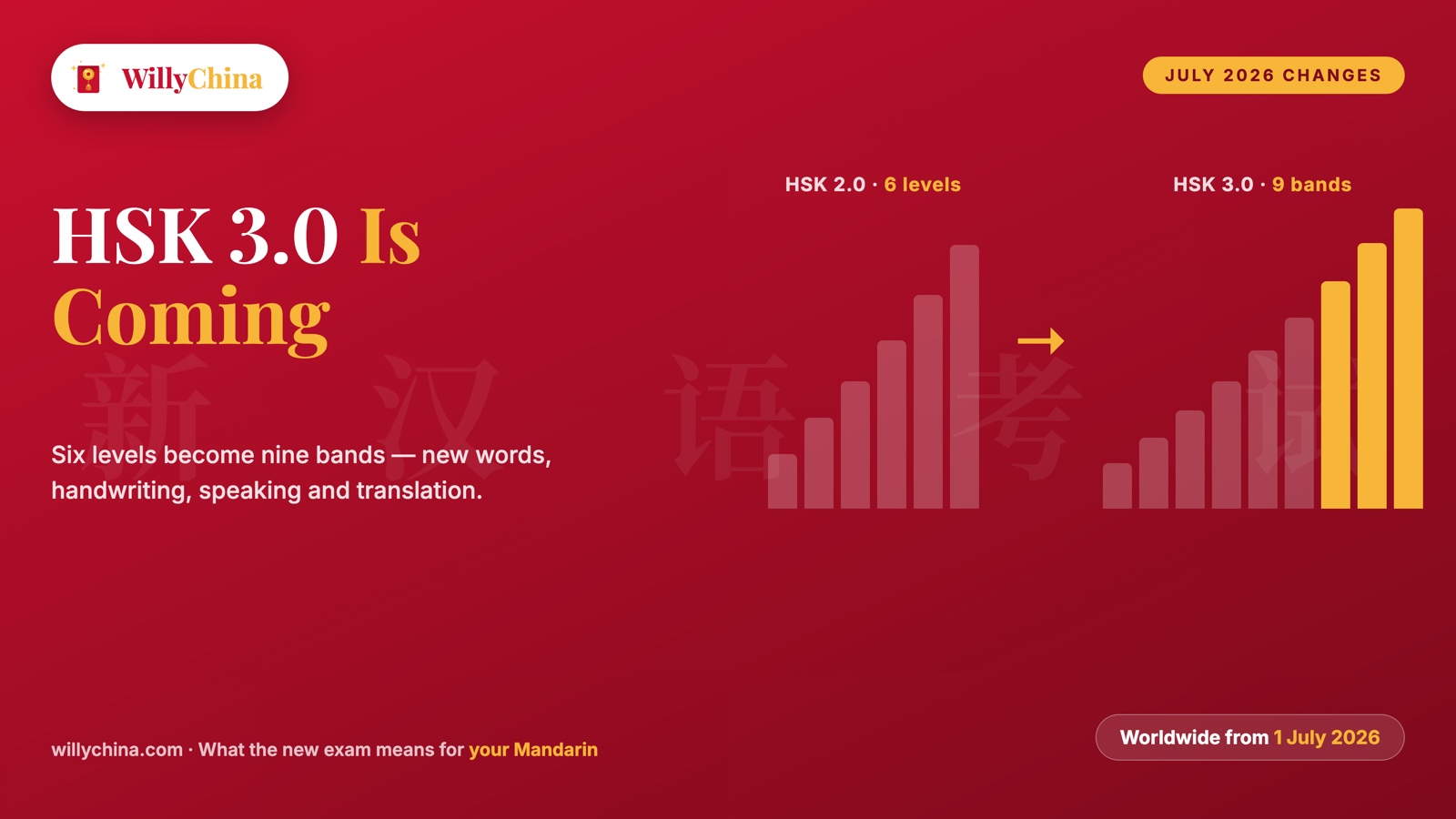
Since 1 July 2026 the HSK has used nine bands instead of six levels — bigger word lists, handwriting from Band 1, speaking from Band 3 and translation from Band 4. Here’s what it means for your Mandarin.
What is HSK 3.0? It’s the new version of China’s official Mandarin proficiency system — nine bands instead of six levels, defined by the 2021 Chinese Proficiency Grading Standards, with exams rolled out worldwide on 1 July 2026.
From six levels to nine bands
The 2021 standard reorganises proficiency into three stages — elementary (Bands 1–3), intermediate (Bands 4–6) and advanced (Bands 7–9) — measured across four dimensions: syllables, characters, vocabulary and grammar. The advanced HSK 7–9 exam has been running since March 2022; in July 2026, Bands 1–6 replaced the familiar six levels. The 2021 standard originally proposed even larger word lists, but the final exam syllabus published by Chinese Testing International in November 2025 settled the counts below — roughly 11,000 words across all nine bands, about double the old HSK 6.
The word counts, side by side
| Level / Band | HSK 2.0 (total words) | HSK 3.0 (total words) | Increase |
|---|---|---|---|
| Level 1 | 150 | 300 | 2.0× |
| Level 2 | 300 | 500 | 1.7× |
| Level 3 | 600 | 1,000 | 1.7× |
| Level 4 | 1,200 | 2,000 | 1.7× |
| Level 5 | 2,500 | 3,600 | 1.4× |
| Level 6 | 5,000 | 5,400 | 1.1× |
| Bands 7–9 | — | ~11,000 | new tier |
Read that table honestly: every band asks more of you than the old level with the same number — double the words at Band 1, converging to a modest increase by Band 6. Nobody got demoted; the rungs just moved further apart at the bottom of the ladder.
Where does my old level land in the new system?
There’s no official conversion certificate — old results stay valid as themselves — but the word counts give a serviceable map for planning your next exam:
| Your HSK 2.0 level | Nearest 3.0 band | The honest caveat |
|---|---|---|
| HSK 1 (150 words) | Below Band 1 | New Band 1 carries 300 words — roughly old HSK 2 territory |
| HSK 2 (300) | Band 1 | A clean fit by vocabulary — but add handwriting practice |
| HSK 3 (600) | Band 2–3 | Band 3 (1,000 words) stretches further than old HSK 3 |
| HSK 4 (1,200) | Band 3–4 | Band 4 adds translation tasks — new skill, not just new words |
| HSK 5 (2,500) | Band 5 | Closest like-for-like match on the ladder |
| HSK 6 (5,000) | Band 6–7 | The 7–9 band group (since 2022) now owns the summit |
Three common situations, played out. Mid-preparation for an old-format exam: if your test date lands before the switch, change nothing — the certificate remains valid. Starting fresh in 2026: prepare straight for the new bands using the Band 1, Band 2 and Band 3 lists — learning the old structure first would be preparing for a discontinued exam. Holding an old certificate for an application: relax; institutions have known about the transition for years, and a recent HSK 4 or 5 reads exactly as it always did.
Three new skills enter the exam
Handwriting from Band 1 — around 100 basic characters from memory at the first band, where old HSK 1–2 needed no characters at all. Speaking from Band 3 — integrated into the main exam rather than the separate HSKK test. Translation from Band 4 — both directions, Chinese–English and English–Chinese, an explicitly assessed skill for the first time.
What it means for you
Your certificates keep their value — HSK 2.0 results remain valid and are not converted to bands. Testing soon? HSK 3.0 is now the standard, so prepare with the new bands in mind; if your test centre still offers the 2.0 format during the transition, sitting the format you’ve trained for is fine. Studying for the long haul? The six-level roadmap and our HSK 1–5 vocabulary lists remain the standard that textbooks and courses follow through the transition — and our HSK 3.0 Band 1 word list — all 300 words of the new first level — is already live. For exam-specific training either way, our 1-on-1 HSK Preparation course adapts to the format you’re sitting.
Official announcements and registration live at chinesetest.cn.
The new skills, in practice
Handwriting from Band 1 is the change that reshapes beginner study most: roughly a hundred characters written by hand at the first level, where old HSK 1–2 never asked for a single stroke. Build five minutes of writing into the daily routine from week one — our character practice tool covers the strokes in exam scope. Speaking from Band 3 folds the old separate HSKK into the main event, which honestly suits most learners: one booking, one exam day, and a reason to start speaking practice before the intermediate plateau makes it awkward. Translation from Band 4 is the quiet professionalising move — sentence-level work between Chinese and English that rewards learners who think in structures rather than word-for-word swaps. None of these are reasons to fear the new exam; they’re reasons the new certificate will mean more.
A booking-strategy footnote: sessions either side of a format change are unusual — final-format sittings fill with candidates racing the deadline, while the first new-format dates attract the curious and the unhurried. If you want the old format, book the autumn 2026 sittings early… they don’t exist; the last 2.0 sittings before July will be the crowded ones. If you’re sitting the new format, an early date means fewer third-party past papers — lean on the official sample materials and live practice instead.
What stays exactly the same
Amid the renumbering it’s easy to miss how much doesn’t move. Registration still runs through chinesetest.cn, at the same network of test centres, with the same admission-ticket-and-passport routine on the day — our test-day guide applies unchanged. Existing certificates keep their validity and their meaning: nobody’s HSK 5 becomes worthless in July. The advanced 7–9 band group has already been running since March 2022, so the top of the ladder is the proven part, not the experiment. And the fundamentals of preparation are untouched — daily vocabulary with audio, reading volume, weekly corrected speaking. The exam is changing shape; the language isn’t.
FAQs
Keep going
The HSK levels, explained
The complete six-level roadmap — words, CEFR, exams.
Read the guide →