Chinese Radicals Chart
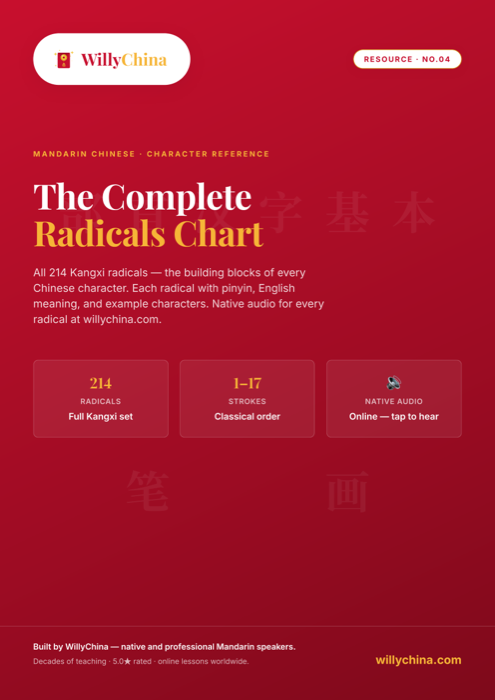
All 214 Kangxi radicals — the building blocks of every Chinese character. Each radical with pinyin, English meaning, two example characters and native audio pronunciation. Tap any radical below to hear it.
⬇ Download PDF (6 pages)- All 214 Kangxi radicals (the classical set)
- Organised by stroke count (1–17 strokes)
- Each radical: pinyin + English meaning + 2 example characters
- Native pronunciation audio for every radical
- Search by character, pinyin, or English meaning
The chart above is free. This is the practice.
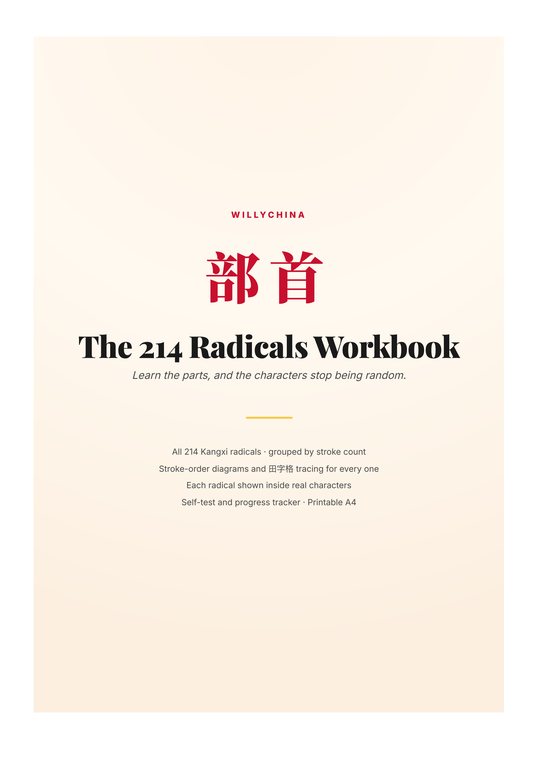
The 214 Radicals Complete Pack
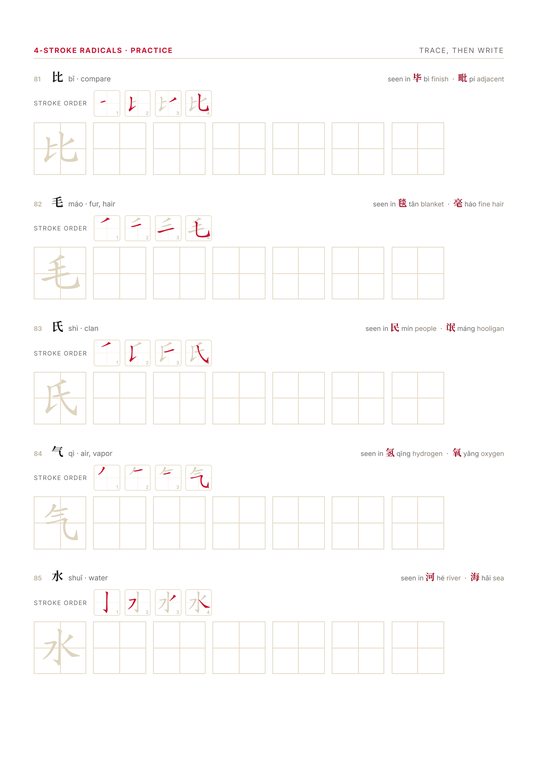
A 69-page workbook with stroke-order diagrams and 田字格 tracing grids for all 214 radicals, each shown inside real characters — plus 830 audio files and three Anki decks, including one that drills spotting a radical inside a character you have not met.
See what is inside — US$32 →One payment · instant download · yours to keep
Tap any radical to hear it spoken
Search by character, pinyin or English meaning. Filter by stroke count. Each card shows pinyin, meaning and two example characters that use the radical.
No radicals match your search.
What are Chinese radicals?
Think of radicals as the alphabet of Chinese characters — except instead of 26 letters, you have 214 building blocks. Most Chinese characters contain at least one radical, and many are simply combinations of multiple radicals. Learn the radicals and you’ve cracked the structural code that lets you decode any character you see — even ones you’ve never met before.
For example, the character 好 (hǎo, “good”) combines 女 (woman) and 子 (child). The character 林 (lín, “forest”) is just 木 (tree) repeated. Once you know the radicals, you stop seeing characters as random squiggles and start seeing the logic inside them. New to how characters are built? See how Chinese characters actually work.
Why radicals matter for Mandarin learners
Most beginner Mandarin courses skip radicals entirely — they go straight to vocabulary. This is a mistake. Here’s why radicals are the unlock:
- Faster character memorisation. Instead of memorising 好 as “三 squiggles in a particular order”, you memorise it as “woman + child = good”. Stories stick; squiggles don’t.
- Pattern recognition. Once you know 氵 (water radical), you spot it in 河 (river), 海 (sea), 湖 (lake), 汁 (juice), 洗 (wash) — and you know each one has something to do with water.
- Dictionary lookup. Traditional Chinese dictionaries index by radical + stroke count. Even modern apps like Pleco let you draw a character by its radical to look it up.
- Decoding new characters. When you encounter an unfamiliar character in the wild, the radical gives you a hint about its meaning. Even if you can’t read it, you can guess the category.
- Reading speed. Recognising radicals at a glance lets your eyes “chunk” characters in the same way they chunk English words. Reading goes from labored to fluent.
Knowing the 214 radicals is the first step. The next step is using them to actually read characters in context — which is exactly what our 1-on-1 Intermediate Mandarin course drills.
How to use this chart
This chart presents all 214 Kangxi radicals in their classical order — sorted by stroke count, from 1 stroke (一, 丨, 丶) up to 17 strokes (龠, the rarely-used “flute” radical). Each radical entry shows:
- The radical character in standard form
- Pinyin pronunciation — how to say the radical’s name
- English meaning — what the radical represents
- Two example characters that use this radical, with their pinyin and meaning
The interactive grid above lets you search by character, pinyin, or English meaning. Filter by stroke count to study groups at a time. Tap any radical card to hear the native pronunciation (slowed slightly so tones are clear).
Reading by stroke count
Radicals are traditionally organised by their stroke count — the number of individual brush strokes used to write them. This is the order they appear in dictionaries and study materials. Here’s what each stroke group covers:
- 1–3 strokes (60 radicals) — The foundational radicals. Many are common standalone characters: 一 (one), 人 (person), 口 (mouth), 大 (big), 女 (woman), 子 (child).
- 4–5 strokes (57 radicals) — Core radicals that appear in the most-common characters: 心 (heart), 手 (hand), 木 (tree), 水 (water), 火 (fire), 目 (eye), 田 (field).
- 6–7 strokes (49 radicals) — Specialised radicals: 米 (rice), 竹 (bamboo), 耳 (ear), 言 (speech), 走 (walk), 足 (foot), 車 (cart), 金 (metal/gold).
- 8+ strokes (48 radicals) — Rarer radicals, often domain-specific: 雨 (rain), 食 (food), 馬 (horse), 魚 (fish), 鳥 (bird), 鼻 (nose).
You don’t need to memorise all 214 at once. Focus on the high-frequency radicals first — the ~50 that appear in the most-common 1000 characters. The grid above shows the most-common categories at the top.

Want a teacher to walk you through real characters?
Radicals are the foundation of character reading — but they only click when you see them inside real words. Our 1-on-1 Intermediate Mandarin course builds character recognition systematically, using radicals as the anchor.
Book a free 30-min intro →How to actually learn radicals
- Don’t memorise the chart cover-to-cover. The full 214 includes obscure radicals like 鬲 (cauldron) and 龠 (flute) — useful for completeness, not daily reading.
- Focus on the high-frequency ~50. These cover 80% of characters you’ll meet: 人 子 女 木 水 火 心 手 口 日 月 言 etc.
- Learn radicals as you meet them in vocabulary. When you learn 好 (hǎo, good), notice the 女 + 子 structure. When you learn 林 (lín, forest), notice 木 × 2. This is how kids in Chinese-speaking countries actually learn.
- Use the example characters. Every radical in this chart has 2 example characters showing it in action. Drill those examples to lock in the radical visually.
- Pair with a writing app. Apps like Skritter, Pleco, or HelloChinese teach you to write characters by their stroke order — radicals naturally fall out of this practice.
- Listen to the audio. Each radical has a pronunciation name. Learning to say them helps when discussing characters with teachers or other learners.
FAQs
Want a teacher to walk you through the characters?
Knowing the radicals is the unlock. But pattern recognition only sticks with practice + feedback. Book a free intro lesson.
Book a Free Intro Lesson →Free PDF
Where should I send it?
Pop your email in and the PDF is yours — it lands in your inbox straight away.
I’ll send new resources now and then, and the odd note on learning Mandarin properly. Unsubscribe from any email.
Sent. Check your inbox — your download is starting now.