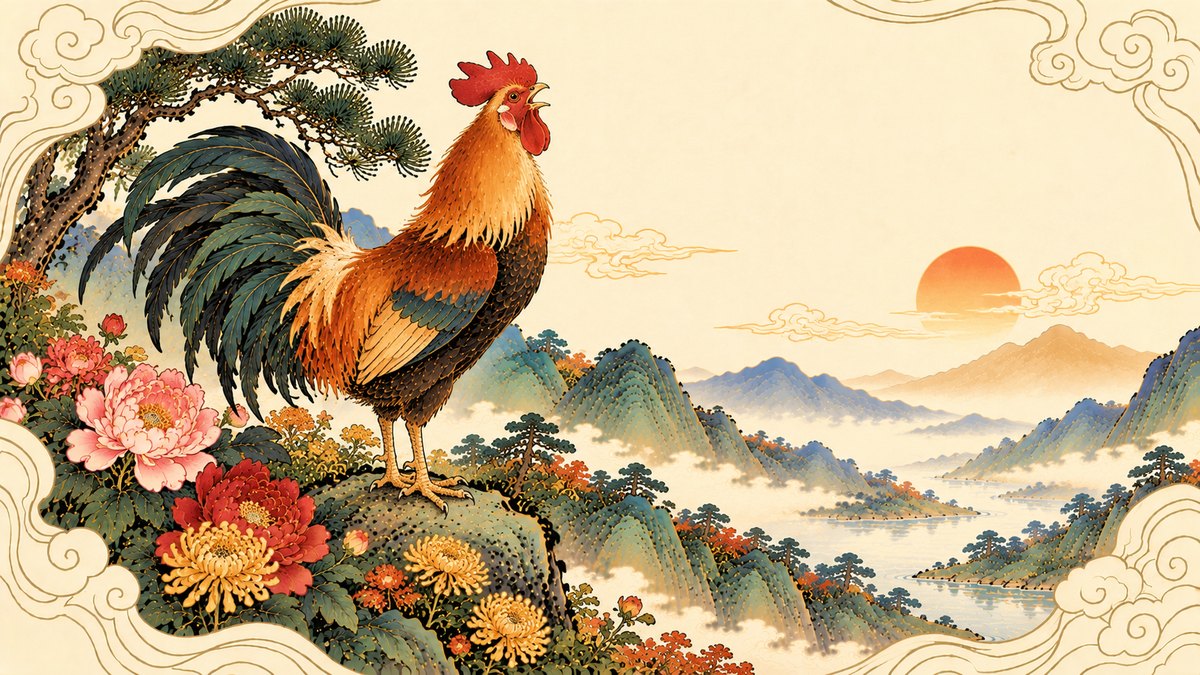
Hardworking, observant and confident: the tenth animal of the Chinese zodiac, and the sign of the year that begins on 13 February 2029.
- Recent Rooster years
- 2005 · 2017 · 2029
- Next Rooster year begins
- 13 February 2029
- Fixed element
- Metal (yin)
- Best matches
- Ox · Snake · Dragon
- Clashes with
- Rabbit
- The Rooster’s hours
- 5 pm – 7 pm (酉时 yǒushí)
Are you a Rooster?
The zodiac year doesn’t start on 1 January. It starts at Chinese New Year, which falls anywhere from 21 January to 20 February. So if you were born in January or February, your birth year alone can’t tell you your animal. Enter your full date of birth for the exact answer.
Every Year of the Rooster, with exact dates
| Year | Chinese name | Element | Begins | Ends |
|---|---|---|---|---|
| 1921 | 辛酉 xīnyǒu | Metal Rooster | 8 Feb 1921 | 27 Jan 1922 |
| 1933 | 癸酉 guǐyǒu | Water Rooster | 26 Jan 1933 | 13 Feb 1934 |
| 1945 | 乙酉 yǐyǒu | Wood Rooster | 13 Feb 1945 | 1 Feb 1946 |
| 1957 | 丁酉 dīngyǒu | Fire Rooster | 31 Jan 1957 | 17 Feb 1958 |
| 1969 | 己酉 jǐyǒu | Earth Rooster | 17 Feb 1969 | 5 Feb 1970 |
| 1981 | 辛酉 xīnyǒu | Metal Rooster | 5 Feb 1981 | 24 Jan 1982 |
| 1993 | 癸酉 guǐyǒu | Water Rooster | 23 Jan 1993 | 9 Feb 1994 |
| 2005 | 乙酉 yǐyǒu | Wood Rooster | 9 Feb 2005 | 28 Jan 2006 |
| 2017 | 丁酉 dīngyǒu | Fire Rooster | 28 Jan 2017 | 15 Feb 2018 |
| 2029 | 己酉 jǐyǒu | Earth Rooster | 13 Feb 2029 | 2 Feb 2030 |
| 2041 | 辛酉 xīnyǒu | Metal Rooster | 1 Feb 2041 | 21 Jan 2042 |
Dates follow the lunar calendar’s New Year, the convention used for the zodiac in everyday Chinese life. Some fortune-tellers instead start the year at 立春 (lìchūn, Start of Spring, around 4 February), so a few early-February birthdays get read differently. In 2029 the two fall ten days apart: 立春 on 3 February, New Year on the 13th.
How to write 鸡, and how a picture became a sound
鸡 (jī) began as a drawing of the bird itself: on Shang oracle bones you can see the crest, the beak and the long sweeping tail. Scribes soon added 奚 (xī) beside it, and the Shuowen Jiezi (c. 100 CE) explains 雞 as “the domestic animal that knows the time”, with the bird for meaning and 奚 for sound. Some scholars think 奚, which pictures a bound captive, also hints at a tethered, tamed bird; that reading is still debated. In the 1950s the 18-stroke 雞 was cut to seven: the shorthand 又 took 奚’s place, and the bird became 鸟.
7 strokes · 又 on the left first, then the five strokes of 鸟
3,000 years of 鸡, from picture to sound
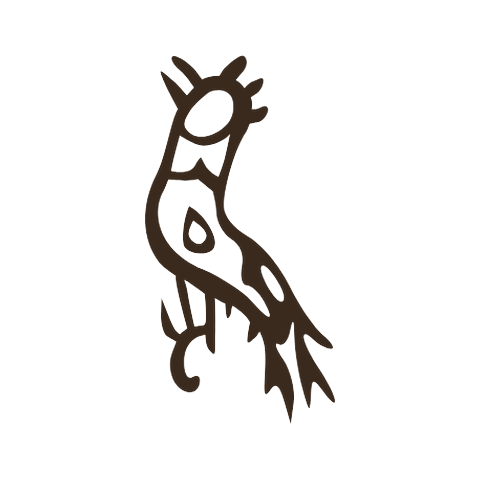 Oracle boneShang dynasty, c. 1250 BCE
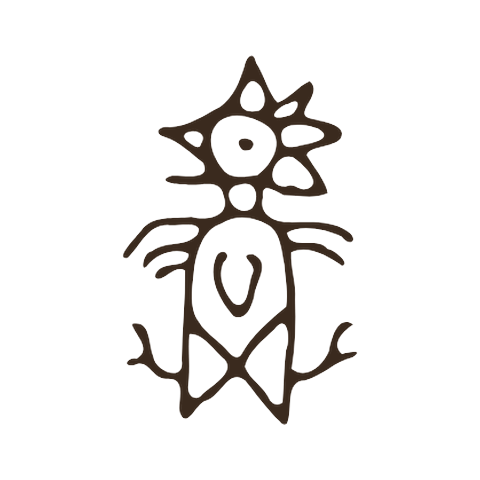 BronzeLate Shang dynasty, c. 1100 BCE
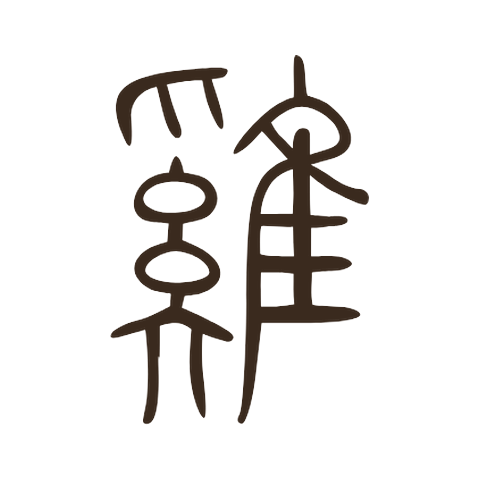 Small sealQin and Han, as in the Shuowen
- 鸡TodayTraditional 雞, simplified 鸡
Ancient forms: public-domain drawings from the Ancient Chinese Characters project on Wikimedia Commons.
Six characters that share the parts of 鸡
Almost no everyday character contains 鸡 whole, so this family is built from its parts: the bird (鸟 niǎo or 隹 zhuī), the old sound element 奚, and the shorthand 又. Tap the speaker to hear each one.
Want the system behind cards like these? Read how Chinese characters actually work and the stroke order rules, then practise 鸡 on the free writing practice board.
Rooster, hen or chicken?
The Chinese sign is simply 鸡, and 鸡 means chicken: male, female, young or on the plate. English chose “Rooster” because the zodiac bird is pictured as a cockerel, and you’ll also see “Cock” or “Chicken” in older books. When Chinese speakers need to be precise, they add a word in front.
公鸡
gōngjī
Rooster. Literally “male 鸡”.
母鸡
mǔjī
Hen. Literally “mother 鸡”.
小鸡
xiǎojī
Chick, a young 鸡.
鸡蛋
jīdàn
Egg. Unless you say otherwise, an egg in Chinese is a chicken’s egg.
So 鸡年 jīnián is, word for word, “the Year of the Chicken”. We use “Rooster”, the most common choice in English today and the bird you’ll see crowing on New Year cards. The everyday word for egg, 鸡蛋 jīdàn, is one of the first food words learners meet.
The Rooster personality
Zodiac personalities are folk tradition, not science, and Chinese people treat them much the way others treat star signs: half seriously, often with a smile. Still, the character traditionally given to people born in the Year of the Rooster is remarkably consistent across the almanacs. It’s the zodiac’s early riser, proud and precise.
Hardworking
qínfèn. Up at dawn and finished before others have started. Roosters are said to trust effort more than luck.
Punctual
shǒushí. The bird that “knows the time” in the oldest dictionary, and the friend who is never late.
Observant
xìxīn. A sharp eye for detail: Roosters notice the typo, the crooked frame and the thing you didn’t say.
Courageous
yǒnggǎn. Like the farmyard cock that faces down a hawk, the Rooster stands its ground when it matters.
And the other side
Proud
ài miànzi. Image matters to Roosters, and losing face in public stings more than losing money.
Picky
tiāoti. High standards can tip into fault-finding, aimed at others and at themselves.
Blunt
xīn zhí kǒu kuài. An idiom for saying exactly what you think, before you’ve thought about how it will land.
A show-off
ài xuànyào. Roosters like to be noticed, and they’re not shy about their achievements.
Lucky things, by tradition
Almanacs don’t fully agree on the Rooster’s lucky charms, and we’d rather show you that than pretend otherwise. Here is what the major sources share, and where they split.
| Lucky | What the sources say | Agreement |
|---|---|---|
| Numbers | 5, 7 and 8, and numbers made of them, such as 58 or 78 | Agreed |
| Colours | Gold, brown and yellow | Agreed |
| Flowers | Gladiolus and cockscomb (鸡冠花 jīguānhuā, “chicken-crest flower”), with impatiens in some lists | Mostly |
| Things to avoid | The numbers 1, 3 and 9 everywhere; red as a colour, with green added in some lists | Mostly |
Which Rooster are you? The five elements
Every animal returns once every 12 years, but it pairs with each of the five elements only once every 60. So a 1969 Rooster and a 2029 Rooster share both animal and element: both are Earth Roosters.
乙酉 yǐyǒu · 1945 · 2005
The Wood Rooster is said to be the kindest Rooster: helpful, principled and keen to improve things for everyone. Its traditional caution is impulsiveness, and a streak of pride.
丁酉 dīngyǒu · 1957 · 2017
The Fire Rooster is the most outgoing Rooster: warm, energetic and adventurous, with a strong sense of responsibility. It’s said to be quick-tempered, so patience is its lesson.
己酉 jǐyǒu · 1969 · 2029
The Earth Rooster is said to be the steadiest: diligent, responsible and generous with friends. Its traditional weakness is caution that slides into conservatism. 2029 is an Earth Rooster year.
辛酉 xīnyǒu · 1921 · 1981 · 2041
Metal is the Rooster’s own fixed element, so the Metal Rooster is the most Rooster of all: resolute, calm and firmly principled. Tradition warns that it can be stubborn and blunt to the point of seeming stern.
癸酉 guǐyǒu · 1933 · 1993
The Water Rooster is the quickest-witted: sharp, sociable and good with words, and said to be more compassionate than most Roosters. Its traditional weakness is restlessness.
Rooster compatibility
Zodiac compatibility isn’t a list of opinions. It’s geometry. Place the twelve animals around a circle, and the classic matches form fixed shapes: triangles of allies, pairs of secret friends, and opposites that clash. Here is the Rooster’s position.
- Best: Ox 牛 and Snake 蛇The Three Harmonies (三合 sānhé), the green triangle. These three share a practical, hard-working outlook and are traditionally the happiest pairing for friendship, business or marriage.
- Secret friend: Dragon 龙The Six Harmonies (六合 liùhé), the gold line. The Dragon’s big ambitions and the Rooster’s eye for detail are said to complete each other.
- Clash: Rabbit 兔The Six Conflicts (六冲 liùchōng), straight across the circle. The precise, outspoken Rooster and the gentle, conflict-shy Rabbit are said to rub each other the wrong way.
- Friction: Dog 狗The Six Harms (六害 liùhài), the dashed line. A milder mismatch, traditionally put down to the loyal Dog finding the Rooster’s bluntness hard to forgive.
See the other pairings from each side: the Ox, the Snake, the Dragon and the Rabbit.
The Rooster in Chinese culture
五德 The five virtues of the chicken
wǔ dé. In the Han-dynasty Han Shi Wai Zhuan, the adviser Tian Rao tells Duke Ai of Lu that the chicken has five virtues: its crested head shows culture, its spurred feet martial spirit, its readiness to fight courage, its habit of calling others to food kindness, and its crowing on time through the night trustworthiness. His complaint was that the duke still ate one every day, simply because chickens were close at hand. The saying 鸡有五德 (jī yǒu wǔ dé), “the chicken has five virtues”, comes from this story.
闻鸡起舞 Rise at the rooster’s crow
wén jī qǐ wǔ. “Hear the rooster, rise and drill.” The Book of Jin tells how Zu Ti and his friend Liu Kun, young men sharing a room, got up at cockcrow in the middle of the night to practise swordplay. The 舞 (wǔ) here is sword drill, not dancing, and the idiom praises anyone who works hard to better themselves. One of the best-loved Chinese idioms.
鸡缸杯 The chicken cup
jīgāngbēi. A tiny Ming porcelain wine cup from the Chenghua reign (1465–1487), painted with a rooster, a hen and their chicks among flowers. Few survive, and they have been prized and copied ever since. In 2014 one sold at auction in Hong Kong for about HK$281 million, a record for Chinese porcelain at the time.
宫保鸡丁 Kung Pao chicken
gōngbǎo jīdīng. Diced chicken with peanuts and dried chillies, a Sichuan classic now cooked around the world. Its origins are uncertain, but it is usually said to be named after Ding Baozhen, a late-Qing official in Sichuan who held the honorary title 宫保 (gōngbǎo, “palace guardian”); the 丁 (dīng, “cube”) may be a pun on his surname. Find more of the province’s food in our Sichuan guide.
Famous people born in the Year of the Rooster
Tradition gives Roosters hard work and a love of the spotlight, and plenty have made their names on stage and on court: musicians, tennis champions and an Olympic diver, across all five elements.
- Quincy JonesRecord producer and composer, United StatesBorn 14 Mar 1933 · Water Rooster
- Eric ClaptonGuitarist and singer-songwriter, EnglandBorn 30 Mar 1945 · Wood Rooster
- Dolly PartonSinger-songwriter, United StatesBorn 19 Jan 1946 · Wood RoosterBorn 14 days before Chinese New Year 1946, so many lists get this one wrong
- Tan Dun 谭盾Composer and conductor, HunanBorn 18 Aug 1957 · Fire Rooster
- Faye Wong 王菲Singer and actor, Beijing and Hong KongBorn 8 Aug 1969 · Earth Rooster
- Roger FedererTennis champion, SwitzerlandBorn 8 Aug 1981 · Metal Rooster
- Serena WilliamsTennis champion, United StatesBorn 26 Sep 1981 · Metal Rooster
- Guo Jingjing 郭晶晶Olympic diving champion, HebeiBorn 15 Oct 1981 · Metal Rooster
- Ariana GrandeSinger and actor, United StatesBorn 26 Jun 1993 · Water Rooster
We checked each full date of birth against the exact Chinese New Year date of that year, so January and early-February birthdays are placed in the right sign.
The Year of the Earth Rooster, 2029
The Earth Rooster year, 己酉年 (jǐyǒu nián), runs from 13 February 2029 to 2 February 2030. Earth is said to steady the Rooster’s sharp, restless energy, so tradition reads 2029 as a year for careful planning, hard work and putting things in order. For the customs, food and greetings that open every zodiac year, see our guide to the Spring Festival.
běnmìngnián, “your own zodiac year”. If you were born in a Rooster year (2017, 2005, 1993, 1981, 1969…), 2029 is your 本命年. Tradition says it’s a year to be careful, so many people wear something red all year round, often red socks, a red string bracelet or red underwear, which shops sell in a rush before every New Year.
Talk about your sign in Mandarin
Asking someone’s zodiac animal is one of the most natural small-talk questions in Chinese, and a polite way to guess an age without asking. Here is the whole conversation.
我属鸡
wǒ shǔ jī
“I’m a Rooster,” literally “I belong to the chicken”.
你属什么?
nǐ shǔ shénme?
“What’s your zodiac sign?”
你也属鸡吗?
nǐ yě shǔ jī ma?
“Are you a Rooster too?”
今年是我的本命年。
jīnnián shì wǒ de běnmìngnián.
“This year is my zodiac year.”
Common misunderstandings
- “I was born in January 1981, so I’m a Rooster.” Not quite: the Rooster year only began on 5 February 1981, so you’re a Metal Monkey. Check any date with the tool above.
- “Red is lucky for everyone, so it’s the Rooster’s colour.” Red is the colour of New Year, but most almanacs list it as an unlucky colour for the Rooster personally, and give gold, brown and yellow as its lucky ones. Like all of this, it’s folk tradition.
- “Rooster and Chicken are two different signs.” There’s only one, 鸡. Rooster, cock and chicken are all translations of the same character.
- “鸡 and 吉 (lucky) are the same word.” They’re close, and New Year art loves the pun, but 鸡 is jī (first tone) and 吉 is jí (second tone). Get the tone right and you’ll be understood.
Quick quiz
1. In the simplified character 鸡, which part replaced the old sound element 奚?
2. Which sign is the Rooster’s Six Harmonies partner?
3. What does the idiom 闻鸡起舞 (wén jī qǐ wǔ) praise?
FAQs
The Year of the Rooster comes round every 12 years: 1933, 1945, 1957, 1969, 1981, 1993, 2005, 2017 and 2029. Each one starts at Chinese New Year rather than on 1 January. The next begins on 13 February 2029 and runs to 2 February 2030.
Yes. 2029 is an Earth Rooster year (己酉 jǐyǒu). It begins on 13 February 2029. Anyone born between 1 January and 12 February 2029 is still a Monkey, the sign of the year before.
Both. The Chinese character 鸡 (jī) means chicken in general. Chinese adds a word to be specific (公鸡 for rooster, 母鸡 for hen), but the zodiac sign is just 鸡. “Rooster” is the more common English choice.
Traditionally the Ox and the Snake, which form the Three Harmonies (三合) with the Rooster, and the Dragon, its Six Harmonies (六合) partner. The Rabbit is the Rooster’s clash sign, sitting directly opposite on the zodiac wheel.
The sources agree on 5, 7 and 8 as the Rooster’s lucky numbers, and on gold, brown and yellow as its colours. For flowers, gladiolus and cockscomb appear most often. These are folk associations, so treat them as tradition rather than rules.
The Rooster’s fixed element is Metal, and it’s a yin sign. Each Rooster year also carries a rotating element (Wood, Fire, Earth, Metal or Water), set by the year’s heavenly stem. 2029 is Earth, 2017 was Fire and 2005 was Wood.
In the legend of the Great Race, the Jade Emperor ranked the animals by the order they crossed a great river. In the popular telling, the Rooster found a raft and crossed together with the Goat and the Monkey, and the three reached the far bank as a team, with the Rooster placed tenth. Read the whole story on our Chinese zodiac guide.
Say 我属鸡 (wǒ shǔ jī), literally “I belong to the chicken”. To ask someone else, say 你属什么? (nǐ shǔ shénme?), “What’s your sign?”. It’s a polite, roundabout way to guess someone’s age, since the answer narrows it to every 12 years.
Say “我属鸡” like a native
The zodiac is one of the easiest conversations to start in Mandarin. Learn the words, the tones and the stories behind them in 1-on-1 online lessons with a native speaker.
Book a Free Intro Call