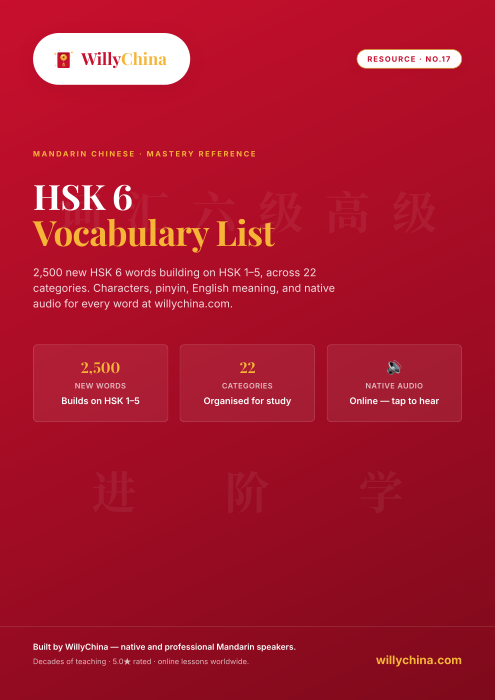
HSK 6 Vocabulary List — PDF + Native Audio
All 2,500 new HSK 6 words organised by category — characters, pinyin, English meaning, and native pronunciation for every word. Tap any word below to hear its native pronunciation.
⬇ Download PDF (50 pages)Free — tell us where to send it and it’s yours. Every word also has native audio in the grid below.
- All 2,500 HSK 6 vocabulary words, including 116 idioms
- Organised across 22 categories for structured study
- Character + pinyin + English meaning for each word
- Search + filter by category on the page
- Native pronunciation audio for every word
Tap any word to hear it spoken
Search by character, pinyin or English meaning. Filter by category. Tap any card to hear native Mandarin pronunciation.
No words match your search. Try a different term or clear filters.
What is HSK 6?
If you’ve completed HSK 1–5, the HSK 6 word list is the last climb, and it is the biggest single level in the exam: it doubles your vocabulary again. Master this HSK 6 vocabulary list and you’ll read opinion pieces, novels and official notices without reaching for a dictionary, follow fast talk shows and lectures, and choose between near-synonyms the way an educated native speaker does.
What changes at HSK 6 is register more than topic. HSK 5 gave you the words for law, economy and media; HSK 6 gives you the formal and literary versions of them. You’ll meet written connectors like 倘若 (tǎngruò, if; supposing) and 鉴于 (jiànyú, in view of), single-character verbs like 熬 (áo, to endure) and 掰 (bāi, to break off with both hands), and 116 four-character idioms. Some Mandarin-taught postgraduate programmes and translation courses ask for an HSK 6 pass.
This resource gives you all 2,500 HSK 6 words in three forms: a free 50-page A4 PDF organised by category for printing and offline study, the search-and-filter grid above for quick lookup, and native pronunciation audio for every word (Microsoft Xiaoxiao voice, Beijing-standard Putonghua).
How to use this HSK 6 vocabulary list
Don’t try to memorise the HSK 6 vocabulary list in one push. At 2,500 words, cramming fails faster here than at any earlier level. What works is the same as always, just slower and steadier: spaced repetition, audio, and every word in a sentence of your own. Here’s how to learn HSK 6 vocabulary:
- Print the PDF one category at a time. Fifty pages on a wall is noise; the five pages you’re working on this week is a plan. Keep the current pages where you’ll see them during dead moments.
- Use the grid above for daily drills. Filter by category, tap each word to hear it, and say it aloud before the audio finishes. Half an hour every day beats three hours on a Sunday.
- Start with the big four categories: Verbs — Action & Daily Life (403), Adjectives & Descriptions (347), Ideas & Concepts (260) and Society & Law (209). Together they hold 1,219 of the 2,500 words, just under half the HSK 6 vocabulary list, and they carry the reading section of the exam.
- Learn words in clusters, never alone: 被告 / 辩护 / 案件 / 颁布 (bèigào, defendant / biànhù, to defend / ànjiàn, legal case / bānbù, to issue a law) is the courtroom set; 财政 / 补贴 / 偿还 / 产业 (cáizhèng, public finance / bǔtiē, subsidy / chánghuán, to repay / chǎnyè, industry) is the budget set. Words that appear together in real articles stick together in memory.
- Build a sentence with each new word. Knowing “不妨 (bùfáng, might as well)” on its own is useless. Knowing “你不妨试试 (nǐ bùfáng shìshi, you might as well give it a try)” is what lets you use it tomorrow.
- Separate the sound-alikes by their characters. HSK 6 is full of pairs that sound identical: 过度 (guòdù, excessive) and 过渡 (guòdù, transition); 以至 (yǐzhì, to such an extent that) and 以致 (yǐzhì, with the result that, usually bad); 启事 (qǐshì, notice) and 启示 (qǐshì, inspiration). Listening won’t separate them, so learn them by the characters and the sentences they live in.
If you’re targeting an actual HSK 6 exam date, vocabulary alone won’t get you there: you’ll need long-passage listening, fast reading and the summary-writing task. That’s what our 1-on-1 HSK Preparation course is built for. If you’re not sitting the exam, conversation is where these words come alive, and lessons are tailored to your level.
The 116 idioms in HSK 6
HSK 6 is the first level where 成语 (chéngyǔ, four-character idioms) arrive in numbers: 116 of the 2,500 words are fixed four-character expressions. They’re spread across the categories by meaning rather than kept in a separate list (our guide to Chinese idioms covers the stories behind many of them), so you’ll find 狼吞虎咽 (lángtūnhǔyàn, to wolf down food) in Food & Dining and 天伦之乐 (tiānlúnzhīlè, the joys of family life) in Family & People.
Learn each one as a single word with a single meaning, then learn where it sits in a sentence. 一目了然 (yīmùliǎorán, clear at a glance) describes something; 半途而废 (bàntú’érfèi, to give up halfway) is something you do; 小心翼翼 (xiǎoxīnyìyì, very carefully) describes how you do it. Using an idiom in the wrong slot is the most common HSK 6 writing mistake, and it’s easy to avoid once you’ve practised each one in a sentence or two.
Search the grid above for any idiom by its English meaning. Typing “give up”, “carefully” or “suddenly” will bring up the idioms alongside the plain words with the same meaning, which is exactly the comparison the exam tests.
The 22 categories in this HSK 6 vocabulary list
This HSK 6 vocabulary list organises the 2,500 words into the same 22 categories as our HSK 5 list, grouped by how they appear in real Mandarin. That makes it easy to see what each level adds: at HSK 6, the biggest growth is in emotions, society and abstract ideas.
- Family & People (35): Spouses, descendants, residents, gentlemen. The formal words for the people around you.
- Time & Sequence (66): Dynasties, instants, “originally”, “on the spot”, and festivals like 端午节 (Duānwǔjié, Dragon Boat Festival).
- Places & Geography (54): Border regions, the equator, warehouses, castles. Maps and settings in detail.
- Food & Dining (29): Protein, frying, stirring, lavish banquets. Cooking described like a recipe writer.
- Body & Health (87): Arteries, scars, massage, cancer. Medical Mandarin for real conversations with doctors.
- Clothing & Appearance (20): Plaits, buttons, jewellery, the 旗袍 (qípáo, qipao). How people look and carry themselves.
- Sport & Leisure (17): Referees, athletics, diving, 气功 (qìgōng, qigong). Competition words beyond “win” and “lose”.
- Verbs — Mental & Speaking (169): To hint, to adopt a suggestion, to spur on, to belittle. The verbs of persuasion and judgement.
- Verbs — Action & Daily Life (403): To endure, to break free, to retaliate, to repay a kindness. At 403 words, the biggest category in the HSK 6 vocabulary list.
- Adjectives & Descriptions (347): Ambiguous, despicable, serene, awkward. Fine shades of description for people and situations.
- Emotions & Attitudes (144): Astonished, timid, to keep someone in mind, to worship. Four times the HSK 5 count, and rich in idioms.
- Education & Learning (34): Reciting, defending a thesis, dialects, 繁体字 (fántǐzì, traditional characters). Academic Mandarin.
- Work & Career (89): Strikes, layoffs, expense claims, memos. The vocabulary of management and the workplace.
- Money & Economy (94): Subsidies, wealth, public finance, best-sellers. The business pages, in full.
- Society & Law (209): Legal cases, defendants, violence, to commend. How institutions and the courts are reported.
- Science & Technology (74): To back up, to log in, navigation, geology. Science reporting and the digital world.
- Media & Arts (68): Versions, leaflets, sculpture, 对联 (duìlián, door couplets). Publishing, performance and craft.
- Transport & Travel (35): Cabins, ports, aviation, to set out. The full vocabulary of a journey.
- Nature & Environment (96): Hail, great waves, dams, carbon dioxide. The natural world as science and as scenery.
- Objects & Materials (67): Lanterns, power points, hammers, scales. The household and the workshop.
- Ideas & Concepts (260): Mystery, instinct, role models, drawbacks. The abstract layer the HSK 6 reading section is built on.
- Function Words & Grammar (103): 甭 (béng, don’t), 不料 (bùliào, unexpectedly), 不惜 (bùxī, not hesitate to). The connectors of formal written Chinese.

Preparing for the HSK 6 exam?
These 2,500 words are the entire HSK 6 vocabulary, but the exam also tests fast listening, reading speed and a summary you write from memory. Our 1-on-1 HSK Preparation course drills exam-specific skills with mock papers and pacing technique.
Book a free HSK consultationA 16-week study plan
Here’s a sixteen-week plan to work through the whole HSK 6 vocabulary list at about 25 words a day, in sessions of 30 minutes. It starts with the concrete categories, where new words attach easily to things you already know, and leaves the big abstract blocks until your reading has caught up.
- Week 1: Family & People (35) + Time & Sequence (66) + Places & Geography (54) + Clothing (20): 175 words. People, places and time: retell a family story with them.
- Week 2: Food & Dining (29) + Body & Health (87) + Sport & Leisure (17) + Transport & Travel (35): 168 words. The physical world: describe a meal, an illness, a trip.
- Week 3: Education (34) + Work & Career (89) + Objects & Materials (67): 190 words. Study and work: talk through your week in detail.
- Week 4: Money & Economy (94) + Science & Technology (74): 168 words. Pair each word with a headline you could write.
- Week 5: Nature & Environment (96) + Media & Arts (68): 164 words. Describe a landscape, then a film or exhibition.
- Weeks 6–7: Society & Law (209) + Function Words & Grammar (103): 312 words, about 22 a day. Read one short news story a day and find the connectors.
- Weeks 8–9: Emotions & Attitudes (144) + Verbs — Mental & Speaking (169): 313 words. Opinion fortnight: say how you feel about something, then argue for it.
- Weeks 10–11: Ideas & Concepts (260 words, about 19 a day). The abstract block: one sentence per word about something you believe.
- Weeks 12–14: Verbs — Action & Daily Life (403 words, about 19 a day). Drill each verb with a real object and a real person.
- Weeks 15–16: Adjectives & Descriptions (347 words) + full review. Filter “All” in the grid and say each word before the audio plays.
After sixteen weeks you’ll have met every word in this HSK 6 vocabulary list with audio. Recognising a word and using it are different skills at this level, so plan on several more months of reading and conversation practice with a teacher before the words feel like your own. For how that fits into a realistic exam timeline, see how long each HSK level takes.
FAQs
Sources: word list from the official HSK 2.0 syllabus via Chinese Testing International; English glosses adapted from CC-CEDICT (CC BY-SA 4.0).
Want a teacher to help you master HSK 6?
Vocabulary lists are a foundation — but you need real practice with feedback. Book a free 30-minute intro lesson.
Book a Free Intro LessonWant a teacher, not just a PDF?
Practise this with a native speaker
The list gets you the words. Saying them out loud to someone who corrects your tones is what makes them stick. Tell us where you’re up to and we’ll suggest a starting point — free, no obligation.
Thanks — that’s in. We’ll be in touch within 24 hours.
Free PDF
Where should I send it?
Tell us a little about you and the PDF is yours — it lands in your inbox straight away.
All fields are required. I’ll send new resources now and then, the odd note on learning Mandarin properly, and occasionally news about my workbooks. Unsubscribe any time. Privacy policy
Sent. Check your inbox — your download is starting now.
Before you go
You’ve got the words. Using 2,500 formal words naturally takes practice with someone who corrects you — try a free 30-minute intro lesson with a native teacher.
Book a free intro lessonNo obligation. A real reply within 24 hours.