The Han Dynasty · 202 BCE–220 CE · the empire whose name became the word for Chinese itself
“Four hundred years so formative that a fifth of humanity still carries its name.”
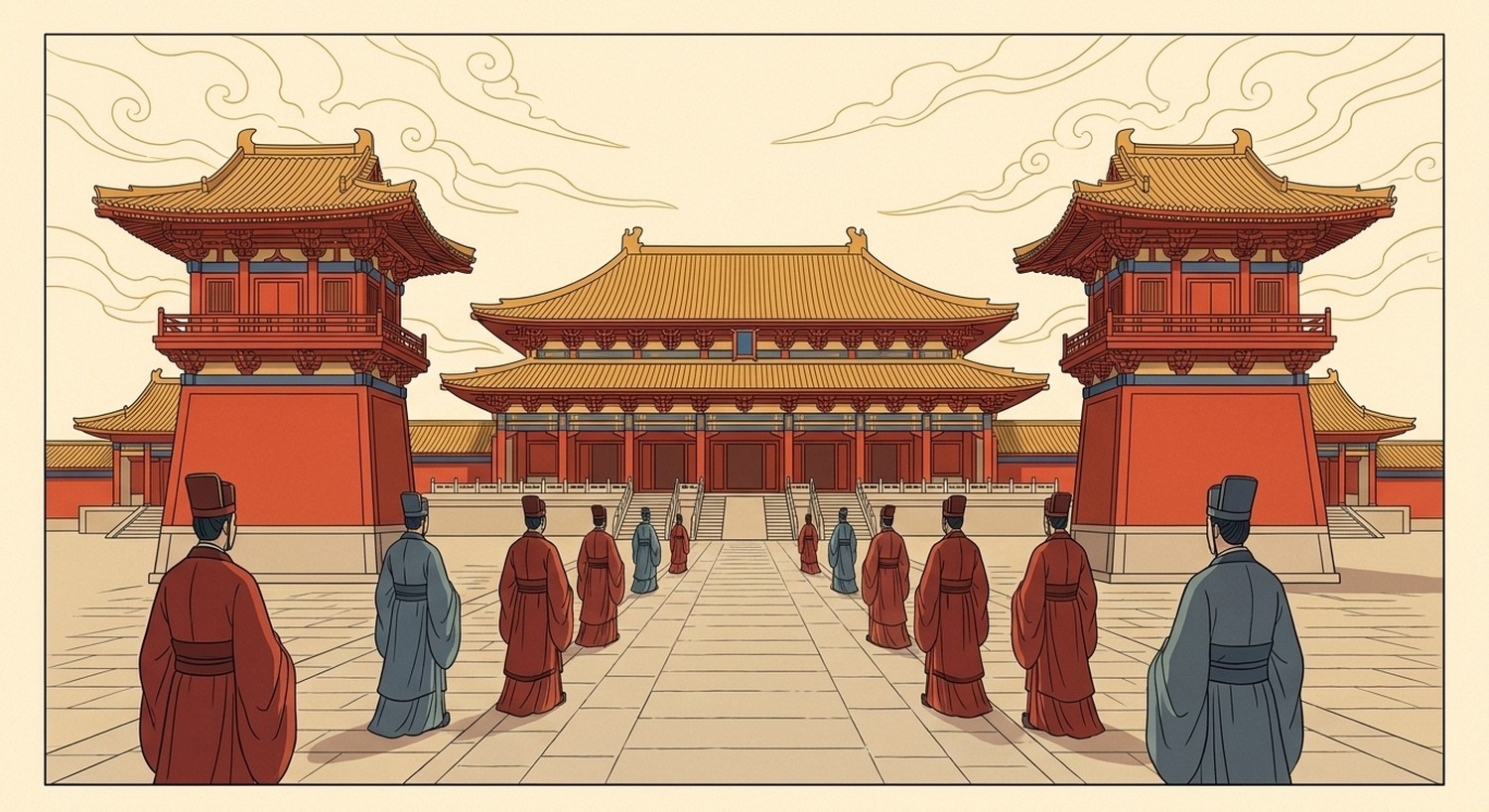
The dynasty that named a people
Ask a Chinese person what they are and the answer is 汉族 (Hànzú) — Han. Ask what they write and it is 汉字 (hànzì) — Han characters. Ask what they speak and it is 汉语 (Hànyǔ) — Han speech. No other dynasty left a mark like that. The Han (汉朝, 202 BCE–220 CE) lasted four centuries, and by the end of them its name had stopped meaning a ruling house and started meaning Chinese.
It was not the first empire. The Qin got there first and held it for fifteen years before collapsing under its own severity. The Han inherited that unified state and did the harder thing: it made unity feel normal. It settled how China would be governed, how officials would be chosen, how the script would look, and what a Chinese person would take for granted about the world. Almost everything later dynasties argued about, they argued about in terms the Han had set.
This guide runs from Liu Bang’s victory at Gaixia to the last emperor’s abdication, and through the institutions, the science, the writing and the people in between.
From peasant to emperor
The Qin fell in 207 BCE and the empire broke into contending kingdoms. The two men left standing were Xiang Yu (项羽), an aristocratic general of terrifying ability, and Liu Bang (刘邦), a village official of no distinguished birth at all. Xiang Yu is the one who smashed the cauldrons and sank the boats — the origin of the idiom 破釜沉舟, and the reason he won at Julu. He lost the war anyway.
Xiang Yu made Liu Bang King of Han (汉王) in 206 BCE, a title taken from Hanzhong, the region on the Han River (汉水) he was given to rule. It was meant as a sidelining. Four years of civil war later — the Chu–Han contention — Liu Bang destroyed Xiang Yu at the Battle of Gaixia in 202 BCE and took the imperial title. The kingdom’s name went with him.
⚑ A note on the date. You will see the Han’s founding given as both 206 and 202 BCE, and both are defensible: 206 is when the name begins, with Liu Bang’s enfeoffment as King of Han, and 202 is when the dynasty does, with his accession as emperor. Current scholarship and Chinese reference works favour 202, which is what this page uses.
That a man of common birth could found a four-hundred-year empire was itself new, and it mattered. The Han never quite lost the idea that ability could outrank ancestry.
Governing an empire without breaking it
Liu Bang — posthumously Emperor Gaozu (汉高祖) — had watched the Qin try to run everything from the centre and fall apart doing it. His compromise was the commandery-kingdom system (郡国并行制): the core of the empire administered directly by centrally appointed officials, the periphery parcelled out as kingdoms to relatives and allies.
It bought peace and stored up trouble. The kingdoms grew into rival power bases, and in 154 BCE seven of them rose together in the Rebellion of the Seven States. It was crushed within three months, and the throne used the victory to strip the kingdoms of real authority. From then on the centre governed, and the kingdoms were ornaments.
The early Han also inherited a ruined countryside and chose, deliberately, to do very little. Taxes were cut, punishments softened, campaigns avoided — a policy the sources describe with the Daoist phrase 无为而治 (wúwéi ér zhì), ruling by not interfering.
文景之治: prosperity by restraint
The reigns of Emperor Wen (文帝, r. 180–157 BCE) and his son Emperor Jing (景帝, r. 157–141 BCE) are remembered together as the 文景之治 — the Rule of Wen and Jing, and the first period Chinese historians hold up as a model of good government.
What they did was mostly refrain. Land tax was cut to a thirtieth of the harvest and at one point suspended altogether. Mutilating punishments were abolished. The court was frugal to the point of austerity — Emperor Wen is said to have abandoned a terrace because it would have cost the equivalent of ten households’ wealth. Granaries filled, the population recovered, and the treasury accumulated the surplus that his grandson would spend on war.
It is a genuinely unusual thing for a historical tradition to celebrate: forty years in which the most praised act of government was leaving people alone.
Emperor Wu and the expansion of everything
Emperor Wu (汉武帝, r. 141–87 BCE) reigned fifty-four years — the longest of the dynasty and one of the longest in Chinese history — and spent the inheritance his grandfather had saved. Under him the Han stopped being a defensive state and became an expansionist one.
The Xiongnu, the steppe confederation to the north, had humiliated the early Han into paying tribute dressed up as marriage alliance. Wu ended that with a series of enormous campaigns that pushed Han power deep into the steppe and out along the Hexi Corridor, at a cost the treasury never fully recovered from. He annexed the southern kingdoms, took northern Vietnam and northern Korea, and opened the Western Regions.
To pay for it he reached for the economy directly: state monopolies on salt and iron, a standardised bronze coinage, and price-stabilisation schemes that bought cheap and sold dear on the state’s account. The monopolies were introduced from around 119 BCE and built out over the following years — the sources give 120, 119 and 117 for different stages, and no single year is settled.
He is also the emperor who, late in life, issued something close to a public apology. The 轮台诏 of 89 BCE renounced further expansion and turned the state back toward agriculture — an admission of exhaustion from the most powerful man alive.
How Confucianism became the state’s language
Under Emperor Wu, Confucian learning acquired the state backing it would keep, with interruptions, for two thousand years. An imperial academy (太学) was founded in 124 BCE, the Confucian classics became the curriculum, and knowing them became the route into office. That is the durable fact.
⚑ The slogan is not Han. Almost every account of this reign quotes 罢黜百家,独尊儒术 — “dismiss the hundred schools, revere only the Confucians” — as Emperor Wu’s policy. Those eight characters appear in no Han-period text. They were coined in 1916 by the essayist Yi Baisha (易白沙) in the journal New Youth, and travelled from there into Chinese school textbooks. What the Han sources actually record, in Ban Gu’s biography of Dong Zhongshu, is the weaker 推明孔氏,抑黜百家 — and they also record that Emperor Wu never formally adopted it.
The reality was messier and more interesting than the slogan. Dong Zhongshu (董仲舒) did argue for Confucian primacy, and did shape the intellectual settlement, but the Confucianism that won was a synthesis that had absorbed Legalist statecraft and yin-yang cosmology along the way. Emperor Wu went on employing Legalists, diviners and fangshi throughout his reign. The Han did not purge the hundred schools; it hired the Confucians and kept using everyone else.
Zhang Qian and the routes to Central Asia
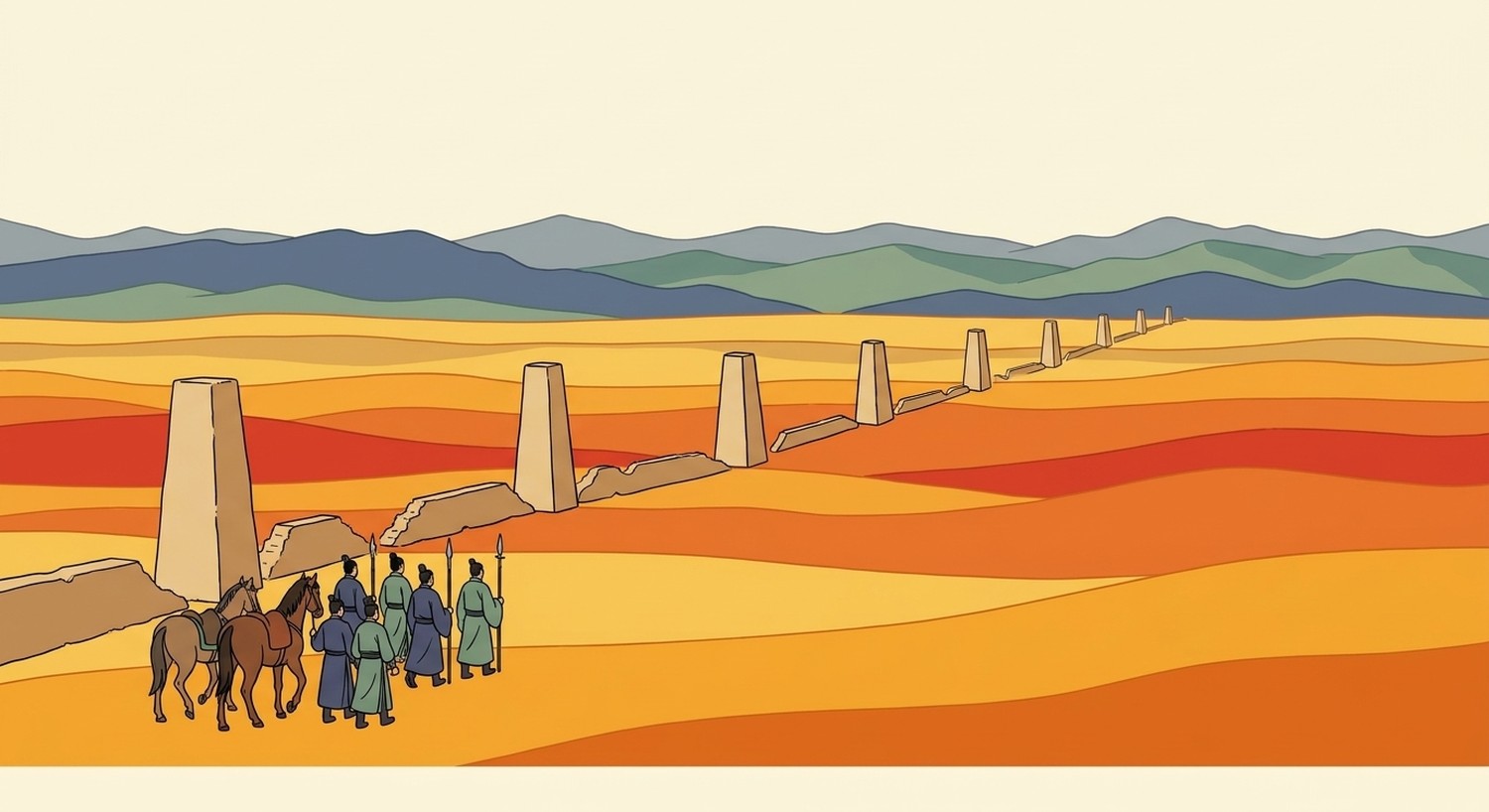
In 139 BCE Emperor Wu sent an officer named Zhang Qian (张骞) west to find allies against the Xiongnu. He was captured almost immediately and held for roughly a decade, married, had a son, escaped, continued west anyway, failed in his diplomatic mission entirely, and came back in 126 BCE after thirteen years with one of the most valuable things a court can receive: accurate information about places nobody there had seen.
He went again in 119 BCE, returning in 115. What followed was regular official traffic along the oasis routes through the Tarim Basin, Han garrisons in the Western Regions, and the long exchange of silk, horses, glass, ideas and disease between China and the west.
⚑ On “opening the Silk Road”. It is an overstatement, though not a modern invention — Sima Qian called Zhang Qian’s achievement 凿空 (záokōng), “hewing through the void”, which is a Han judgement on a Han man. But goods had moved across Eurasia long before him, and “Silk Road” itself is a German coinage from 1877. What Zhang Qian opened was not the route; it was the Han court’s knowledge of what lay along it.
Wang Mang and the Xin
By the end of the Western Han the throne had been captured by consort families, and the most capable of them was Wang Mang (王莽). He served as regent, then in 9 CE took the throne outright and declared a new dynasty, the Xin (新) — “new”.
His programme was radical in effect and deeply conservative in intent: he was trying to restore the institutions of the Zhou as the classics described them. All land was nationalised as 王田, and the sale of land and of slaves was banned — an attempt to break the great estates and revive the ancient well-field system. He reissued the currency repeatedly until nobody trusted any of it.
It failed comprehensively. Landowners resisted, the currency reforms wrecked commerce, and then the Yellow River changed course, drowning the north China plain and displacing enormous numbers of people. The Red Eyebrows rose in the famine that followed. Wang Mang was killed in his palace at Chang’an in 23 CE.
Historians have never agreed on him. Hu Shi called him a socialist nineteen centuries early; Qian Mu thought him a bookish antiquarian who mistook the classics for a manual.
The Eastern Han begins again at Luoyang
A member of the imperial clan, Liu Xiu, was proclaimed emperor in 25 CE and spent a decade reuniting the empire by force. As Emperor Guangwu (光武帝) he moved the capital east from ruined Chang’an to Luoyang, which is why the second half of the dynasty is the Eastern Han.
There is a two-year gap in the dates — the Xin fell in 23 CE and Guangwu acceded in 25 — filled by the short-lived Gengshi regime, which is usually passed over but is the reason the timeline does not simply run on.
A small detail says a lot about how the Han thought. Guangwu wrote Luoyang as 雒阳 rather than 洛阳, swapping the water radical out, because the Han claimed the virtue of fire under the five-phases theory and water extinguishes fire. The spelling of the capital was a cosmological statement.
The restored dynasty was a more modest thing than the first: less expansionist, more dependent on great landowning families, and increasingly run from the inner palace.
Eunuchs, Yellow Turbans and warlords
The Eastern Han’s structural weakness was succession. Emperor after emperor came to the throne as a child, which put power in the hands of the empress dowager and her family, which the emperor then broke by allying with the palace eunuchs — who became a faction in their own right. The cycle ran for a century and hollowed the court out.
In 184 CE a Daoist healing movement rose across eight provinces at once under Zhang Jue (张角), its followers in yellow headscarves chanting that the blue heaven was dead and the yellow heaven should stand. The Yellow Turban Rebellion was broken militarily within about a year — but only because the court had devolved real military authority to regional governors to fight it.
Those governors did not give the authority back. When Dong Zhuo seized the capital in 189 CE the emperor became a possession to be fought over, and the men fighting over him — Cao Cao, Liu Bei, Sun Quan — are the figures of the Three Kingdoms. The last Han emperor abdicated in 220 CE, ratifying a collapse that was already thirty years old.
Government, law and the three lords
The Han ran on a structure later dynasties recognised as the template: the Three Lords and Nine Ministers (三公九卿) at the top, the empire divided into commanderies (郡) and those into counties (县), each with centrally appointed officials who could be moved, audited and sacked.
It was a genuinely large bureaucracy — something on the order of 130,000 salaried officials — and it was checked. Regional inspectors (刺史) toured on the court’s behalf with a brief to report on governors above their own rank, an early and deliberate separation of administration from oversight.
The law was Qin law with the sharpest edges filed off. Gaozu is said to have entered Chang’an promising a code of three articles only — murder, injury, theft — which was propaganda rather than policy, but the direction was real. Mutilating punishments were abolished under Emperor Wen, and the principle that the classics could be cited in judgement gave the Confucian canon a foothold inside the legal system it never gave up.
察举: the ancestor of the examinations
The Han did not have written examinations — those come later. What it had was 察举 (chájǔ), a recommendation system in which commanderies were required to put forward candidates each year under set categories, the most famous being 孝廉 (xiàolián), “filial and incorrupt”.
The principle was radical for its time: office should go to demonstrated character and learning rather than birth. The practice drifted, as it was always going to. Recommendation ran through existing networks, great families recommended each other’s sons, and by the Eastern Han a satirical verse was circulating that the men recommended as filial did not live with their parents and the men recommended as learned could not read.
It failed in a specific and instructive way — and the examination system that eventually replaced it was an attempt to fix exactly that failure by making the test impersonal.
Chang’an and Luoyang
Chang’an (长安, “Perpetual Peace”), in what is now Shaanxi, was built new for the Western Han on the Wei River plain, an irregular walled city of some 36 square kilometres dominated by the Weiyang Palace. Han architecture was lower and heavier than the Tang’s: broad tiled roofs, rammed-earth terraces raising the important halls above everything else, and paired free-standing gate-towers (阙) flanking the approach — the silhouette you see on Han tomb reliefs.
Luoyang, in what is now Henan, was the Eastern Han capital — smaller and more regular, laid out on a rectangle with the palaces at its heart. It was here that the imperial library sat, that Ban Gu compiled the Hanshu, and that the first Buddhist community in the Chinese record appears.
Both were eventually burned. Chang’an was wrecked in the fighting that ended the Western Han; Luoyang was put to the torch by Dong Zhuo in 190 CE when he dragged the court west.
An agrarian empire with a state in the market
Nine in ten Han subjects farmed, mostly millet in the north and rice in the south, on smallholdings taxed at a famously light rate — a thirtieth of the harvest for much of the dynasty. The heavier burdens were the poll tax, which fell on people rather than land and so pressed hardest on the poor, and corvée labour and military service.
Han agriculture was also technically inventive. The iron mouldboard plough, the seed drill, the ridge-and-furrow system (代田法) promoted by Zhao Guo, and water-powered bellows for iron smelting all belong to this period, and all of them raised yields per worker rather than merely per acre.
The state’s role in the economy was the great political argument of the dynasty. The salt and iron monopolies funded Emperor Wu’s wars and were resented for it, and in 81 BCE the court staged a formal debate on whether to keep them — some sixty Confucian scholars against the finance minister Sang Hongyang. The 盐铁论 (Discourses on Salt and Iron) records it, though as a reconstruction compiled later by Huan Kuan rather than a transcript. The arguments in it — state revenue against private enterprise, frontier defence against domestic welfare — have not dated as much as you would expect.
Family, rank and the shape of a life
Han society was ordered by a hierarchy that put scholars and farmers above artisans and, at the bottom of the respectable order, merchants — who could be rich and were legally restricted anyway, barred at times from wearing silk or riding in carriages. Below everyone were convicts and slaves, a small but real part of the population.
The household was the unit that mattered, and filial piety (孝) was its organising virtue and, through 孝廉, a qualification for public office. Han tombs are the best witness to ordinary life: the pottery models buried in them show farmyards, watchtowers, wells, stoves, dogs and dancing girls, because the dead were expected to need all of it.
People ate millet gruel, steamed grain, pickles and bean dishes; wheat arrived as noodles and cakes during this period and began its long conquest of the north. Chopsticks were in use, but for cooking and serving more than for eating. They ate seated on mats at individual low tables — the shared round table of later Chinese dining is centuries away.
Where 汉字 got their modern shape
The Qin standardised the script; the Han decided what it would look like for the next two thousand years. The formal Qin seal script (小篆) was slow to write, and the working alternative that clerks had been using — clerical script, 隶书 — became the Han’s standard hand.
The change was not cosmetic. Clerical script broke the smooth curves of seal script into flat, separate strokes with distinct starts and finishes. That shift, called 隶变, is the single largest break in the history of Chinese writing, and it is the reason a literate person today can read a Han inscription with effort but a Shang oracle bone not at all. Every character you learn descends from the Han form, not the Qin one.
The Han also produced the first real dictionary of the script. Xu Shen’s 说文解字 (Shuowen Jiezi), completed in 100 CE, analysed over nine thousand characters and organised them under 540 radicals — the ancestor of the radical system every learner still uses to look things up.
Sima Qian and the 史记
Sima Qian (司马迁, c. 145–c. 86 BCE) inherited the post of court historian from his father and with it an unfinished project: a history of everything. The 史记 (Records of the Grand Historian) runs from the legendary Yellow Emperor to his own emperor’s reign, and it invented the form Chinese history would take — annals, chronological tables, treatises on subjects like ritual and rivers, and, most importantly, biographies.
It cost him appallingly. He defended a general who had surrendered to the Xiongnu, was condemned, and chose castration over the honourable suicide expected of him, specifically so that he could finish the book. He explains why in a surviving letter to Ren An, and it is one of the most direct things anyone wrote in the ancient world about the value of finishing work.
The manuscript was substantially complete by around 91 BCE. Its influence is hard to overstate: it is the source for most of what anyone knows about the Qin and the Chu–Han war, including the account behind 破釜沉舟 — and it set the expectation that a Chinese historian judges as well as records — an attitude that runs through classical Chinese writing long after him.
Confucians, Daoists, and the arrival of the Buddha
Han religion was layered rather than exclusive. State ritual centred on sacrifices to Heaven, Earth and the imperial ancestors, performed by the emperor as the hinge between the human and cosmic orders. Confucianism supplied the ethics and the texts; yin-yang and five-phases cosmology supplied the mechanics, including the theory that natural disasters were Heaven’s commentary on government.
Popular Daoism took organised form late in the dynasty, and did so as a political force: the Yellow Turbans were a Daoist healing movement, and the Celestial Masters ran an effectively independent theocratic state in Hanzhong for decades.
Buddhism arrived during the Eastern Han, and it is worth separating the tradition from the evidence. The traditional account is Emperor Ming’s dream of a golden man in 67 CE, the embassy sent west, and the founding of the White Horse Temple at Luoyang — a story that comes from a text written nearly two centuries later. The earliest documentary evidence is a little earlier and much drier: an edict of 65 CE concerning Liu Ying, Prince of Chu, which notes that he made offerings to the Buddha and observed fasts. A prince’s private devotion, recorded in passing, is the first Buddhist community in the Chinese record.
Paper, earthquakes and the heavens
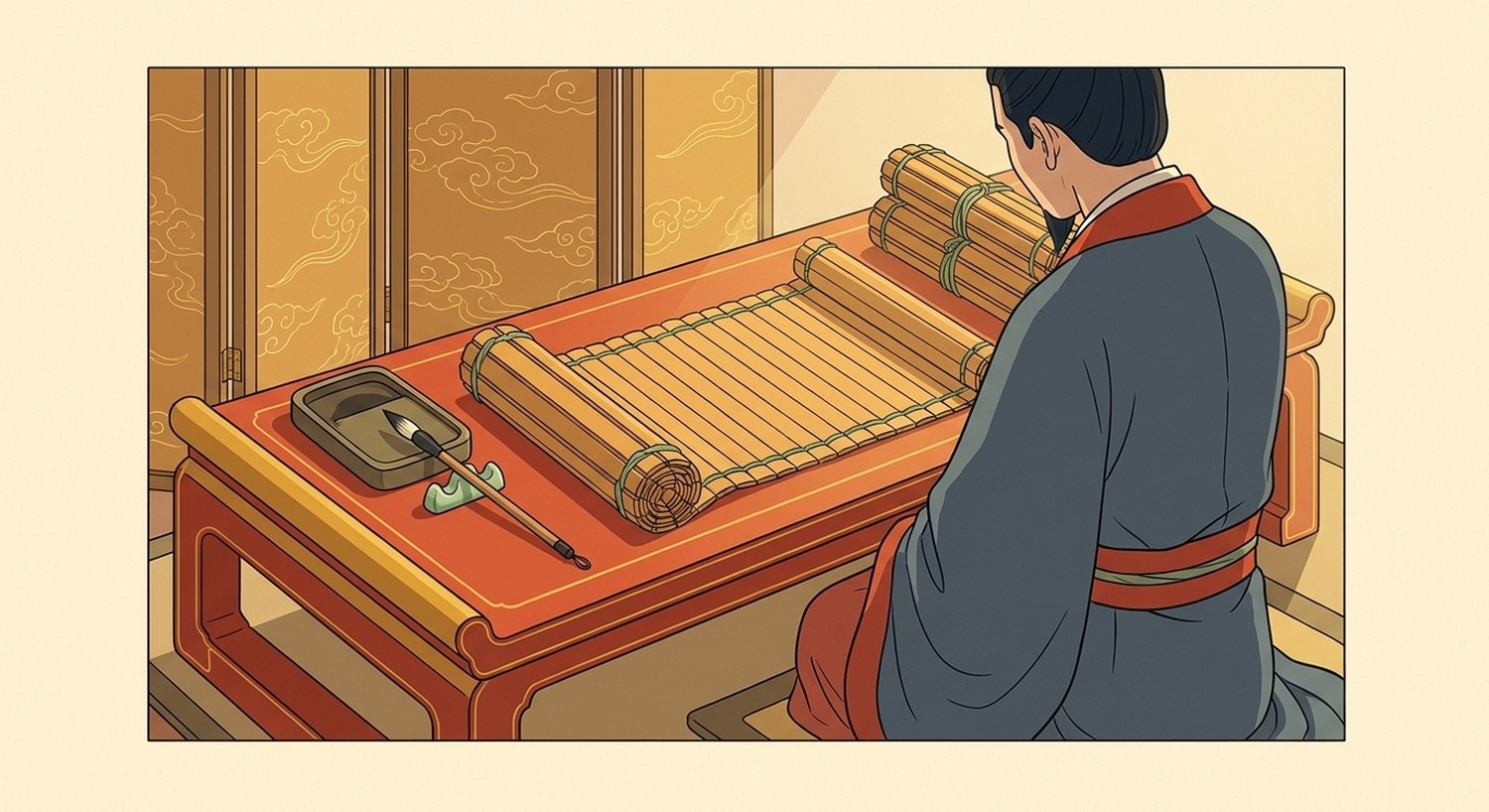
⚑ Paper. Cai Lun (蔡伦) did not invent it. Plant-fibre sheets have been excavated from Western Han sites predating him by two centuries, though some of those finds are themselves disputed — one famous example may be hemp packing rather than paper at all. What Cai Lun did, and reported to the throne in 105 CE, was develop a process using bark, hemp waste, rag and old fishing net: cheap materials that made paper affordable enough to start displacing bamboo slips and silk. He is the standardiser, and that mattered more than invention would have.
⚑ The seismoscope. In 132 CE the polymath Zhang Heng (张衡) built a bronze instrument said to indicate the direction of distant earthquakes, and the Book of the Later Han records it registering a quake in Longxi in 138 CE that nobody in the capital had felt. Treat that carefully: the account was written some three centuries after the event, the device is lost, and it survives only in a description of 196 characters. The reconstruction in every textbook and museum was made in 1951 and is now regarded as mechanically unsound — it failed to register the Tangshan earthquake. A later reconstruction does respond to simulated waves, which tells us the idea can work, not that Zhang Heng’s did.
Zhang Heng also argued that the heavens were a sphere with the earth inside it like the yolk of an egg, calculated π to 3.1622, and built a water-driven armillary sphere. Elsewhere the Han produced the wheelbarrow, the water-powered trip hammer, the stern-mounted rudder, and — in medicine — the 伤寒杂病论 of Zhang Zhongjing, still a foundation text of Chinese medicine — and the man to whom the winter-solstice dumpling custom is traditionally attributed.
Xiongnu, the Western Regions, and a Rome they never reached
The defining foreign relationship was with the Xiongnu. The early Han bought peace with 和亲 — imperial women and silk sent north as tribute in the language of marriage. Emperor Wu replaced that with war, and after decades of campaigning the confederation split; the southern half submitted, and in 51 BCE a Xiongnu leader came to the Han court in person.
In the Western Regions — the oasis states of what is now Xinjiang — the Han installed a Protector-General to manage them states, and under the Eastern Han Ban Chao held the whole system together for three decades with almost no troops and an extraordinary talent for playing the local kings against each other.
It was Ban Chao who in 97 CE sent his officer Gan Ying (甘英) west to reach Rome. Gan Ying got as far as the Persian Gulf — the furthest west anyone in the Chinese record had been — and turned back when Parthian sailors told him the crossing could take two years and that men died of homesickness on the way. The Parthians made their living as middlemen on the silk trade, which is worth bearing in mind when reading their advice.
There is one recorded contact, in 166 CE, when a party reached the Han court claiming to represent “An-tun, king of Daqin” — Marcus Aurelius. No Roman source mentions it, the gifts they brought were Southeast Asian rather than Mediterranean, and the Han court itself suspected them of being merchants. Most historians agree with the Han court. The two empires knew of each other for four hundred years and never quite met.
The first census of a whole empire
⚑ In 2 CE the Han counted itself. The Hanshu records 12,233,062 households and 59,594,978 people — the earliest census of an entire empire whose figures survive, and a number roughly comparable to the Roman Empire at its height.
You will often see 57.6 million quoted instead. That figure is real and widely printed in English sources, but it is a different aggregation and not the total the primary text states; this page uses the Hanshu‘s own number.
Chinese demographic historians regard the count as broadly reliable, because it was a tax register and the late Western Han took registration seriously. The caveat is what a tax register is for: it counts registered households, so unregistered dependants, slaves and frontier populations are under-represented, and the true figure was somewhat higher. Eastern Han counts are noticeably less complete.
Key figures of the Han dynasty
- Emperor Gaozu (汉高祖, Liu Bang) — the founder, r. 202–195 BCE; a village official who ended up an emperor.
- Emperor Wen & Emperor Jing (文帝 · 景帝) — the restrained reigns remembered as the 文景之治.
- Emperor Wu (汉武帝) — fifty-four years of expansion, state monopolies and Confucian patronage.
- Dong Zhongshu (董仲舒) — the scholar who argued Confucian learning into the centre of the state.
- Zhang Qian (张骞) — thirteen years west, and the Han’s first real map of Central Asia.
- Sima Qian (司马迁) — the historian who chose mutilation over death so he could finish the 史记.
- Wang Mang (王莽) — the regent who took the throne and lost it in fourteen years.
- Emperor Guangwu (光武帝, Liu Xiu) — restored the dynasty and moved it to Luoyang.
- Ban Chao & Ban Gu (班超 · 班固) — brothers; one held the Western Regions, the other wrote the Hanshu.
- Cai Lun (蔡伦) — made paper cheap.
- Zhang Heng (张衡) — astronomer, mathematician, poet, instrument-maker.
- Cao Cao (曹操) — the warlord who kept the last Han emperor as an asset and whose son ended the dynasty.
What the Han dynasty left behind
The Han’s deepest legacy is the one hiding in plain sight: its name. All three of the words a Chinese person uses for their own people, script and language descend from it — 汉族, 汉字, 汉语 — and behind the dynasty the chain runs further back still, to Liu Bang’s title King of Han, and behind that to the Han River in Hanzhong. A provincial river ended up naming a fifth of humanity.
None of those words is a Han-dynasty word, which is the genuinely interesting part. They are later coinages, and they mostly appear when Chinese needed distinguishing from something else. 汉人 hardened from “subject of the Han state” into an ethnic label under the non-Chinese dynasties of the Northern and Southern period, when rulers from the steppe needed a word for the people they governed. 汉字 is attested from the early Tang, in contexts contrasting Chinese script with other peoples’. And 汉族 in its modern sense is barely a century old, arriving with Western ideas of nationhood in the late 1800s. The Han were named from outside, by comparison, long after they had stopped existing. The characters you learn first are still, literally, Han characters.
Beyond the name: the bureaucratic state with a written examination culture growing inside it, the Confucian canon as the language of government, clerical script and the radical system, the histories in Sima Qian’s form, paper, and the idea — never abandoned for long afterwards — that China is properly one empire rather than many states.
Han dynasty timeline
- 206 BCE — Liu Bang is made King of Han; the name begins.
- 202 BCE — Xiang Yu is defeated at Gaixia; Liu Bang takes the imperial title.
- 180–141 BCE — The 文景之治, the reigns of Wen and Jing.
- 154 BCE — The Rebellion of the Seven States is crushed.
- 141–87 BCE — The reign of Emperor Wu, the longest of the dynasty.
- 139–126 BCE — Zhang Qian’s first mission to the Western Regions.
- c. 119 BCE — The salt and iron monopolies are introduced.
- c. 91 BCE — Sima Qian’s 史记 is substantially complete.
- 81 BCE — The Discourses on Salt and Iron debate.
- 2 CE — The census records 59,594,978 people.
- 9–23 CE — Wang Mang rules as the Xin dynasty.
- 25 CE — Liu Xiu restores the Han at Luoyang as Emperor Guangwu.
- 65 CE — The first documentary evidence of Buddhism in China.
- 97 CE — Gan Ying reaches the Persian Gulf and turns back.
- 100 CE — Xu Shen completes the 说文解字.
- 105 CE — Cai Lun reports his papermaking process to the throne.
- 132 CE — Zhang Heng builds his seismoscope.
- 184 CE — The Yellow Turban Rebellion.
- 189–190 CE — Dong Zhuo seizes the capital; central authority effectively ends.
- 220 CE — The last Han emperor abdicates; the Three Kingdoms begin.
FAQs
Bring the history to life
Learn the language, the stories and the culture of China together — in 1-on-1 online lessons with a native speaker.
Book a Free Intro Call