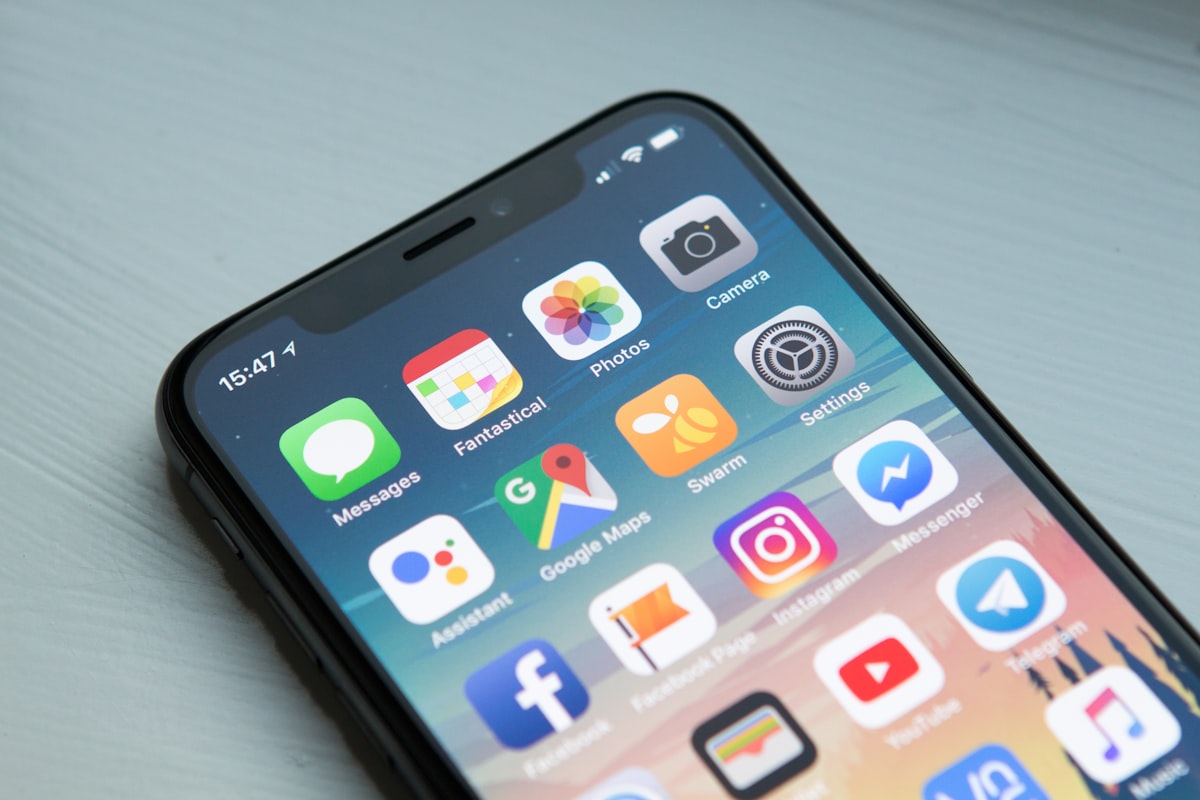
Short answer: download Pleco today — it is free, and every serious Mandarin learner uses it. If you want a structured course, add HelloChinese. If you are past the beginner stage and still cannot read anything real, the app you are missing is Du Chinese.
Everything else on this page depends on what you are actually trying to fix. Below are ten Mandarin apps worth your time, what each one genuinely does well, where each one stops, and what they cost. Prices were checked in September 2026 and are listed in US dollars — your app store will convert, and regional pricing varies.
I teach Mandarin one-on-one, which means I meet learners who arrive from every app on this list. That shapes what follows. I am less interested in feature lists than in what a person can actually do after six months with each of these — and there is a large gap between the two.
Which app should you download?
The fastest way to choose is to name the problem you are actually having.
- Starting from zero
- HelloChinese — the only free course built for Mandarin rather than adapted to it.
- Looking things up
- Pleco — the dictionary. Free, offline, and non-negotiable.
- Vocabulary that sticks
- Anki — spaced repetition, free on desktop and Android.
- Cannot read real Chinese
- Du Chinese — graded stories with tap-to-translate and audio.
- Cannot write characters
- Skritter — stroke-by-stroke handwriting with correction.
- Nobody to speak to
- HelloTalk — native speakers, free, with all the caveats below.
- Stuck after HSK 3
- The Chairman’s Bao — graded news, the bridge to native material.
The Mandarin apps compared
Three columns matter more than the rest, because they are where Mandarin apps quietly differ: whether the app teaches tones as a system rather than a label, whether it builds character knowledge or lets you lean on pinyin forever, and whether it gives you any real speaking practice at all.
Scroll the table sideways to compare tones, characters and speaking.
| App | Free tier | Paid from | Tones | Characters | Speaking |
|---|---|---|---|---|---|
| Pleco | Full dictionary | US$29.99 once | Reference | Strong | None |
| HelloChinese | First levels | US$11.99/mo | Strong | Good | Recorded |
| Du Chinese | Sample lessons | US$14.99/mo | Audio only | Strong | None |
| Anki | Desktop, Android | US$24.99 once | Your decks | Your decks | None |
| Skritter | 1-week trial | US$14.99/mo | Drilled | Strong | None |
| Duolingo | Full course | US$12.99/mo | Weak | Recognition | Recorded |
| HelloTalk | Generous | US$6.99/mo | Peer feedback | Incidental | Strong |
| The Chairman’s Bao | None | US$11/mo | Not taught | Strong | None |
| LingoDeer | First unit | US$8.99/mo | Introduced | Recognition | Recorded |
| ChinesePod | Limited lessons | US$29/mo | Explained | Transcripts | None |
Prices checked September 2026, in US dollars, before regional conversion or store promotions. “Recorded” speaking means the app compares your audio to a model and scores it — useful for confidence, not a substitute for being corrected by a person.
The ten apps, in detail
1. Pleco — the one app every learner needs
Free core app · iOS and Android · Paid bundles from US$29.99, one-time
Pleco is not a course and does not pretend to be one. It is a Chinese dictionary, and it is the single most useful thing on a Mandarin learner’s phone. Type a word, draw a character you cannot type, or point your camera at a menu and read the translation live. Every entry gives you pinyin, tone, meaning, stroke order, example sentences and native audio.
The free version is genuinely complete — this is not a trial. Paid add-ons buy you academic dictionaries, better handwriting recognition and a document reader, sold individually or as bundles. Most learners never need them, and the ones who do will know exactly why.
Where it stops: Pleco will not teach you anything. It answers questions; it does not ask them. A learner who only has Pleco has a magnificent reference and no curriculum.
Get it if: you are learning Mandarin at all. Start here, today, before anything else on this page.
2. HelloChinese — the best free beginner course
Free tier · iOS and Android · Premium from US$11.99/month or US$69.99/year
HelloChinese was designed for Mandarin from the ground up, and it shows in the one place it matters most: tones. It introduces the four tones with pitch contour diagrams, drills tone pairs separately from vocabulary, and keeps returning to them as sentences get longer. That is the correct order, and almost nothing else on this list does it.
The course runs from zero through roughly HSK 2–3, covering pinyin, characters, grammar patterns and listening. Lessons are five to ten minutes, and the character writing practice is better than it needs to be. The free tier is usable on its own; Premium unlocks the later units, offline mode and the review tools.
Where it stops: it runs out. Somewhere around HSK 3 the course ends and you are left needing real reading and real conversation, neither of which HelloChinese provides. Its speech scoring is also generous — it will pass a third tone that a listener in Chengdu would not.
Get it if: you are starting from zero and want one structured path rather than five half-finished ones.
3. Du Chinese — the app that finally makes you read
Free sample lessons · iOS, Android and web · From US$14.99/month or US$119.99/year
Du Chinese is a library of graded stories, from absolute beginner through advanced, each with native audio, a pinyin toggle and tap-any-word translation. You read something real, you tap what you do not know, and the word goes into a review list. New lessons are added continually.
This fills the gap that sinks most self-taught learners. Courses teach you sentences; dictionaries define words; nothing in between gives you volume. Reading volume is what converts a vocabulary list into recognition fast enough to be useful, and Du Chinese is the most pleasant way to get it.
Where it stops: it is input only. You will finish a year of Du Chinese able to read far above the level at which you can speak, which is a real and slightly demoralising imbalance.
Get it if: you have finished a beginner course and cannot read a sentence you have not been taught. If you want to work on the characters themselves first, start with how Chinese characters actually work.
4. Anki — vocabulary that does not fade
Free on desktop and Android · US$24.99 one-time on iOS
Anki is a spaced repetition system, which means it shows you a card at the moment you are about to forget it rather than on a fixed schedule. The effect on vocabulary retention is large and well documented, and it is why medical students and language learners have used it for fifteen years.
For Mandarin it is particularly strong, because characters reward exactly this kind of review. Thousands of shared decks exist — HSK levels, radicals, sentence banks — and the iOS app is the only paid piece, a one-time purchase that funds the free versions everywhere else.
Where it stops: Anki does what you tell it, including the wrong thing. A downloaded deck with poor audio, missing tone marks or English-first prompts will train those flaws into you efficiently. The best decks are the ones you build from words you actually met, which takes discipline most people do not have in month one.
Get it if: you are working towards an HSK level and need several thousand words to stay put. Pair it with the HSK vocabulary lists rather than a random deck.
5. Skritter — handwriting, properly corrected
One-week free trial · iOS, Android and web · From US$14.99/month or US$99.99/year
Skritter has you write characters stroke by stroke on the screen and corrects you as you go — wrong stroke order, wrong direction, wrong proportion. It then schedules each character for review using spaced repetition, so what you write stays written. It supports HSK lists and most major textbook series.
Handwriting is the skill learners drop first and regret losing. Writing a character by hand builds a much more durable memory of it than recognising it on a screen, which is why it survives in classrooms long after everyone started typing. If you intend to sit a written HSK paper, this is not optional.
Where it stops: it is narrow and it is not cheap. Skritter does one thing. If handwriting is not a goal, your money is better spent elsewhere.
Get it if: you are sitting a written exam or want genuine reading depth. For a free alternative, our own Chinese writing practice tool gives stroke-order coaching on a 米字格 (mǐ zì gé) grid with printable worksheets, and the eight stroke order rules are worth twenty minutes before you start.
6. Duolingo — good at the thing it is good at
Free with ads · iOS, Android and web · Super from US$12.99/month or US$83.99/year
Duolingo takes more criticism from serious learners than it deserves, usually for failing at a job it never claimed. Its Mandarin course is adapted from a template built for European languages, so it under-teaches tones and over-teaches translation. Judged as a Mandarin course, it is the weakest thing on this list.
Judged as a habit machine, it is the best. The streak, the three-minute lessons and the notifications are engineered to bring you back daily, and daily contact with a language beats intense contact twice a month. For a lot of people Duolingo is the difference between studying and intending to study.
Where it stops: it gives a convincing feeling of progress that the progress does not always justify. A long streak and a high level can coexist with tones you have never been corrected on. Treat the streak as attendance, not as achievement.
Get it if: consistency is your actual problem. Use it alongside something that teaches, not instead of it.
7. HelloTalk — real people, with real caveats
Generous free tier · iOS and Android · VIP from about US$6.99/month or US$45.99/year
HelloTalk pairs you with native speakers for language exchange — text, voice notes and calls — with correction tools built into the chat so someone can fix your sentence inline. You help them with English, they help you with Mandarin. It is free for the parts that matter.
It is the only app here that produces the thing learners are most short of: the experience of being understood, or not, by a person who was not expecting your sentence. That experience is worth more than any number of lessons about it.
Where it stops: your partner is a native speaker, not a teacher, and those are different jobs. Native speakers are excellent at noticing something is wrong and poor at explaining why, which is why the most common correction you will receive is a rewritten sentence with no reason attached. Conversations also drift towards small talk, and the platform has a well-known tendency to be used as a social app rather than a study one.
Get it if: you have vocabulary and no outlet. Set a topic before each exchange or it will become a pen-pal service.
8. The Chairman’s Bao — the bridge to native material
No free tier · iOS, Android and web · From US$11/month or US$88/year
The Chairman’s Bao rewrites current news stories at graded difficulty from HSK 1 to HSK 6, with audio, word lists and grammar notes on each article. New pieces appear constantly, so unlike a textbook it never goes stale.
It solves the specific problem of the intermediate plateau. At HSK 3 you know enough words to read a real article and not nearly enough to enjoy one; graded news sits exactly in that gap and pulls you across it. Reading about something that happened this week also does something a textbook cannot — it makes the language feel current rather than preserved.
Where it stops: there is no free tier, and it assumes you already have grammar. Below HSK 2 it will be discouraging rather than useful.
Get it if: you are at HSK 3 or above and your reading has stalled on textbook dialogue.
9. LingoDeer — for learners who want the grammar explained
First unit free · iOS, Android and web · From US$8.99/month or US$35.99/year
LingoDeer was built for Asian languages rather than adapted to them, and its distinguishing feature is that it explains things. Each unit comes with a written grammar note that tells you why a sentence is ordered the way it is, instead of leaving you to infer the rule from twenty examples.
For adults this matters. Adult learners are generally faster when given the rule and then the practice, and Mandarin word order is different enough from English that guessing is slow. LingoDeer is the most comfortable of the course apps for anyone who likes to know what is going on.
Where it stops: the Mandarin course is smaller than HelloChinese’s and its tone work is lighter. As a second course it is redundant; as a first one it is a reasonable alternative if the explanatory style suits you.
Get it if: you bounced off HelloChinese or Duolingo because neither told you why.
10. ChinesePod — twenty years of listening practice
Limited free lessons · iOS, Android and web · Premium from US$29/month
ChinesePod is a very large library of dialogue-based audio lessons, graded from newbie to advanced, each built around a realistic scene — ordering, arguing about a bill, a job interview — and then unpacked in English. Two decades of back catalogue means almost any situation you can think of has a lesson.
Listening is the skill that lags furthest behind in self-study, because reading can be done slowly and listening cannot. ChinesePod trains the ear on natural pace and natural reduction, which textbook audio deliberately avoids.
Where it stops: at US$29 a month it is easily the most expensive option here, and the library’s age shows in places — some older lessons carry references and audio quality from another era. Judge it on the current tier before committing to a year.
Get it if: your listening is the weak link and you have a commute to fill.
What app learners actually arrive knowing
Feature lists are easy to write and tell you very little. What is more useful is the shape of the learner each approach produces — and because I teach one-on-one, that is the part I see. Four patterns come up again and again in a first lesson with someone who has been studying alone.
A large vocabulary and no sentences
This is the most common of the four, and it comes from flashcard-heavy study. The learner recognises several hundred words instantly and cannot assemble twenty of them into speech on demand. Recognition and production are separate skills, and apps train the first far harder than the second, because the first is easy to test with a tap.
The fix is cheap but uncomfortable: produce before you are ready. Say the sentence badly, out loud, and let it be corrected.
Tones that are correct alone and wrong together
Most apps teach the four tones in isolation, one syllable at a time, and most learners can produce them perfectly that way. Then two syllables meet and the system falls apart, because Mandarin changes tones in combination and almost nothing on this list drills that.
The clearest example is the one every beginner says on day one. 你好 is written nǐ hǎo, two third tones — but nobody says it that way. The first shifts to a rising tone, so it comes out as ní hǎo. A learner who has only ever been shown the written pinyin will say it wrong for years without a single app objecting. If this is new to you, our guide to tone sandhi covers the rules, and the tones cheatsheet has audio for every pair.
Reading pinyin, not reading Chinese
Pinyin is scaffolding, and scaffolding left up too long becomes the building. Because most apps display pinyin alongside characters by default, the eye learns to take the easy route, and a learner can complete a whole beginner course while the characters remain decorative.
You can usually tell within a minute: ask someone to read a sentence with the pinyin hidden and watch what happens. Turning the toggle off early is one of the highest-value decisions a self-taught learner can make. Starting from the most common characters makes it much less painful, because a small core does a very large share of the work.
No plan for being misunderstood
Apps are a cooperative environment. They wait, they accept near-misses, and they never look confused. Real conversation is not like that, and the moment that ends most beginners’ first real exchange is not a missing word — it is the silence after someone does not understand them.
Knowing how to rephrase, how to ask someone to slow down, and how to say you did not catch that is a learnable skill, and it is the one that turns study into conversation. It is also the single thing no app on this page will ever teach you, because it only exists in the presence of someone who might genuinely misunderstand you.
How to stack them by level
You do not need all ten. You need two or three that cover different jobs, and the right combination changes as you improve. Thirty minutes a day across the right apps beats two hours across the wrong ones.
Absolute beginner
- HelloChinese — fifteen minutes daily as your course.
- Pleco — open whenever you meet a word.
- Duolingo — only if you struggle to show up at all.
Do not add a fourth. At this stage the risk is not too little material, it is too many parallel courses and no finished one.
HSK 1 to 2 — the vocabulary years
- Anki — ten to twenty minutes of review, first thing.
- Du Chinese — one graded story a day, pinyin off after the first read.
- Skritter — only if you are sitting a written paper.
This is the stage where reading volume starts to matter more than new lessons. A story a day for three months changes what you can read more than another course will.
HSK 3 and beyond — the plateau
- The Chairman’s Bao — graded news, to get off textbook dialogue.
- ChinesePod — listening at natural speed, on the commute.
- HelloTalk — two real exchanges a week, with a topic set in advance.
The plateau is not a vocabulary problem. It is an output and listening problem, and the apps that got you here are not the ones that get you out. If it is taking longer than you expected, how long it takes to learn Mandarin sets realistic expectations against the hours you are putting in.
The one thing no app does
Every app on this page shares a limitation, and it is worth naming plainly now rather than at the top, where it would have read as a sales pitch before you had the information you came for.
None of them can hear you properly. Speech scoring compares your audio to a model and returns a number, and it is lenient by design — an app that rejected learners constantly would be abandoned in a week. So it passes things a listener would not. In Mandarin that matters more than in most languages, because pitch carries meaning: 妈 (mā) is mother, 麻 (má) is hemp, 马 (mǎ) is horse and 骂 (mà) is to scold. Same syllable, four words.
What is missing is not correction, exactly. It is the loop — someone who hears the error, knows which of several causes produced it, gives you the fix, and then listens to whether the fix took. That loop is what stops a small habit becoming a permanent one, and it is the difference between a learner who is understood and one who is almost understood.
Apps are genuinely good at the rest. Use them for vocabulary, reading, listening and daily contact — they are better at those than any classroom. Just do not expect them to tell you what you sound like. For a fuller comparison of the three ways to learn, see online lessons versus apps versus classroom, and if you are weighing up teachers, how to choose a Mandarin teacher covers what to look for.
Books worth pairing with an app
Apps are good at drilling and poor at explaining. A reference you can open flat next to your laptop still earns its place, particularly for grammar.
- Integrated Chinese — the standard university series, and the one most teachers will already know.
- HSK Standard Course — written to the exam, so use it if you are sitting one.
- Chinese Character Writing Workbook — pairs directly with Skritter or with pen and paper.
- Chineasy by ShaoLan — a visual introduction to characters, and the gentlest way in for anyone intimidated by them.
This post contains affiliate links. If you purchase through them, I may earn a small commission — at no extra cost to you.
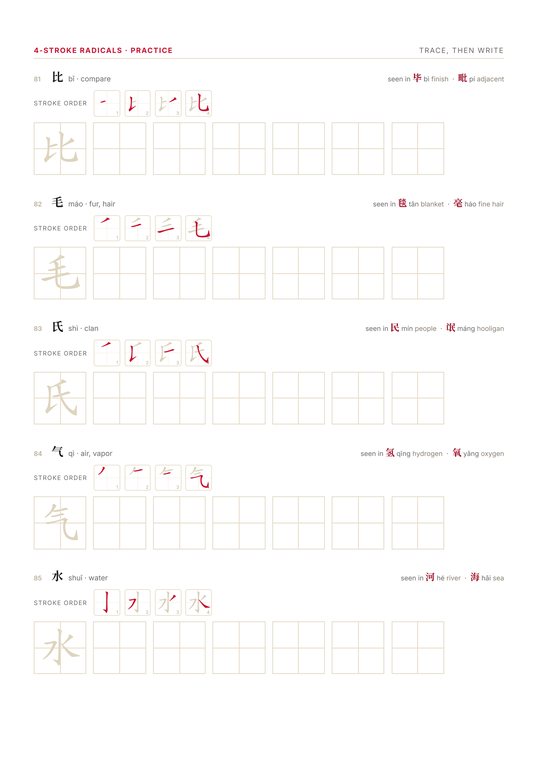
No app on this list teaches handwriting properly.
The 214 Radicals Complete Pack
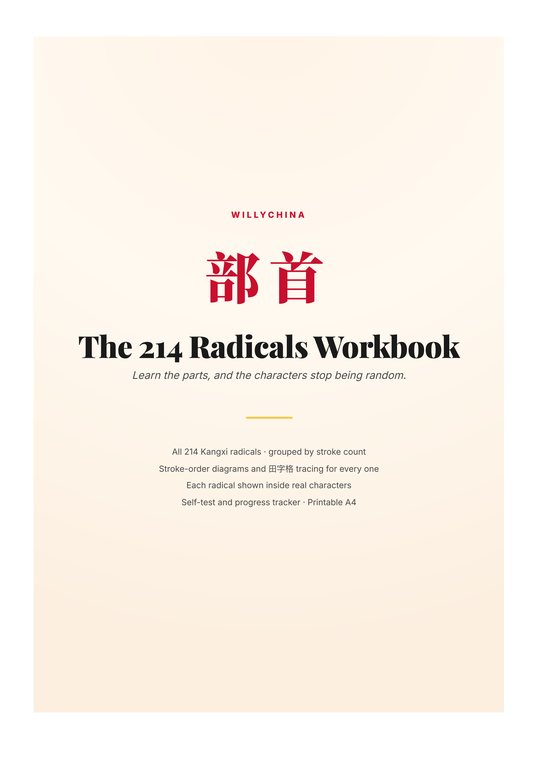
That is the one gap every app here leaves. The 214 Radicals Complete Pack is a 69-page workbook with stroke-order diagrams and 田字格 (tián zì gé) tracing for all 214 radicals, each shown inside real characters, plus 830 audio files and three Anki decks.
See what is inside — US$21One payment · instant download · yours to keep