A Guide to Hubei (湖北): Wuhan, the Three Gorges & Wudang
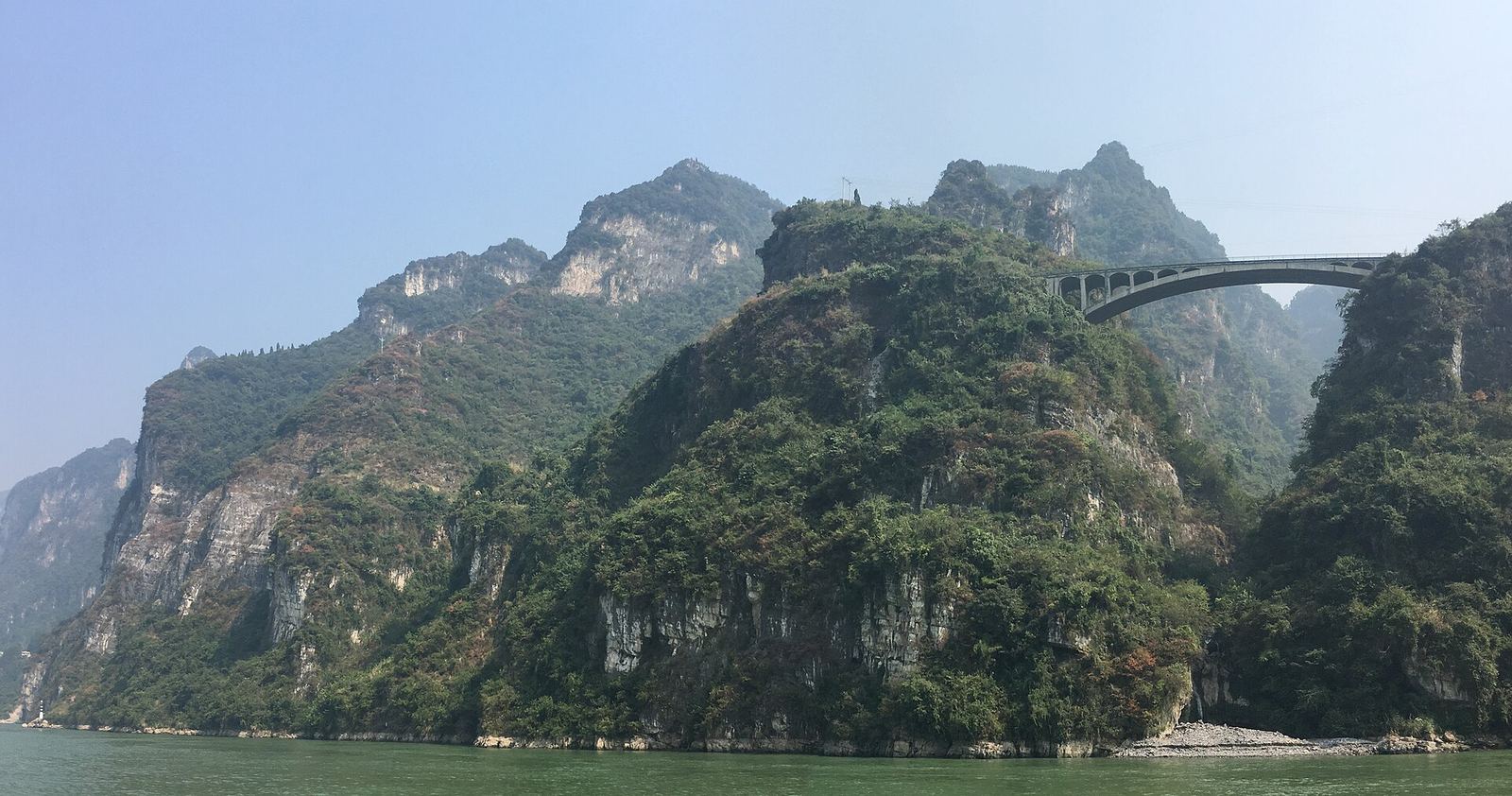
Hubei (Húběi) sits in the middle of China, in the middle of the Yangtze, and has spent most of the last three thousand years being the place everyone else had to pass through. The name means “north of the lake” — the lake being Dongting, just over the border in Hunan — and the province lives up to its old nickname, 千湖之省 (qiān hú zhī shěng), “the province of a thousand lakes”.
It is a province of big water and big history: the Yangtze cutting through the Three Gorges, the bronze bells of an ancient kingdom, the mountain where Taoist martial arts were said to begin, and Wuhan — three river towns fused into one of China’s great cities, where the day starts with a bowl of noodles eaten standing up.
A brief history of Hubei
Long before there was a China in the modern sense, this was the heartland of Chu 楚 (Chǔ), the great southern kingdom of the Zhou era. Chu was large, rich and culturally distinct from the states of the Yellow River plain — its art was wilder, its religion full of shamans and river spirits — and its capital, Ying 郢 (Yǐng), stood near present-day Jingzhou. Hubei people still use 楚 as a proud shorthand for their home.
Chu’s most famous son was the poet Qu Yuan, traditionally said to have been born at Zigui on the Yangtze, whose drowning in the Miluo River is remembered every year at the Dragon Boat Festival. Its most astonishing surviving treasure is the set of bronze bells from the tomb of the Marquis Yi of Zeng, found at Suizhou in 1977 and excavated the following year. The sixty-five bells date from around 433 BC, carry more than three thousand characters of inscriptions, most of them about music and pitch, and they can still be played. They are the centrepiece of the Hubei Provincial Museum in Wuhan.
Hubei’s position on the middle Yangtze made it a battleground whenever China split apart. Much of the Romance of the Three Kingdoms happens here: Jingzhou was the prize every warlord wanted, and the Battle of Red Cliffs 赤壁之战 (Chìbì zhī zhàn) in 208 AD, when an alliance of southern forces burned Cao Cao’s fleet, is traditionally placed on this stretch of river, at the city that now carries the name Chibi.
The modern province was shaped by trade. Hankou became a treaty port in 1861, and foreign concessions, banks and tea merchants lined its riverfront. On 10 October 1911 an uprising at Wuchang set off the revolution that ended two thousand years of imperial rule. Wuchang, Hankou and Hanyang were first joined under the name Wuhan in 1927 and merged for good in 1949, and in 1957 the first bridge across the Yangtze finally tied the city’s two banks together.
The Hubei dialect and Standard Mandarin
About two-thirds of Hubei speaks Southwestern Mandarin 西南官话 (xīnán guānhuà) — the same broad family as the speech of Sichuan and Chongqing. That is good news for learners: it is a form of Mandarin, not a separate language like Cantonese or Shanghainese, and the grammar is broadly the grammar you have learnt. The east is different again: it speaks Jianghuai Mandarin, and the south-east has pockets of Gan.
The Wuhan accent is another matter. It is fast, loud and famously blunt — Wuhan people will tell you themselves that what sounds like an argument is usually just a conversation. The tones sit differently from the standard, and the everyday vocabulary has its own flavour, much of it from the river-port slang of old Hankou. Hubei people have a saying they enjoy repeating about themselves: 天上九头鸟,地下湖北佬 (tiānshàng jiǔtóuniǎo, dìxià Húběi lǎo), “in heaven, the nine-headed bird; on earth, the Hubei folk” — a playful boast that nobody is sharper.
Six words you will genuinely hear. The audio plays the Standard Mandarin reading of each — a local speaker will colour them differently, but the characters are the same.
Phrases worth knowing in Hubei
Standard Mandarin, but pitched at this province — things you might actually say on a morning in Wuhan or a boat through the gorges.
Hubei cooking: fish, lotus and the breakfast capital
Hubei cuisine 鄂菜 (È cài) is a cuisine of lakes and rivers: freshwater fish, lotus root, steamed dishes and soups, with a moderate chilli heat that sits between the fire of Hunan and the gentler cooking of the east. But the thing visitors remember is breakfast. Wuhan treats the morning meal as a sport — there is even a local verb for it, 过早 (guòzǎo), and most people do it on the street.
Notable cities of Hubei
Wuhan 武汉
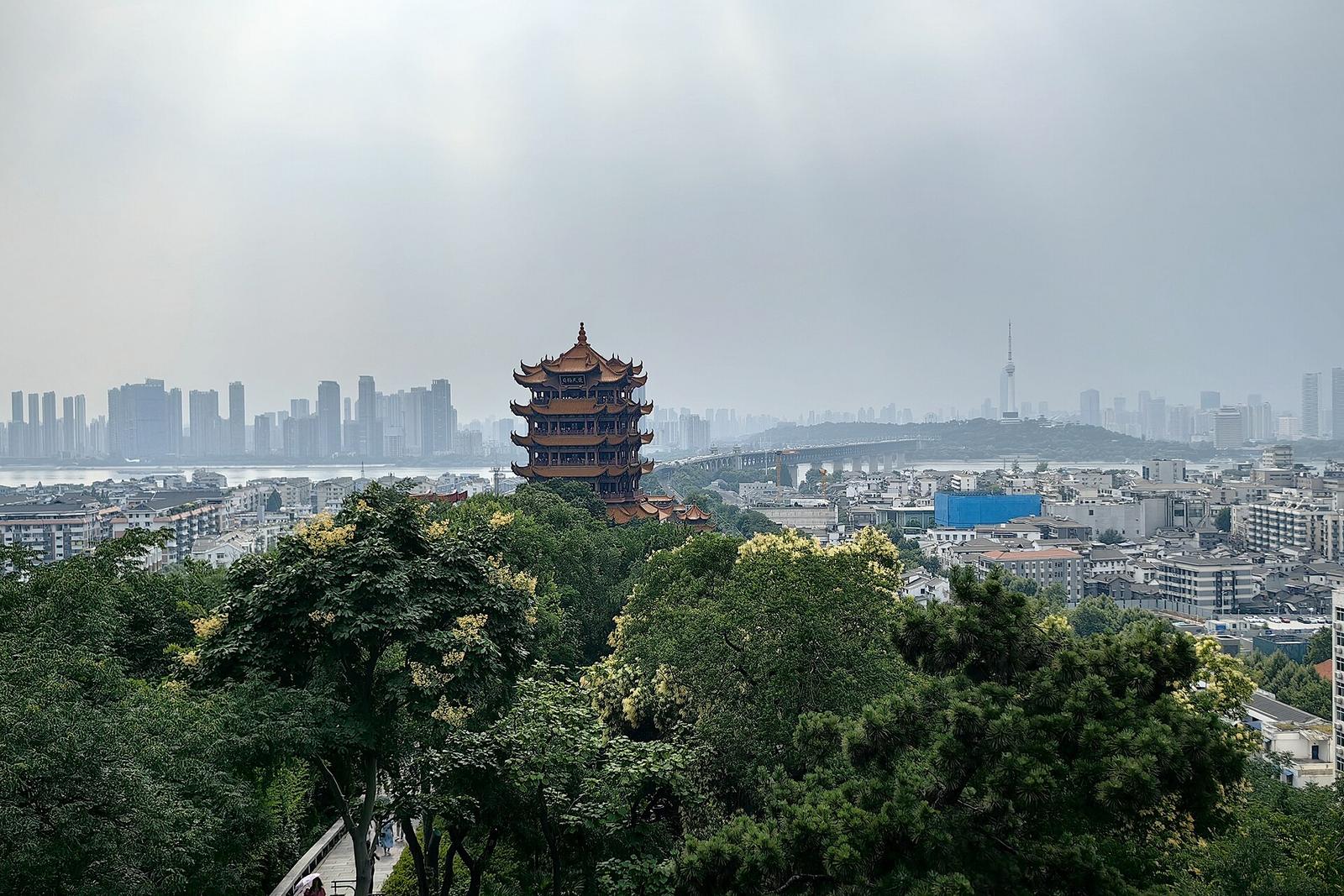
Three historic towns on two rivers — Wuchang, Hankou and Hanyang, where the Han River joins the Yangtze — make up one of China’s biggest and busiest cities. Hankou’s riverfront still has the banks and customs house of the treaty-port era, and East Lake 东湖 (Dōng Hú) is about six times the size of Hangzhou’s West Lake.
It is also a city of students, with well over a million in its universities, and a city that eats breakfast in the street. Come in spring for the cherry blossom at Wuhan University and East Lake; avoid July unless you enjoy heat.
Don’t miss: the Yellow Crane Tower, the 1957 Yangtze River Bridge, East Lake, Hubu Alley for breakfast, and the Hubei Provincial Museum.
Yichang 宜昌
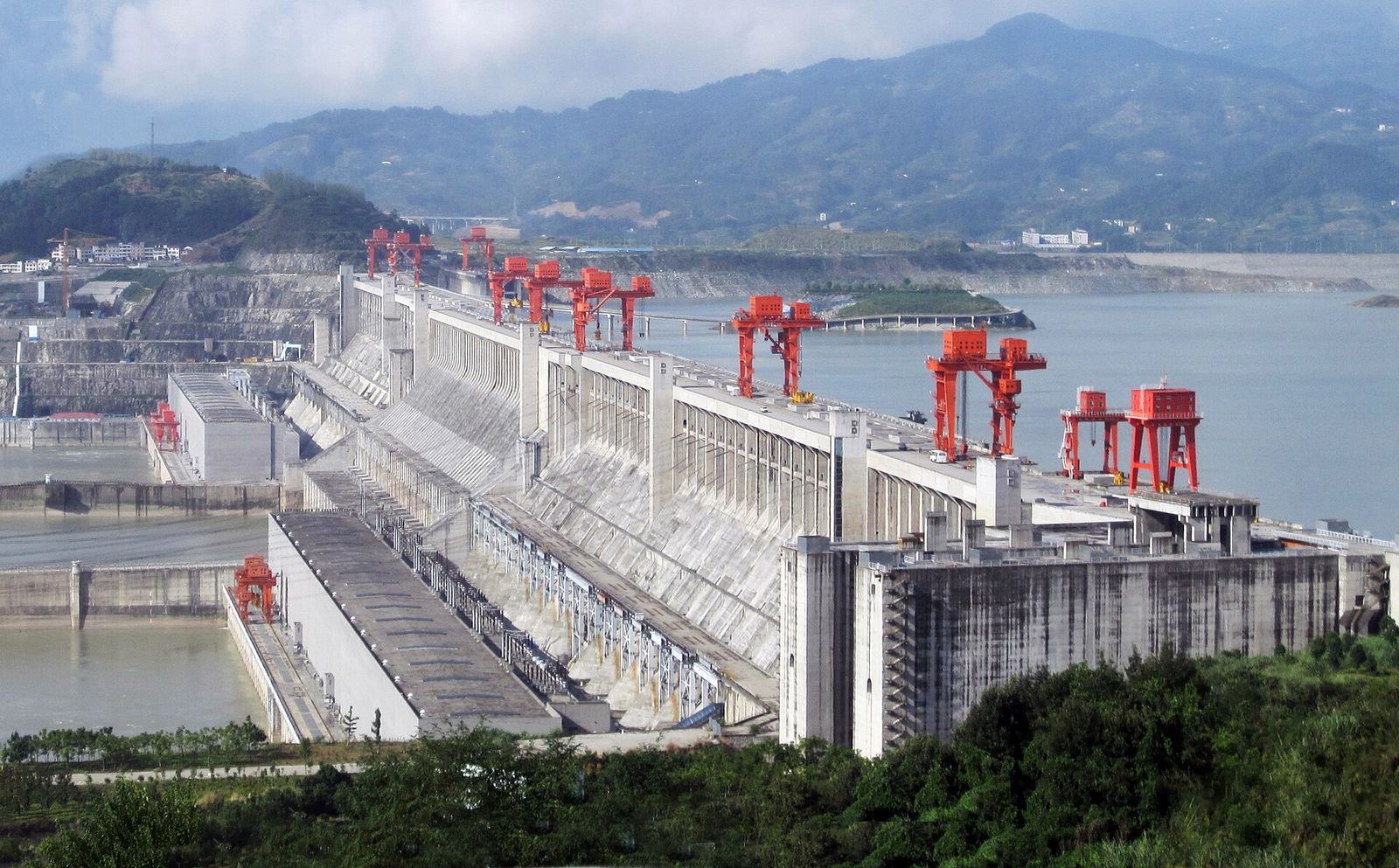
Yichang sits where the Yangtze leaves the mountains and spreads out onto the plain, which is exactly why the Three Gorges Dam was built just upstream. The dam is the largest power station in the world by installed capacity, and its visitor area looks down on the ship locks, which raise vessels more than a hundred metres in five steps.
Upstream lies Xiling Gorge 西陵峡 (Xīlíng Xiá), the longest of the three gorges, and the start of the river cruises to Chongqing. The poet Qu Yuan and the beauty Wang Zhaojun are both traditionally said to have come from these valleys.
Don’t miss: the dam’s viewing platform, Xiling Gorge by boat, and Qu Yuan’s memorial at Zigui.
Xiangyang 襄阳
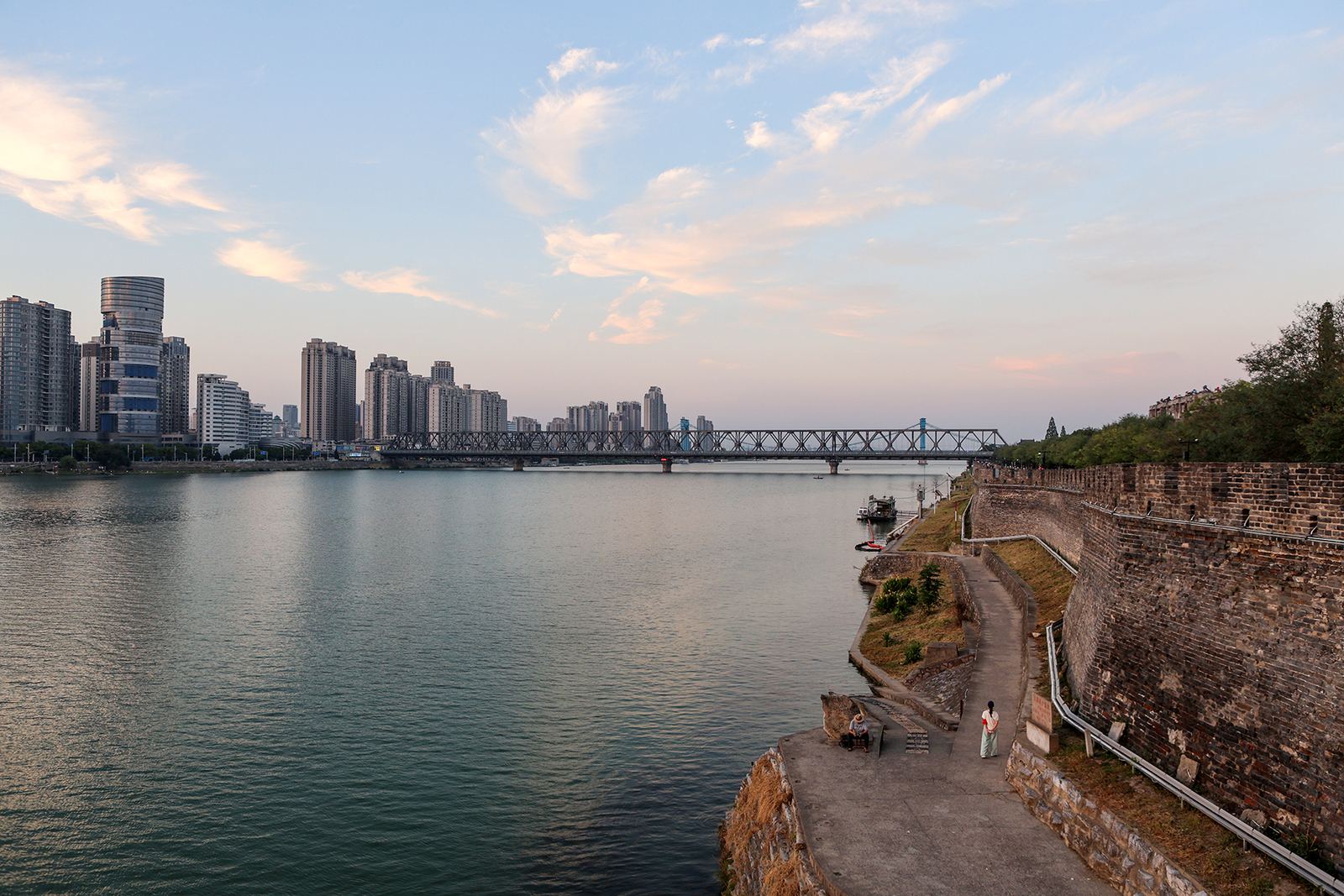
Xiangyang guards the Han River on the road between north and south China, and for two thousand years whoever wanted to cross had to take it first. Its city wall and broad moat are among the best preserved in the country, and its six-year siege, which ended in 1273, sealed the fate of the Song dynasty.
For Three Kingdoms readers it is holy ground: Gulongzhong 古隆中 (Gǔlóngzhōng), just outside town, is by tradition where the strategist Zhuge Liang lived in his thatched cottage until Liu Bei came to ask for his help three times. The poet Meng Haoran was born here too.
Don’t miss: the city wall and moat, Gulongzhong, and a walk along the Han River at dusk.
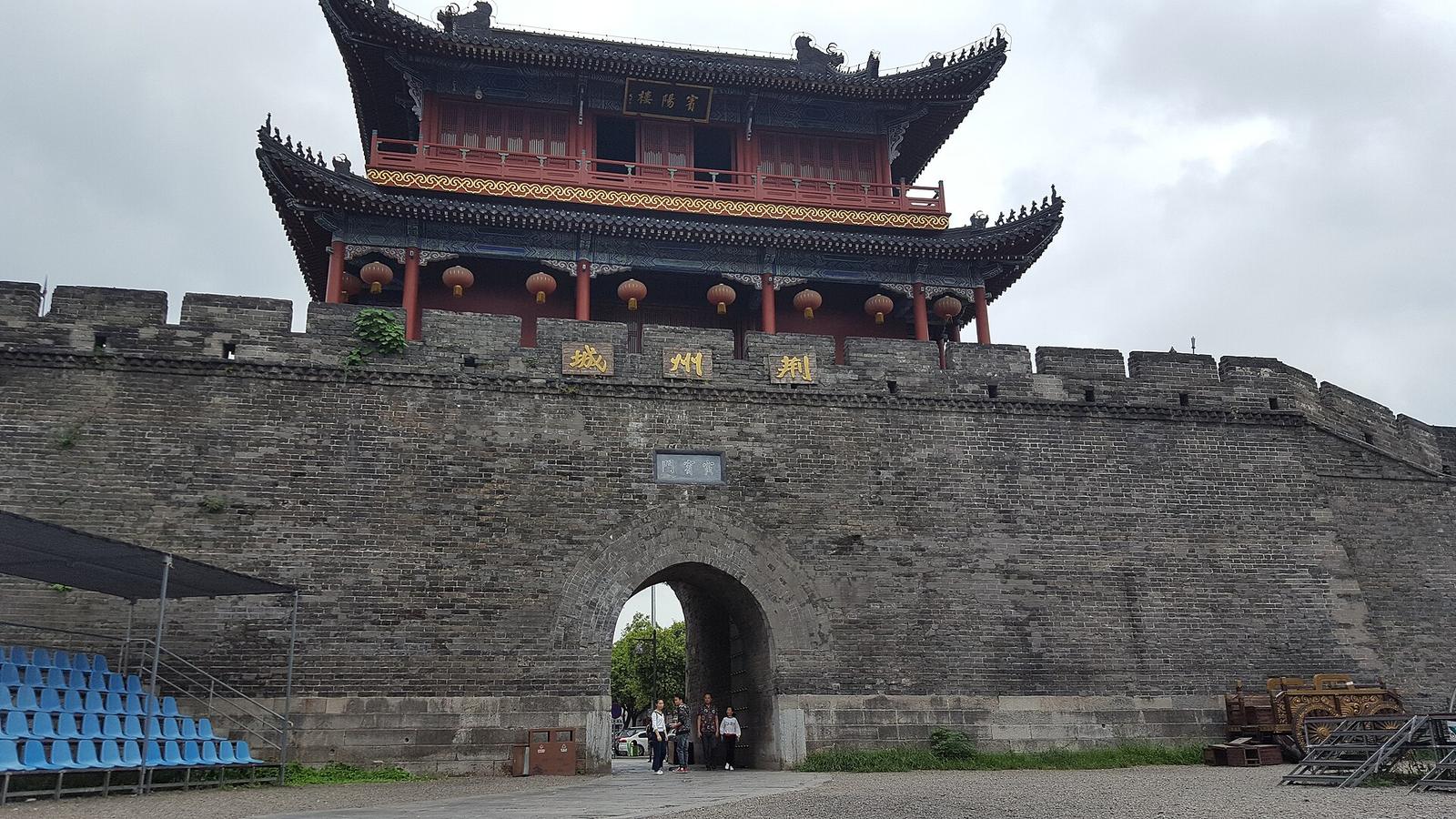
Jingzhou 荆州
Near Jingzhou stood Ying, the capital of the kingdom of Chu for some four hundred years, and the fields around the city are still giving up tombs, lacquerware and bamboo texts. The famous bronze sword of King Goujian of Yue was found at Jiangling, just outside town, in 1965.
The city itself is ringed by a complete wall about eleven kilometres around, rebuilt in 1646 on Ming foundations, with gate towers you can walk between. In the Romance of the Three Kingdoms, “borrowing Jingzhou” 借荆州 (jiè Jīngzhōu) became a byword for a loan that is never repaid.
Don’t miss: a walk or cycle on the city wall, the Jingzhou Museum, and the ruins of the Chu capital at Jinancheng.
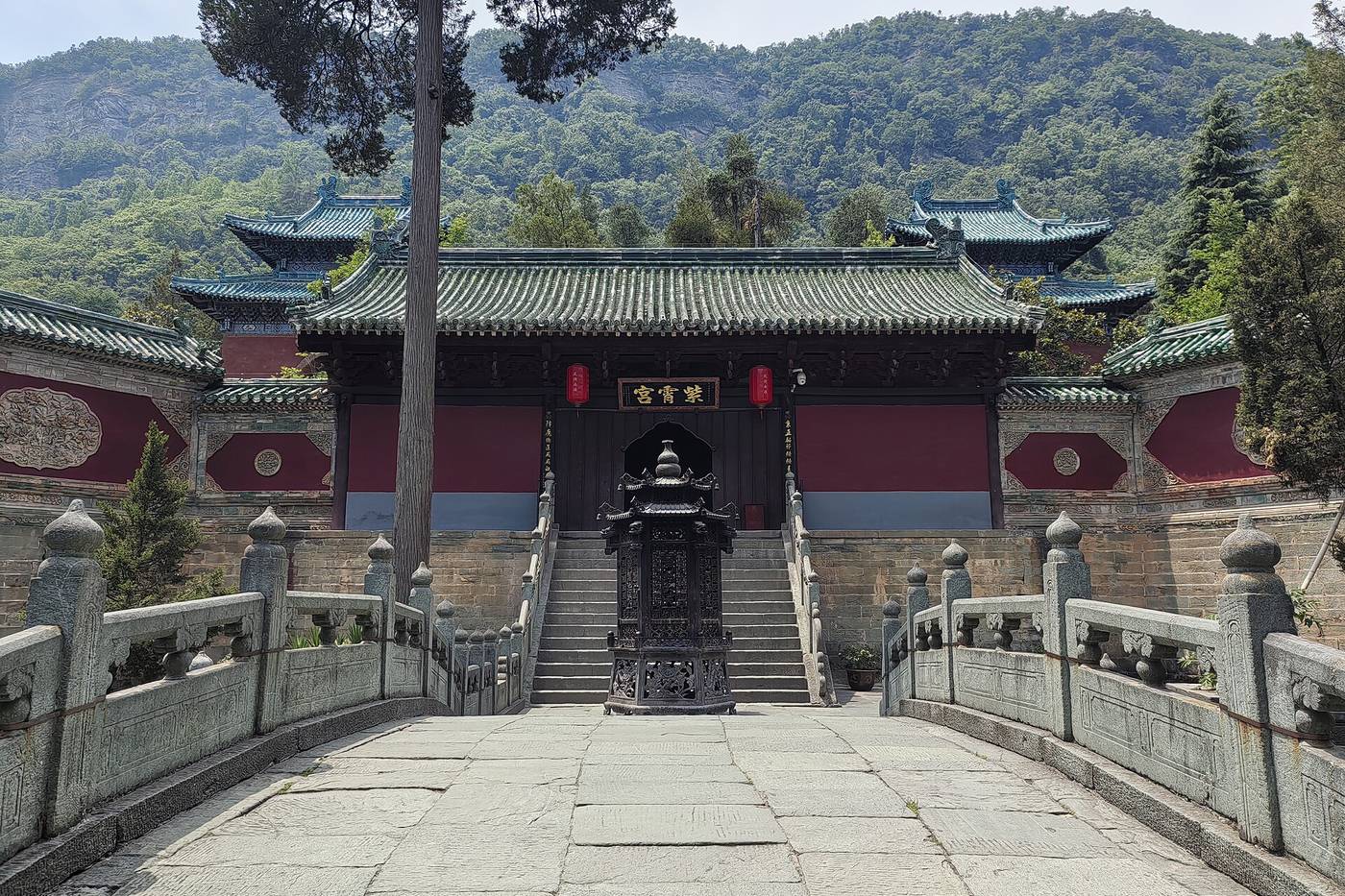
Shiyan 十堰
Shiyan grew up as a factory town: Dongfeng, one of China’s biggest car makers, was founded here in 1969 as the Second Automobile Works. Most visitors, though, come for the mountains on its doorstep, the Wudang Mountains 武当山 (Wǔdāng Shān).
Wudang is one of the great centres of Taoism, with Ming-dynasty palaces and temples strung along its ridges up to the bronze Golden Hall on the summit. Legend says the hermit Zhang Sanfeng invented tai chi here, and schools of Wudang martial arts still train on the mountain.
Don’t miss: the Purple Cloud Palace, the climb to the Golden Summit, and a morning tai chi class.
Iconic attractions across Hubei
Yellow Crane Tower 黄鹤楼
Wuhan’s emblem, on Snake Hill above the Yangtze. The present tower was built in the 1980s, but the site has been famous since the Tang dynasty, when Cui Hao wrote his poem 黄鹤楼 and Li Bai wrote his farewell to Meng Haoran here — both still learnt by Chinese schoolchildren.
The Three Gorges and the dam 长江三峡
Xiling Gorge and part of Wu Gorge lie in Hubei, the rest upstream in Chongqing. Below them the Three Gorges Dam, finished in 2006 and fully running from 2012, is the largest power station on earth; the ship lift beside it opened in 2016.
Wudang Mountains 武当山
Taoist palaces and temples spread over the peaks near Shiyan, many built under the Ming Yongle emperor. The Ancient Building Complex in the Wudang Mountains has been a UNESCO World Heritage Site since 1994.
Shennongjia 神农架
Deep forest in the far west of the province, home to golden snub-nosed monkeys and to Hubei’s highest peak at 3,105 metres. The name means “Shennong’s ladder”, after the legendary farmer-god who climbed here to gather herbs. A UNESCO World Heritage Site since 2016.
Hubei Provincial Museum 湖北省博物馆
One of the best museums in China. The sixty-five bronze bells of the Marquis Yi of Zeng and the gold-inlaid sword of King Goujian of Yue are the stars of a collection that tells the story of Chu.
Enshi Grand Canyon 恩施大峡谷
Limestone cliffs, plunging gorges and a lone stone pillar about 150 metres tall known as 一炷香 (yí zhù xiāng), “a single stick of incense”, in the Tujia and Miao country of the southwest.
Famous figures from Hubei
Qu Yuan 屈原
The great poet of the kingdom of Chu, traditionally said to have been born at Zigui. His drowning is remembered every year with dragon boats and sticky-rice dumplings at the Dragon Boat Festival.
Wang Zhaojun 王昭君
Born in what is now Xingshan County, she was sent from the Han court to marry a Xiongnu ruler and became one of the Four Beauties of Chinese legend.
Meng Haoran 孟浩然
A Tang poet who was born and died in Xiangyang. His four-line poem 春晓 (Chūn xiǎo), “Spring Dawn”, is one of the first poems Chinese children learn.
Li Shizhen 李时珍
Born in Qichun, he spent twenty-seven years writing the 本草纲目 (Běncǎo gāngmù), the Compendium of Materia Medica, the most famous book in the history of Chinese medicine.
Zhang Juzheng 张居正
Born in Jiangling, near Jingzhou, he ran the Ming government for ten years as Senior Grand Secretary and pushed through some of the dynasty’s boldest reforms to tax and administration.
Li Na 李娜
Born in Wuhan, she won the 2011 French Open and the 2014 Australian Open, becoming the first Asian-born player to win a Grand Slam singles title.
Hubei’s modern economy
Hubei is one of the engines of central China: its economy was worth about ¥6.27 trillion in 2025, seventh largest of all the provinces. Its strength comes from geography — the Yangtze and the Han River for shipping, and Wuhan at the crossroads of China’s north–south and east–west rail lines — and from industries planted here in the twentieth century.
Wuhan’s steelworks opened in 1958 and the car maker Dongfeng was founded in Shiyan in 1969; both are still giants. The newer story is the “Optics Valley” 光谷 (Guānggǔ) in Wuhan’s East Lake High-tech Zone, which makes a large share of the world’s fibre-optic cable, and a university population in Wuhan of well over a million students, one of the largest of any city in the world.
Cars
Dongfeng, founded in Shiyan and now based in Wuhan, anchors a car industry spread across the province.
Optics Valley
Wuhan’s high-tech zone makes optical fibre and cable, lasers and chips for markets around the world.
Hydropower
The Three Gorges Dam and the Gezhouba Dam below it send electricity from Yichang across central and eastern China.
Steel
Wuhan Iron and Steel, opened in 1958, is now part of China Baowu, one of the largest steel groups in the world.
Why Hubei matters for Mandarin learners
Hubei is a good place to test your Mandarin. The local speech is a cousin of the standard language rather than a different language, everyone you meet can switch to Standard Mandarin, and Wuhan people are talkative and direct. Order breakfast at a street stall at seven in the morning and you will get more listening practice in ten minutes than in a week of textbook dialogues.
It is also where a great deal of the Chinese you study comes from. The Dragon Boat Festival, the poems of Qu Yuan, Li Bai at the Yellow Crane Tower, Meng Haoran’s “Spring Dawn”, the idioms of the Three Kingdoms — all of them have roots in this province. Learners who know the stories behind the words remember the words far better.
For more on how the country fits together, our Explore China map covers every province, and the guide to China’s provinces puts Hubei in context. If the Wuhan accent intrigues you, the Mandarin pronunciation guide explains the tones that regional speech moves around.
Visiting Hubei — practical notes
When to go. Spring (March to May) and autumn (September to November) are best: mild, clear, and in early spring the cherry blossom is out at East Lake and Wuhan University. Wuhan is one of the old “furnaces” of the Yangtze, with July averaging about 29 °C and very humid, so summer is for the mountains of Shennongjia and Wudang rather than the city.
Getting there. Wuhan Tianhe International Airport has direct flights across China and Asia, and Wuhan is one of the great hubs of the high-speed rail network: about four hours from both Beijing and Guangzhou.
The gorges. Yichang is the Hubei base for the Three Gorges. You can visit the dam and take a day boat into Xiling Gorge, or join a multi-day river cruise upstream to Chongqing.
Eat the province. Breakfast is the meal to plan around in Wuhan: Hubu Alley in Wuchang is the famous street, but any busy corner stall at seven in the morning will do. Learn the word 过早 (guòzǎo) before you go.
Test your Hubei knowledge
1. What does the name Hubei mean?
2. What is Hubei’s one-character abbreviation?
3. In Wuhan, what does 过早 (guòzǎo) mean?
4. Which ancient kingdom had its heartland in Hubei?
5. Which mountains near Shiyan are a great centre of Taoism and tai chi?
6. Which of the Three Gorges lies wholly in Hubei?
FAQs
Photographs: Hero (Xiling Gorge, Yangtze River) by Fredlyfish4, CC BY-SA 4.0, via Wikimedia Commons; Wuhan (Yellow Crane Tower, Wuhan) by Uuongkinghe, CC BY-SA 4.0, via Wikimedia Commons; Yichang (Three Gorges Dam) by Le Grand Portage (derivative work: Rehman), CC BY 2.0, via Wikimedia Commons; Xiangyang (Han River at Xiangyang) by Windmemories, CC BY-SA 4.0, via Wikimedia Commons; Jingzhou (Binyang Tower, Jingzhou) by Fxqf, CC BY-SA 4.0, via Wikimedia Commons; Shiyan (Purple Cloud Palace, Wudang Mountains) by Yumeto, CC BY-SA 4.0, via Wikimedia Commons.
Start your Mandarin journey
Want to learn the Standard Mandarin spoken across Hubei and the rest of China? Online 1-on-1 lessons with a native speaker.