The Tang Dynasty · 618–907 · widely regarded as the golden age of Chinese civilisation
“The most cosmopolitan, confident and poetic age China ever knew.”
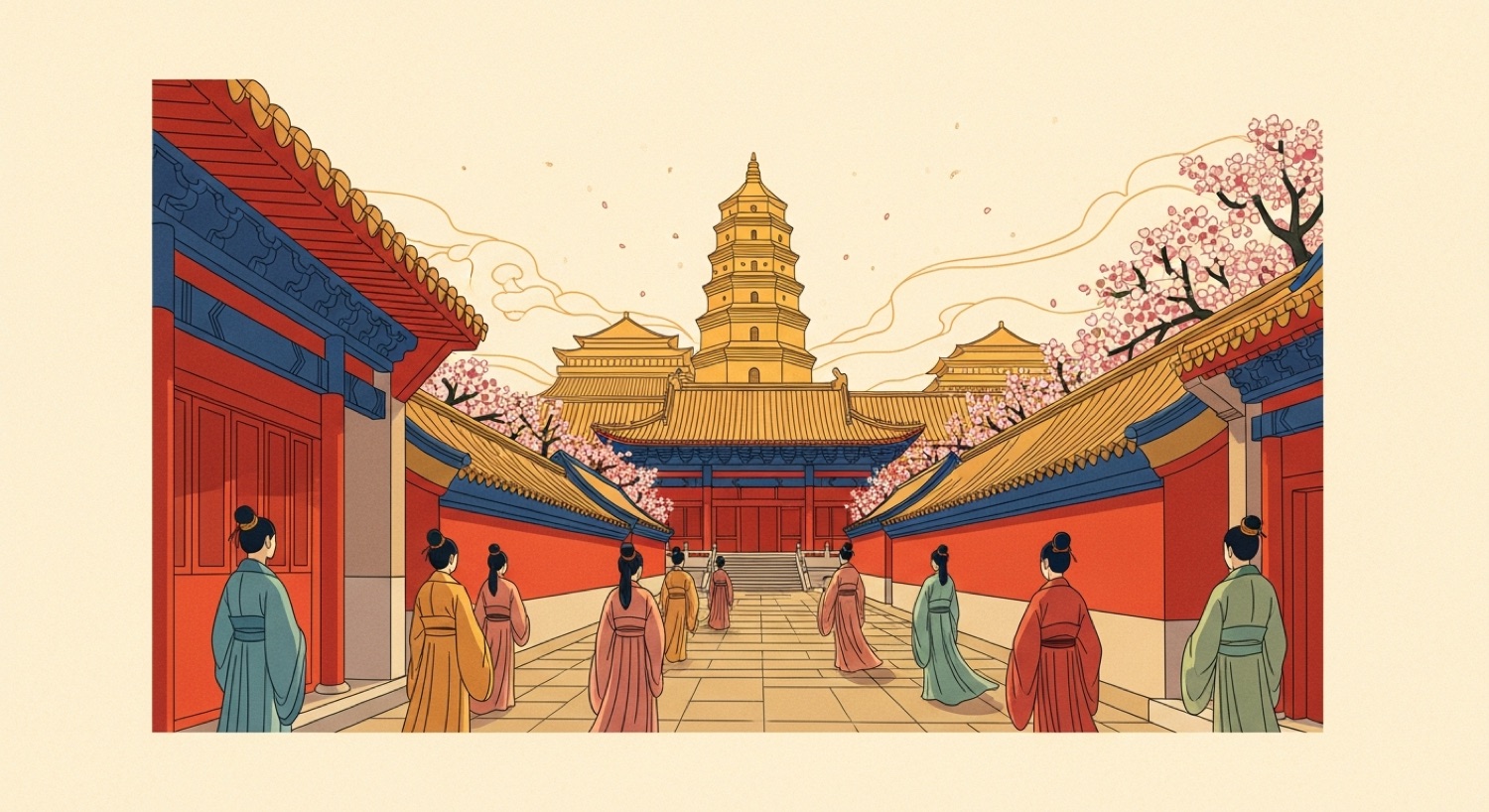
- Dates
- 618 – 907 (289 years)
- Capital
- 长安 Chang’an (modern Xi’an)
- Founder
- 李渊 Li Yuan (Emperor Gaozu)
- Peak population
- Chang’an > 1 million — world’s largest city
- Ruling house
- The Li 李 family
- Turning point
- The An Lushan rebellion (755–763)
China’s golden age
If you ask which age Chinese people look back on with the most pride, most will name the Tang (唐朝, 618–907). For nearly three centuries it was the richest, largest and most open-minded state on earth — a cosmopolitan empire whose capital, Chang’an, drew merchants, monks, musicians and students from Persia, India, Korea, Japan and Central Asia. At its height it was, by most counts, the biggest city in the world.
The Tang gave China some of its most enduring glories: the poetry of Li Bai and Du Fu, the maturing of the imperial examinations, block printing, the height of the Silk Road, and the only female emperor in the nation’s history. Its confidence ran so deep that overseas Chinese communities are still called 唐人 (“people of Tang”), and a Chinatown anywhere in the world is a 唐人街 — a “Tang people’s street.” This guide walks through the whole dynasty: its rulers, its institutions, its cities and its culture, and why it fell.
The rise of the Tang
The Tang rose from the wreckage of the short-lived Sui dynasty, whose ruinous wars against Korea and forced labour on the Grand Canal sparked nationwide revolt. In 617 a Sui aristocrat and garrison commander, Li Yuan, marched on the capital; the next year he declared himself Emperor Gaozu, founding the Tang. The Li family were a mixed Han–Xianbei aristocratic line from the north-west, at ease in both Chinese and steppe worlds — part of why the dynasty would be so open to the peoples beyond the frontier.
It was Gaozu’s brilliant, ruthless second son, Li Shimin, who actually won the empire, defeating rival warlords one by one. In 626, in the Xuanwu Gate Incident, he ambushed and killed his two brothers, then pressed his father to abdicate — taking the throne himself as Emperor Taizong. It was a bloody beginning to what became the model reign of Chinese history.
Emperor Taizong & the Zhenguan era
As Emperor Taizong (唐太宗), Li Shimin gave his name to the ideal of good government in China. His “Reign of Zhenguan” (贞观之治, 627–649) was remembered for just laws, light taxes, careful spending and, above all, a ruler who listened. He kept famously blunt ministers such as Wei Zheng, and is quoted as saying that an honest minister is a mirror in which a ruler can see his own faults.
Abroad, his armies shattered the Eastern Turkic Khaganate and pushed Tang power deep into Central Asia along the Silk Road; the Turkic and other steppe peoples acclaimed him as their “Heavenly Khan” (天可汗) — a Chinese emperor who was also the overlord of the steppe. The Zhenguan reign set the template of a confident, cosmopolitan, well-governed empire that the rest of the dynasty tried to live up to.
Wu Zetian: the only female emperor
No figure of the Tang is more extraordinary than Wu Zetian (武则天). A concubine of Taizong who became the favourite — then empress — of his son Emperor Gaozong, she ran the government during his illnesses, outmanoeuvred every rival, and in 690 took the throne in her own name, proclaiming a new “Zhou” dynasty. She remains the only woman ever to rule China as emperor, not as regent or dowager.
Her methods were ruthless — a network of informers and secret police, and the elimination of opponents — and traditional historians condemned her fiercely. Yet she was also a highly effective ruler: she widened the examination system, promoted officials on talent rather than birth, patronised Buddhism on a grand scale (the colossal Vairocana Buddha at the Longmen Grottoes is associated with her), and kept the empire strong. Forced to abdicate in 705, she asked to be buried under a famous “wordless stele” — a blank monument, leaving posterity to judge her.
The Kaiyuan golden peak
Under Emperor Xuanzong (唐玄宗, r. 712–756) the Tang reached its dazzling summit. The early decades of his reign, the Kaiyuan era (开元盛世, 713–741), were the empire’s high noon: efficient government, a booming economy, secure frontiers, and a court that was the artistic centre of the world. This was the age when Li Bai and Du Fu were young, when Chang’an glittered, and when Tang culture radiated across all of East Asia.
But the long reign curdled. The ageing emperor withdrew from affairs, infatuated with his beautiful consort Yang Guifei (杨贵妃), one of the legendary “Four Beauties” of China. Power fell to the wily chancellor Li Linfu and then to Yang Guifei’s cousin Yang Guozhong, while an ambitious frontier general of Sogdian–Turkic descent, An Lushan, built up huge armies on the north-eastern border.
The An Lushan rebellion
In December 755, An Lushan revolted and marched on the capitals. Luoyang fell, then Chang’an; the emperor fled south toward Sichuan. At the Mawei post-station, his own mutinous troops refused to go on until the hated Yang family was destroyed — and Xuanzong was forced to have his beloved Yang Guifei strangled, a tragedy retold ever after in Bai Juyi’s great poem, the Song of Everlasting Sorrow.
The rebellion dragged on for eight years, put down only with the help of loyal generals like Guo Ziyi and of Uyghur cavalry allies. When it ended in 763 the toll was staggering: whole regions were depopulated, the treasury was empty, and the registered population had collapsed — as much from the breakdown of the census as from death. The An Lushan rebellion is the great hinge of the dynasty: everything before it is the golden age; everything after is the long afternoon of a wounded empire.
The long decline & fall
The Tang survived another 150 years, but never regained full control of its own territory. Real power in the provinces passed to the jiedushi (节度使) — regional military governors who raised their own taxes and armies and passed their commands to their heirs, ruling as near-independent warlords. At court, palace eunuchs came to command the elite armies and even to make and unmake emperors. On the frontiers, a resurgent Tibetan Empire seized the north-west and briefly sacked Chang’an itself in 763.
The end came with the vast Huang Chao rebellion (875–884), which sacked Chang’an and shattered what remained of central authority. In 907 the warlord Zhu Wen deposed the last child-emperor and took the throne, ending the Tang and opening the fragmented age of the Five Dynasties and Ten Kingdoms.
Government & law
The Tang perfected a model of centralised bureaucracy so effective that it lasted, in essence, until 1912. At its heart stood the Three Departments and Six Ministries (三省六部): one department drafted policy, a second reviewed it, and a third carried it out through six ministries — Personnel, Revenue, Rites, War, Justice and Works. It was, in effect, an early separation of drafting, checking and executing power.
Tang law was equally influential. The Tang Code (唐律疏义) laid out crimes and precise punishments with a clarity admired ever since, and became the template for the legal systems of Japan, Korea and Vietnam. The empire was divided into prefectures and counties staffed by centrally appointed officials — a professional civil service governing a fifth of humanity.
Land, tax & the army
Early Tang society rested on the equal-field system (均田制), under which the state allotted land to peasant households and reclaimed it at death, in theory keeping wealth broadly spread. On it stood the fubing (府兵) militia — farmer-soldiers who served in rotation and supplied their own equipment, giving the early Tang a cheap, loyal army.
Both systems slowly broke down as land concentrated in great estates and frontier wars demanded permanent professional troops — the very armies that made the jiedushi so dangerous. In 780, the reformer Yang Yan (杨炎) swept away the old head-tax and introduced the Two-Tax System (两税法): households were taxed twice a year on their land and wealth rather than per head. It was a landmark in Chinese fiscal history, and endured in some form for 800 years.
The examination system
The Tang did more than any earlier dynasty to build the imperial examinations (科举, keju) into a real ladder of power. Candidates competed in written tests — famously including the composition of poetry — for coveted degrees such as the jinshi, the gateway to high office. Birth and connections still counted for much, but in principle a talented commoner could now rise through learning alone.
The result was the beginning of the scholar-official class — men schooled in the Confucian classics and in verse — who would administer China for the next thousand years. It is no accident that this was also the golden age of poetry: in Tang China, the ability to write a fine poem was quite literally a qualification for government.
Chang’an: the greatest city on earth
For much of the Tang, Chang’an (on the site of modern Xi’an) was simply the largest, richest city in the world — well over a million people inside walls enclosing some thirty square miles. It was laid out on a vast, strict grid of more than a hundred walled residential wards, split by the 150-metre-wide Vermilion Bird Avenue, with two great government-supervised markets. To the north lay the Imperial City of ministries and the sprawling Daming Palace.
Above all it was cosmopolitan. Sogdian and Persian merchants, Turkic soldiers, Korean and Japanese students, Indian monks and Arab traders lived and worshipped there side by side; Buddhist, Daoist, Nestorian Christian, Zoroastrian, Manichaean and Muslim houses of worship stood in the same city. So admired was Chang’an that Japan modelled its own capitals at Nara and Heian-kyō (Kyoto) directly on its grid plan.
Economy & the Silk Road
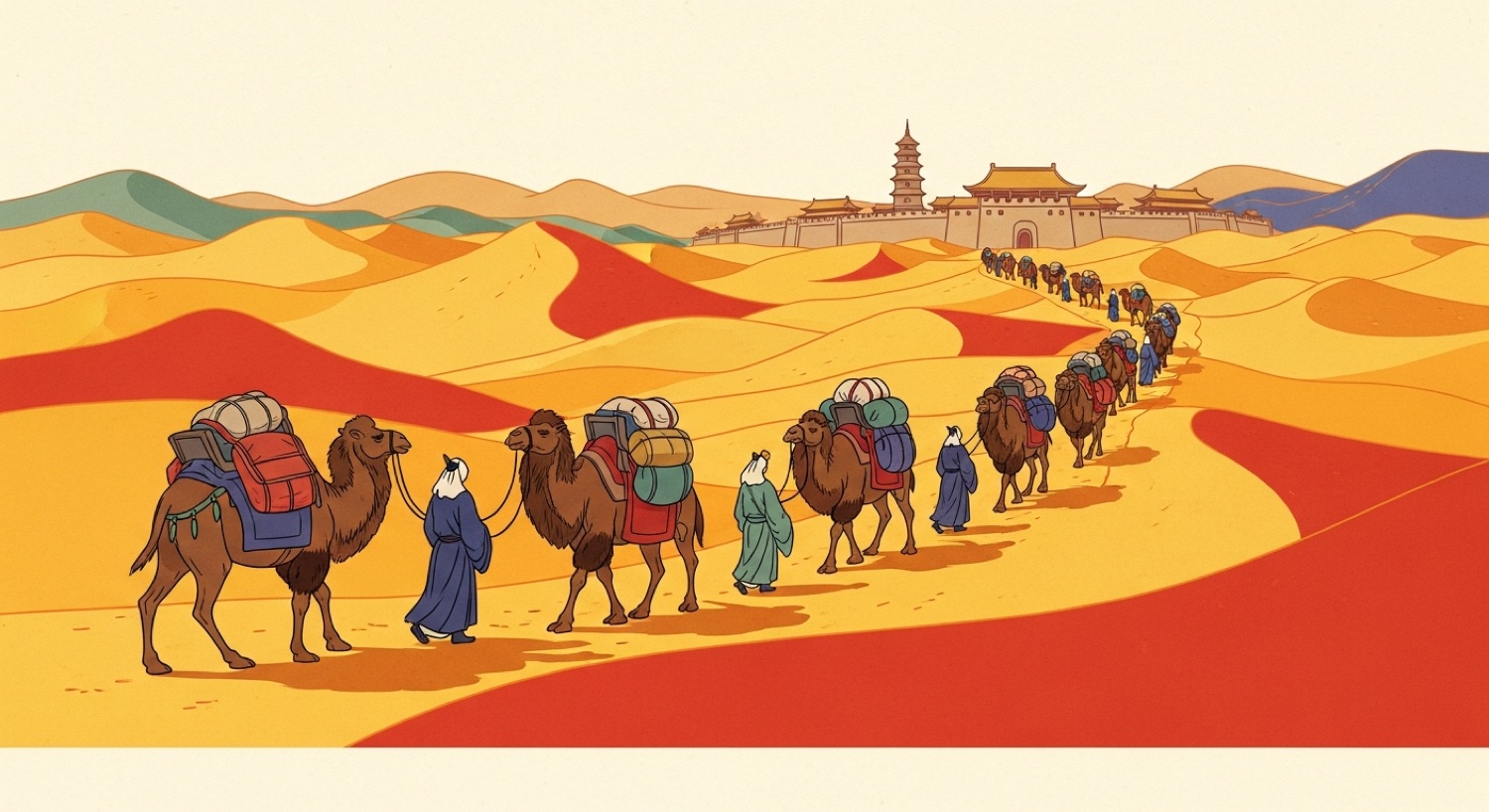
Under the Tang the Silk Road reached its greatest flowering. Camel caravans carried Chinese silk, tea, paper and porcelain west across Central Asia, and returned with horses, jade, spices, glassware, music and religions. But trade was not only overland: a booming maritime route brought Arab and Persian ships to Guangzhou (Canton), where the Tang appointed a Maritime Trade Commissioner to tax the incoming goods — the beginning of China’s great southern ports.
Inside the empire, the Grand Canal knit the rice-rich south to the northern capitals, and merchants developed “flying cash” (飞钱), an early system of remittance notes that foreshadowed paper money. Tea, silk and the fine tri-coloured pottery of the age all became major industries.
Society & daily life
Tang society was headed by a great aristocracy, but the rising examinations and booming trade made it unusually fluid and open for pre-modern China. Its most striking feature to modern eyes is the relative freedom of women: elite women rode horses, played polo, wrote poetry, wore bold fashions influenced by Central Asia, and — in Wu Zetian — even ruled the empire. Later dynasties would be far more restrictive.
The cosmopolitan mood ran through daily life. Central Asian music and dance were the height of fashion; “Western” foods, wines and dress were prized; foreign grooms, entertainers and camels crowded the markets. It was a society that wore its openness to the world as a mark of confidence.
A golden age of poetry
No age of Chinese history is so bound to poetry as the Tang. Almost fifty thousand Tang poems by some 2,200 poets survive in the great Qing anthology, the Complete Tang Poems, and they remain the beating heart of the language — memorised by children, quoted in idioms, loved across the whole Chinese world. Poetry was woven into official life, friendship, travel and the examinations alike.
Two giants tower over the rest. Li Bai (李白), the wine-loving, moon-gazing “Immortal of Poetry,” wrote with dazzling, romantic freedom; his 静夜思 (“Quiet Night Thoughts”) is the most famous poem in the language. His friend Du Fu (杜甫), the sober “Sage of Poetry,” chronicled the suffering of the An Lushan years with unmatched compassion. Around them shone Wang Wei, the painter-poet of the mountains, and Bai Juyi, whose plain-spoken ballads any commoner could follow. Explore Tang poetry →
Art, music & craft
The Tang was a high point of Chinese art. Its most famous signature is sancai (唐三彩), the lead-glazed “three-colour” pottery — amber, green and cream — whose horses, camels and foreign grooms capture the whole cosmopolitan world in fired clay. In painting, the age revered masters such as Wu Daozi, the “Sage of Painting”; in Buddhist art, the murals of the Mogao Caves at Dunhuang reached their glory.
Music and dance were passions of the court and the street alike, drawing heavily on Central Asian styles; the pear-shaped pipa lute, imported along the Silk Road, became the signature instrument of the age. Emperor Xuanzong even founded a school of music and drama, the “Pear Garden” (梨园) — still a poetic name for the world of Chinese opera today.
Religion in the Tang
Buddhism reached its Chinese peak under the Tang. Home-grown schools such as Chan (the ancestor of Japanese Zen) and Pure Land took shape, and the monk Xuanzang (玄奘) made his legendary pilgrimage — slipping out of Chang’an in 629, journeying to India, and returning in 645 with cartloads of scriptures to translate, the true story behind the novel Journey to the West.
Yet the imperial house favoured Daoism: the Li emperors claimed descent from Laozi (whose surname was said to be Li), and made him an imperial ancestor. Foreign faiths flourished too — Nestorian Christianity (commemorated on a famous 781 stele), Islam, Zoroastrianism and Manichaeism all had communities in Chang’an. This openness ended abruptly in the Great Anti-Buddhist Persecution of 845, when the Daoist Emperor Wuzong, needing money and hostile to the monasteries’ vast wealth, destroyed some 4,600 temples and forced over 260,000 monks and nuns back into lay life — a blow from which Chinese Buddhism never fully recovered.
Science & technology
印刷 Woodblock printing
The Tang produced the world’s first printed books; the Diamond Sutra of 868 is the earliest dated, printed book known to survive — centuries before Gutenberg.
天文 Astronomy
The monk-scientist Yi Xing (一行) built a water-powered armillary sphere with an escapement — an ancestor of the mechanical clock — and organised a vast survey to measure the meridian.
医学 Medicine
The physician Sun Simiao, later revered as the “King of Medicine,” compiled vast prescription manuals; the state ran one of the world’s first academies of medicine.
火药 Early gunpowder
Tang alchemists seeking an elixir of immortality instead recorded the first formulas for gunpowder — a discovery that would change the world.
Foreign relations & Tang influence
At its height the Tang sat at the centre of an East Asian order, receiving embassies and tribute from Korea, Japan, Tibet, Central Asia and beyond. Its cultural pull was immense: Japan sent wave after wave of official missions to study Tang law, Buddhism, writing and city planning, and rebuilt its own state and capitals on the Tang model; Korea’s Silla and Vietnam borrowed just as deeply. To this day Japanese and Korean keep layers of vocabulary and the Chinese characters absorbed in these centuries.
Tang power was not unchallenged. In 751, at the Battle of Talas, a Tang army was defeated by the Abbasid Caliphate in Central Asia — a clash traditionally linked to the westward spread of Chinese papermaking into the Islamic world and, eventually, Europe. With the Tibetan Empire the Tang alternated war and marriage alliance, most famously sending Princess Wencheng to the Tibetan king in 641.
Key figures of the Tang
- Emperor Gaozu (唐高祖, Li Yuan) — the founder, r. 618–626.
- Emperor Taizong (唐太宗, Li Shimin) — the model ruler; his Zhenguan reign is a byword for wise government.
- Wu Zetian (武则天) — the only female emperor in Chinese history.
- Emperor Xuanzong & Yang Guifei (唐玄宗 · 杨贵妃) — the ruler of the golden peak and his famous consort, whose love ended in the An Lushan tragedy.
- Li Bai & Du Fu (李白 · 杜甫) — the two greatest poets China ever produced.
- Xuanzang (玄奘) — the pilgrim monk whose real journey inspired Journey to the West.
- Guo Ziyi (郭子仪) — the loyal general who saved the dynasty in the An Lushan rebellion.
The Tang legacy
The Tang left a mark that a thousand years could not erase. Its Three-Departments government, its examination system and its law code became the template every later Chinese dynasty followed, and the model for the states of Korea, Japan and Vietnam. Its poetry remains the summit of the Chinese literary tradition, and its cosmopolitan openness the image of China at its most self-assured.
Most of all it left a feeling — of a moment when China was the most brilliant, confident and open civilisation on earth. That is why, to this day, Chinese people overseas call themselves 唐人 (“people of Tang”) and their neighbourhoods 唐人街, and why the Tang remains the golden age of the Chinese imagination.
Timeline of key dates
- 618 — Li Yuan founds the Tang as Emperor Gaozu.
- 626 — The Xuanwu Gate Incident; Li Shimin becomes Emperor Taizong.
- 627–649 — The Zhenguan era, the model of good government.
- 690–705 — Wu Zetian rules as China’s only female emperor.
- 713–741 — The Kaiyuan golden peak under Emperor Xuanzong.
- 755–763 — The An Lushan rebellion shatters the empire’s power.
- 780 — The Two-Tax reform reshapes the fiscal system.
- 845 — The Great Anti-Buddhist Persecution under Emperor Wuzong.
- 868 — The Diamond Sutra, the world’s oldest dated printed book.
- 907 — The last Tang emperor is deposed; the dynasty ends.
FAQs
Bring the history to life
Learn the language, the stories and the culture of China together — in 1-on-1 online lessons with a native speaker.
Book a Free Intro Call