How Chinese Characters Actually Work
Characters look like thousands of pictures to memorise one stroke at a time. They’re not. They’re built from a small set of reusable parts — and once you see the logic, the whole system starts to click.
In short
Chinese characters aren’t random drawings. They’re built from reusable components, and around 85% follow a single pattern: a meaning part (the radical) plus a sound part (the phonetic). Learn to spot those two clues and thousands of characters stop being memorisation and start being readable.
The “picture” myth
The most common belief about Chinese is that every character is a tiny picture you simply have to memorise. It’s the single biggest reason beginners feel overwhelmed — if all 3,000-plus characters were unrelated drawings, the task really would be impossible.
But only a few hundred characters ever started as pictures, and even those have been abstracted beyond recognition. The vast majority are constructed — assembled from a limited kit of parts according to clear principles. Learn the kit and the principles, and you stop memorising and start decoding.
Characters are built from components
Almost every character is a combination of smaller, reusable pieces. The same handful of components — 女 (woman), 木 (tree), 口 (mouth), 日 (sun) — turn up again and again. Once you recognise them, a “complex” character is just two or three familiar parts stacked together.
The four types of character
Traditionally characters fall into six categories (六书 liùshū), but four of them cover almost everything you’ll meet.
1. Pictographs (象形) — stylised pictures
The oldest characters were simplified drawings of real things. Just a few hundred exist, but they’re the building blocks for everything else.
2. Simple ideographs (指事) — abstract ideas
A handful of characters represent ideas that can’t be drawn — numbers and positions, shown with simple marks.
3. Compound ideographs (会意) — meanings combined
Two meaning-parts joined to suggest a new idea — like the 好, 明, 林 and 休 you saw above. Logical, memorable, and a small but useful group.
4. Phono-semantic compounds (形声) — the big one
This is the key insight: around 85% of all characters are made of a meaning part (the radical) plus a sound part (the phonetic). The radical tells you roughly what the character is about; the phonetic hints at how it sounds.
Radicals: the meaning clue
The radical is the component that carries the character’s broad meaning — and it’s how paper dictionaries are organised. Spot the radical and you can often guess the general sense of a character you’ve never seen. A few of the most common:
| Radical | Meaning | Shows up in |
|---|---|---|
| 氵 | water | 河 (river), 海 (sea), 清 (clear) |
| 木 | tree / wood | 林 (woods), 桌 (table), 树 (tree) |
| 扌 | hand | 打 (hit), 拿 (take), 推 (push) |
| 口 | mouth | 吃 (eat), 喝 (drink), 叫 (call) |
| 心 / 忄 | heart / feeling | 想 (think), 情 (emotion), 怕 (fear) |
| 女 | woman | 好 (good), 妈 (mum), 姐 (sister) |
Phonetics: the sound clue
In a phono-semantic compound, the other half is the phonetic component — it hints at pronunciation. Take 青 (qīng): keep it as the sound part, swap the meaning part, and you get a whole family of related-sounding characters.
Why this makes characters learnable
Once you see characters as components, not strokes, three things change. You stop memorising blindly and start recognising familiar parts. You can guess at the meaning and sound of new characters from their radical and phonetic. And you remember far more, because each new character connects to ones you already know. That’s the difference between an impossible wall of pictures and a system you can actually learn.
Where to start
You don’t need to attack characters head-on. The fastest route is to learn the common components first — the few dozen radicals and building blocks (女, 木, 氵, 口, 心, 日…) that appear in character after character. With those in your toolkit, new characters become combinations of things you already recognise rather than fresh shapes to cram.
From there, three habits do the heavy lifting: read in context so you meet high-frequency characters again and again; write a little, because forming a character by hand cements its components in memory; and review with spacing rather than cramming. Our Chinese Writing Practice tool and Radicals Chart are built for exactly this — start with the components, then build outward.
Five myths, busted
✕“Every character is a picture”
Only a few hundred are pictographs. Around 85% are meaning-plus-sound compounds.
✕“You must memorise stroke by stroke”
Memorise components, not strokes. Characters are reusable parts stacked together.
✕“Radicals are pointless”
The radical gives the meaning category and is how dictionaries are ordered — a real shortcut.
✕“The phonetic gives the exact sound”
It’s an approximate hint — often the right syllable or tone, not always both.
✕“Simplified characters threw away the logic”
Most simplified forms keep the same radical + phonetic structure, just with fewer strokes.
✕“You need thousands before you can read”
The most common few hundred cover the bulk of everyday text — and they share components.
Quick quiz
Test your character logic
1. Roughly what share of characters are phono-semantic compounds?
2. In 妈 (mā), what does the 女 part tell you?
3. What does the radical 氵 mean?
FAQs
Want characters to finally click?
Book a free 30-minute intro lesson — Will will show you how to break characters into components and learn them the smart way.
Book a free intro →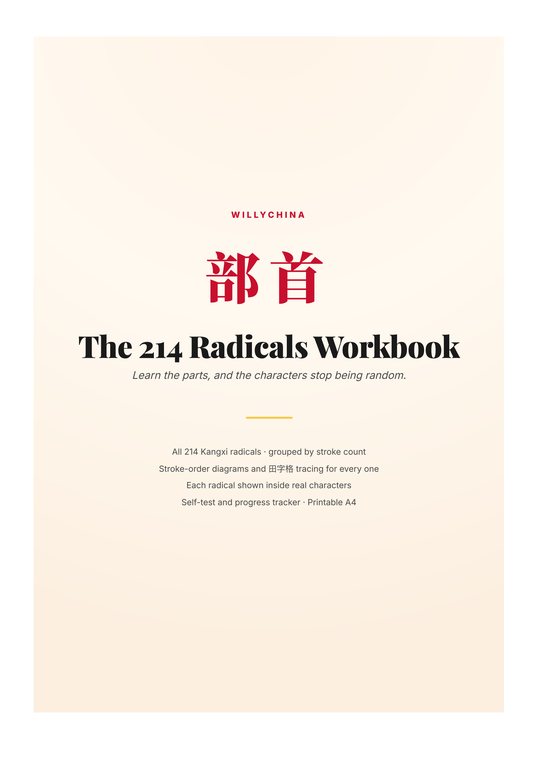
You have the theory. This is the practice.
The 214 Radicals Complete Pack
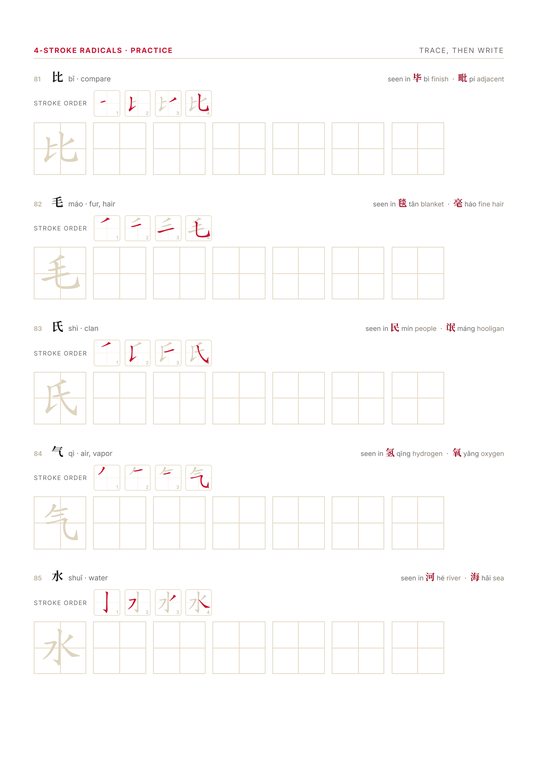
This article explains the system; the 214 Radicals Complete Pack is the drill. A 69-page workbook with stroke order and 田字格 tracing for all 214 radicals, each shown inside real characters, 830 audio files and three Anki decks — including one that drills spotting a radical inside a character you have never met.
See what is inside — US$32 →One payment · instant download · yours to keep