Brave, confident and bold: the third animal of the Chinese zodiac, and the sign of the year that begins on 19 February 2034.

- Recent Tiger years
- 2010 · 2022 · 2034
- Next Tiger year begins
- 19 February 2034
- Fixed element
- Wood (yang)
- Best matches
- Horse · Dog · Pig
- Clashes with
- Monkey
- The Tiger’s hours
- 3 am – 5 am (寅时 yínshí)
Are you a Tiger?
The zodiac year doesn’t start on 1 January. It starts at Chinese New Year, which falls anywhere from 21 January to 20 February. So if you were born in January or February, your birth year alone can’t tell you your animal. Enter your full date of birth for the exact answer.
Every Year of the Tiger, with exact dates
| Year | Chinese name | Element | Begins | Ends |
|---|---|---|---|---|
| 1926 | 丙寅 bǐngyín | Fire Tiger | 13 Feb 1926 | 1 Feb 1927 |
| 1938 | 戊寅 wùyín | Earth Tiger | 31 Jan 1938 | 18 Feb 1939 |
| 1950 | 庚寅 gēngyín | Metal Tiger | 17 Feb 1950 | 5 Feb 1951 |
| 1962 | 壬寅 rényín | Water Tiger | 5 Feb 1962 | 24 Jan 1963 |
| 1974 | 甲寅 jiǎyín | Wood Tiger | 23 Jan 1974 | 10 Feb 1975 |
| 1986 | 丙寅 bǐngyín | Fire Tiger | 9 Feb 1986 | 28 Jan 1987 |
| 1998 | 戊寅 wùyín | Earth Tiger | 28 Jan 1998 | 15 Feb 1999 |
| 2010 | 庚寅 gēngyín | Metal Tiger | 14 Feb 2010 | 2 Feb 2011 |
| 2022 | 壬寅 rényín | Water Tiger | 1 Feb 2022 | 21 Jan 2023 |
| 2034 | 甲寅 jiǎyín | Wood Tiger | 19 Feb 2034 | 7 Feb 2035 |
| 2046 | 丙寅 bǐngyín | Fire Tiger | 6 Feb 2046 | 25 Jan 2047 |
Dates follow the lunar calendar’s New Year, the convention used for the zodiac in everyday Chinese life. Some fortune-tellers instead start the year at 立春 (lìchūn, Start of Spring, around 4 February), so a few early-February birthdays get read differently. In 2034 the gap is unusually wide: 立春 falls on 4 February but New Year not until the 19th, so a baby born in between is a Tiger to some fortune-tellers and an Ox on the lunar calendar.
How to write 虎, and the tiger standing on its tail
虎 (hǔ) began as a picture of the whole animal: on Shang oracle bones it is a tiger drawn side-on, turned upright to fit the narrow strips of bone, with open jaws at the top, a striped body and a tail at the bottom. Over the centuries the body shrank away. The top part, 虍, kept the head and stripes, and the legs became the two strokes underneath. The Shuowen Jiezi calls the tiger the lord of the mountain beasts and says its feet look like a person’s, the traditional explanation for that lower part.
8 strokes · the tiger’s head 虍 first, top vertical leading, then the two legs, ending with the long hooked stroke
3,000 years of 虎, in four steps
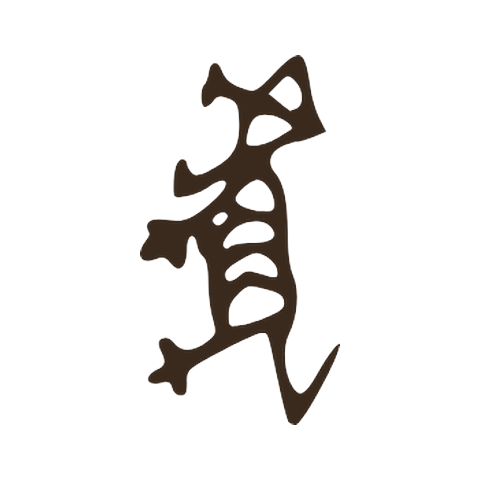 Oracle boneShang dynasty, c. 1250 BCE
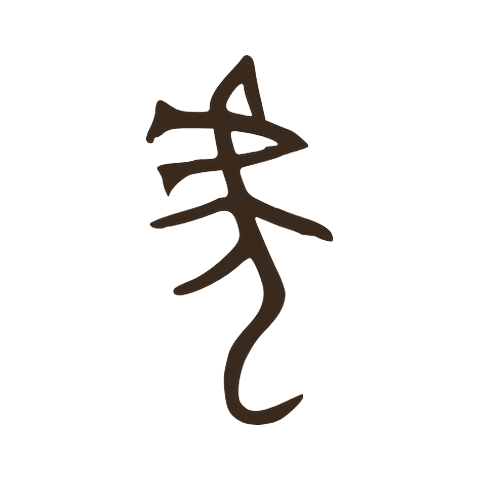 BronzeZhou dynasty, c. 1000 BCE
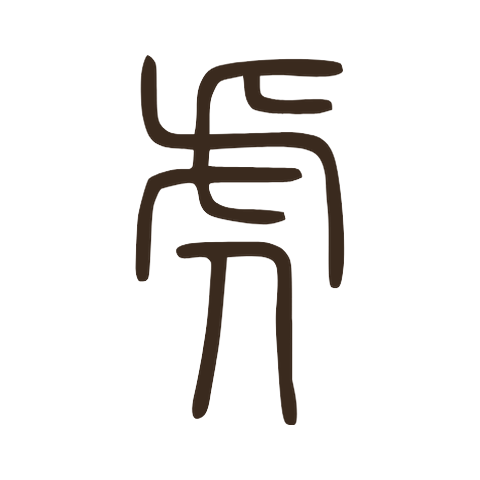 Small sealQin dynasty, 221 BCE
- 虎TodaySame in simplified and traditional
Ancient forms: public-domain drawings from the Ancient Chinese Characters project and Academia Sinica’s oracle bone font, via Wikimedia Commons.
Six characters built from 虎 and its head 虍
The tiger lends its whole body to some characters and just its striped head, 虍 (the “tiger top” learners call 虎字头), to others. Sometimes it brings fierce meaning, and sometimes only its sound. Tap the speaker to hear each one.
Want the system behind cards like these? Read how Chinese characters actually work and the stroke order rules, then practise 虎 on the free writing practice board.
Why is the tiger “old”?
In everyday Mandarin a tiger is 老虎 (lǎohǔ). 老 usually means “old”, but here it carries no sense of age at all: a tiger cub is still a 小老虎, a “little old tiger”. It’s a prefix, the same one in 老鼠 lǎoshǔ (rat or mouse) and 老鹰 lǎoyīng (eagle), and exactly how it attached to animal names is still debated. The bare character 虎 lives on in the zodiac (虎年, Year of the Tiger), in idioms and in compound words.
老虎
lǎohǔ
Tiger, the everyday word. No age implied.
母老虎
mǔ lǎohǔ
Tigress, and also a teasing word for a fierce, bossy woman.
老虎机
lǎohǔjī
Slot machine. Literally “tiger machine”, the one that eats your money.
马虎
mǎhu
Careless, sloppy. Literally “horse tiger”.
That last one has a popular story behind it: a painter put a horse’s body under a tiger’s head, and the muddled picture gave us 马马虎虎, “so-so, careless”. It’s a folk tale told to learners rather than a documented origin, but it’s a memorable way to keep both animals in your head.
The Tiger personality
Zodiac personalities are folk tradition, not science, and Chinese people treat them much the way others treat star signs: half seriously, often with a smile. Still, the character traditionally given to people born in the Year of the Tiger is remarkably consistent across almanacs. As befits the king of the mountain, it’s the boldest of the twelve.
Brave
yǒnggǎn. The Tiger’s defining trait: first to step forward when something frightening needs doing.
Confident
zìxìn. Tigers trust their own judgement and carry themselves like it, which is why others tend to follow.
Decisive
guǒduàn. Quick to choose and quicker to act. Tigers would rather risk a wrong move than make none.
Warm-hearted
rèqíng. Generous and spirited with friends, and fiercely protective of the people they love.
And the other side
Impulsive
chōngdòng. The same speed that makes Tigers bold can send them leaping before they look.
Impatient
jízào. Slow people and slow plans try a Tiger’s temper.
Stubborn
gùzhí. Once a Tiger has made up its mind, changing it takes real patience.
Must win
hàoshèng. Tigers love a contest, and losing gracefully doesn’t come naturally.
Lucky things, by tradition
Almanacs don’t fully agree on the Tiger’s lucky charms, and we’d rather show you that than pretend otherwise. Here is what the major sources share, and where they split.
| Lucky | What the sources say | Agreement |
|---|---|---|
| Numbers | 3 in every list, usually with 1 and 4 (some Chinese almanacs give 2 and 3) | Agreed |
| Colours | Blue everywhere, plus grey and orange in English-language lists, or gold and green in some Chinese almanacs | Mostly |
| Flowers | Cineraria and lily in most lists, anthurium in some | Mostly |
| Numbers to avoid | 6 and 7 in most lists, with 8 in some and 9 in others | Disputed |
Which Tiger are you? The five elements
Every animal returns once every 12 years, but it pairs with each of the five elements only once every 60. So a 1974 Tiger and a 2034 Tiger share both animal and element: both are Wood Tigers.
甲寅 jiǎyín · 1974 · 2034
Wood is the Tiger’s own fixed element, so the Wood Tiger is said to be the most open-hearted Tiger: compassionate, sociable and full of ideas. Its traditional caution is spreading itself too thin. 2034 is a Wood Tiger year.
丙寅 bǐngyín · 1926 · 1986 · 2046
The Fire Tiger is the most dramatic of the five: optimistic, independent and full of energy. Tradition warns that its fire burns hot, and self-control is its lesson.
戊寅 wùyín · 1938 · 1998
The Earth Tiger is said to be the most realistic Tiger: still adventurous, but steadier, more practical and readier to think before it pounces.
庚寅 gēngyín · 1950 · 2010
The Metal Tiger is said to be the most determined: outspoken, competitive and hard to stop once set on a goal. Its traditional weakness is stubbornness.
壬寅 rényín · 1962 · 2022
The Water Tiger is the calmest Tiger: perceptive, open to new ideas and a quick learner. It’s said to judge people well and to soften the Tiger’s temper.
Tiger compatibility
Zodiac compatibility isn’t a list of opinions. It’s geometry. Place the twelve animals around a circle, and the classic matches form fixed shapes: triangles of allies, pairs of secret friends, and opposites that clash. Here is the Tiger’s position.
- Best: Horse 马 and Dog 狗The Three Harmonies (三合 sānhé), the green triangle. Together these three share courage, loyalty and a strong sense of fair play, and are traditionally the happiest pairing for friendship, business or marriage.
- Secret friend: Pig 猪The Six Harmonies (六合 liùhé), the gold line. The easygoing Pig calms the Tiger, and the Tiger protects the Pig.
- Clash: Monkey 猴The Six Conflicts (六冲 liùchōng), straight across the circle. The bold Tiger and the clever Monkey compete for the lead and rarely give way.
- Friction: Snake 蛇The Six Harms (六害 liùhài), the dashed line. A quieter mismatch: the careful Snake and the headlong Tiger misread each other.
See the other pairings from each side: the Horse, the Dog, the Pig and the Monkey.
The Tiger in Chinese culture
不入虎穴 Into the tiger’s den
bù rù hǔ xué, yān dé hǔ zǐ. “If you don’t enter the tiger’s den, how will you catch its cubs?” The Book of the Later Han gives the words to the envoy Ban Chao, urging his small party to take a great risk. It’s the Chinese “nothing ventured, nothing gained”, and one of the best-known Chinese idioms.
三人成虎 Three people make a tiger
sān rén chéng hǔ. In the Strategies of the Warring States, an official asks his king: if three people told you a tiger was loose in the market, would you believe it? The king admits he would. The idiom means a rumour repeated often enough starts to sound like fact.
武松打虎 Wu Song fights the tiger
Wǔ Sōng dǎ hǔ. The most famous tiger scene in Chinese literature, from the novel Water Margin. Ignoring an inn’s warning, “three bowls and you won’t cross the ridge”, the hero Wu Song drinks far more, staggers up Jingyang Ridge and kills a man-eating tiger with his bare hands. Storytellers and opera stages still perform it.
虎头鞋 Tiger-head shoes
hǔtóu xié. Embroidered baby shoes with a tiger’s face on each toe, often made by a grandmother for a newborn. Folk belief holds that the tiger wards off evil and keeps small children safe, so tiger-head hats and pillows are made too. In parts of China the stitching is now protected as local intangible heritage.
Famous people born in the Year of the Tiger
Tigers have a reputation for boldness, and this list of performers, athletes and artists born in Tiger years does little to dispel it.
- Marilyn MonroeActor and singer, United StatesBorn 1 Jun 1926 · Fire Tiger
- Stevie WonderSinger, songwriter and musician, United StatesBorn 13 May 1950 · Metal Tiger
- Phil CollinsDrummer, singer and songwriter, EnglandBorn 30 Jan 1951 · Metal TigerBorn 7 days before Chinese New Year 1951, so many lists get this one wrong
- Stephen Chow 周星驰Comedy actor and director, Hong KongBorn 22 Jun 1962 · Water Tiger
- Michelle Yeoh 杨紫琼Actor, Malaysia and Hong KongBorn 6 Aug 1962 · Water Tiger
- Eason Chan 陈奕迅Singer and actor, Hong KongBorn 27 Jul 1974 · Wood Tiger
- Leonardo DiCaprioActor, United StatesBorn 11 Nov 1974 · Wood Tiger
- Usain BoltSprinter, JamaicaBorn 21 Aug 1986 · Fire Tiger
- Shawn MendesSinger and songwriter, CanadaBorn 8 Aug 1998 · Earth Tiger
We checked each person’s full date of birth against the exact Chinese New Year date of that year, so January and early-February birthdays are placed in the right sign.
The Year of the Wood Tiger, 2034
The next Tiger year is a Wood Tiger, 甲寅年 (jiǎyín nián), running from 19 February 2034 to 7 February 2035. Wood is the Tiger’s own element, so tradition reads 2034 as a doubly vigorous year, good for bold starts, growth and generosity. For how the New Year itself is celebrated, see our guide to the Spring Festival.
běnmìngnián, “your own zodiac year”. If you were born in a Tiger year (2022, 2010, 1998, 1986, 1974…), 2034 is your 本命年. Tradition says it’s a year to be careful, so many people wear something red all year round, often red socks, a red string bracelet or red underwear, which shops sell in a rush before every New Year.
Talk about your sign in Mandarin
Asking someone’s zodiac animal is one of the most natural small-talk questions in Chinese, and a polite way to guess an age without asking. Here is the whole conversation.
我属虎
wǒ shǔ hǔ
“I’m a Tiger,” literally “I belong to the tiger”.
你属什么?
nǐ shǔ shénme?
“What’s your zodiac sign?”
你也属虎吗?
nǐ yě shǔ hǔ ma?
“Are you a Tiger too?”
今年是我的本命年。
jīnnián shì wǒ de běnmìngnián.
“This year is my zodiac year.”
Common misunderstandings
- “I was born in January 1951, so I’m a Rabbit.” Not quite: the Rabbit year only began on 6 February 1951, so you’re a Metal Tiger, like Phil Collins, born on 30 January that year. Check any date with the tool above.
- “A Tiger year is a bad year to have a baby.” It’s an old folk belief in some communities, but classical astrology gives it no special weight, and plenty of families happily welcome Tiger babies.
- “老虎 means an old tiger.” It doesn’t. 老 here is just a prefix, the same one in 老鼠 (rat). A newborn cub is still a 老虎.
- “The White Tiger is the zodiac Tiger.” The White Tiger, 白虎 (báihǔ), is one of the Four Symbols guarding the four directions, standing for the west. It’s a separate tradition from the twelve zodiac animals.
Quick quiz
1. What does the oldest, oracle bone form of 虎 picture?
2. Which sign forms the Three Harmonies triangle with the Tiger and the Horse?
3. What does 老 mean in 老虎 (lǎohǔ, tiger)?
FAQs
The Year of the Tiger comes round every 12 years: 1926, 1938, 1950, 1962, 1974, 1986, 1998, 2010, 2022 and 2034. Each one starts at Chinese New Year rather than on 1 January. The next begins on 19 February 2034 and runs to 7 February 2035.
Yes. 2034 is a Wood Tiger year (甲寅 jiǎyín). It begins on 19 February 2034. Anyone born between 1 January and 18 February 2034 is still an Ox, the sign of the year before. The last Tiger year was 2022.
In 老虎 (lǎohǔ), 老 is a prefix with no sense of age, the same one found in 老鼠 (rat or mouse) and 老鹰 (eagle). The core word is 虎 (hǔ), which is what the zodiac uses: the Year of the Tiger is 虎年 hǔnián.
Traditionally the Horse and the Dog, which form the Three Harmonies (三合) with the Tiger, and the Pig, its Six Harmonies (六合) partner. The Monkey is the Tiger’s clash sign, sitting directly opposite on the zodiac wheel.
Every source we checked lists 3 as a lucky number, most adding 1 and 4. Blue appears in every list of lucky colours, with grey and orange added in most English-language sources. These are folk associations, so treat them as tradition rather than rules.
The Tiger’s fixed element is Wood, and it’s a yang sign. Each Tiger year also carries a rotating element (Wood, Fire, Earth, Metal or Water), set by the year’s heavenly stem. 2034 is Wood, 2022 was Water and 2010 was Metal.
In the legend of the Great Race, the Jade Emperor ranked the animals by the order they crossed a great river. The Tiger was strong and a good swimmer, but the current kept dragging it downstream, and it hauled itself onto the bank just behind the Rat and the Ox. Read the whole story on our Chinese zodiac guide.
Say 我属虎 (wǒ shǔ hǔ), literally “I belong to the tiger”. To ask someone else, say 你属什么? (nǐ shǔ shénme?), “What’s your sign?”. It’s a polite, roundabout way to guess someone’s age, since the answer narrows it to every 12 years.
Say “我属虎” like a native
The zodiac is one of the easiest conversations to start in Mandarin. Learn the words, the tones and the stories behind them in 1-on-1 online lessons with a native speaker.
Book a Free Intro Call