Home › China Today › Culture
The sacred mountain that survived by being a staircase
Mount Tai’s meaning was never at the summit. It was in the climb — which is why a crowd that knows nothing of the old rite still performs it.
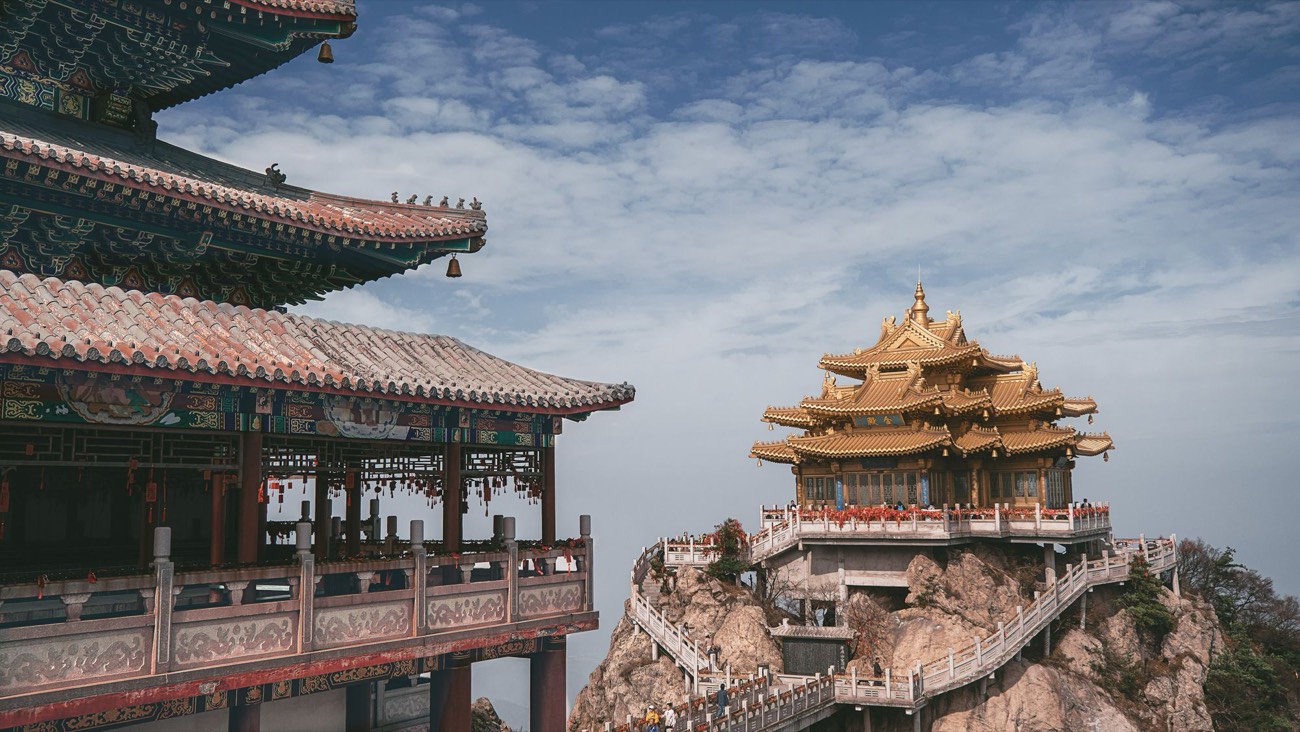
Almost everything that ever mattered about Mount Tai happened on the way up.
This is easy to miss, because sacred places are usually organised around a destination. There is a summit, a sanctum, a relic, a spot; the journey is the tax you pay to reach it. Mount Tai does not work that way and has not for two thousand years. The ceremony that made it politically indispensable was an ascent. The inscriptions that cover it are beside the path. The porters are on the path. The fair is at the bottom of the path. Even the single most-quoted line about the mountain is grammatically about having climbed it.
Which produces an unlikely result. The rite has not been performed in over a century, the empire that required it is gone, and the several thousand people on the stairs before dawn on any given morning could not tell you what it was. They are nonetheless doing the correct thing. The mountain survived by being a staircase, and a staircase does not need you to believe in it.
What the mountain was for
泰山 (Tàishān) is the eastern peak of the 五岳 (wǔyuè), the Five Sacred Mountains, and among those five it held a seniority that was never seriously contested. East is the direction of sunrise and of beginnings, and Mount Tai was given the job of standing for both.
That seniority had a formal expression, and the formality is the interesting part. The ceremony was 封禅 (fēngshàn) — a rite in which an emperor climbed the mountain to report to heaven that the realm was in order and the mandate was being honoured. CC-CEDICT defines the term with unusual specificity: (of an emperor) to pay homage to Heaven at Mount Tai. The mountain sits inside the definition. There was nowhere else it could be done.
Very few emperors performed it. That was the mechanism, not a shortage of opportunity. To climb Mount Tai and address heaven was to make a public claim about the condition of your reign, auditable by anyone who could read a chronicle. A ruler who attempted it without the record to support it was not blessed; he was compared. The rite’s power came from its scarcity, and its scarcity came from the fact that history could refuse it.
So this was never a mountain you visited. It was a mountain you were, or were not, in a position to climb.
The stairs outlived the state that needed them
The 封禅 ended with the empire. The stairs did not, and the stairs turn out to have been the durable part.
The main route is a staircase of 石阶 (shíjiē), stone steps, running from the temple complex in the town at the base to the summit. The number usually given is somewhere around seven thousand, and counts disagree depending on where you start and how you treat the flatter stretches — which is itself revealing. A figure quoted constantly and agreed on rarely is a figure nobody has ever needed to settle.
What has not changed is the traffic. Mount Tai is not a technical climb and it does not require belief. It is a staircase up a mountain, which means the people on it at four in the morning are of every possible description: students, retired couples moving with unhurried competence, a parent carrying a sleeping child, groups in matching gear taking it extremely seriously.
They climb in the dark for the 日出 (rìchū), the sunrise. Arriving after it has happened is, socially, a failure.
It is worth pausing on how strange this continuity is. Enormous quantities of Chinese ritual life were interrupted in the twentieth century. Temples closed, rites lapsed, lineages of practice broke. The thing that made Mount Tai famous was among the casualties. And yet the physical act at the centre of it — walking up — never stopped, because walking up a staircase was never legible as a religious act in the first place. It was too plain to abolish.
The commentary is on the climb, not about it
The second reason the path is the point is that people wrote on it.
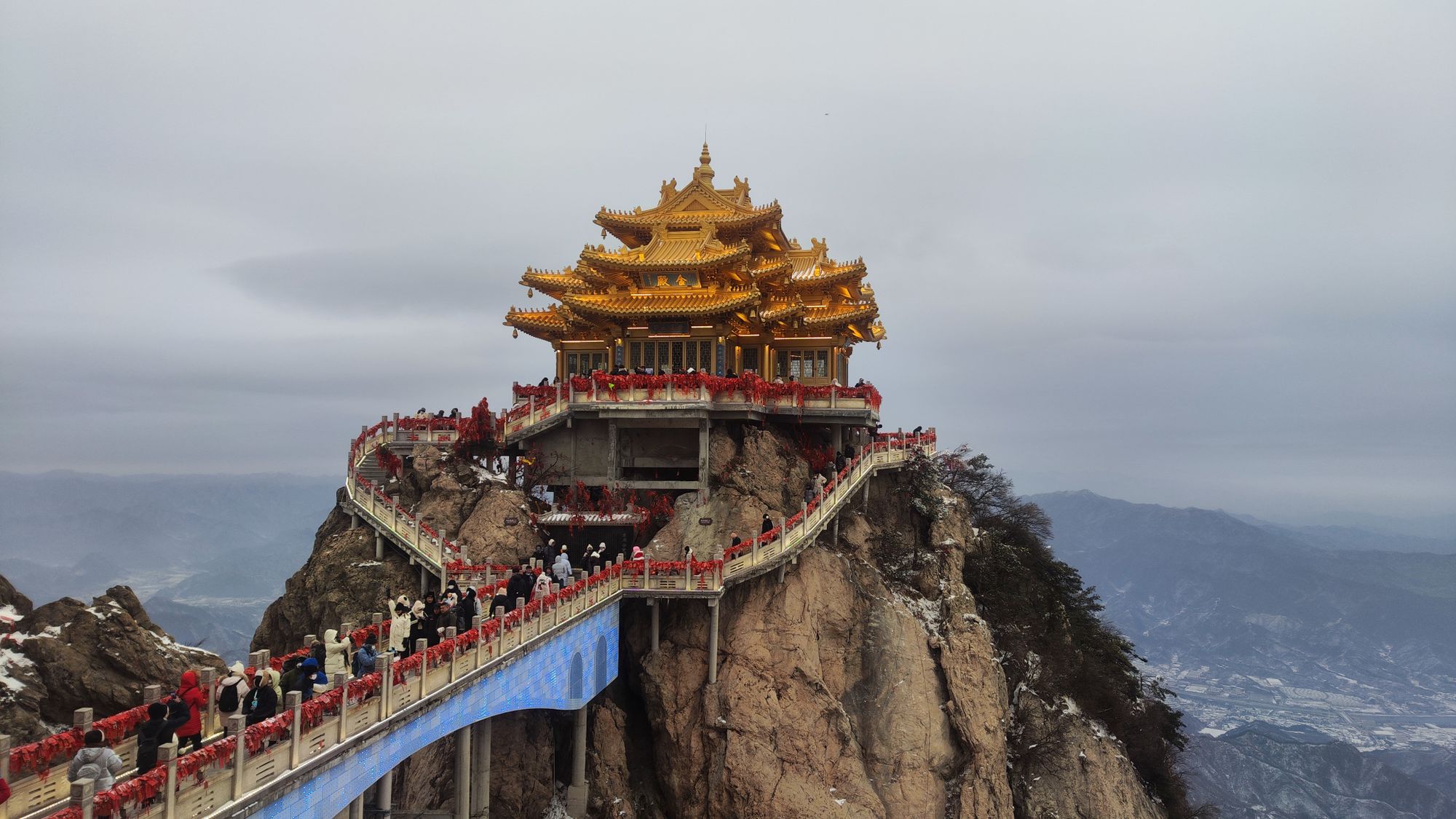
Mount Tai carries one of the densest concentrations of 石刻 (shíkè), stone inscriptions, anywhere in China: characters cut directly into cliffs and boulders beside the steps, at every scale from a modest couplet to single characters several metres across. Some are imperial. Many are not — officials, monks, scholars and travellers who climbed, were moved, and left a line.
They were not curated and they are not plaques. They accumulate. A Tang inscription may sit a few metres from a Qing one and a few metres from something cut last century, at whatever angle the rock permitted, in whatever hand the writer had. The effect is unlike a museum in a specific way: the commentary is not about the climb, displayed somewhere afterwards. It is on the climb, at eye level, left by people who were exactly as short of breath as you are.
It is also one of the better places anywhere to watch calligraphy do what calligraphy is for. At that size, cut into granite and weathered for centuries, the difference between a confident stroke and a hesitant one is not a specialist’s distinction. You do not need to read the characters to see which writers meant it.
Near the top the route passes through 南天门 (Nántiānmén), the South Gate to Heaven, a stone gateway set in a notch in the ridge. From below it appears, vanishes behind a shoulder of rock, and reappears higher and further off than seems reasonable — an effect the builders can hardly have failed to notice, and a fairly direct statement about how much mountain is left.
The people who make the summit possible
Some way up you will be overtaken by someone carrying more than you would attempt on flat ground.
The 挑山工 (tiāoshāngōng) — CC-CEDICT gives labourers who carry cargo up and down the mountains on shoulder poles — supply the shops and temples on the upper mountain. Crates of water, gas cylinders, building material, balanced across a pole and walked up the same steps everyone else is labouring on.
Their technique repays watching rather than admiring. They do not climb in a straight line; they traverse diagonally, swapping shoulders on a rhythm dictated by the load rather than the stairs, and they do not rest where tired visitors rest. They have their own places.
They are also the answer to a question most people never think to ask, which is how a noodle shop near the summit of a sacred mountain gets its gas. The sublime runs on logistics. On Mount Tai the logistics are not hidden behind the scenery. They are walking past you, twice a day, in the same direction.
What the fair is doing at the bottom
At the foot of the mountain, around the temple complex, sits the 庙会 (miàohuì), the temple fair.
The form is old and the content was never fixed. A 庙会 is what happens when a temple’s festival days draw enough people that a market assembles around them, and then keeps assembling because the market has become as much the reason as the festival. Food stalls, tools, toys, performances, things you did not come for and will carry home regardless.
Inside, the 香火 (xiānghuǒ) — incense burning before the temple — is doing older work. The phrase carries more than its literal sense: sustained incense is the standard image for a temple that is still alive, still visited, still supported. To say a temple has good 香火 is to say people still come.
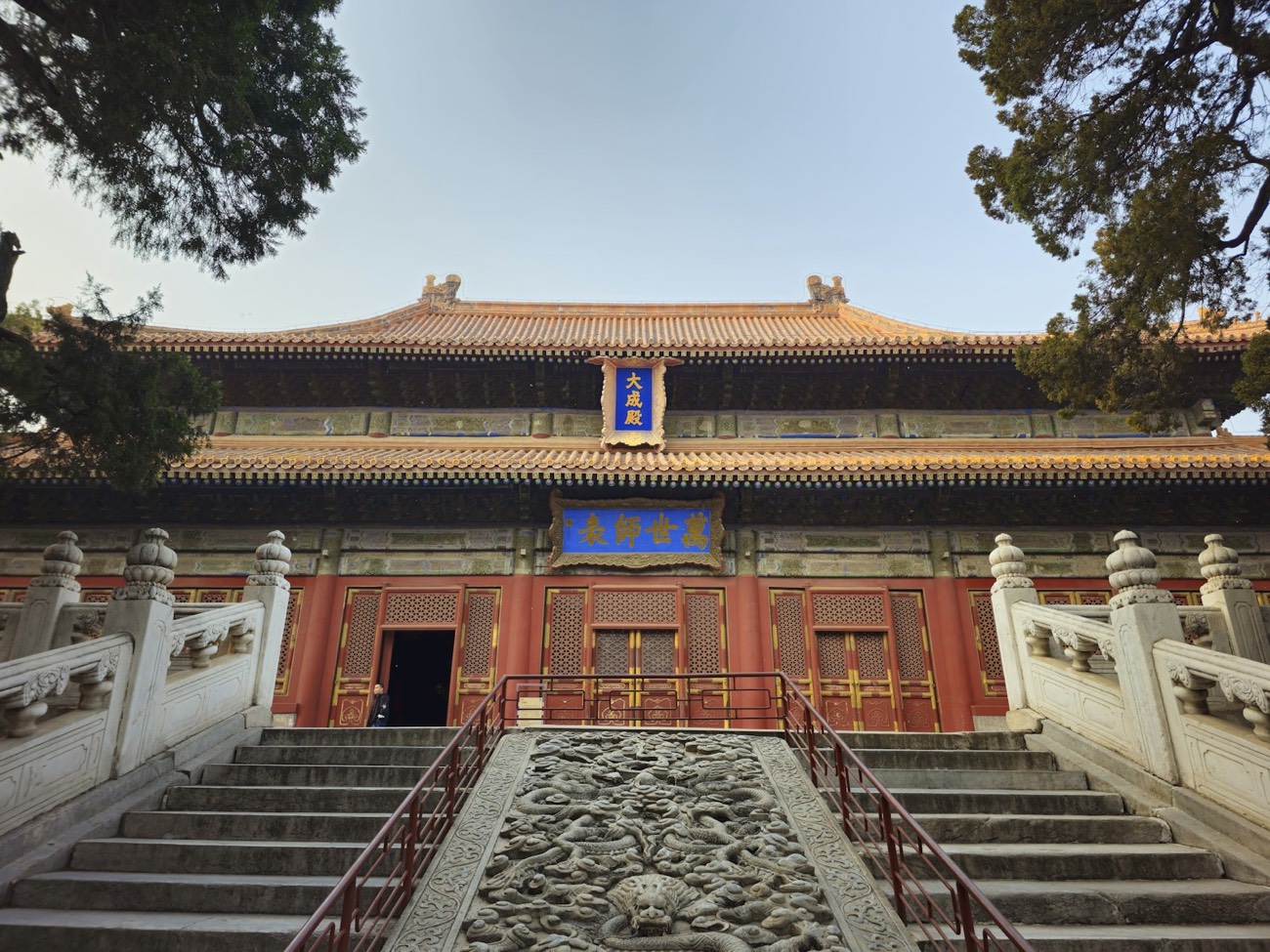
The fair assembles around 岱庙 (Dàimiào), the Dai Temple, which is the formal start of the ascent. The name is worth noticing. 岱 (Dài) is an old name for Mount Tai itself, so the temple is named not for a deity or a dynasty but for the mountain — it is the mountain’s temple, the place where the mountain was addressed. CC-CEDICT records it as a temple for the god of Mount Tai: the peak was not merely a sacred site but a recipient.
Its layout makes the argument physically. The complex runs on a north–south axis pointing at the mountain, so the sequence of halls and gates is also a sequence of framed views, each closer than the last. By the time you leave the northern gate you have been walked, deliberately, from a town into a pilgrimage. Most day-trippers skip it, because the stairs are the attraction and the temple looks like a detour. It is the opposite of a detour. It is the first half of the sentence the stairs complete.
Having climbed Mount Tai
The line everyone quotes is from Mencius, describing Confucius:
登泰山而小天下Dēng Tàishān ér xiǎo tiānxià — having climbed Mount Tai, he found the world below small.
It is usually offered as encouragement and it is not quite that. The claim is about perspective and its cost: from up there, things that looked large from the plain are not. Whether that consoles or unsettles you depends entirely on what you left at the bottom.
Note the grammar, though, because the grammar is the whole thesis. 登 (dēng) is to climb, and the sentence is built on a completed ascent. Not at the summit of Mount Tai. Not on Mount Tai. Having climbed it. The insight is not available at an altitude. It is available to someone who went up.
There is a cable car now, and it works perfectly well. The sunrise happens whether you walked to it or not, and nobody at the top is checking. Plenty of people ride it, including plenty who have done the stairs before and have nothing left to prove.
But the crowd on the steps in the dark — complaining, encouraging each other, stopping where the porters do not — have arrived, without intending to and largely without knowing it, at the correct relationship with this mountain. They are performing the only part of the rite that was ever transferable. The emperors came to make a claim about themselves in front of heaven. Everyone else comes to find out what they are like at four in the morning, seven thousand steps from the bottom, with a long way still to go.
The world below does look different afterwards. Mostly because your legs hurt. That is not a diminishment of the idea. It may be the most honest version of it anyone has managed.
Eight terms this piece runs on, every gloss checked against CC-CEDICT. Tap any one to hear it.
Photographs from the WillyChina library.