Home › China Today › Travel
The most looked-at landscape in China, and how to stop looking at it wrong
The Li River is famous for being looked at, and almost everyone looks at it wrong. The naming system, the painting tradition, and eight words that fix it.
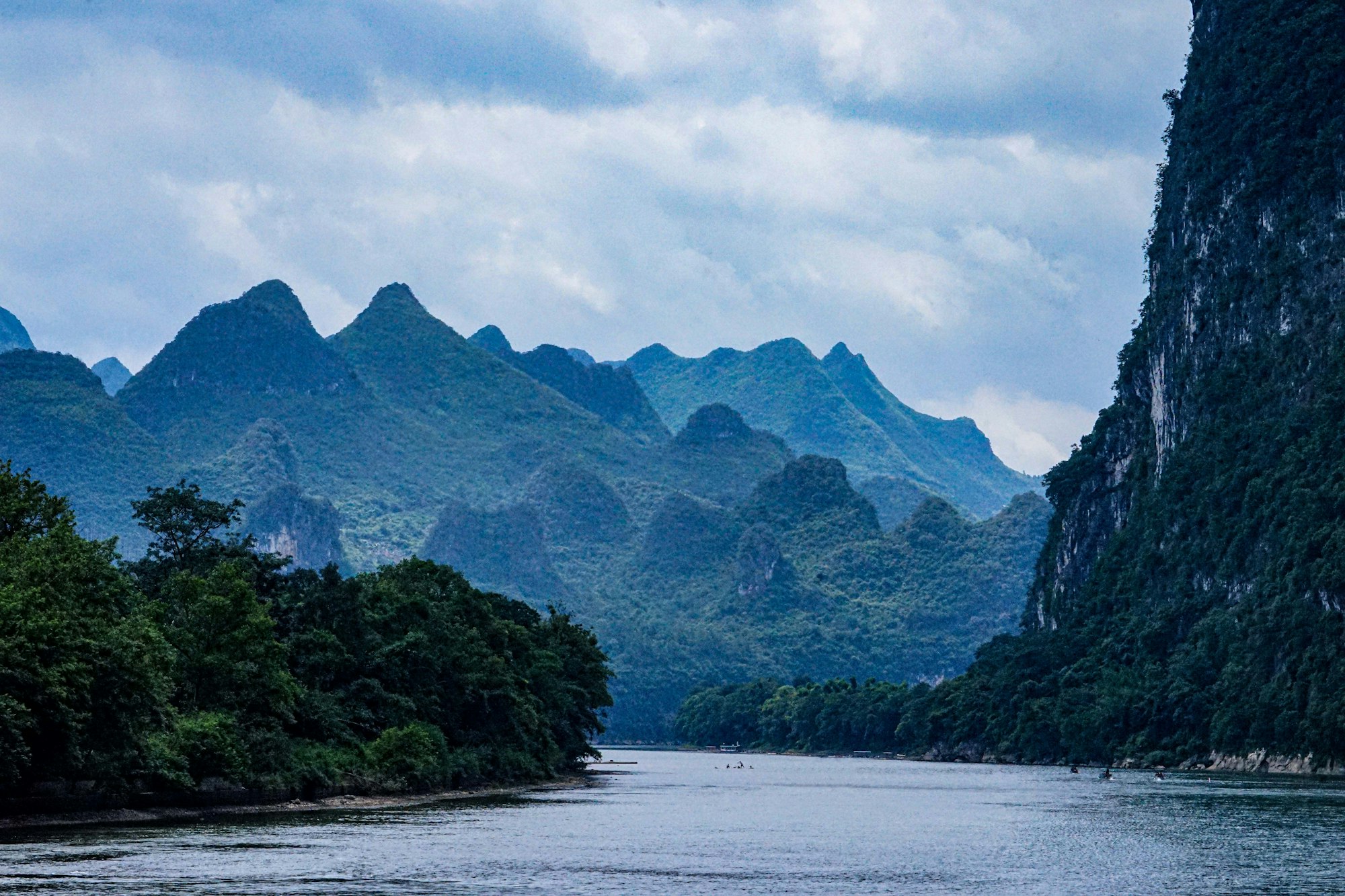
The Li River has a problem that almost no landscape has: it is too well known to be seen.
It has been on the back of the twenty-yuan note. It is the standard image of China in every travel brochure printed anywhere, and the standard image of Chinese landscape painting for about a thousand years before that. By the time most people arrive, they are not looking at a river. They are checking a view against a picture they already have, and the picture wins.
Which is a waste, because the people who work this river do not look at it that way at all. They read it. The difference between looking and reading is a system, and the system is learnable in about twenty minutes.
The peaks are a residue
Start with what the rock is doing, because the shapes are the reason for everything else.
漓江 (Líjiāng), the Li River, runs south from Guilin through some eighty kilometres of 喀斯特 (kāsītè) — karst, a loanword in Chinese as in English. The peaks rise almost vertically out of flat paddy and flat water, a few hundred metres at most, with no foothills and no approach. One ends, there is a field, another begins.
The mechanism is unglamorous. Limestone dissolves in slightly acidic water; rain picks up carbon dioxide on the way down and becomes weakly acidic; over a long enough period the rock goes into solution along its joints and fractures. What remains standing is whatever happened to be least soluble or least fractured.
That single fact reorganises the view. The towers are not what was built up. They are what did not go away. Each 山峰 (shānfēng) is a survivor rather than a feature, and the flat ground between them is not a plain that peaks were placed on — it is the shape of everything that has already dissolved. You are looking at an absence with a few pieces left in it.
The same process runs in reverse underground. A 溶洞 (róngdòng) — CC-CEDICT’s gloss is solutional cave, meaning dissolved rather than carved — is the negative space of what stands above it. Water that took limestone into solution on the way down puts it back when it arrives in a chamber and loses its load, building 石笋 (shísǔn), stalagmites, from the floor upward at rates usually described in centuries per centimetre. One process, two directions. The towers and the columns are the same event, and the whole district is its residue.
The names are not decoration, they are infrastructure
Now the part that changes how you look.
Every significant peak on the river has a name, and the names are overwhelmingly figurative: this one an animal, that one a brush-pot, those a group of figures. 象鼻山 (Xiàngbíshān), Elephant Trunk Hill, sits at the edge of Guilin where a rock arch meets the water; CC-CEDICT records it plainly as Elephant Trunk Hill in Guilin, Guangxi. Once told, you cannot unsee it — an animal with its trunk in the river, drinking.
It is tempting to file this under folklore. It is closer to engineering.
Consider the problem a boatman has. There are a great many peaks. They are similar in scale, and to an untrained eye almost identical in silhouette. He needs a passenger, on a moving boat, to look at one specific formation immediately, without first pointing at nine wrong ones. Coordinates are useless. Descriptions of position are useless, because everything is behind something else. What works is a shape: a name that is also a picture, resolvable in one glance by someone who has never been here.
The naming system is therefore a piece of practical technology for directing attention, refined over centuries by people whose living depended on it working. Learn six names and the river stops being scenery and becomes a sequence — a list of specific things, arriving in order, each one distinguishable from the next.
That is the whole difference between looking and reading. A view is undifferentiated and produces two hours of impressiveness you will not be able to recall. A sequence has items in it.
The painting was an argument about how to see
The word for landscape, in the sense a painter means it, is 山水 (shānshuǐ) — literally mountain 山 (shān) and water 水 (shuǐ), the two elements named and nothing else.
It is not a coincidence that a genre is named after precisely what is in front of you here. This river was the standard the tradition measured itself against for centuries. And the conventions of that painting — receding planes of peaks, mist separating them, water with no far bank, enormous quantities of empty paper — are not stylisation. On a morning with any humidity, that is a literal description of the view.
Which means the paintings are not attempts at a photograph that failed for lack of technique. They are a considered argument about what is worth recording: that the gaps matter as much as the rock, that distance should be shown by subtraction rather than by detail, that a landscape is legible in layers.
The famous line is Song dynasty and appears on every second signboard in the city:
桂林山水甲天下Guìlín shānshuǐ jiǎ tiānxià — Guilin’s mountains and waters are first under heaven.
甲 (jiǎ) is the first of the ten Heavenly Stems, the old enumerating series, so the sense is first in rank rather than merely best. The claim is competitive, and it was meant to be. Someone was placing this river above other rivers, in public, in a ranked list.
The reflection, and the hour it lives in
The thing photographs get wrong is the water.
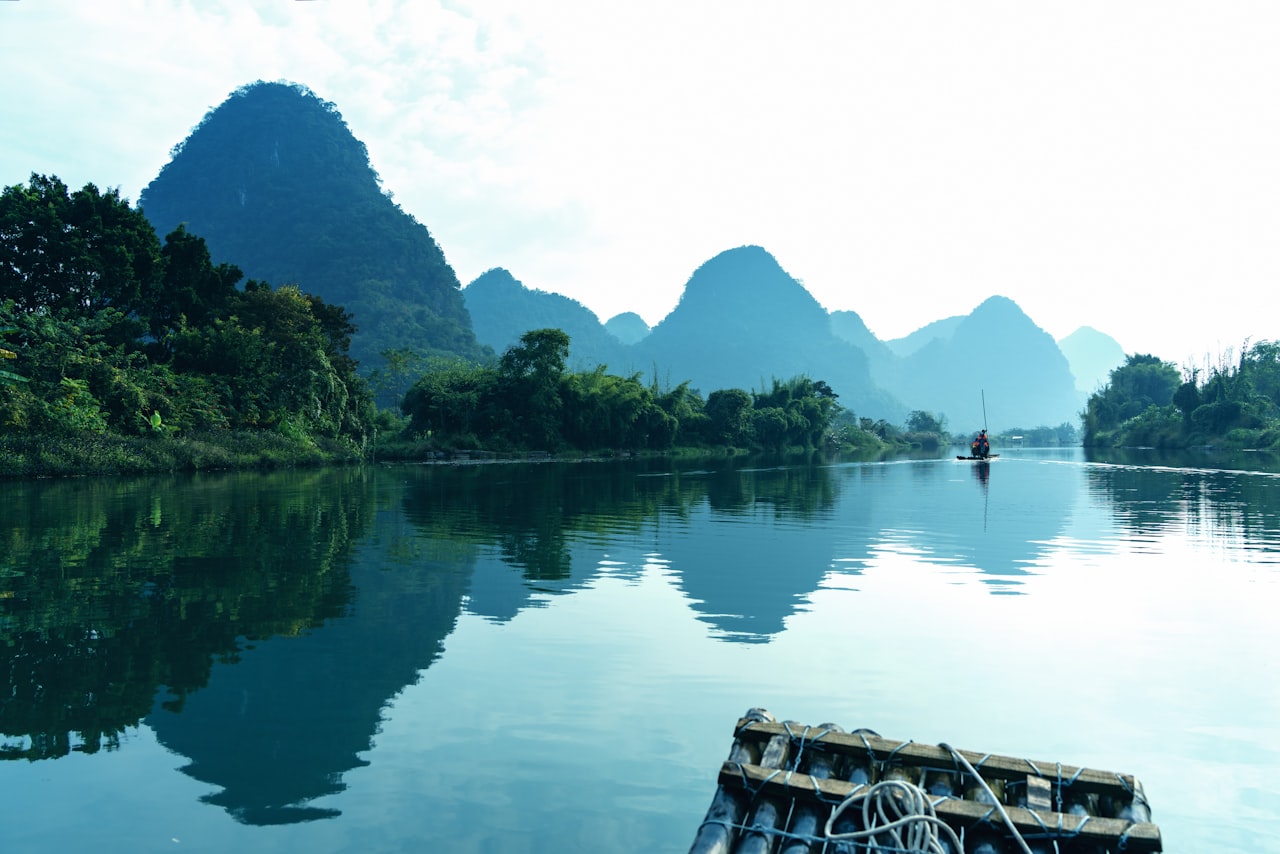
On a still morning the river returns a 倒影 (dàoyǐng), an inverted reflection, complete enough that the horizon becomes ambiguous. CC-CEDICT’s gloss is inverted image, which is exactly right and slightly clinical about a genuinely disorienting effect: the peaks continue downwards, the sky is beneath the boat, and the only thing establishing which way is up is the wake.
It does not last. By the middle of the day there is wind, and wind ends it. The river becomes a river again, the reflection becomes chop, and the view flattens into the postcard everyone already owns.
This is the second correction to make, and it is about light rather than names. The Li River is most photographed in flat mid-morning sun, which is when the boats are fullest and when the peaks look most like the picture. It is not when they look most like themselves. Early, in mist, the towers separate into exactly the receding planes the painters spent a thousand years reproducing — near ones dark, far ones almost gone, the gaps doing as much work as the rock. Late, they go flat and graphic against the sky.
Neither is the correct view. But the mist version is the one the entire tradition is built on, and seeing it once explains an enormous amount about why anyone bothered.
What the birds are actually selling
You will be offered a photograph with a 鸬鹚 (lúcí), a cormorant.
The birds were working animals, and cormorant fishing is a real technique with a long history on these rivers: the bird dives, catches fish, and a loosely tied cord prevents it swallowing the larger ones, which the fisherman removes. It was a functioning livelihood within living memory.
On this stretch it is now, essentially, a photographic one. The men on the bamboo rafts — 竹排 (zhúpái) — at dawn, a bird on each end of a pole, are for the most part making their living from the image of the practice rather than from the fish.
This is worth knowing before you take the picture rather than after. It is not a deception and nobody pretends otherwise; it is a straightforward transaction, and the men are working. But the photograph most people carry home is a photograph of a photograph being offered, and a landscape this heavily mediated deserves at least one sentence that says so out loud.
It is the same failure as the rest, in a different costume: arriving with the image already in hand, and spending the morning matching reality to it.
Fifteen minutes out of town
The boats finish at 阳朔 (Yángshuò), Yangshuo, which was a market town, then the place backpackers washed up after the river trip, and is now a destination with its own gravity — climbing, cycling, a main street given over entirely to visitors. Whether that reads as ruined or thriving depends on what you were hoping for and how far you are prepared to walk.
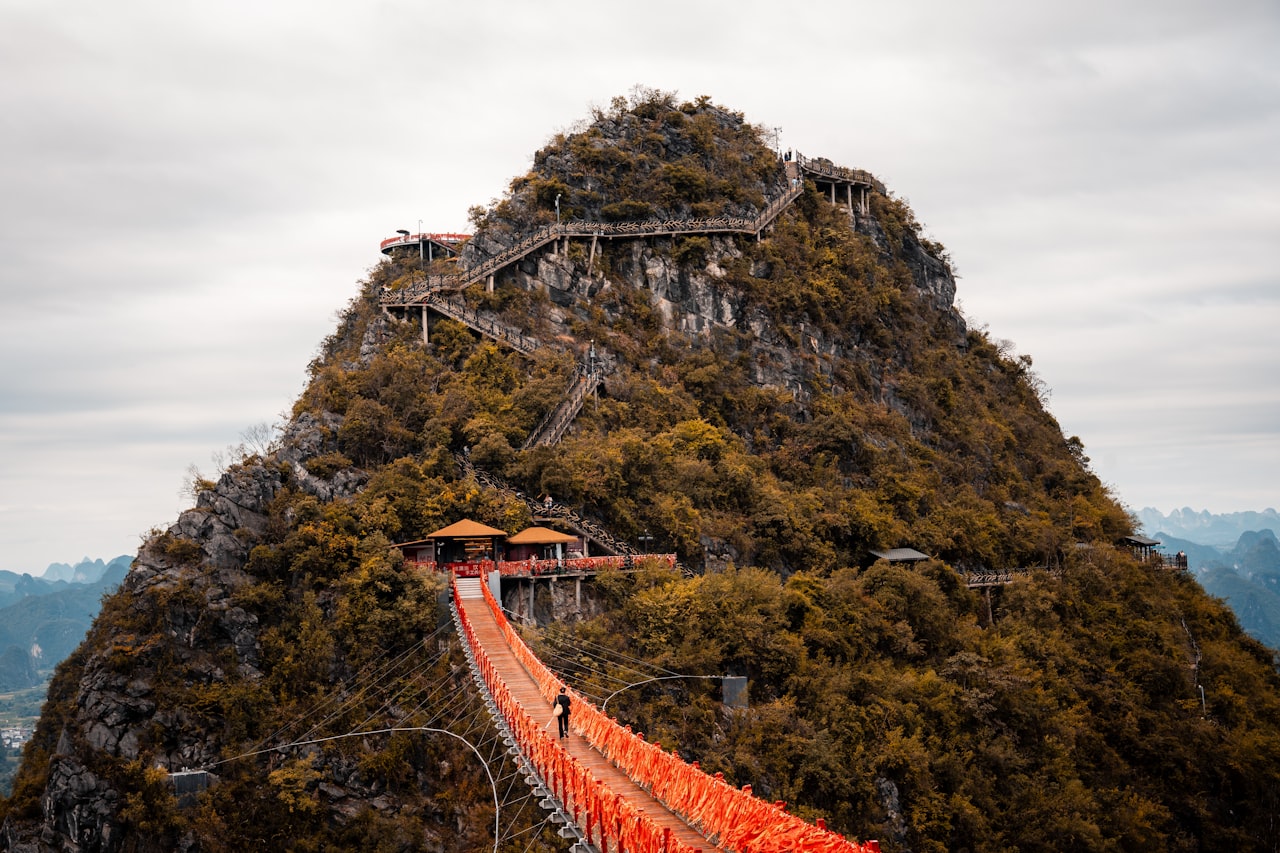
The peaks do not care. Fifteen minutes out of town on a bicycle, on any of the lanes between the paddies, they are exactly what they were: unhelpfully vertical, badly lit for most of the day, impossible to photograph in a way that conveys the scale. The landscape the painters were measuring themselves against is not in the town and never was. It is in the flat ground between the towers, which you have to get out into.
It is also where the river stops being a view and goes back to work. Water buffalo in the shallows. Vegetable plots running to the bank. Somebody’s laundry. The twenty-yuan note is real, and it is about four hundred metres from a man mending a scooter.
So the instruction, in the end, is smaller than the scenery deserves and more useful than it sounds. Stop trying to see all of it. Work peak by peak, name by name, as the person steering is doing. Go early, when the reflection is still there and the mist is still separating the planes. Get off the boat and into the fields, where nobody has arranged anything for you.
Do that and you will not have seen the most famous landscape in China. You will have read a few hundred metres of it, properly, which is considerably more than most people leave with.
Eight terms this piece runs on, every gloss checked against CC-CEDICT. Tap any one to hear it.
Photographs from the WillyChina library.