Home › China Today › Food
The cuisine that gives away the cooking
Hotpot hands you boiling fat and raw offal and then walks away. What a cuisine gives up when it gives away the cooking — and the eight words it runs on.
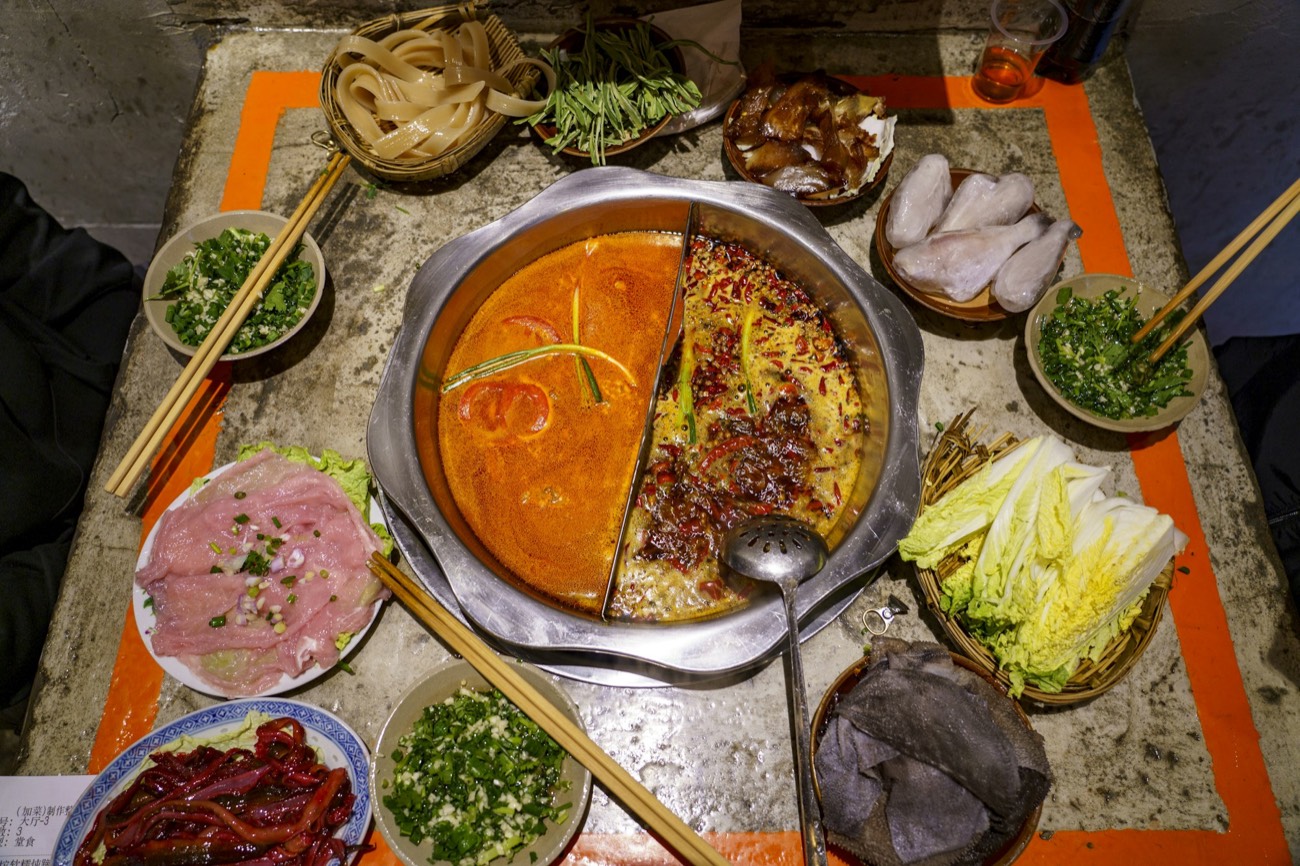
Every other great cuisine in the world hands you a finished plate. Someone trained has decided when the meat was done, how much salt, what goes beside it and in what order it arrives. Hotpot hands you a vat of boiling beef fat and a tray of raw offal, and then — this is the genuinely strange part — walks away.
Consider what that abolishes. There is no chef’s judgement standing between you and dinner. There is no correct moment that somebody else owns. The most consequential decision of the meal, the four or five seconds that separate tripe with a snap from tripe like a bath mat, belongs to whoever is holding the chopsticks. They are holding them in a restaurant they paid to be cooked for in.
This is not an oversight in the format. It is the format. And a cuisine that gives away the cooking is giving away authority, which means it must be getting something substantial in return.
What the pot is actually for
火锅 (huǒguō) is literally fire pot, and the name is unhelpfully modest about what the object does.
A pot of broth on a burner in the middle of a table is, functionally, a shared clock. Everything that happens for the next two hours is timed against it. Nobody’s food is ready at the same moment, because nobody put their food in at the same moment. There is no course structure to move the table along, no plates cleared to signal a transition, no moment at which a waiter can reasonably ask whether you are finished.
Compare that to almost any other restaurant format, all of which are built to control duration. Courses arrive in sequence. Plates are removed. The bill appears. A restaurant is, among other things, a machine for turning tables, and hotpot is a machine with that part deliberately removed.
The base is beef tallow — 牛油 (niúyóu) — and the choice is not incidental to any of this. Tallow is solid at room temperature and carries fat-soluble aromatics that a thin oil cannot hold. It coats rather than rinses, which means the flavour on the twentieth thing you cook is not the flavour on the first. The broth is a cumulative object. It gets more like itself as the evening goes on, which is another way of saying the pot rewards you for staying.
Into it go dried chillies and 花椒 (huājiāo), Sichuan pepper — not a chilli and not a peppercorn, but a husk that produces a fizzing, buzzing numbness closer to a mild electrical current than to heat. That numbness is 麻 (má). The chilli burn is 辣 (là). Together, 麻辣 (málà).
The compound is doing something cleverer than intensity. The numbing dulls the burn just enough to let you keep going, so the two sensations are not additive but regulatory — each buying headroom for the other. A pot that was only hot would stop you. A pot that is hot and numbing will not.
The negotiation the pot performs
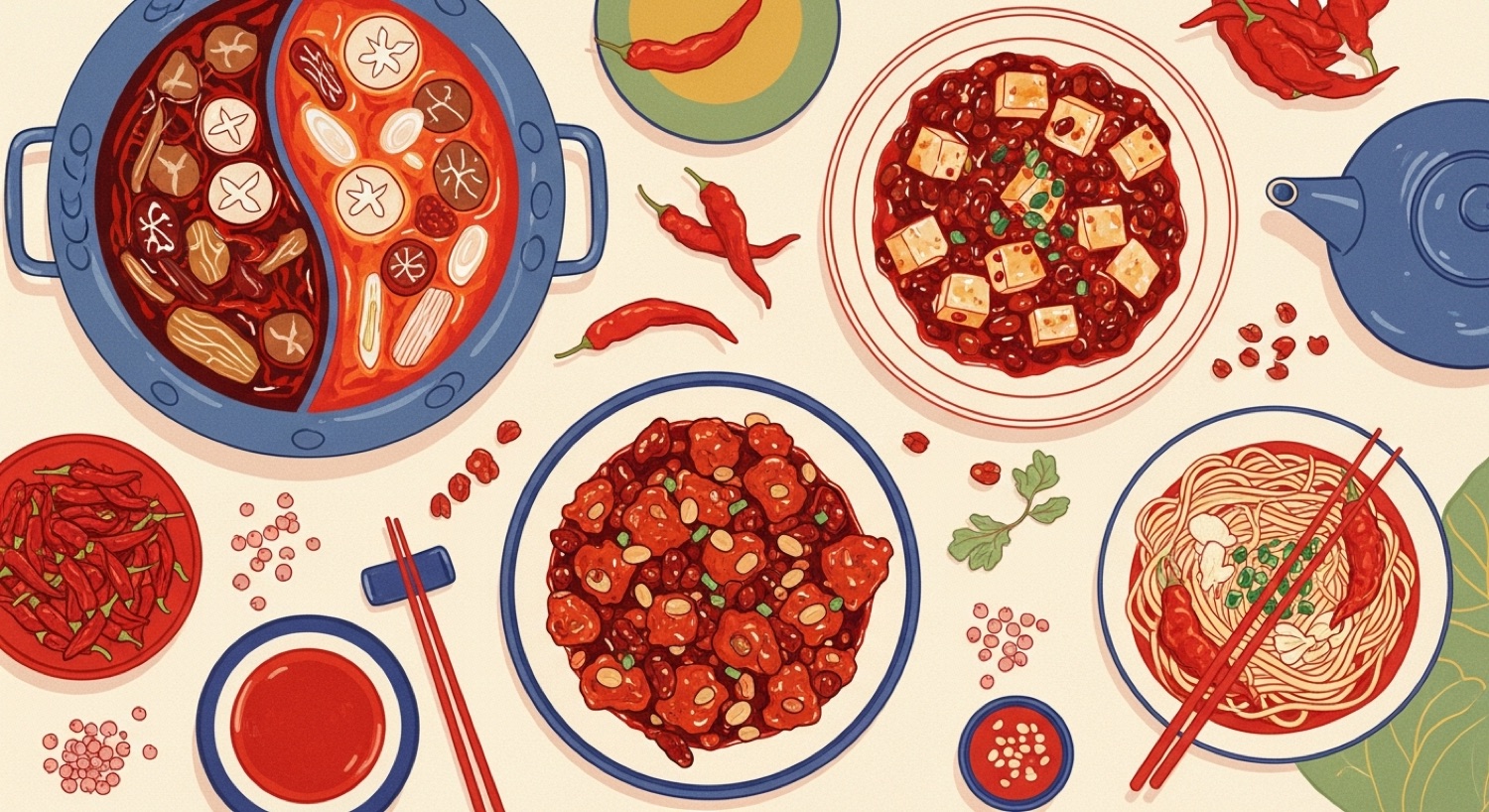
Order a 鸳鸯锅 (yuānyangguō) and you have said something about the table without anyone having to say it.
鸳鸯 (yuānyāng) is the mandarin duck, which in Chinese has stood for centuries for a devoted pair: two things that belong together while remaining distinct. The 鸳鸯锅 is a pot with a divider down the middle — the numbing broth on one side, a plain 清汤 (qīngtāng) on the other.
What that divider actually does is spare someone a conversation. There is a person at the table who cannot take the 麻辣 side, or who could but does not want to tonight, and in a single-pot meal that fact has to be raised, explained and accommodated in front of everyone. The divided pot removes the need. The equipment absorbs the negotiation, and nobody has to be the person who asked.
Purists are dismissive of it. Purists also order it, because the alternative is eating alone.
The more serious version of the same idea is the 九宫格 (jiǔgōnggé), a three-by-three grid set into one pot over one flame. It looks like novelty and is the opposite. The broth circulates underneath but the grid slows it, and the compartments do not behave alike: the centre square sits over the heat and rolls hardest, the corners are gentler. One vessel, nine cooking conditions.
Its social function is as precise as its thermal one. In an undivided pot, everything you put in immediately becomes everyone’s, and anything you are waiting for stands a fair chance of being eaten by somebody who was not waiting for it. Nine compartments convert a commons into allotments. That is your square. Those are your things. It is a property system, improvised in cast iron, and it exists because the alternative produced friction that nobody wanted to name.
Seven up, eight down
The most repeated instruction in a Chongqing hotpot restaurant is about tripe, and it is a joke.
毛肚 (máodǔ) — the frilled leaf tripe that arrives folded like a dark towel — is not stewed. It is gripped in the chopsticks and swished through the broth, lifted, swished again. The motion has its own verb, 涮 (shuàn), to rinse or swish something through liquid. It cooks in seconds and is then ruined; the entire point of the ingredient is a texture that snaps, and overcooking converts it into something with the mouthfeel of an eraser.
The rule people recite is seven up, eight down. Dip it seven times, lift it eight. This borrows the idiom 七上八下 (qī shàng bā xià), which in ordinary Chinese means nothing of the kind — it describes agitation, a churning stomach, being all over the place, much as English says at sixes and sevens. The kitchen has taken a phrase about nerves and pointed it at a pot.
Nobody counts. The counting was never the instruction. The instruction is: this happens faster than you think, and you cannot look away from it.
And notice what that demands of you. In a conventional restaurant, inattention costs nothing — the kitchen is paying attention on your behalf. Here, the person who drifts out of the conversation to check a phone comes back to a pot that has quietly destroyed something. Hotpot makes attention a social obligation and enforces it with texture.
Beef aorta — 黄喉 (huánghóu), which CC-CEDICT defines with disarming directness as aorta (ingredient of hotpot, Sichuan cuisine) — behaves the same way and punishes the same lapse. The denser, 嫩 (nèn), more tender things want the calmer corners and want leaving alone. Put them in the wrong square and you have not broken a rule. You have simply wasted the pot’s design.
Hotpot makes attention a social obligation and enforces it with texture.
The bowl is where the individual survives
The pot is communal. The bowl is not, and the distinction matters more than it first appears.
Each person gets a small dish built on sesame oil — 香油 (xiāngyóu) — usually with mashed garlic, 蒜泥 (suànní), stirred through. That is close to the entire recipe. It is not a sauce in the sense of adding flavour; it is a counterweight. The oil coats what you lift from the broth, cools it slightly, and blunts the tallow’s grip just enough that the next mouthful still registers.
The northern convention is different — thicker, sesame-paste based — and ordering by habit in the wrong city produces mild confusion in both directions. The Chongqing bowl is deliberately thin and deliberately plain because the broth is already doing an enormous amount of work and the bowl’s job is to get out of its way.
There is no correct ratio, and that is the point of it. Everyone at the table is eating from the same pot and correcting it privately, to their own taste, over a couple of hours. The communal object is fixed; the individual adjustment is constant. Watching somebody build their bowl tells you roughly how often they do this.
What the origin story is doing
Ask where hotpot came from and you will be told about the wharves.
The version repeated everywhere: the men who worked the docks where the Jialing River meets the Yangtze — the 码头 (mǎtóu) — ate what the butchers could not sell. Offal, mostly, cooked in a fiercely spiced pot over a brazier, the spice making cheap cuts worth eating and the heat answering a river fog that got into everything.
It is a good story, told with conviction, and it is the kind of origin story that tidies itself over time. Hold it a little loosely. What is not in doubt is the shape that survived, and the shape is the argument of this piece: a communal pot, a hard-working broth, ingredients that reward technique rather than money, and no one in charge.
That last clause is the inheritance. A format invented by people who had no servants and no chef produced a meal in which nobody is served and nobody cooks for you. It was not designed to be egalitarian. It simply came from a place where the alternative was not available, and it kept the shape after it no longer needed to.
A small society, convened nightly
So: what does a cuisine get for giving away the cooking?
It gets a table that has to organise itself. Someone is trusted with the timing. Someone orders. Someone is quietly making sure the person who cannot take the chilli still has something worth eating. The grid gets divided, the bowls get adjusted, the tripe gets watched. None of this is discussed and all of it is decided.
Two hours of that is not a meal with company. It is a small society, convened nightly, and the pot is only the excuse for convening it.
Which is why the restaurants do not close in any meaningful sense, and why the queues outside them are not a sign of scarcity. There is no stopping point built into the format — no final course, no cleared plate, no natural moment at which a table dissolves. It ends when the group decides it ends, and the group is in no hurry, because the thing they came for is not on the menu.
Eight terms this piece runs on, every gloss checked against CC-CEDICT. Tap any one to hear it.
Photographs from the WillyChina library.