Finally talk with your family in Mandarin
Live Mandarin lessons for Chinese families, built around the people you want to speak to. For adults who grew up in a Chinese family, parents and partners.
Who do you want to talk to?
The first thing she hears from you.
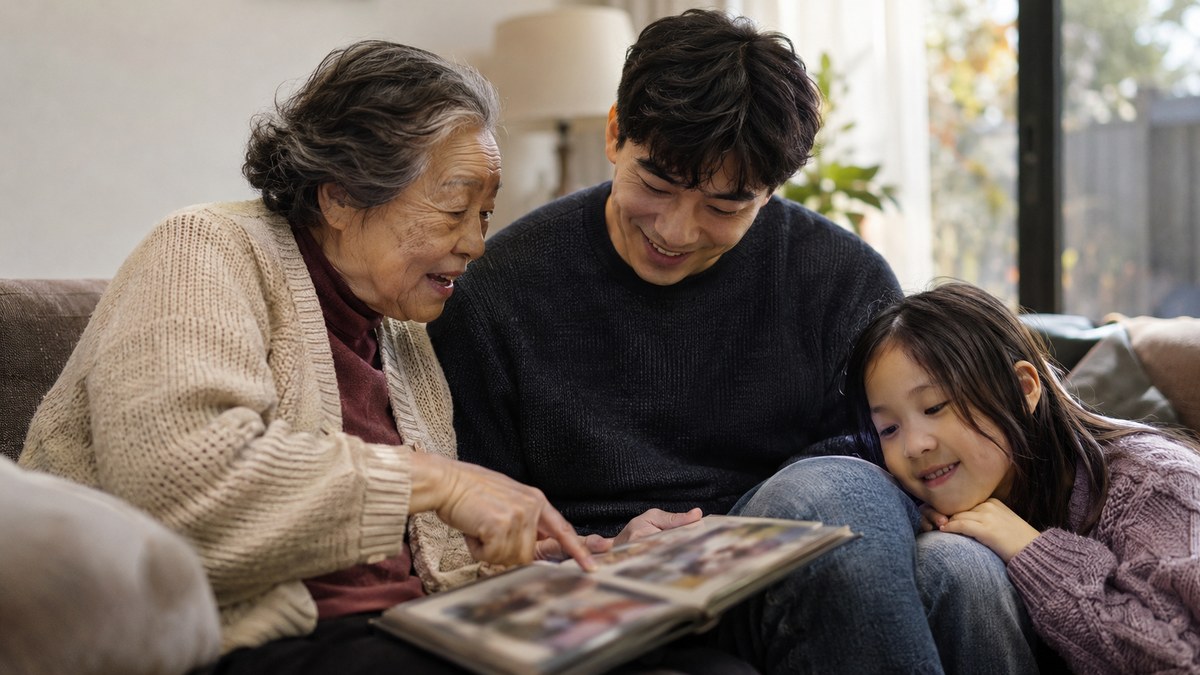
I would sit with my wài pó for hours and watch Chinese historical dramas and documentaries together.
Will, Founder and Principal Teacher, was born in China and raised in Australia. Read the whole story
Who these lessons are for
You grew up in a Chinese family
You may follow some of what your relatives say but struggle to answer, or you may be starting from nothing. Both are fine. We start from what you already have.
You’re raising children
You want them to know the language and talk with their grandparents. Learn alongside them as a pair, or book their own lessons from age 5.
You married into the family
You want to greet your partner’s parents properly and follow more at the dinner table. We start with the words you’ll use with them.
Mandarin for the moments your family shares
- Lunar New YearXīnnián kuàilè!Happy New Year!
- A birthdayShēngrì kuàilè!Happy birthday!
- The phone callWǒ xiǎng nǐ.I miss you.
- At the tableChī fàn le ma?Have you eaten?
Hear a call with Grandma
Nine short lines, the kind of call you could build up to. Tap any line, or play the whole call.
- GrandmaWéi?Hello?
- YouWéi, nǎinai!Hello, Grandma!
- GrandmaĀiyō! Shì wǒ de bǎobèi sūnnǚ ya! Chī fàn le ma?Aiyo! It’s my precious granddaughter! Have you eaten?
- YouChī le. Nín shēntǐ hǎo ma?Yes, I have. How are you keeping?
- GrandmaHěn hǎo. Nǐ shénme shíhou lái?Very well. When are you coming?
- YouGuònián huílai. Wǒ xiǎng nǐ.I’ll come back for New Year. I miss you.
- GrandmaWǒ yě xiǎng nǐ.I miss you too.
- GrandmaJìde ànshí chī fàn. Jīntiān tiānqì liáng, duō chuān diǎn yīfu. Hǎohǎo gōngzuò, cháng gěi wǒ dǎ diànhuà!Don’t skip your meals. It’s cool today, so wear enough clothes. Do well at work, and call me often!
- YouÈn, hǎo de, nǎinai. Zàijiàn!Mm, okay, Grandma. Bye!
Not sure what to call someone?
Hear every family word, find any relative and print your own chart in What to Call Your Chinese Family.
How our Mandarin lessons for Chinese families work
It starts with your people
Tell us who you want to talk to and what you want to say. Your first lesson is built from that conversation.
You can ask in English
Your teacher is a native speaker of Mandarin and English, so you can stop and ask whenever you’re stuck.
Your words stay in one place
Your notes and homework live in a shared course guide, ready to check before your next family call.
Your first lesson
We start with your family, not chapter one. Tell us who you want to talk to and what they call you. We’ll find what you already know, then build one real sentence for one real person. Your homework is to say it to them.
Map your family
Who you want to talk to, what they call you and what you remember hearing at home.
Find what you know
We play family words and see what you recognise. You may know more than you think.
Build your sentence
One greeting for one person, with the right family word, practised until it feels natural.
Say it to them
Make the call or send a voice message. Your next lesson opens with how it went.
Learning with your child? You each choose a relative, and you practise on each other.
Learn on your own, or with your child
Mandarin lessons for Chinese families are priced by the hour, in three ways.
One-to-one
From US$36 an hour
Your teacher’s full attention, at your pace.
Parent and child
US$57 an hour for two
Two of you, one lesson.
Traditional characters
From US$53 an hour
50% more than simplified lessons, for families who read traditional.
Prices show in your own currency where we can tell it. See every option on our Chinese courses page.
In their own words
Mandarin lessons for Chinese families, with teachers such as Will: three students on what has changed at home.
I grew up in a very small town in Australia where my family and I were the only people of colour for miles.
As a result, I grew up not speaking much Chinese at all. I felt embarrassed for many years that I didn’t even know how to greet our relatives from China in Mandarin and how to properly address them. I am grateful for the lessons and resources by WillyChina that have helped me improve my Mandarin and more importantly, help regenerate the connection with my Chinese heritage.
Learning Mandarin alongside my son has been one of the best things we’ve done together.
I moved to Australia when I was two, so I never learnt Mandarin properly. I worried my son would lose that connection to our heritage, and I didn’t feel confident enough to teach him. Now we have lessons with Will together. He’s patient and encouraging, and he makes it fun for both of us. We practise at home and pick up new words side by side, and hearing my son chat with his grandparents means the world to our family.
I look forward to every lesson, and I can’t wait to see what Will brings out next.
I’m Canadian with Punjabi roots, and when I married into a Chinese-Canadian family I wanted to truly understand their culture and language. Will’s lessons explain the culture behind the words, and the resources make it easy to keep practising between sessions. My in-laws have noticed the difference, and being part of family conversations and celebrations has been so rewarding.
FAQs
Can my child and I learn together?
Yes. You can take lessons as a pair. Pairs work best when you’re at a similar level, so we’ll check that on your free intro call.
Are these Mandarin lessons for Chinese families only?
No. They suit anyone learning Mandarin to talk with family, including partners and in-laws.
How young can my child start?
Children can start one-to-one lessons from age 5.
Do you teach simplified or traditional characters?
We use simplified unless you ask otherwise. If your family reads traditional, we can teach that for 50% more. Traditional lessons for a pair are US$71 an hour.
Is this Mandarin or Cantonese?
Mandarin. If your family speaks another Chinese language at home, tell us on your intro call. Our guide to Mandarin and Cantonese explains the difference.
How do lessons work?
Every lesson is live and online, by Zoom or Google Meet. Pay for each hour as you go, with no contract to sign.
How do I start?
Book a free 30-minute intro call. There’s no charge and you won’t need payment details.
Tell us who you want to talk to
We’ll build your plan around them.