There’s a question I’ve been asked more times than I can count, across two continents and three decades of life: Where are you actually from?
It sounds simple. It isn’t. Not when the honest answer is something like: I was born in China, raised in Australia, spent years pretending I was one and ignoring the other, then spent three years in Beijing figuring out how to be both.
That’s my story. And if you’re overseas-born Chinese — if you grew up in Australia or the United States or anywhere outside China, carrying a heritage that felt more like a background detail than a living part of you — then I think you’ll recognise something in it. The specific details will be different. The feeling won’t be.
My Family’s Decision to Leave
I was born in China. I was three years old when my parents made the decision to leave.
They weren’t fleeing anything dramatic — at least not in the way films portray it. But China in the early 1990s offered a particular kind of life, and my parents wanted a different one. They were practical people with ambitions that didn’t fit the circumstances around them. Australia offered space, possibility, and the chance to build something from nothing on their own terms.
They took it.
We landed in Sydney and settled first in the Inner West, then moved further west as so many immigrant families do — chasing cheaper rent, familiar communities, the particular comfort of hearing your own language in the supermarket. Those early years in western Sydney were hard in the way that immigrant years always are. My parents were working constantly. My father managed a small fleet of taxis. My mother did what needed doing. There wasn’t much left over at the end of the day for anything except getting through to the next one.
Eventually, we made our way to the Sutherland Shire.
If you know Sydney, you know the Shire. It sits at the southern edge of the city, pressed against the Royal National Park on one side and the coast on the other. It’s beautiful country. It’s also one of the most deeply Anglo-Australian parts of Sydney — a place where the culture is beach, rugby league, and a particular brand of easy confidence that comes from never having had much reason to question where you belong.
That’s where I grew up. That’s where I became Australian.
Becoming Australian
Here’s what people don’t always understand about immigrant kids who assimilate: it’s not passive. It takes work. You study the people around you. You notice what gets laughs, what gets acceptance, what gets you left out. You adjust accordingly. You become very good at code-switching before you even know that’s what it’s called.
My parents didn’t actively discourage my Chinese identity — they just didn’t have the bandwidth to cultivate it. They were immigrants trying to survive and build something, and in that context, fitting in wasn’t a social nicety. It was a strategy. The more Australian we seemed, the smoother things went. The smoother things went, the better chance we had of making it.
So I became Australian. Genuinely, not performatively. Rugby league was everything — State of Origin was practically a religion in the Shire, and I was as invested as anyone. I spent weekends at Cronulla Beach, burning through long summer afternoons in the surf and on the sand the way every Shire kid did. I drifted through Miranda Fair with mates on school holidays. I sounded like every other white Aussie kid from the Shire — broad enough to fit right in, though thankfully not quite bogan territory.
I thought of China the way you think of a birthplace you left too young to remember clearly — as a fact about you, not a part of you.
I thought I had it worked out.
The Values They Never Named
What I didn’t recognise at the time — and wouldn’t for many years — was that my parents were teaching me to be Chinese every single day. Just not in any way I knew to look for.
They never sat my brother and me down to talk about values. They never explained their feelings or shared what was on their mind. That simply wasn’t how they operated. In our household, love wasn’t something you said. It was something you did — quietly, consistently, without acknowledgement or expectation of thanks.
It looked like this: food always on the table. School uniforms washed and ready. Every basic need met without fuss, no matter how hard the week had been. My parents never missed those things. Not once. On the days when the taxi business was difficult and the hours had been punishing, dinner was still there. The rent was still paid. My brother and I were still looked after.
I understood none of the sacrifice involved at the time. Children rarely do. But looking back, I can see that this was one of the most distinctly Chinese things about my upbringing — the expression of love through action rather than language. The idea that you show the people you care for by doing, by providing, by turning up without drama and making sure that what needs to happen, happens.
Their ambitions for us followed the same logic. They wanted my brother and me to become lawyers or doctors — not because those were our dreams, but because they had calculated, with the practical clarity of people who had navigated life as immigrants in a Western country, that those were the professions most likely to earn respect and acceptance. They weren’t wrong, exactly. They were doing what every first-generation immigrant parent does: trying to spare their children the particular vulnerability that comes with being visibly different in a society that doesn’t always know what to do with you. A lawyer or a doctor wasn’t just a career. It was a form of armour.
The work ethic they modelled — the relentless, unspectacular, daily commitment to showing up and doing what was required — passed into me without any deliberate effort on anyone’s part. I absorbed it the way you absorb an accent. It’s simply who I am. And the older I get, the more clearly I see it for what it is: a deeply Chinese inheritance, handed down not through conversation but through example.
My parents never called it that. They probably wouldn’t recognise the framing. But it was there all along, woven into ordinary life, waiting to be understood.
What Kept China Close
Culture, it turns out, is patient. It waits.
For me, it waited in two places: the kitchen, and my grandmother’s lap in front of the television.
My mother and my maternal grandmother — my 外婆 (wài pó) — were extraordinary cooks. Not in a restaurant sense, but in the way that matters more: every meal they made was an act of care so deliberate and complete that you felt it without being able to name it. Our love language was food. It always has been. Dumplings on cold Sunday mornings. Slow-braised pork belly that filled the whole house with something warm and ancient. Dishes I couldn’t name in English and didn’t need to, because the name wasn’t the point.
I didn’t understand at the time that I was being given something. I thought I was just eating dinner. Looking back, I was receiving an education in what it means to be Chinese — that food is never just sustenance, that cooking for someone is one of the most direct expressions of love the culture has, and that there is a whole philosophy of care embedded in the act of feeding the people you love well.
My wài pó had immigrated from China to be near us — a grandmother crossing the world to stay close to her grandchildren. My parents had installed Chinese satellite television originally for her, so she’d have something familiar in an unfamiliar world. But it became something for me too.
I would sit with my wài pó for hours and watch Chinese historical dramas and documentaries together. Romance of the Three Kingdoms. Water Margin. The story of the Kangxi Emperor — one of China’s greatest rulers, a man who took the throne as a child and shaped a dynasty. Journey to the West, with its irrepressible Monkey King and its deeper currents of Buddhist philosophy running beneath the surface adventure. These weren’t just entertainment. My wài pó would pause the programmes and explain things — who this character was, what this event meant, why this story had been told and retold for centuries.
She was handing me a history that no Australian school curriculum was ever going to cover. And I was absorbing more than I knew. The seeds were planted. They just had to wait.
The Racism That Left Its Mark
Primary school was where the other lesson arrived — the harder one.
In the beginning, it was fine. Kids adapt quickly to new faces and I was just the new kid. I made friends. I played in their games. I thought I’d navigated my way in.
Then something shifted.
Gradually, over months, I began to be treated differently. Not by everyone — but by enough people that it couldn’t be ignored. Friends who had seemed genuine started pulling away. Eventually some of them told me directly: they couldn’t hang around with me anymore. Because I was Chinese.
My mum said you’re not Australian. You’re different.
I was probably eight or nine. I remember it clearly.
The fights that followed were schoolyard fights — the kind that seem minor in retrospect but aren’t minor when you’re in the middle of them. What made them worse wasn’t the fights themselves. It was the aftermath. When things escalated and teachers got involved, the resolution was always the same: I was in trouble. The white kids weren’t. There were no investigations, no balance of perspectives, no attempt to understand what had actually happened. The teachers defaulted to a version of events that didn’t include me as the wronged party.
I learned from this. Perhaps not what I should have learned, but what the situation taught me: standing out as Chinese made life harder. Fitting in made it easier. The maths was brutal and clear.
I redoubled my efforts to be as Australian as possible. I suppressed everything that marked me as different. And in time, it worked — I made good friends, genuine ones, who didn’t see my background as a problem. I was happy. I thought I’d resolved the question of who I was.
I hadn’t. I’d just buried it.
The Selective School: A Shock in the Other Direction
My parents were, like most Chinese parents, focused intensely on academic achievement. It wasn’t a conversation — it was the atmosphere. So when the opportunity came to sit the entrance exam for one of Sydney’s most prestigious selective high schools, there was never any doubt that I would sit it, and never much doubt I was expected to pass.
I passed.
Walking through the gates on the first day of Year 7 was one of the most disorienting experiences of my life — not because it was new, but because of what was there.
Almost everyone was Asian.
After years of being the only Chinese kid in every room, I was suddenly surrounded by them. And I had absolutely no idea how to act.
The cultural references were foreign to me. Anime, which everyone seemed to have encyclopaedic knowledge of. K-pop, which was already massive in these communities years before it became a global phenomenon. Jay Chou, whose music was apparently playing constantly in the households of everyone around me. There were in-jokes I couldn’t follow, shared references to Chinese food, Chinese TV shows, Chinese family dynamics — all discussed with a casual fluency I didn’t have.
I hadn’t grown up in Chatswood or Hurstville or Burwood, where the Chinese-Australian community was dense and visible and unashamed of itself. I’d grown up in the Sutherland Shire.
My new classmates had a word for it: whitewashed. Too Aussie.
The irony cut deeply. I had spent years being told I was too Chinese for the white kids. Now I was too white for the Chinese kids. I was stuck in the middle with no map.
Six Years of Gradual Shift
High school didn’t deliver an epiphany. It delivered something more useful: time, and proximity.
Over six years — Years 7 through 12 — I was surrounded by Chinese-Australian peers who related to their heritage completely differently to how I’d been shaped to. They weren’t embarrassed by it. They didn’t feel the need to choose between being Chinese and being Australian. Many of them had grown up in heavily Chinese communities where that duality was the norm, not a source of tension.
They talked about their grandparents’ cooking with the same warmth I felt for my wài pó’s. They referenced Chinese history, Chinese films, Chinese family customs — not as exotic or niche, but as ordinary and theirs. Being around them gave me permission, slowly and without drama, to start exploring what that might look like for me.
It wasn’t a transformation. It was a thaw.
Beijing, and the Three Years That Changed Everything
In my early twenties, I made a decision: I was going to China.
Not as a tourist. I enrolled in an intensive Mandarin programme in Beijing and committed to staying until the language was genuinely mine — not just functional, but natural. Embedded. I wanted to absorb not just vocabulary and tones but the whole world that lives inside the language.
I stayed for three years.
Starting From Almost Nothing
I should be honest about what those early months actually looked like — because they were humbling in a way I hadn’t fully anticipated.
I’ve been told throughout my life that I don’t look typically Chinese. Something about my features reads differently to people, and in Beijing that created a particular kind of comedic situation I came to accept as part of daily life. Street vendors, taxi drivers, fellow commuters on the subway — they’d clock that I was Chinese-looking, direct a full sentence of rapid Mandarin at me, and then watch my face crumple into the expression of someone who had understood approximately one word in four. The looks I got ranged from mild confusion to barely concealed amusement. They weren’t cruel about it. They were just clearly puzzled by the gap between what they expected and what they got.
And what they got, in those early months, was not much. I could communicate in simple sentences. I could order food — if the menu had pictures. I could ask where the bathroom was. The kind of phrases covered in a Mandarin for travellers course were my entire toolkit. I could say thank you and apologise and tell people my name. Beyond that, Beijing was a city I was navigating largely on instinct and goodwill — which is why having even a handful of essential Mandarin phrases makes such a difference when you’re starting out.
The Mandarin classes themselves were genuinely hard. I don’t say that to dramatise it — I say it because I think it’s important for anyone considering this path to know what they’re getting into. Mandarin has four tones plus a neutral tone, and the difference between them is not subtle. The same syllable spoken in the first tone versus the third tone means two entirely different things, and in the beginning, I was getting them wrong constantly in ways that ranged from embarrassing to genuinely funny. The characters were another world entirely. Thousands of them, each one its own small architecture of strokes and radicals and meaning. I could read almost none of them when I arrived. Progress felt impossibly slow. (If you’re wondering how long it really takes to learn Mandarin, the honest answer is: longer than you hope, shorter than you fear.)
But it came. Slowly, then noticeably, then — at some point I couldn’t precisely identify — naturally.
The moment things began to shift wasn’t a single breakthrough. It was an accumulation of small ones. The first time I followed an entire conversation on the subway without losing the thread. The first time I read a sign without stopping to think. The first time someone spoke to me and I answered without translating in my head first — just responded, the way you do in your own language, without the delay. That was the moment I understood what fluency actually means. Not knowing every word. Thinking in the language without realising you’re doing it.
And as the language improved, something else improved with it: my sense of myself. The more Mandarin I had, the more Chinese I felt. Not in a way that displaced the Australian part of me — but in a way that filled in something that had been missing.
Finding Joy in the Everyday
Some of my most vivid memories from those years in Beijing have nothing to do with classrooms or textbooks. They’re from the streets.
I used to love wandering through the hutongs — Beijing’s ancient narrow alleyways, lined with courtyard houses, where the old rhythms of the city still survived. Elderly men playing chess on upturned crates. Children chasing each other through the lanes. Neighbours leaning in doorways having conversations they’d probably been having in some form for decades. I would walk slowly and listen. Not to eavesdrop rudely — just to absorb. The sound of Mandarin spoken naturally and unselfconsciously, without any concession to someone who might be struggling to follow along, was one of the most grounding things I’ve ever experienced. I was in the right place. This was mine.
And then there was the food.
Beijing’s street food is its own education — and if you want to understand how food varies across China’s regions, Beijing is just the beginning. Shāobǐng — those layered sesame flatbreads, warm from the griddle, slightly flaky and extraordinarily satisfying. Jiānbǐng — egg crepes folded around crispy wonton skins and smeared with hoisin and chilli, eaten standing up on the pavement at seven in the morning. And then, of course, kǎo yā — Peking Duck, lacquered and gleaming, carved tableside with a precision that made it feel like ceremony. Every one of these things gave me a particular kind of joy that I don’t think I can fully explain to someone who hasn’t felt it. It wasn’t just that the food was delicious, though it was. It was the understanding that this — all of this — was the product of a culture that was mine. China had created these things. My people had created these things. That felt extraordinary every single time.
Travelling the Country
Beyond the city, one of the greatest gifts of those years was travel — moving through China’s provinces with a gradually deepening ability to read what I was seeing.
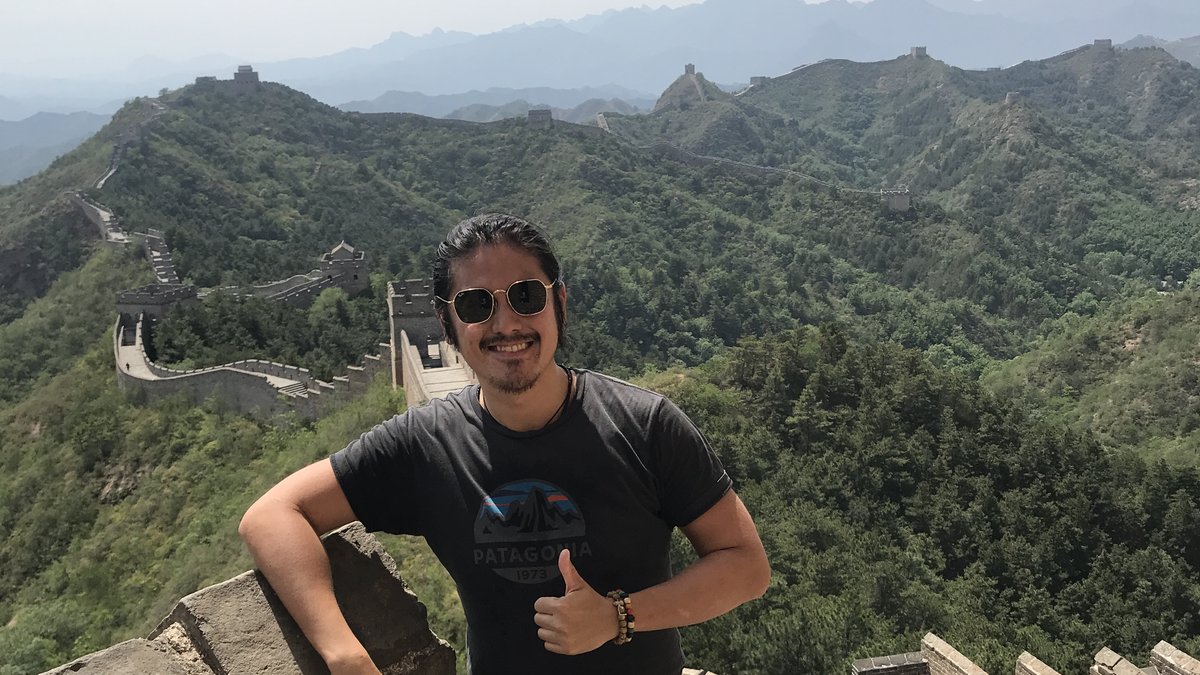
In Beijing itself, the historical sites undid me in ways I hadn’t anticipated. Standing at the Great Wall — really standing there, not looking at a photograph — was one of those experiences that quietly reorganises something inside you. The Summer Palace, with its long covered corridors and the still weight of Kunming Lake, gave me a sense of scale I hadn’t encountered before — not just the physical scale of the place, but the scale of the civilisation that had produced it.
The Temple of Heaven and the Forbidden City gave me chills. Not tourist chills — something deeper and older than that. A recognition. A feeling of standing somewhere your blood has always known about, even when your mind didn’t. Walking through those ancient courtyards, I felt something that had been switched off in me for a long time begin to stir. A pride I can only describe as dormant — present but sleeping — woke up. And with each passing day, each new city, each ancient site, each ordinary kindness from strangers who simply treated me as one of their own, it grew stronger.
Wài Pó’s Ancestral Home: Fujian Province
Then there was Fujian Province — my wài pó’s ancestral home.
Travelling there to meet family friends and distant relatives was unlike anything else I experienced in those three years. I was welcomed with a warmth that was simultaneously overwhelming and immediately familiar. These were people who had never met me, but who treated me as though I’d simply been away for a while and had finally come back. Food was produced before we’d finished greeting each other. Stories were shared. The local dialect was different from the Mandarin I’d been studying in Beijing — a humbling reminder of how vast and varied China truly is — but the connection was there in a way that cut clean through language.
For all my years of growing up in the Sutherland Shire feeling like the Chinese part of me was a background detail, here were people who looked like me, who shared a history with me, for whom I was simply family. Not a curiosity. Not an outsider. Just family.
That trip to Fujian did something I hadn’t fully expected. It made the abstract concrete. By the time I returned to Beijing, the pride that had stirred at the Forbidden City had grown roots. It wasn’t going anywhere.
Falling in Love With Being Chinese
Somewhere in those three years, I fell in love with being Chinese.
Not as an ethnicity recorded on a document. Not as a box to tick. As a living, breathing, extraordinary thing — a history and a culture and a way of engaging with the world that is unlike anything else, and that was mine. Had always been mine. I just hadn’t known how to claim it.
The stories my wài pó had told me as a child suddenly had context. The meals my mother had cooked made sense as a language of their own. The values my parents had modelled — the work ethic, the love expressed through action, the quiet sacrifice — weren’t just personality traits. They were culture, passed down in the only way my family knew how: without words, through living.
The language was the key. Once I had it, everything else followed.
Mandarin as a Bridge to the World
Returning to Australia was not the end of the journey. If anything, it was the beginning of a different one.
In the years since, I’ve travelled widely — across Asia, through Europe, into parts of the world where I had no particular reason to expect my Chinese identity to be relevant. And yet, again and again, it has been.
There are approximately 60 million overseas Chinese living around the world. Chinese communities exist on every continent, in cities and towns you might never think to associate with China. What I’ve discovered — and what continues to surprise me — is that the moment you can communicate in Mandarin, doors open that would otherwise stay shut. Not just professionally, though that too. Something more human than that.
I’ve been in situations where I was the unexpected bridge between people — where my ability to speak Mandarin turned a transaction into a conversation, a misunderstanding into a connection, a stranger into someone I’ll remember. There is something extraordinary about the moment someone realises you speak their language — the surprise, followed by an immediate warmth and ease that wasn’t there a moment before. It happens every time, without exception.
Being Chinese and being able to communicate that through the language has made me more useful, more connected, and more capable of helping people than I would otherwise have been. It has opened professional doors I never anticipated, built relationships that wouldn’t have been possible otherwise, and given me a way of moving through the world that feels both grounded and expansive.
That’s the thing nobody tells you when you’re a kid growing up in the Shire, trying to blend in and put the Chinese part of yourself quietly to one side: what you’re setting aside isn’t a limitation. There are more compelling reasons to learn Mandarin than most people realise — and for overseas-born Chinese, those reasons are deeply personal. It’s an asset. A rare one. And the world will show you that, if you give it the chance.
Coming Home — Whole
I came back to Australia a different person. Not a different nationality — I have always been Australian and I always will be. Rugby league, Cronulla Beach, the particular irreverence and warmth of Australian culture — that’s as much a part of me as anything. That hasn’t changed.
But I came back whole.
Today I feel genuinely both. Australian and Chinese. Not half of each — fully both. And the Chinese part of me is something I carry with deep pride. It’s not a complication. It’s not a qualification. It’s my superpower.
How WillyChina Helps Overseas-Born Chinese Reconnect
Since starting WillyChina, I’ve met many people who share a version of this story.
Overseas-born Chinese who grew up in Australia, the United States, the Netherlands, New Zealand — people born outside China to Chinese parents, or who left China young enough that the memories are faint. People who feel the pull of a heritage they’ve never fully accessed. People who carry a quiet guilt about not speaking Mandarin, or a quiet loss about grandparents they couldn’t communicate with properly, or a quiet curiosity about what they’ve missed. I’ve also met people who were adopted from China into Western families and are approaching their heritage from an entirely different angle — knowing intellectually that they are Chinese, but having very little lived experience of what that means.
All of these people share something: the in-between feeling, and a desire to find a way back.
What I offer through WillyChina isn’t just Mandarin lessons in the traditional sense. For overseas-born Chinese students, the work goes deeper than vocabulary lists and grammar exercises. We talk about Chinese history — the dynasties, the stories, the events that shaped the culture and that live on inside the language itself. We explore Chinese philosophy and the values embedded in everyday expressions. We talk about what it means to be Chinese in a Western context, the shared experiences of navigating dual identities, and the extraordinary richness that comes from belonging to both worlds rather than neither.
For many students, these conversations are as meaningful as the language learning itself. There’s something powerful about sitting with someone who has walked the same path — who knows exactly what it feels like to be told you’re too Chinese for one group and too Australian for another, and who came out the other side with something worth holding onto. That shared understanding is part of what makes these lessons different.
Nothing brings me more joy than connecting with another overseas-born Chinese person, hearing their story, and watching the language open something up in them that had been closed for a long time. Every student who finds their way back to Mandarin — and through it, to their heritage — is a reminder of why this work matters. Read what students have to say about their experience.
Mandarin is the bridge. The culture, the history, the identity — it’s all there on the other side, waiting.
If you’re ready to start that journey, book a free introductory call and let’s talk about where to begin.
FAQs
I didn’t grow up speaking Mandarin at all. Is it actually possible to learn as an adult?
Yes — and often more readily than you’d expect. Heritage learners frequently carry more than they realise: exposure to sounds from childhood, a cultural framework that gives context to what they’re learning, and a depth of motivation that purely academic students don’t always have. Read more about how adults learn Mandarin effectively.
Do I need to explain my background before starting lessons?
Not at all — but it often comes up naturally and enriches the learning. Understanding where you’re starting from helps tailor the focus. Some heritage learners want to prioritise conversation to speak with elderly relatives. Others want to understand historical films or classical texts. All of these are valid starting points.
Is learning Mandarin as an overseas-born Chinese person different from learning as a complete outsider?
In meaningful ways, yes. The motivation is personal in a way it isn’t for someone learning purely for business. The emotional stakes are different. And the gaps tend to be specific — heritage learners often have some listening comprehension but little reading or writing, or a strong cultural foundation but no formal grammar. Lessons should reflect that specific profile, not treat you as a generic beginner.
What if I feel embarrassed that I can’t speak Mandarin despite being ethnically Chinese?
This is one of the most common feelings among overseas-born Chinese, and it’s worth saying clearly: there’s nothing to be embarrassed about. The circumstances that shaped your relationship with the language were not in your control. Many students grew up in environments where learning Mandarin wasn’t encouraged, wasn’t available, or directly conflicted with the need to fit in. You’re not behind. You’re exactly where you are, and that’s the right place to start from.
How long does it take to reach a conversational level?
Most students who study consistently reach a meaningful conversational level within 12 to 18 months. Heritage learners often progress faster in listening and speaking because the sounds aren’t entirely new. For a detailed breakdown, read how long it takes to learn Mandarin. Explore the courses here to find a path that suits your starting point.
I want to be able to speak with my grandparents before it’s too late. Where do I start?
This is one of the most moving motivations I encounter — and one of the most urgent. Get in touch directly and we’ll work backwards from that specific goal, focusing on the vocabulary and patterns that will matter most in those conversations.
WillyChina helps overseas-born Chinese — and anyone who feels a connection to Chinese culture and heritage — reconnect with Mandarin and the rich history and identity that comes with it.