What to Call Your Chinese Family
In Chinese, your uncle isn’t just your uncle. Here’s what to call your Chinese family: tap your way to any relative, hear the word, and say it with confidence at the next family meal.
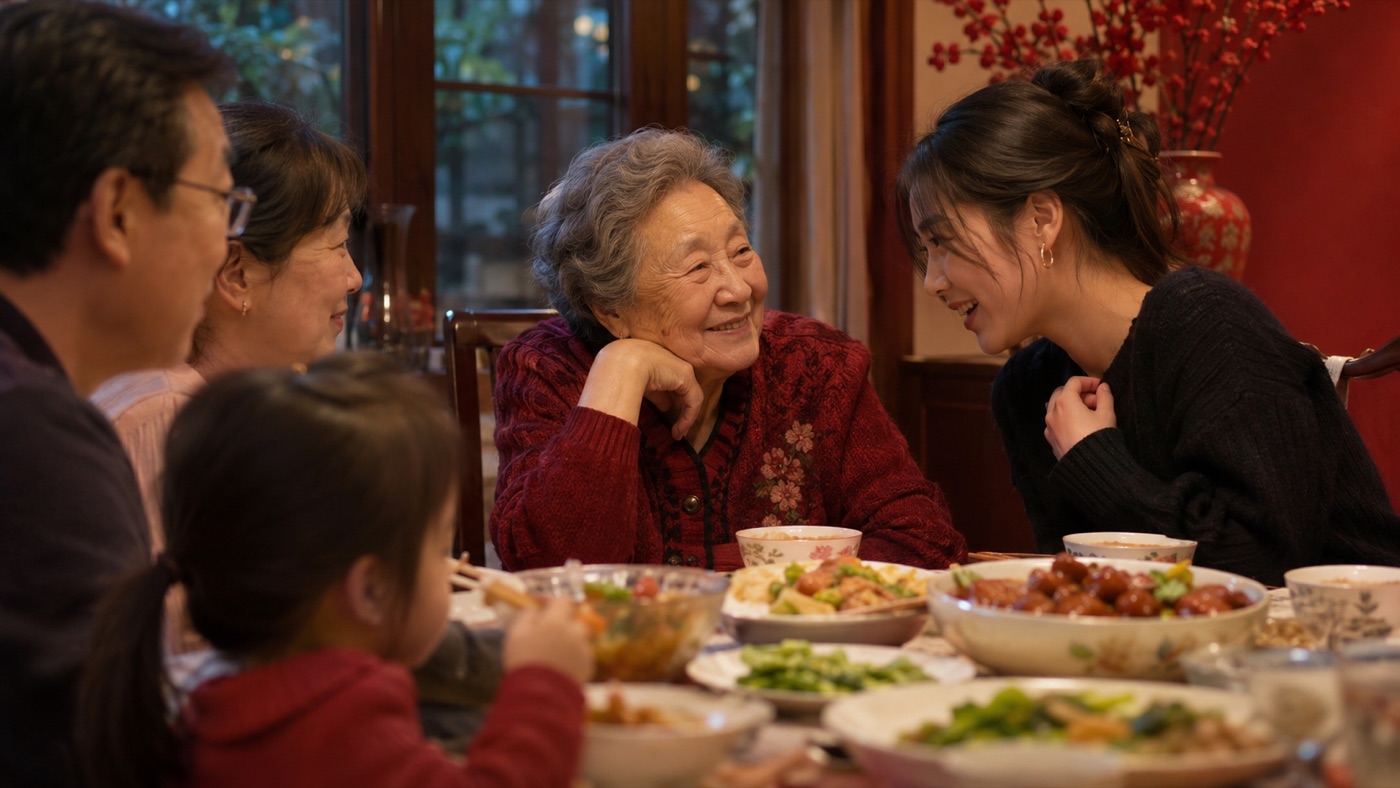
Find any relative in a few taps
Not sure what to call your Chinese family? Start with you, then tap your way to the person. You’ll get the word to use and hear how it sounds.
Your Chinese family at a glance
Choose a side of the family, then tap any relative to hear what to call them.
Grandparents
Dad’s brothers
Their children
Your parents
You and your brothers and sisters
Their husbands and wives
Dad’s sisters
Their children
伯父 (bófù) is the more formal word for 伯伯 (bóbo).
Grandparents
Mum’s brothers
Their children
Your parents
You and your brothers and sisters
Their husbands and wives
Mum’s sisters
Their children
Your mum’s parents have two pairs of names. See which pair your family might use. 阿姨 (āyí) also means Mum’s sister.
Three questions Chinese asks about every relative
Once you know the questions, the words start to make sense.
Which side?
姑姑 (gūgu) is your dad’s sister. 姨妈 (yímā) is your mum’s sister.
Older or younger?
伯伯 (bóbo) is older than your dad. 叔叔 (shūshu) is younger than him.
Blood or marriage?
舅舅 (jiùjiu) is your mum’s brother. 舅妈 (jiùmā) is his wife.
大伯 (dàbó), 二姨 (èryí): how families number aunts and uncles
Calling an older relative by their given name is seen as disrespectful, so when there’s more than one, families add a word for birth order: 大 (dà) for the eldest, 二 (èr) and 三 (sān) for the next, and 小 (xiǎo) for the youngest.
Dad’s brothers
Dad’s sisters
Mum’s brothers
Mum’s sisters
Families count in different ways and regions have their own words, so ask what yours says. Some of these words can also mean a husband’s or wife’s brother or sister. Source: Zheng Zining in Jiemian, on Chinese family terms.
What will my child call everyone?
Your child’s words depend on which parent you are. Your father is 爷爷 (yéye) to your brother’s children, and 外公 (wàigōng) to your sister’s.
Your family
Their mum’s family
Your family
Their dad’s family
Your child has the same family tree as you, one generation down. Stand them in the “You” spot above and every word follows. If your family uses 姥爷 (lǎoyé) and 姥姥 (lǎolao), use those instead of 外公 (wàigōng) and 外婆 (wàipó).
Who is it? A six-question family quiz
Use the three questions above. Tap your answer to hear it.
外婆 (wàipó) or 姥姥 (lǎolao)? Which word your family might use
Your mum’s parents have two common pairs of names. 姥姥 (lǎolao) and 姥爷 (lǎoyé) are more common in the north, and 外婆 (wàipó) and 外公 (wàigōng) in the south. There’s no strict dividing line, and people in both understand both pairs. The right word is the one your family already uses, so if you’re not sure, ask.
Sources: Sina, on the 2018 Shanghai textbook change; Hangzhou News, on the words for Mum’s mother.
My mother and my maternal grandmother — my 外婆 (wài pó) — were extraordinary cooks.
My wài pó had immigrated from China to be near us — a grandmother crossing the world to stay close to her grandchildren.
I would sit with my wài pó for hours and watch Chinese historical dramas and documentaries together.
What to call your partner’s parents
The word changes once you’re married, so it helps to know which stage you’re at.
Before marriage
叔叔 (shūshu) and 阿姨 (āyí) are the safe choice. 伯父 (bófù) and 伯母 (bómǔ) are more formal. Ask your partner which their family prefers.
After the wedding
People call their in-laws 爸 (bà) and 妈 (mā), the same as their own parents, unlike in Western culture. The switch is called 改口 (gǎikǒu). Not everyone is comfortable with it, so talk it through with your partner. These four words are for talking about in-laws.
Sources: ChinesePod, dinner with the girlfriend’s parents; ETtoday, on changing what you call in-laws.
Nieces, nephews and grandchildren
These words say how someone is related to you, and they also tell you what you are to your elders. To your 奶奶 (nǎinai) you’re a 孙子 (sūnzi) or 孙女 (sūnnǚ). To your 外婆 (wàipó) you’re a 外孙 (wàisūn) or 外孙女 (wàisūnnǚ).
Your children
Nieces and nephews
Grandchildren
Short phrases for family occasions
Tap to hear each one. For Grandpa, swap in 爷爷 (yéye).
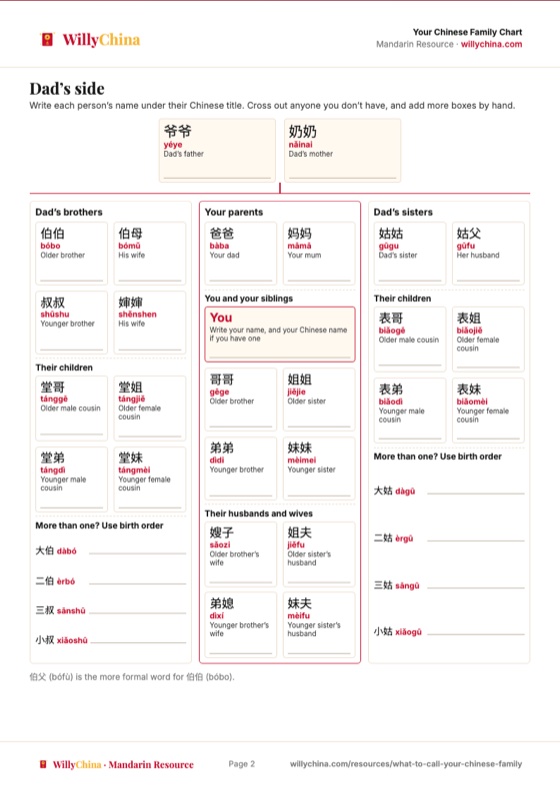
Your Chinese family chart
Print it, sit down with your parents, and fill in your real family, name by name. It has both sides of the family, birth-order names, your partner’s family and the next generation, with Chinese, pinyin and English for each relative and space to write everyone’s name.
FAQs
Free PDF
Where should I send your chart?
Tell us a little about you and your family chart is yours: what to call your Chinese family on both sides, ready to print and fill in. It lands in your inbox straight away.
All fields are required. I’ll send new resources now and then, the odd note on learning Mandarin properly, and occasionally news about my workbooks. Unsubscribe any time. Privacy policy
Sent. Check your inbox, or open your chart here.
Ready to talk with your family?
See our Chinese coursesFree 30-minute intro call
Talk with your family in Mandarin
Knowing the words is a start. Talking with your family takes practice, with a teacher who can hear your tones and build lessons around the people you want to talk to.
- One-to-one lessons online, built around your goals
- A real reply within 24 hours
- No obligation, no sales pitch
Thanks, that’s in. We’ll reply within 24 hours.