Home › Learn Chinese Anywhere › Australia › HSK test centres
The HSK in Australia
HSK Test Centres in Australia 澳大利亚HSK考点 Àodàlìyà HSK kǎodiǎn
Where you can actually sit the HSK in 2026, checked centre by centre against the official register, plus what the December switch to HSK 3.0 means for your booking.
Checked 11 October 2026. Every centre below was checked on the official HSK register and, where it has one, the centre’s own page.
Most lists of HSK test centres in Australia are out of date. They still send people to Confucius Institutes that have closed, they give old addresses, and some leave out centres that are running sittings right now. The HSK, or 汉语水平考试 (Hànyǔ Shuǐpíng Kǎoshì), is the international Chinese proficiency test, and you can only sit it at a centre approved by Chinese Testing International (CTI), the body that runs it.
So we went back to the source. CTI’s register lists 28 entries for Australia. Seven are second entries for the same centre’s computer-based test, which leaves 21 hosts. As of 11 October 2026, eight of them have HSK sittings in 2026, three run only the YCT, the test for school students, and the rest have nothing listed or have closed. This guide covers every one of them, along with fees, deadlines and the change to the new HSK on 13 December 2026.
Where to sit it
The HSK test centres with sittings in 2026
These eight HSK test centres have run a sitting this year or have one open for booking. Each link goes to the centre’s page on the official register, which shows its upcoming dates and lets you book.
| Centre | Where | What it has run or listed in 2026 | Book |
|---|---|---|---|
| UNSW HSK Centre | Kensington, Sydney NSW | HSK 1–6 and HSKK. YCT and BCT by arrangement. Sittings listed for 7, 21 and 28 November. | Official listing |
| Sydney HSK Centre | Haymarket, Sydney NSW | HSK, HSKK and YCT. The only Australian centre with a 13 December HSK 3.0 sitting on the official register. | Official listing |
| Griffith University (Tourism Confucius Institute) | Nathan campus, Brisbane QLD | HSK, HSKK, YCT and BCT, paper-based. Sittings on 13 September and 17 October; the register also lists November dates. | Official listing |
| Perth Beijing School | Northbridge, Perth WA | HSK. Its last 2026 sitting is 7 November; there is no December sitting. | Official listing |
| Australian School of Contemporary Chinese | Braddon, Canberra ACT | HSK and HSKK on 22 March and 13 December; YCT on 24 May. | Official listing |
| The Hutchins School | Sandy Bay, Hobart TAS | HSK 1–5 on 17 October. | Official listing |
| New Chinese Language and Culture School | Box Hill, Melbourne VIC | HSK on 17 October. | Official listing |
| Lyrebird Education | Melbourne VIC | HSK, HSKK and YCT. HSK listed for 7 November, YCT for 22 November. | Official listing |
HSK test centres running only the YCT
The YCT, or Youth Chinese Test, is the HSK’s sister test for primary and secondary school students. Three more HSK test centres are registered for it, and each has a YCT sitting listed for 22 November, but no HSK.
| Centre | Where | What it has listed in 2026 | Book |
|---|---|---|---|
| Mandarin Stars Australia | Perth WA | YCT on 22 November. | Official listing |
| EverGreen Education | Adelaide SA | YCT on 22 November. | Official listing |
| Darling Downs and Toowoomba Chinese Language School | Toowoomba QLD | YCT on 22 November. | Official listing |
Before you book
HSK test centres that are closed, quiet or no longer listed
This is where most other lists go wrong. Six more hosts are on the official register but had no sitting listed when we checked. The register only shows sittings from mid-October onwards, so a blank listing does not prove a centre has stopped. If one of them is near you, ask it directly before you plan around it.
| Centre | Where | Status on 11 October 2026 |
|---|---|---|
| Confucius Institute at QUT | Kelvin Grove, Brisbane QLD | On the register, no sitting listed. QUT said in 2025 the arrangement would be reviewed in 2026. |
| Australian Multicultural Education Centre | Sunnybank, Brisbane QLD | On the register, no sitting listed. |
| Queensland Miaomiao Chinese School | Brisbane QLD | On the register, no sitting listed. |
| Xin Jinshan Chinese Language and Culture School | Mount Waverley, Melbourne VIC | On the register, no sitting listed. |
| Australia EQDemic School | Mitcham, Melbourne VIC | On the register, no sitting listed. |
| Australia China Cultural Promotion Association | Adelaide SA | On the register, no sitting listed. |
The HSK test centres below are the ones you will still find on other websites and in search results. Several Australian universities closed their Confucius Institutes between 2021 and 2024, and two of those institutes are still on CTI’s register.
| Centre | Where | What happened |
|---|---|---|
| Confucius Institute at the University of Queensland | St Lucia, Brisbane QLD | Closed. The university says the agreement ended at the end of 2024. Still on the official register. |
| Confucius Institute at the University of Western Australia | Perth WA | Closed in 2023, the university says. Still on the official register. |
| Confucius Institute at the University of Adelaide | Adelaide SA | Its website now returns an error page. The university has not confirmed a closure. Still on the register. |
| Confucius Institute at Charles Darwin University | Darwin NT | Its website section has been withdrawn. No closure announced. Still on the register. |
| RMIT University | Melbourne VIC | Its Confucius Institute closed in 2021, and RMIT is no longer on the register. |
| Victoria University (VBCI) | Melbourne VIC | Not on the register. The last test plan we could find was for 2025. |
| Griffith University, Gold Coast | Southport QLD | Griffith now offers its paper tests at Nathan only. |
Live in Adelaide or Darwin? As of 11 October 2026 there is no HSK sitting listed anywhere in South Australia or the Northern Territory, and no at-home option (see below). From Adelaide the nearest HSK sittings are in Melbourne; from Darwin, every centre is a flight away. Check the register before you book travel, because centres add and drop dates through the year.
The new HSK
The switch to HSK 3.0 on 13 December 2026
On 8 September 2026, CTI announced that HSK 3.0, the new version of the exam, will launch worldwide on 13 December 2026. The new syllabus took effect in July 2026, but the exam itself did not change then: the October and November 2026 sittings still use the old format. For Australian candidates that means three things.
- 7 November is the last old-format date on the global calendar. UNSW, the Sydney HSK Centre, Griffith, Perth Beijing School and Lyrebird all listed it. Perth Beijing School moved its final 2026 sitting forward to 7 November and will not hold one in December because of the change. A few centres list extra November dates of their own (UNSW on 21 and 28 November, for example), so ask which format those use before you book.
- 13 December is the first new-format sitting. The Sydney HSK Centre is the only Australian centre with it on the official register so far. The Australian School of Contemporary Chinese in Canberra lists it on its own website, with an earlier registration deadline of 13 November.
- Levels 3 to 6 come with a speaking test. In both HSK 3.0 trials, a written level from 3 to 6 had to be booked together with the matching speaking test, and the Sydney HSK Centre’s December listing pairs each level with its speaking paper.
The new exam uses CTI’s “three stages, nine levels” framework and tests listening, speaking, reading and writing, adding translation at the advanced levels. No Australian centre has published HSK 3.0 fees yet. In the trials, CTI priced levels 3 to 6 as the written test plus the matching speaking test, so expect to pay more than the old written fee for those levels, and confirm the price with your centre before you book. For what the new levels contain, see our guide to HSK 3.0.
Levels 7 to 9, the advanced exam, are a single internet-based paper. No Australian centre lists them, and UNSW says it offers levels 1 to 6 only.
Step by step
How to register for the HSK in Australia
- Create an account on the official site, chinesetest.cn. Enter your name exactly as it appears on the ID you will bring on the day.
- Choose the test, the date and the centre. Not every centre runs every date, so start from the centre’s listing above rather than the global calendar.
- Pay the centre, not CTI. Overseas candidates pay their test centre directly, by the method it specifies. Perth Beijing School and Canberra take a bank transfer, and UNSW contacts you with payment details after you register.
- Print your admission ticket, the 准考证 (zhǔnkǎozhèng), from your account five to seven days before the test, and keep it afterwards: you need its number to look up your result.
Registration deadlines
Book early. In CTI’s 2026 calendar, registration for the paper test closes 27 days before each sitting, and for the computer-based test 10 days before. Some centres set their own earlier cut-off: Canberra’s closes 30 days before its 13 December sitting. Count back from the deadline, not the exam date, when you plan your preparation.
Paper or computer?
Seven Australian hosts are registered for the computer-based test, but none had a computer-based sitting listed when we checked, and Griffith’s 2026 dates are all paper-based. Plan on paper unless your centre tells you otherwise.
Can I take the HSK at home?
Not from Australia. CTI’s date search lists no at-home sittings anywhere, and when it last set rules for the at-home test, in December 2021, it was only for candidates in countries where centres had not reopened. Australia’s HSK test centres are running, so you sit it in person.
What it costs
HSK fees in Australia
Fees are the same at every Australian centre that publishes them: UNSW, the Sydney HSK Centre, Griffith, Perth Beijing School and the Australian School of Contemporary Chinese. UNSW says the current fees were set by the exam’s headquarters in Beijing from 2025, and that they are GST-free.
| Test | Fee | What it covers |
|---|---|---|
| HSK 1 and 2 | A$50 each | The written test for that level |
| HSK 3 and 4 | A$70 each | The written test for that level |
| HSK 5 and 6 | A$90 each | The written test for that level |
| HSKK (speaking) | A$50, A$70 or A$90 | Beginner, intermediate or advanced |
| YCT (for school students) | A$40 at most centres | Each written level; A$35 to A$45 in Canberra |
Ask about refunds before you pay. CTI’s general rules allow a full refund up to 27 days before the test and half up to 10 days before, but overseas candidates withdraw through their centre, and centres set their own terms. Perth Beijing School, for example, says all exam payments are non-refundable.
After the exam
Results, score reports and how long they last
- Online results: about a month after a paper test, and 15 days after a computer-based written test (20 days for computer-based speaking). Log in to chinesetest.cn and search with your admission ticket number and name.
- The printed score report: CTI sends reports to overseas centres about 45 days after the exam, and you collect yours from the centre. Australian centres quote longer: UNSW says from eight weeks, and Perth Beijing School about 60 days, with a postage fee of around $28 if you want it mailed.
- Validity: CTI says an HSK score is valid for two years from the exam date as proof of your level. Some other sites claim results are valid indefinitely; for admissions and scholarships, they are not.
- Passing: each level has its own pass mark. At HSK 4, for example, the maximum is 300 and 180 is a pass.
Why sit it
What Australians use the HSK for
The HSK matters most if your plans lead to China. CTI describes HSK scores as a requirement for international students applying for admission, graduation and scholarships in China, and says a high score helps foreigners looking to work there show their level to employers and improves their chances of a work visa.
The clearest Australian example is the Chinese Government Scholarship. In the 2026/27 round, administered through the Chinese Consulate-General in Melbourne, applicants for Chinese-taught programs needed HSK 3 for a general scholar place (unless they were going to study Chinese itself) and HSK 4 for a master’s or doctoral program, with a valid score report. With the two-year validity rule, time your sitting so the report is still current when you apply.
We could not find any official equivalence between Year 12 Chinese, such as the HSC or the VCE, and HSK levels, so treat any table that claims one with caution. For many learners the HSK is simply a fixed, external goal that gives study a deadline. If that is you, our guide to HSK levels explains what each one asks of you, and how long each HSK level takes helps you pick a sitting you can actually be ready for.
Getting ready
Preparing for the HSK from anywhere in Australia
Because only a handful of cities have HSK test centres, most Australians travel once, for the exam itself. The preparation can happen anywhere. WillyChina’s one-to-one HSK preparation runs online and live, on your timezone, and is built backwards from your sitting date: the level, the sections you are weakest in, and for the new format, the speaking test and handwriting.
- Not sure which level to book? Take the free Mandarin level test first.
- Building vocabulary? Start with the HSK 1 vocabulary list and work up through the levels.
- Booked already? Read what happens on HSK test day, so nothing on the morning is a surprise.
- Booking for a child? The YCT is the school-age test; our guide to Mandarin for kids in Australia covers how Chinese works at school.
Every student starts with a free 30-minute intro call, with no obligation, to work out which level and sitting make sense.
Questions
FAQs
Where can I sit the HSK in Australia?
As of 11 October 2026, eight HSK test centres have sittings in 2026: UNSW and the Sydney HSK Centre in Sydney, Griffith University at Nathan in Brisbane, Perth Beijing School, the Australian School of Contemporary Chinese in Canberra, The Hutchins School in Hobart, and the New Chinese Language and Culture School and Lyrebird Education in Melbourne.
How much does the HSK cost in Australia?
A$50 for HSK 1 or 2, A$70 for HSK 3 or 4 and A$90 for HSK 5 or 6, the same at every centre that publishes fees. The HSKK speaking test is A$50, A$70 or A$90. HSK 3.0 fees had not been published by any Australian centre as of 11 October 2026.
Can I take the HSK online at home in Australia?
No. CTI lists no at-home sittings, and its at-home test was only for countries where test centres had not reopened. In Australia you sit the HSK at a test centre.
When does HSK 3.0 start in Australia?
On 13 December 2026, the worldwide launch date CTI announced on 8 September 2026. The 7 November 2026 sitting is the last old-format date on the global calendar. In the HSK 3.0 trials, levels 3 to 6 were booked together with the matching speaking test.
How far ahead do I need to register?
In CTI’s 2026 calendar, paper-test registration closes 27 days before the sitting and computer-based registration 10 days before. Some centres close earlier: Canberra’s deadline for 13 December 2026 is 13 November.
Is there an HSK test centre in Adelaide or Darwin?
Not one with an HSK sitting in 2026. Adelaide has a YCT sitting for school students at EverGreen Education, and the University of Adelaide and Charles Darwin University Confucius Institutes have both withdrawn their websites. From Adelaide, the nearest HSK sittings are in Melbourne.
How long is an HSK result valid?
Two years from the exam date, according to CTI. Results appear online about a month after a paper test, and Australian centres quote six to nine weeks for the printed report.
What HSK level do I need for a Chinese Government Scholarship?
In the 2026/27 round run through the Chinese Consulate-General in Melbourne, HSK 3 for a Chinese-taught general scholar program and HSK 4 for a Chinese-taught master’s or doctoral program. Check the current round’s requirements before you book.
Sources. HSK test centres, upcoming sittings and the 2026 calendar are from Chinese Testing International’s register and 2026 test dates, checked 11 October 2026. The HSK 3.0 launch is from CTI’s announcement of 8 September 2026; refunds, results and validity from CTI’s regulations; the at-home rules from CTI’s notice of 6 December 2021. Fees and dates are from the centres’ own pages: UNSW, the Sydney HSK Centre, Griffith University, Perth Beijing School and the Australian School of Contemporary Chinese.
Closures are from the universities’ statements to the ABC (1 April 2025) and the hosts’ own websites, checked 11 October 2026. Scholarship requirements are from the Chinese Consulate-General in Melbourne. Map outline from Natural Earth.
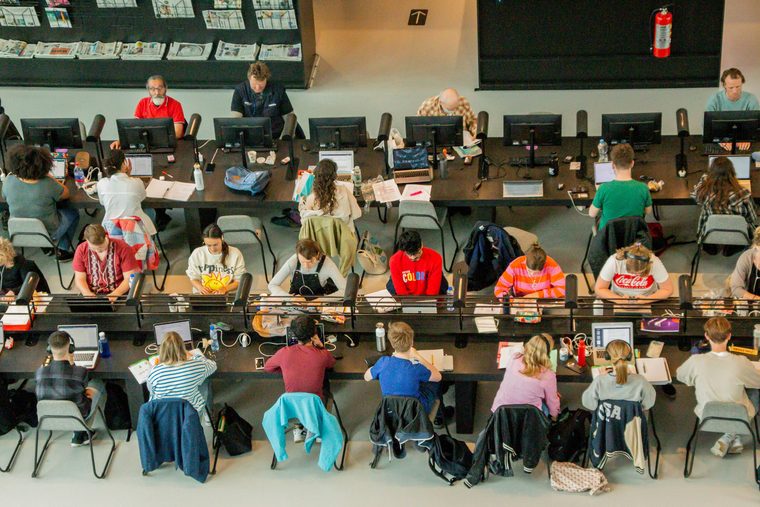
Photograph by Denise Jans.
Start preparing
Walk into the exam room ready
One-to-one HSK preparation, online from anywhere in Australia, planned back from your sitting date. Start with a free 30-minute intro call.
Book a free intro call