Home › Chinese Australia › History
History
The History of Chinese Australians 澳大利亚华人史 Àodàlìyà Huárén Shǐ
The history of Chinese Australians runs for more than two hundred years: goldfield miners and market gardeners, the people a new nation wrote its first laws to keep out, and today one of the largest communities in Australia. This is that story, from the first known Chinese settler in 1818 to today.
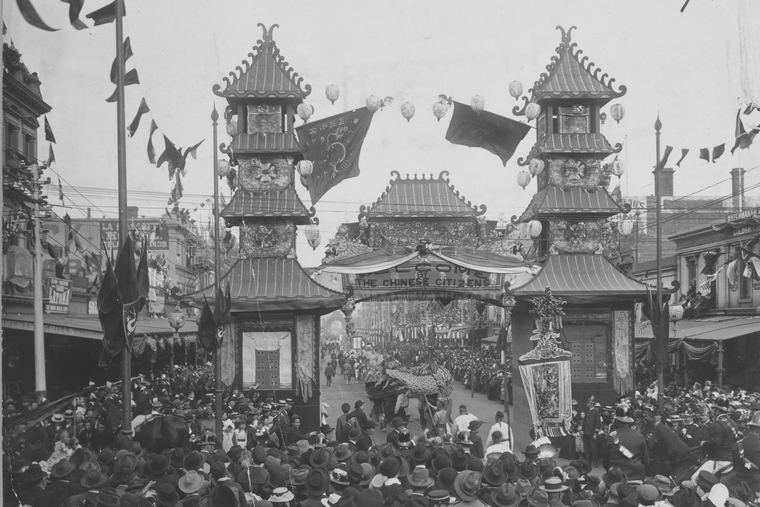
In May 1901, the month the first federal Parliament opened in Melbourne, the city’s Chinese citizens put up an arch with a banner that read “Welcome by the Chinese citizens”. Before the year was out, that Parliament had passed the Immigration Restriction Act, a law written to keep people like them out of the country.
That is the history of Chinese Australians in one moment: a community already part of Australia, celebrating it, and being shut out by it. Chinese arrivals were wanted as labour, then taxed, attacked and legislated against. Under White Australia the community shrank for half a century. Once the policy ended it grew faster than almost any other, and at the 2021 Census 1,390,639 people reported Chinese ancestry, 5.5% of the population. Mandarin is now the most common language spoken at home after English.
This guide follows that story from 1818 to today, through the records, photographs and the words of the people who lived it.
At a glance
The history of Chinese Australians in seventeen dates
Each date links to the chapter that tells it.
Chapter 1 · 1818–1853
The first arrivals, before the gold
The first Chinese settler we can name is Mak Sai Ying, who arrived at Port Jackson on the ship Laurel on 27 February 1818. Born in Guangzhou in the late 1790s, he worked as a carpenter for John Blaxland at Newington and then at Elizabeth Farm for Elizabeth Macarthur. In 1823 he married Sarah Jane Thompson at St John’s Church, Parramatta, and by 1829 he held the licence of a Parramatta hotel, the Golden Lion: a Chinese publican in colonial New South Wales, a full generation before the gold rush.
Larger numbers came when convict transportation to New South Wales ended and the colony ran short of shepherds. Pastoralists turned to contract labour from southern China, and on 2 October 1848 the barque Nimrod reached Port Jackson from Amoy, now Xiamen in Fujian province, carrying 120 Chinese emigrants. More than 3,000 contract workers followed through Sydney by 1853, almost all of them from Fujian.
Chapter 2 · 1851–1860s
The gold rushes and New Gold Mountain
Within a few years of the Victorian finds of 1851, tens of thousands of men were sailing from southern China. Most were Cantonese-speaking villagers from the See Yup, the Four Districts of Guangdong: Toishan, Sunwui, Hoiping and Yanping. They called the Australian goldfields 新金山 Xīn Jīnshān, “New Gold Mountain”. California, where the earlier rush had been, was the Old Gold Mountain.
Arrivals peaked in 1856, when 12,396 Chinese came. By the 1861 census, 38,258 people living in Australia had been born in China, 3.3% of the entire population. Australia would not count that many China-born residents again until the late 1980s. More than 24,000 of them were on the Victorian goldfields, at Ararat, Ballarat, Beechworth, Bendigo, Castlemaine and Maryborough, and more than 11,000 on the fields of New South Wales.
Few came as free men. Most travelled as indentured or contract labourers, or on credit tickets, their fares advanced by a lender and repaid out of what they earned. Only a minority paid their own way.
Chapter 3 · 1855–1877
Taxed, turned away and attacked
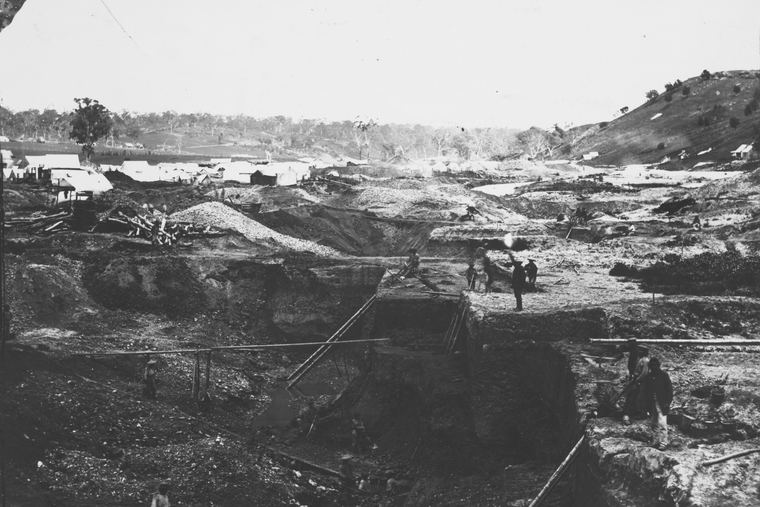
The colonies answered with law and, too often, with violence. In 1855 Victoria limited ships to one Chinese passenger for every ten tons and charged a £10 tax on every Chinese arrival. A residence tax followed in 1857.
The Chinese answered with petitions. “We feel that as strangers in a strange land, unacquainted in general with your laws, language and customs, and religion, our actions may be misconstrued,” the Chinese of Castlemaine told the Victorian parliament in August 1857. Two years later the Chinese of Bendigo described what the tax meant in practice: “Hundreds of our unfortunate countrymen have been taken away from their daily avocations and marched through the public streets in custody of police officers, like common felons, to prison because they were too poor to pay for a license.”
The walk from Robe
Ship captains found a way round it. They landed their passengers at Robe, on Guichen Bay in South Australia, beyond the reach of Victoria’s law, and the men walked overland to the goldfields. About 4,300 Chinese landed at Robe in 1856 and 10,325 in 1857, more than 16,000 in all; on 25 June 1857 a single ship, the Koenig Willem II, put 397 ashore. South Australia passed its own restriction Act that month. Heritage Victoria estimates that about 20,000 people entered Victoria overland between 1855 and 1862, most of them Chinese avoiding the tax.
Buckland, 1857
On 4 July 1857, in the Buckland Valley in Victoria’s north-east, a mob of European miners drove the Chinese from their claims. About 750 tents, 30 stores and a newly opened Chinese temple were destroyed, and Chinese losses were put at around £50,000. Police found four bodies; the true number of dead is unknown. Most of the men put on trial were acquitted. By October more than 500 Chinese miners were back in the valley.
Lambing Flat, 1861
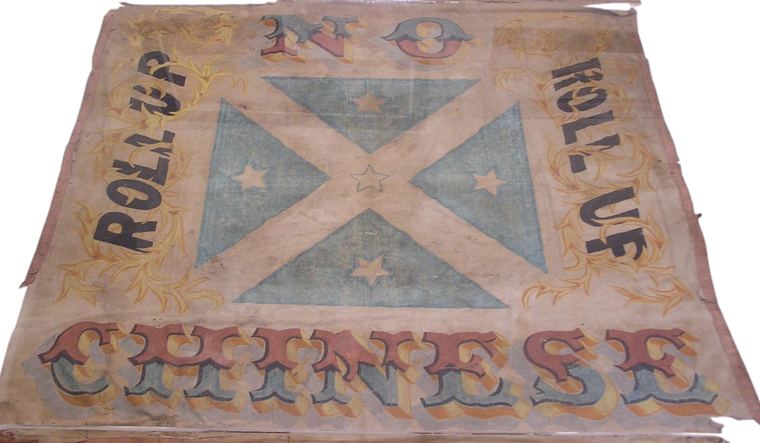
Worse came at Lambing Flat, now Young in New South Wales, where riots ran on and off for ten months in 1860 and 1861. On 30 June 1861 European diggers — about 2,000 by the National Museum of Australia’s count, some 3,000 by the state heritage register’s — marched on the Chinese camps under a banner reading “Roll up, roll up, no Chinese”. About 250 Chinese miners were badly injured and most lost everything they owned. One local family, the Robertses, sheltered about 1,200 Chinese refugees on their property near Back Creek. That November, New South Wales passed its own Chinese restriction Act.
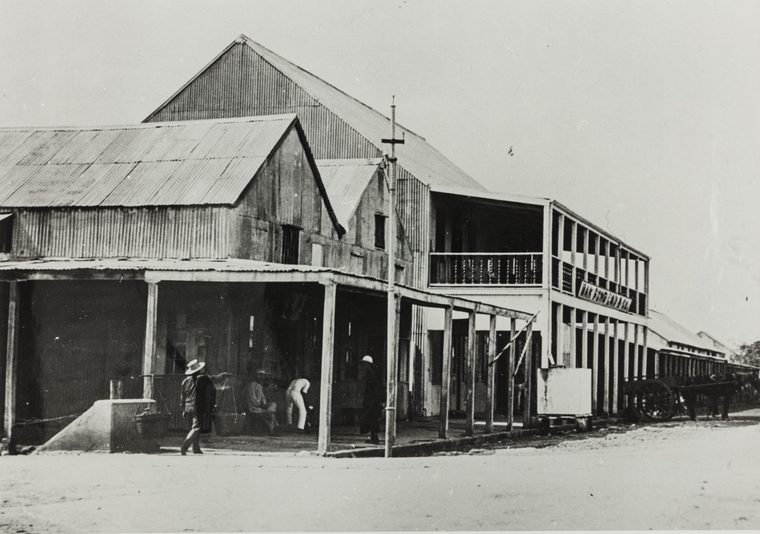
The pattern moved north with the gold. On Queensland’s Palmer River goldfield a new phase began on 30 January 1875, when the steamship Victoria arrived with two hundred Chinese passengers. By early May 5,000 more had come by steamer from Chinese ports, and in June 1875 a local estimate put the Chinese of Cooktown and the Palmer at 12,000. Queensland answered as the southern colonies had, with heavier fees for Chinese miners, which became law in 1877. Many of those miners stayed in the north, and the next chapter follows them.
Chapter 4 · 1874–1942
North and west: Darwin, the tropics and the tin fields
The story is usually told from Melbourne and Sydney, but for a generation the Northern Territory had more Chinese residents than European ones. In 1874 the South Australian government, which then administered the Territory, brought in 200 Chinese labourers, and others came on their own account after gold was found. More than 2,000 Chinese labourers built the railway from Palmerston, now Darwin, to Pine Creek, completed in 1889; the National Museum of Australia calls it the only railway in Australia built with Chinese labour.
By the late 1880s the Territory’s Chinese residents outnumbered its Europeans several times over, and the Commonwealth Year Book records that 1911 was “the first in which the population was dominated by the European race”.
In Darwin, Chinese bakers, fishermen, tailors, market gardeners and tradesmen built a Chinatown around Cavenagh Street. The community shrank under White Australia, to 1,331 in 1911 and 772 in 1922.
When war reached the north, Sue Wah Chin and her six youngest children were evacuated on the SS Montoro in January 1942, weeks before the first bombing. Chinatown, the National Museum records, was razed by the military, and Lee Toy Kim came back after the war to find the land she had owned had been acquired by the government. Harry Chan, evacuated to Sydney in 1942, returned to become the first elected president of the Territory’s Legislative Council in 1965 and Mayor of Darwin in 1966.
Queensland: cane, bananas and a temple
In Queensland, many who had come for the Palmer stayed to farm. By the 1880s one in five of Cooktown’s residents was Chinese. In 1882 the Chinese-run Hap Wah plantation crushed the first cane processed in the Cairns district, and in 1886 Chinese growers made up 60% of the farmers around Cairns and 90% of its market gardeners. They dominated Australia’s banana trade until the 1930s, and Queensland legislated against them too: its Banana Industry Preservation Act of 1921 required “coloured” labourers to pass a dictation test.
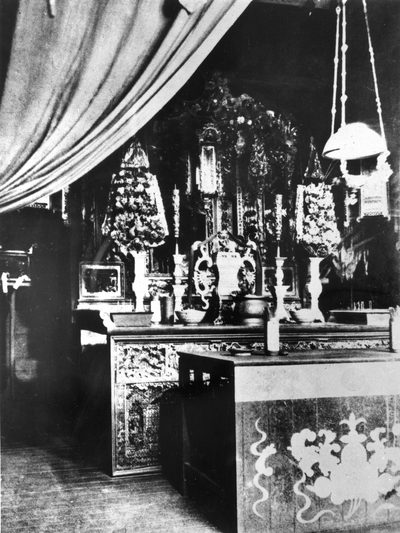
On the Atherton Tableland, Chinese tenants who could not own land pioneered maize growing in north Queensland, and in 1903 they built the Hou Wang temple, a social and spiritual focus for over a thousand people. After the First World War their leases were revoked in favour of soldier settlers, and most had left by the end of the 1920s. The temple survives, in the care of the National Trust.
Tasmania and Western Australia
Payable tin was found in north-east Tasmania in 1874, and through the 1880s Chinese tin miners outnumbered European ones; Weldborough was their largest town. Tasmania was the only colony to allow unrestricted entry to Chinese women, though most miners could not afford to bring a wife. As the temples of the tin fields closed, their contents were kept, and in 1934 they were donated to the Queen Victoria Museum in Launceston, where they stand today as the Guan Di Temple.
Western Australia’s Chinese community was small: 145 people in 1881, and at most 1,812 in 1911. In Broome the pearl divers were mostly Japanese, and earlier Aboriginal and Malay; the Chinese ran its stores, tailors’ shops, kitchens and boarding houses. By the early 1900s market gardening in Perth was done almost exclusively by Chinese growers, though they were barred from selling at the Perth City Markets. On the goldfields, laws from 1886 shut “Asiatic or African” aliens out of mining, and those exclusions stayed for more than sixty years.
Chapter 5 · 1854–1925
Temples, market gardens and Little Bourke Street
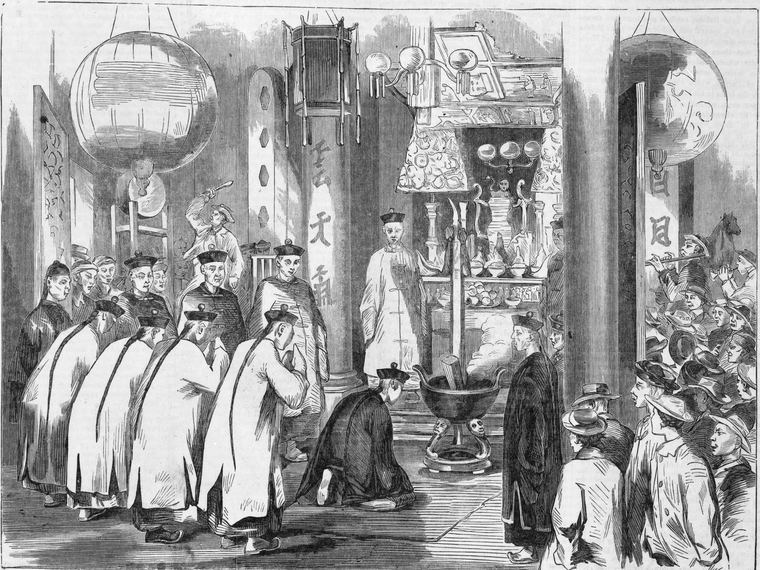
Not everyone went home, and those who stayed built institutions. The See Yup Society was founded in Melbourne in 1854, and in 1866 it opened a temple at Emerald Hill, now South Melbourne, designed by the architect George Wharton on land given by the merchant Louis Ah Mouy. Heritage Victoria calls it the most important centre of Chinese worship in Victoria in the nineteenth century. In Bendigo the Joss House at Emu Point, built in the 1860s, is the only temple from the gold rush years still standing in country Victoria.
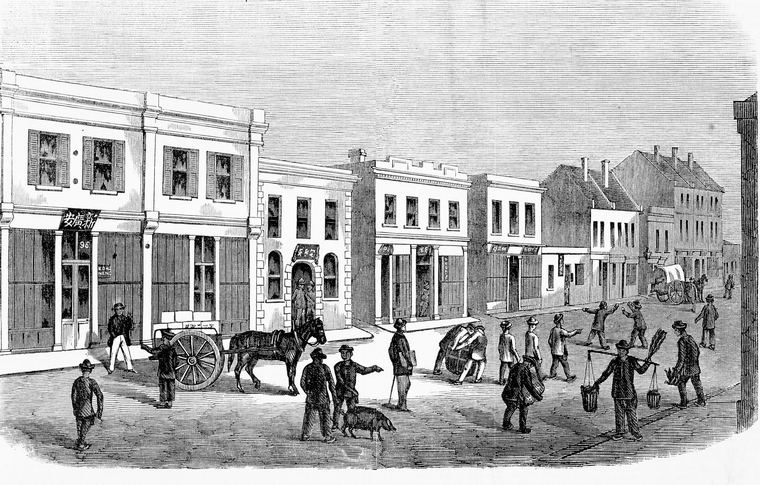
By 1855 Chinese merchants had stores and lodgings in Little Bourke Street, and the district societies made their headquarters there. It is still Melbourne’s Chinatown. In Sydney the first Chinese quarter grew up in lower George Street in The Rocks in the 1850s, moved towards the Haymarket in the 1870s and settled in Dixon Street early in the twentieth century.
The work that fed the cities
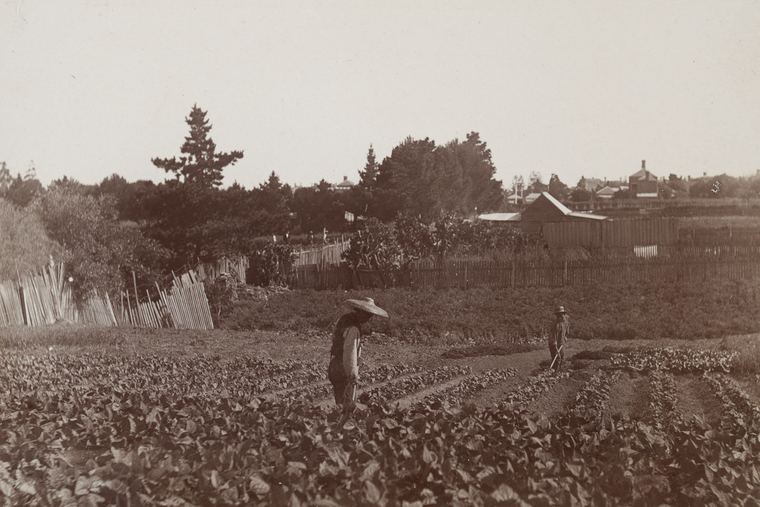
Between 1901 and 1921 Chinese growers were Victoria’s main vegetable producers, and Little Bourke Street merchants almost monopolised the wholesale fruit and vegetable trade. Chinese cabinet-makers captured the cheap furniture market, and by 1895 there was a Chinese laundry in every Melbourne suburb. Success brought new restrictions: Victoria passed discriminatory factory laws in 1896 and again between 1904 and 1907. Chinese herbalists, whose numbers peaked in 1925, fought off a Victorian bill that year that would have stopped them practising.
The community speaks for itself
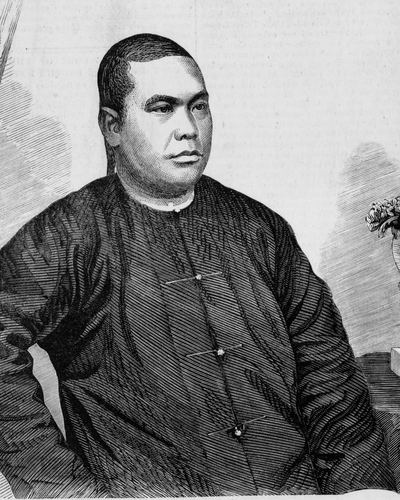
The community also found its own voice. In 1879 three Melbourne leaders — the merchant and shipowner Lowe Kong Meng, the merchant Louis Ah Mouy and the missionary Cheong Cheok Hong — published The Chinese Question in Australia, 1878–79, arguing that the colonies should honour the 1860 Treaty of Peking, which allowed Chinese people to go to British territories.
“You do not endeavour to exclude Germans, or Frenchmen, or Italians, or Danes, or Swedes. There are men of all these nationalities here. Then why are Chinese colonists to be placed under a ban? Are we an inferior race?”
Lowe Kong Meng, Cheong Cheok Hong and Louis Ah Mouy, The Chinese Question in Australia, 1879.
By the 1890s there was a Chinese-language press too: the Chinese Australian Herald, 廣益華報 Guǎngyì Huábào, from 1894, and the Tung Wah News, 東華新報 Dōnghuá Xīnbào, from 1898.
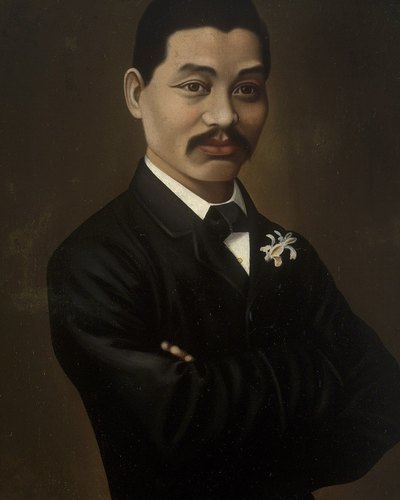
In Sydney, Mei Quong Tart had come to New South Wales at nine, with an uncle bound for the Braidwood goldfields. He became one of the colony’s best-known businessmen, running a chain of tea rooms and, from December 1898, a dining hall in the new Queen Victoria Markets, and he campaigned against the opium trade with petitions in 1884 and 1887.
Chapter 6 · 1888–1958
Federation and the White Australia policy
The turning point came in 1888. When the SS Afghan arrived with more than 200 Chinese passengers, quarantine rules were used to keep them off. In Melbourne the Burrumbeet brought fourteen Chinese, eight of them holding Victorian naturalisation certificates, and none was allowed to land. In Sydney, Chinese passengers were detained and deported under laws rushed through Parliament. An intercolonial conference that year tightened the restrictions everywhere. Museums of History NSW describes the episode as paving the way for the White Australia policy.
Melbourne’s Chinese residents, through a committee chaired by Cheong Cheok Hong, wrote to the conference that the cry of a great influx of Chinese was “one of those poor hollow things that time and reflection will cause the generous British mind to feel heartily ashamed of”.
Thirteen years later, keeping Chinese out was among the first things the new Commonwealth did. The Immigration Restriction Act became law on 23 December 1901. It never named the Chinese. Instead it gave immigration officers the dictation test: any non-European arrival could be made to write out fifty words in a European language, and after 1905 in any prescribed language. Between 1902 and 1909 the test was given 1,359 times and passed 52 times. After 1909, nobody passed.
Chinese Australians protested from the start. In 1901 Cheong Cheok Hong wrote to the new Prime Minister, Edmund Barton, against laying on them “a double yoke of national ignominy and dishonour”. William Ah Ket, born in Wangaratta in 1876 and admitted as a lawyer in 1903, campaigned against the 1901 bill and later against the factory licensing laws.
The census shows what the policy did. In 1861 China-born people were 3.3% of the population. By 1947 there were 6,404 of them, less than a tenth of one per cent of Australia.
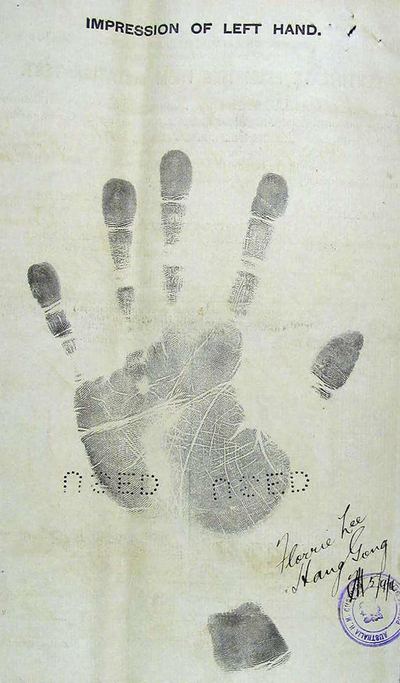
For Chinese Australians already here, the policy became paperwork. Anyone who wanted to visit China and come back needed a Certificate Exempting from the Dictation Test, which let them travel for up to three years and return without sitting it. The paperwork carried photographs, hand prints and character references, and from December 1905 the certificates were limited to residents of good character with five years’ residence. In Victoria alone, a family historians’ index lists about 13,000 applicants between 1904 and 1959.
Even the Australian-born were questioned. James Cheong, born in Ballarat and a graduate of the University of Melbourne, was interviewed by customs officers when he landed at Fremantle in 1904. “I felt hurt,” he said, “that I hadn’t free ingress into the land of my birth and education and training, where I had hoped to spend the best years of my life.”
Chapter 7 · 1857–1930s
Wives, daughters and divided families
For most of this history Chinese Australia was a community of men. Victoria’s 1861 census counted 24,724 Chinese men and 8 Chinese women; in 1901, across Australia, it was 29,153 men and 474 women. In general, the historian Michael Williams writes, wives stayed in the home villages to look after their husbands’ parents, and the earnings went back to them. The authors of The Chinese Question in Australia gave another reason in 1879: treated “as pariahs and outcasts by the people of this great, ‘free’ country”, they wrote, Chinese men in Victoria had had little encouragement to bring their wives.
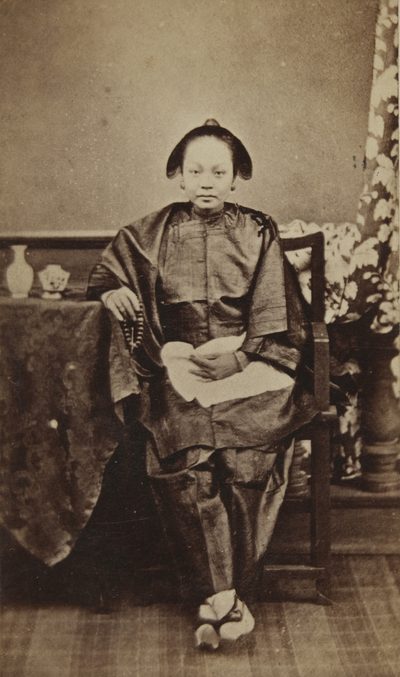
Some married here. Marriage records for New South Wales and Victoria document hundreds of relationships between Chinese men and European women from the 1850s to the turn of the century, the historian Kate Bagnall has found. Mei Quong Tart married a young Englishwoman, Margaret Scarlett, in 1886, and in Darwin the merchant Lee Hang Gong’s wife was the renowned midwife Sarah Bowman. In 1911 the census found 801 Chinese living with their wives: 181 of the wives had been born in China, 485 in Australia, and 100 in England, Scotland and Ireland.
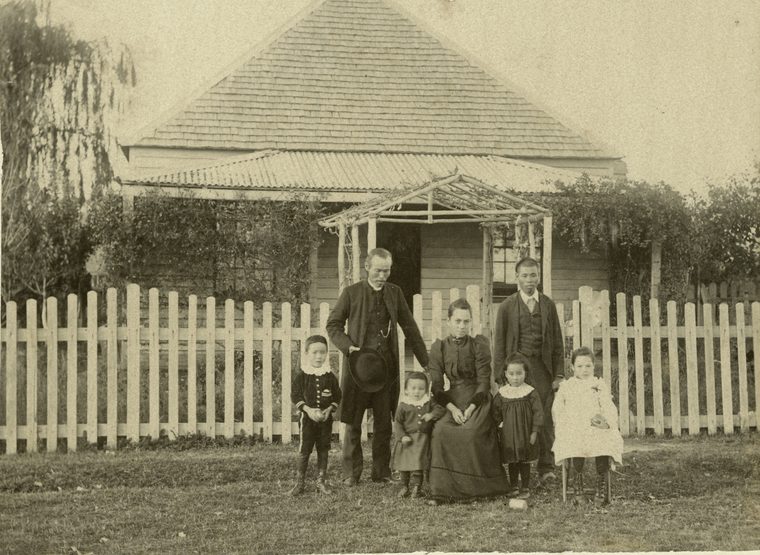
Ham Hop and the Gold Mountain wives
White Australia narrowed even that door. The 1901 Act let a wife enter with her husband, but in March 1903 the exemption was suspended by proclamation, and from then on Chinese wives could come only on temporary certificates, at the government’s discretion.
The case that made it national news was Ham Hop’s. She married Poon Gooey in 1900 and spent the next ten years in China as a 金山婆 gum saan po (Mandarin jīnshān pó), a “Gold Mountain wife”, while he worked in Victoria. In 1910 he brought her to Australia on a six-month permit. It was extended five times, through two pregnancies, and both their daughters were born here.
Churches protested and Chinese communities petitioned. In Sydney, Ping Nam of the Chinese Empire Reform Association dismissed Senator Findley’s appeal to White Australia as “mere moonshine”. The government did not move. On 7 May 1913 the family left Melbourne for China on the Yawata Maru, carrying a letter from the Mayor of Geelong, written on behalf of its residents, in praise of Poon Gooey.
“It is your Government I don’t like. The people would let us stay; the people are very nice. But your Government makes us go.”
Ham Hop, speaking through her husband as she left Melbourne, 7 May 1913, as reported in The Sun, Sydney.
Children between two countries
Children were sent back and forth. Selina Lee, born in Darwin in 1901, granddaughter of Lee Hang Gong and Sarah Bowman, was left in Canton at seven with two of her brothers and her father’s second wife. Sue Wah Chin and her children moved between China and Darwin through the 1920s and 1930s on short-term exemptions. And some broke through: Mary Chong of Dubbo became the first Chinese woman to graduate from an Australian university, at Sydney in 1929, and Rose Quong, born in East Melbourne in 1879, went on to a career as a performer and lecturer in London and New York.
Chapter 8 · 1914–1945
Chinese Australians at war
The Defence Act 1909 barred people “not substantially of European origin or descent” from the army. More than 200 Australians of Chinese heritage enlisted in the First World War anyway, most of them born here, and 19 of them won bravery medals.
The best known is William “Billy” Sing, born in Clermont, Queensland, in 1886 to a father from Shanghai and an English mother. A sniper at Gallipoli, he had shot 105 Turkish soldiers by August 1915 and 201 by that October, and won the Distinguished Conduct Medal. Caleb Shang, from Fortitude Valley in Brisbane, won the DCM and Bar and the Military Medal on the Western Front.
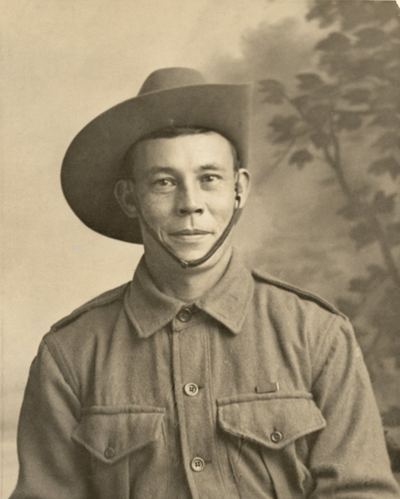
In the Second World War more than a thousand Australians of Chinese heritage enlisted, including, by the Chinese Museum’s count, about 47% of the men of eligible age. Thomas See became the first Australian of Chinese origin in the RAAF, and Roy Goon commanded No. 83 Squadron from 1943.
Chapter 9 · 1947–1975
From “two Wongs” to the end of White Australia
The war brought some 15,000 evacuees of every nationality to Australia, 4,400 of them from Asia, among them Chinese refugees and merchant seamen. Arthur Calwell, Australia’s first Minister for Immigration, wanted them gone. On 2 December 1947, answering a question about deportations, he told the House of Representatives that about 500 Chinese, most of them seamen, remained, and that “all of these people will have to leave Australia”. In the same answer he made the remark he is remembered for. Speaking of a Chinese man named Wong, he punned on the name of a fellow member, Thomas White.
“There are many Wongs in the Chinese community, but I have to say — and I am sure that the honorable member for Balaclava will not mind me doing so — that ‘two Wongs do not make a White’.”
Arthur Calwell, House of Representatives, 2 December 1947. It is usually misquoted as “two Wongs don’t make a White”.
Wong is the Cantonese spelling of two of the commonest Chinese surnames, 黄 Huáng and 王 Wáng in Mandarin. The War-time Refugees Removal Act 1949 gave Calwell the power to deport, but the government changed that December, and wartime refugees of good character were then granted limited rights to stay.
How the policy was taken apart
White Australia was never repealed in a single act. It was dismantled over seventeen years.
1958
The Migration Act replaces the Immigration Restriction Act and abolishes the dictation test.
1966
The Holt government puts all would-be migrants under the same rules, the biggest step yet. Historians caution that it did not abolish the policy.
1973
The Whitlam government definitively renounces the White Australia policy.
1975
The Racial Discrimination Act receives Royal Assent on 11 June.
Chapter 10 · 1975–1993
Refugees, Hong Kong and a new generation
The first large Chinese migrations after White Australia came by indirect routes. Refugees from Vietnam began arriving after 1975: 5,400 settled in 1978, and 12,915 arrived in 1980. The nationalisation of the southern Vietnamese economy fell especially hard on ethnic Chinese Vietnamese, and many of those who reached Sydney were housed first in migrant hostels in Fairfield, the largest of them at Cabramatta. Plenty stayed. The Chinese characters on the Pai Lau gate in Cabramatta’s Freedom Plaza belong to the ethnic Chinese business community that grew up there.
Hong Kong came next. Australia’s Hong Kong-born population rose from about 5,400 in 1971 to 62,400 in 1991 and 75,200 by 2001, and Cantonese, the language of the goldfields generations, was renewed with it.
The students of 1989
On 16 June 1989 Prime Minister Bob Hawke announced that every citizen of the People’s Republic of China legally in Australia on 4 June would have their temporary permit extended for a further twelve months, with the right to work up to 20 hours a week. Four-year permits followed in 1990, and in November 1993 the Keating government granted the group permanent residence. The group was later reported at around 42,000 people, family members included. For many of the Mandarin-speaking families in Australia today, this is where their own story starts.
Chapter 11 · 1994–today
Chinese Australians today
The Chinese Australians of the last thirty years came mostly from mainland China, and mostly by choice: as skilled migrants, as family and as students. In 2010–11 China overtook the United Kingdom as the largest source of permanent migrants under Australia’s Migration Program, with 29,547 places, 17.5% of the total. India has led since 2011–12, with China second, and in every year from 2021–22 to 2024–25 China was the largest source of family migrants. Students came in even greater numbers: in 2019, before the pandemic, Chinese nationals accounted for 261,056 international student enrolments, 27.3% of the total.
The language of Chinese Australia changed with them. Between the 2006 and 2011 censuses Mandarin went from the fifth most common language other than English spoken at home to the first. By 2021, 685,274 people spoke it at home, and Cantonese, the language of the goldfields generations, was fourth with 295,281.
At the same census 549,618 residents had been born in mainland China, and the Australian Bureau of Statistics estimated 731,540 by June 2025. The community has moved to the suburbs, to Box Hill and Glen Waverley in Melbourne, Hurstville and Chatswood in Sydney and Sunnybank in Brisbane; what each of them speaks is mapped in the Chinese suburbs of Australia, and the shift from Cantonese to Mandarin is told state by state in Mandarin or Cantonese in Australia.
In public life
A century after the Commonwealth’s first Parliament legislated to keep Chinese people out, Chinese Australians sit in it. In 1990 Bill O’Chee, aged 24, became the first person of Chinese ancestry in federal Parliament, as a senator for Queensland. Tsebin Tchen, born in Chongqing, was elected a senator for Victoria in 1998.
Penny Wong, born in Malaysia to a father of Chinese descent, entered Cabinet in 2007 and became Foreign Minister in 2022. And in 2019 Gladys Liu, born in Hong Kong, said in her first speech to the House of Representatives that she hoped to be seen as more than just “the first Chinese woman elected to this place”. She ended that speech in three Chinese languages: the Chaozhou dialect of her family’s hometown, Cantonese for her sister, and Mandarin for the Chinese community in Australia.
Medicine has its own landmark. Victor Chang, born in Shanghai in 1936 to parents born in New South Wales, came to Sydney in 1951 and led the National Heart Transplant Program at St Vincent’s Hospital from 1984. By his death in 1991 it had performed 266 heart transplants and 22 heart-lung transplants.
Old prejudice, new forms
The old hostility has not vanished. In November 2020 the Lowy Institute surveyed 1,040 Australians of Chinese heritage. In the previous year, because of that heritage, 31% said they had been called offensive names and 18% that they had been physically threatened or attacked; two-thirds said COVID-19 had caused or contributed to it. In the same survey 40% said someone had expressed support for them because of their Chinese heritage.
For one family’s version of growing up between the two cultures, read Will’s own story, from Cronulla Beach to the Great Wall.
The history you can still see
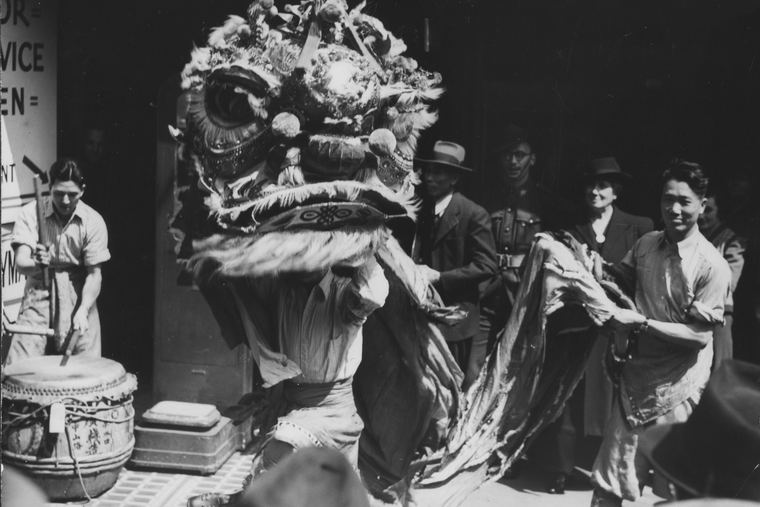
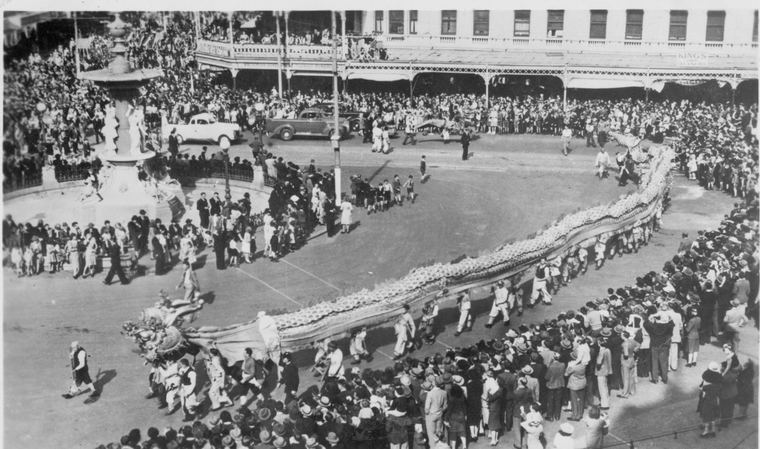
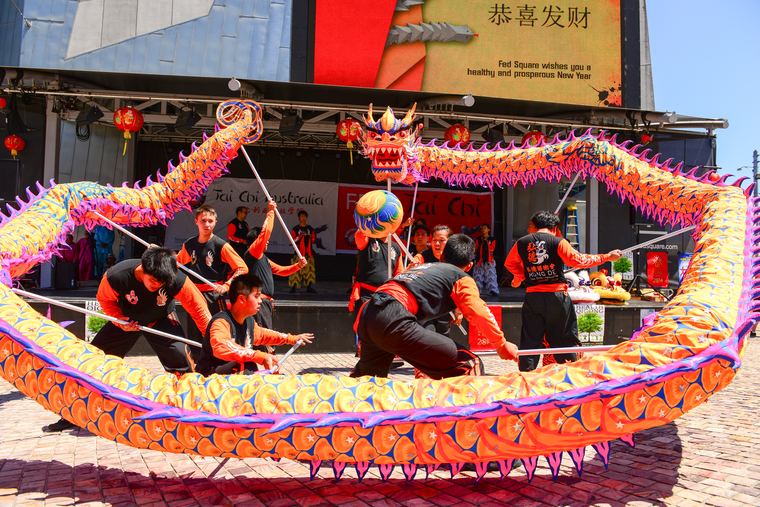
The older story is still on show. Bendigo’s Chinese community first joined the town’s Easter Fair parade in 1879, and Bendigo’s is the only Chinese procession of its kind to have continued to the present day. The Golden Dragon Museum, which opened in 1991, holds Loong, which it describes as the world’s oldest complete processional dragon, alongside its successors Sun Loong and Dai Gum Loong. Chinese New Year now fills the streets of every capital: where and when is in Chinese New Year in Australia.
Go and see it
Where to see Chinese Australian history for yourself
Nine places where the story in this guide is still standing, from Melbourne’s Chinatown to a temple on the Atherton Tableland.
Chinese Museum
Little Bourke Street, Melbourne
Opened in 1985 as the Museum of Chinese Australian History, in the heart of the Chinatown the goldfields built.
Golden Dragon Museum
Bendigo, Victoria
Opened in 1991, it holds around 30,000 objects, including Loong, Sun Loong and Dai Gum Loong.
Bendigo Joss House Temple
Emu Point, North Bendigo
Built in the 1860s, it is the only temple of the gold rush years left standing in country Victoria.
See Yup Temple
South Melbourne
Built in 1866 for the See Yup Society, it was Victoria’s most important centre of Chinese worship.
Lambing Flat Folk Museum
Young, New South Wales
It holds the “Roll up, no Chinese” banner carried against the Chinese miners on 30 June 1861.
Buckland memorial
Buckland Valley, Victoria
In 2008 the See Yup Society unveiled a memorial stele at Buckland Cemetery, near the 1857 riot.
Hou Wang Temple
Atherton, Queensland
Built in 1903 by Atherton’s Chinatown, it is the only temple outside China known to honour Hou Wang.
Guan Di Temple
Queen Victoria Museum, Launceston
It holds the contents of temples from the north-east tin fields, donated to the museum in 1934.
Chinese Temple
Woods Street, Darwin
The first temple on this site was built in 1887; the present building dates from 1977.
Questions
FAQs
When did Chinese people first come to Australia?
The first Chinese settler on record is Mak Sai Ying, who arrived in Sydney on 27 February 1818 and later held a hotel licence in Parramatta. Larger numbers came as contract labourers from 1848, and tens of thousands during the gold rushes of the 1850s.
Why did Chinese people come to Australia during the gold rush?
For gold, and the chance to send money home. Most were Cantonese-speaking men from the See Yup districts of Guangdong, travelling as contract labourers or on credit tickets. They called Australia New Gold Mountain, and by 1861 there were 38,258 China-born people in the colonies, 3.3% of the population.
What was the White Australia policy?
The laws and practices, beginning with the Immigration Restriction Act of 1901, that kept non-European migrants out of Australia. Its main tool was the dictation test, fifty words in a European language and later any prescribed language, which almost nobody passed. The test was abolished in 1958, and the Whitlam government renounced the policy in 1973.
When did the White Australia policy end?
In stages. The dictation test went in 1958, the Holt government put all migrants under the same rules in 1966, the Whitlam government renounced the policy in 1973, and the Racial Discrimination Act followed in 1975.
How many Chinese Australians are there?
At the 2021 Census, 1,390,639 people reported Chinese ancestry, 5.5% of Australia’s population, and 549,618 had been born in mainland China. The Australian Bureau of Statistics estimated 731,540 China-born residents by June 2025.
What did “two Wongs do not make a White” mean?
It was a remark by Arthur Calwell, Australia’s first Minister for Immigration, in the House of Representatives on 2 December 1947. Answering a question about deportations, he punned on the name of a fellow member, Thomas White. It is often misquoted as “two Wongs don’t make a White”.
Sources. The gold rush figures and the Lambing Flat account are from the National Museum of Australia’s Harvest of Endurance; the colonial Acts and census counts from the ABS Year Book Australia 1925 and Year Book 2004; Buckland from Heritage Victoria; the Immigration Restriction Act from the Museum of Australian Democracy; the Chinese Anzacs from the National Archives of Australia and, for the Second World War, the Chinese Museum; Melbourne’s Chinese community from eMelbourne; Sydney’s Chinatown from the Dictionary of Sydney.
The lives of Lowe Kong Meng, Louis Ah Mouy, Cheong Cheok Hong, Mei Quong Tart, William Ah Ket, Billy Sing, Caleb Shang and Victor Chang are from the Australian Dictionary of Biography; Mak Sai Ying’s from the City of Parramatta. Calwell’s words are from Hansard, 2 December 1947. The 1989 decision is from Prime Minister Hawke’s statement of 16 June 1989. The end of White Australia is from the National Museum’s Defining Moments. Today’s figures are from the ABS 2021 Census and the ABS estimate of Australia’s population by country of birth; Bendigo’s from the Golden Dragon Museum.
The north and west are from the National Museum’s Harvest of Endurance, Library & Archives NT, the Commonwealth Year Book, the Queensland Heritage Register, the Royal Historical Society of Queensland, the Companion to Tasmanian History, the Queen Victoria Museum, the Heritage Council of Western Australia and the WA Museum.
The 1857 and 1859 petitions are quoted from Anna Kyi in Provenance; the 1888 address and James Cheong’s words from Ian Welch’s ANU thesis on Cheok Hong Cheong; the 1879 words from The Chinese Question in Australia. Ham Hop’s story is from Kate Bagnall’s Chinese Australia, the Chinese Museum and The Sun of 7 May 1913; the 1861, 1901 and 1911 counts of women and wives from the ABS Year Book 1925; the suspension of the wives’ exemption from Michael Williams’ Chinese Australian history.
The population chart is from the ABS Australian Historical Population Statistics and Census QuickStats. The last thirty years are from the Department of Home Affairs’ China country profile and Migration Program reports, the Department of Education’s 2019 international student data, the Parliament of Australia, the Senate’s Biographical Dictionary, SBS and the Lowy Institute’s Being Chinese in Australia survey of 2021.
Images. State Library Victoria, all out of copyright with no restrictions: the Chinese arch, Harvie & Sutcliffe, 1901 (H96.160/651); Guildford camp, Richard Daintree, 1861 (H32956); Little Bourke Street, 1863 (IAN21/10/63/5); the Emerald Hill joss house, 1866 (IAN20/12/66/5); market gardens, about 1901 (H26629); Lowe Kong Meng, 1866 (IAN27/09/66/4); the Bendigo lion, The Argus, about 1943 (H99.201/533); the Bendigo dragon postcard (H23096); the Chinese woman, Davies & Co. (H9542); the Inverell family (H2005.34/103). Library & Archives NT: Cavenagh Street, 1915 (PH0107/0226), no known copyright. State Library of Queensland: the Hou Wang temple, 1929 (negative 15791), out of copyright.
National Archives of Australia: Florrie Lee Hang Gong’s certificate, NAA: E752, 1916/54. Australian War Memorial: Billy Sing, P03633.006, public domain. Wikimedia Commons: the Lambing Flat banner, public domain; Mei Quong Tart, oil portrait about 1885, artist unknown, public domain; Lunar New Year in Melbourne by Chris Phutully, CC BY 2.0. Cropped to fit; the archive borders and printed captions are removed. Maps drawn from Natural Earth, public domain.
Keep reading
More on Chinese Australia
Chinese Australians
The hub: history, language, communities and the people.
CommunitiesChinese suburbs of Australia
Twenty-nine suburbs mapped, and what is spoken in each.
LanguageMandarin or Cantonese?
Which one Australia speaks, state by state, and which to learn.
FestivalsChinese New Year in Australia
Where every capital celebrates, and what to say when you go.
Start learning
Learn the language behind the story
One-to-one Mandarin lessons online, on your timezone, whether you are reconnecting with a family language or starting from nothing.
Book a free intro call