Home › Chinese Australia › Chinese New Year
Festivals
Chinese New Year in Australia 澳大利亚的春节 Àodàlìyà de Chūnjié
Chinese New Year in Australia lands on Saturday 6 February 2027, the first day of the Year of the Goat — but most cities hold their celebrations on the weekends that follow, not on the day. Here is where each one celebrates, which 2027 dates are already set, and what to say when a lion dancer stops in front of you.
The dates
Chinese New Year 2027 in Australia, day by day
The lunar calendar moves the festival every year, somewhere between late January and mid-February. In 2027 New Year’s Day falls on a Saturday, which is unusually convenient, and the celebrations spread across the fortnight that follows.
Fri 5 FebNew Year’s Eve
The reunion dinner. The family meal that matters most in the whole festival, eaten at home rather than in the street.
Sat 6 FebNew Year’s Day
The Year of the Goat begins. Sydney opens its Lunar Festival the same evening with Lunar Streets in Haymarket.
Mon 8 & Tue 9 FebChristmas Island only
The only public holidays in Australia for it. Christmas Island observes two days, moved to Monday and Tuesday because the new year falls on a weekend.
Sat 13 FebThe first weekend after
Canberra and Hurstville celebrate, and the Sydney Town Hall stage runs its two shows. Cities yet to announce usually choose a weekend soon after New Year’s Day.
Sat 20 FebLantern Festival
The fifteenth and final day. Cabramatta holds its festival, and the Sydney Lunar Festival closes on Hay Street.
Lunar New Year is not a public holiday in any Australian state or mainland territory, so the big celebrations are held on weekends rather than on the day. When the day itself falls midweek, as it did on Tuesday 17 February 2026, the cities wait for the weekend: Melbourne, Perth and Hobart all held theirs on Sunday 22 February that year.
City by city
Where every capital celebrates Chinese New Year
Chinese New Year in Australia looks different in every capital — a two-week festival in Sydney, an afternoon on the lawns in Hobart. Each card says where it happens, whether the 2027 date has been announced, and how many people in that city spoke Mandarin or Cantonese at home at the 2021 Census, because that tells you whose festival it is.
SydneyNSW
6–20 Feb- Where
- Haymarket, from Chinatown through to Thaitown, with events at Sydney Town Hall.
- 2027
- 6 to 20 February 2027, opening with Lunar Streets in Haymarket on Saturday 6 February.
- Look for
- Lion dancing on the Town Hall steps and a walk-through lantern installation in Chinatown.
- At home
- 259,429 people speak Mandarin and 144,538 Cantonese.
MelbourneVIC
Not yet set- Where
- Little Bourke Street, in the Chinatown precinct that dates back to the 1850s gold rush.
- 2027
- Not yet announced. In 2026 it was Sunday 22 February, the weekend after New Year’s Day.
- Look for
- A dragon parade through Chinatown, with lion dances and stalls along Little Bourke Street.
- At home
- 212,680 people speak Mandarin and 80,584 Cantonese.
BrisbaneQLD
Not yet set- Where
- Chinatown Mall in Fortitude Valley, and Sunnybank on the southside, under the BrisAsia program.
- 2027
- Not yet announced. In 2026 the Valley celebrated on 21 and 22 February.
- Look for
- Lion and dragon dances with firecrackers in the Valley, and a rooftop fireworks night at Sunnybank Plaza.
- At home
- 64,045 people speak Mandarin and 21,694 Cantonese.
PerthWA
Not yet set- Where
- James Street and Lake Street in Northbridge, including Northbridge Piazza.
- 2027
- Not yet announced. In 2026 the fair was Sunday 22 February, from midday to 9pm.
- Look for
- The Chung Wah Association’s fair, which the WA Government says draws over 40,000 people.
- At home
- 49,624 people speak Mandarin and 19,171 Cantonese.
AdelaideSA
Venue moving- Where
- Usually Gouger and Moonta Streets in Chinatown, but roadworks rule that out for 2027.
- 2027
- Not yet announced. Victoria Square is the likely stand-in venue, and not yet confirmed.
- Look for
- A Chinatown street party that reached its twenty-third year in 2026, two paifang gateways at its heart.
- At home
- 31,056 people speak Mandarin and 9,958 Cantonese.
CanberraACT
13 Feb- Where
- Woolley Street in Dickson, in the inner north of Canberra.
- 2027
- Saturday 13 February 2027, midday to 10pm, free, a week after New Year’s Day.
- Look for
- A food village, the Mini Mongkok market and stage shows, closing with pyrotechnics.
- At home
- 14,391 people speak Mandarin and 4,225 Cantonese.
HobartTAS
Not yet set- Where
- Parliament House Lawns on Salamanca Place, run by the Chinese Community Association of Tasmania.
- 2027
- Not yet announced. In 2026 it was Sunday 22 February, from 10am to 4pm.
- Look for
- Lion dances, a children’s Panda Zone and three-metre strings of firecrackers.
- At home
- 6,334 people speak Mandarin and 1,161 Cantonese.
DarwinNT
Not yet set- Where
- Events run by the Chung Wah Society, traditionally around Smith Street Mall and the waterfront.
- 2027
- Not yet announced. In 2026 the society also opened its Woods Street temple to visitors.
- Look for
- Lion dancers blessing local shops and businesses, as the Chung Wah troupe does every new year.
- At home
- 2,095 people speak Mandarin and 705 Cantonese.
Dates checked against each organiser on 8 October 2026. “Look for” describes the 2026 festival.
Sydney is the one to plan a trip around. The City of Sydney has run it for thirty years and calls it one of the largest celebrations of the Lunar New Year outside Asia, and in 2026 it ran for a fortnight, from a 43-metre walk-through lantern in Chinatown to dragon boats on Cockle Bay. Melbourne’s is the oldest setting: its Chinatown, which its precinct association describes as the longest continuous Chinese settlement in the Western world, has been on Little Bourke Street since the 1850s.


Closer to home
The suburban celebrations are often the better ones
The city festivals draw the crowds, but the suburbs where Chinese Australians actually live celebrate closest to home. Up to 100,000 people turned out for Box Hill’s festival in 2026, according to the local member speaking in Victoria’s Parliament, and Hurstville’s reaches its twenty-fourth year in 2027. Several have already set their dates.
| Where | Venue | Run by | 2027 |
|---|---|---|---|
| Hurstville NSW | Forest Road and Hurstville Plaza | Georges River Council | Saturday 13 February |
| Cabramatta NSW | Freedom Plaza, Park Road and Arthur Street | Fairfield City Council | Saturday 20 February, 11am to 9pm |
| Box Hill VIC | Bank Street | Asian Business Association of Whitehorse | February, exact date to come |
| Chatswood NSW | Victoria Avenue | Willoughby City Council | Not yet announced (2026: 21 and 22 February) |
| Glen Waverley VIC | The Kingsway | Monash Chinese Events Organising Committee | Not yet announced (2026: 1 March) |
| Sunnybank QLD | Sunnybank Plaza | Part of Brisbane’s BrisAsia program | Not yet announced (2026: 28 February) |
What each of these suburbs actually speaks, and how far it leans to Mandarin or to Cantonese, is mapped street by street in the Chinese suburbs of Australia. One regional note, because it catches people out: Bendigo’s famous imperial dragons, Sun Loong and Dai Gum Loong, parade at the Bendigo Easter Festival, not at Chinese New Year.
What you are watching
Lion dance or dragon dance: how to tell
Most visitors call everything at a Chinese New Year festival a dragon. Most of what you will actually see is lions, and the two do different jobs.
The lion
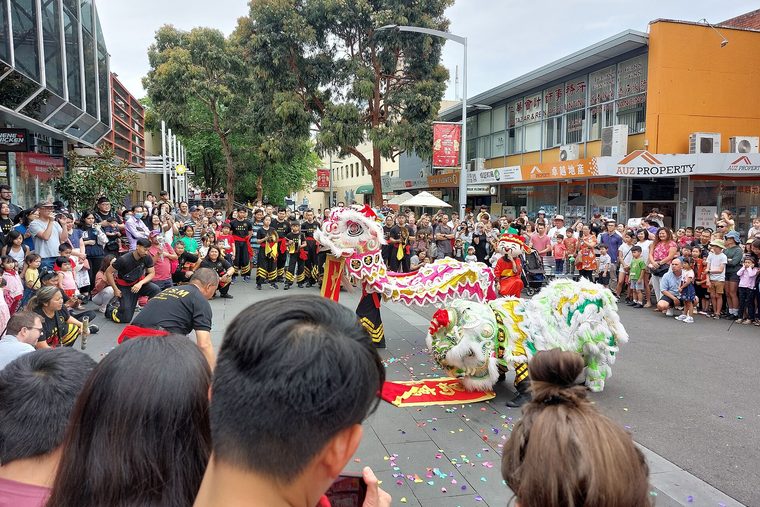
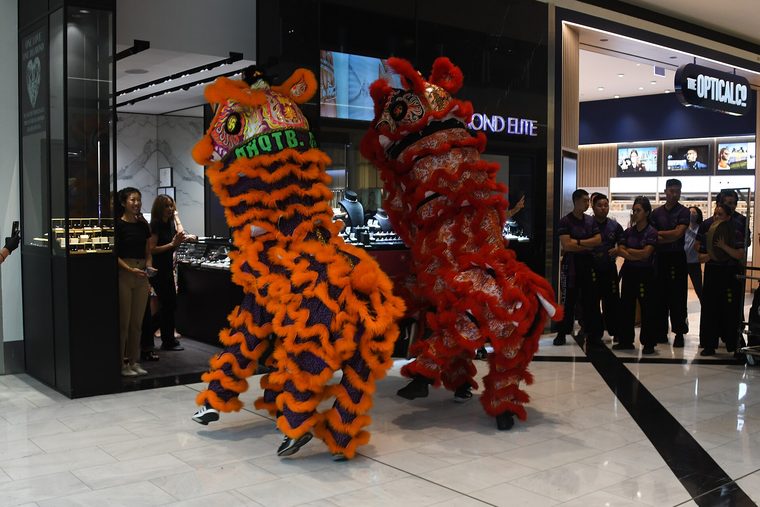
舞狮 wǔshīTwo performers share one costume, one working the head and one the body, and the lion moves like an animal: it blinks, shakes, sniffs and sulks. Lions go where people are, which is why you find them in shopping centres and outside restaurants.
The lion visits to bless a place for the year. In Darwin the Chung Wah Society’s lions have long toured the town’s businesses; as a former society president put it, “The Lion Dance is believed to scare away evil spirits and brings good luck, joy, fortune, and happiness.”
The dragon
舞龙 wǔlóngA long body carried on poles by a whole team, rising and rolling as one. Dragons are parade creatures, too long for a shopfront, so they belong to the big street processions.
Australia has some famous ones. Melbourne’s Millennium Dragon belongs to the Melbourne Dai Loong Association and winds from the ground floor to the lower ground of the Chinese Museum’s Dragon Gallery. A new lion or dragon is woken by painting in its eyes, the ceremony behind the idiom 画龙点睛 huàlóng diǎnjīng, “paint the dragon, dot the eyes”.
Then there are the firecrackers, which are the part children remember. Hobart’s festival lights three-metre strings of them on the Parliament House Lawns, and Brisbane’s Chinatown Mall sets them off with the lion dances. The noise is the point: it is meant to drive off bad luck before the year starts.
Hear it
What to say at Chinese New Year, in Mandarin and Cantonese
Chinese New Year in Australia is bilingual. Sydney alone has 259,429 people who speak Mandarin at home and 144,538 who speak Cantonese, and at a Hurstville or Chatswood festival you are likely to hear both. So every greeting here comes in both, with the Cantonese written in the traditional characters Cantonese speakers use.
The red line under each greeting is its romanisation: pinyin for Mandarin, Yale for Cantonese, both marking tone above the vowel. The grey line is a rough English respelling to get you started. It cannot carry the tones, so press Hear and copy the recording instead.
Happy New Year
Mandarin
新年快乐xīnnián kuàilè say it: sin-NYEN kwhy-LUH
Cantonese
新年快樂sān nìhn faai lohk say it: sun NEEN fai LOK
Wishing you prosperity — the one you will hear most
Mandarin
恭喜发财gōngxǐ fācái say it: gong-SHEE fah-TSAI
Cantonese
恭喜發財gūng héi faat chòih say it: gung HAY faht CHOY
Good health — the one to say to older relatives
Mandarin
身体健康shēntǐ jiànkāng say it: shun-TEE jyen-KAHNG
Cantonese
身體健康sān tái gihn hōng say it: sun TAI geen HONG
Good fortune in the Year of the Goat — for 2027 only
Mandarin
羊年大吉yángnián dàjí say it: yahng-NYEN dah-JEE
Cantonese
羊年大吉yèuhng nìhn daaih gāt say it: yeung NEEN die GUT
If you only learn one, learn 恭喜发财 gōngxǐ fācái. It is the greeting you will hear most at every festival on this page, and a Cantonese grandmother will smile at it in either language. More greetings, and what each one means, are in how to say Happy New Year in Chinese.
Red packets
Red packets in Australia: what to put in and how to give
If you spend Chinese New Year in Australia with Chinese family or friends, you will meet the red packet: cash in a red envelope, called 红包 hóngbāo in Mandarin and lai see in Cantonese. Married adults give them to children, to unmarried younger relatives and to the elderly. The amount depends on how close you are, and nobody can honestly give you a standard Australian figure, so here are the rules that do not change.
Do
- Use the newest, crispest notes you can find. New notes stand for a new start.
- Give an even amount. Good things are said to come in pairs, and eights are best.
- Give and receive with both hands, and say thank you when you receive one.
Do not
- Put in an amount containing a four. 四 sì sounds close to 死 sǐ, death.
- Give an odd amount. Sources differ on the reason, and all of them agree on the rule.
- Reuse last year’s packet. An old packet implies an old, used-up wish.
2027
The Year of the Goat, the Australian way
The 2027 animal is 羊 yáng, which you will also see translated as the Year of the Sheep or the Ram. Chinese does not separate them: the one character covers all three, and English translations simply pick one. Who is a Goat, which years count and what the sign is said to mean are all on our Chinese New Year 2027 page.
The lunar stamps are a Christmas Island story too: Australia Post’s Lunar New Year issue is released each year under the Christmas Island name, usually in early January. The 2027 Goat issue had not been announced when this page was checked.
One more thing worth knowing before you go. In 2019 the City of Sydney renamed its Chinese New Year festival the Sydney Lunar Festival, saying it would “embrace all communities and cultures, whether or not they use the lunar calendar”. Korean, Vietnamese and other communities celebrate the same new moon in their own way, which is why most council events now say Lunar New Year — and why many Chinese Australians still say Chinese New Year, or simply 过年 guònián, “passing the year”. If you want the festival’s traditions from the beginning, start with Spring Festival.
Questions
FAQs
When is Chinese New Year 2027 in Australia?
Chinese New Year 2027 is on Saturday 6 February 2027, the first day of the Year of the Goat, and the same date applies across Australia. New Year’s Eve, the night of the reunion dinner, is Friday 5 February. Most public celebrations follow on later weekends: Sydney runs from 6 to 20 February 2027, and Canberra and Hurstville celebrate on Saturday 13 February.
Is Chinese New Year a public holiday in Australia?
Not in any state or mainland territory. The one exception is Christmas Island, an Australian external territory, which observes two days. In 2027 they fall on Monday 8 and Tuesday 9 February, in lieu of the weekend. Everywhere else the festivals are scheduled around the weekend instead.
Where is the biggest Chinese New Year celebration in Australia?
Sydney’s. The City of Sydney has run its Lunar Festival for thirty years and describes it as one of the largest celebrations of the Lunar New Year outside Asia, with a fortnight of events from Chinatown and Haymarket to Sydney Town Hall. Among the suburban festivals, up to 100,000 people turned out for Box Hill in Melbourne in 2026.
Why is it called Lunar New Year in Australia?
Because the same new year is celebrated by several communities, not only Chinese ones. The City of Sydney renamed its festival in 2019 so that it would embrace all communities whether or not they use the lunar calendar, and most councils now use Lunar New Year. Both names are correct, and plenty of Chinese Australians still say Chinese New Year.
What do you say at Chinese New Year?
The safest greeting is “gōngxǐ fācái” in Mandarin or “gūng héi faat chòih” in Cantonese, which wishes the other person prosperity. “Xīnnián kuàilè” is Happy New Year, and “shēntǐ jiànkāng”, good health, is the respectful one for older relatives. For 2027 you can add “yángnián dàjí”, good fortune in the Year of the Goat.
How much money goes in a red packet in Australia?
There is no fixed Australian amount; it depends on how close you are to the person. The rules are consistent, though: use crisp new notes, give an even amount, avoid any number containing a four, and use a fresh packet. Married adults give to children, unmarried younger relatives and the elderly.
Sources. The 2027 date is from the Hong Kong Observatory’s 2027 calendar conversion table. Festival dates are from each organiser: the City of Sydney, Events ACT, Georges River Council, the City of Hobart, the Chung Wah Association and Brisbane City Council. Adelaide’s venue change was reported by InDaily, quoting the City of Adelaide.
Public holidays are from Tourism Australia’s list for every state and territory. Population and language figures are from the ABS 2021 Census and the ABS community profile for each capital city. The Melbourne Chinatown description is the Chinatown Precinct Association’s, the Box Hill attendance is from the Victorian Hansard of 3 March 2026, and the Year of the Goat coins are from the Royal Australian Mint. Cantonese romanisation is Yale, checked headword by headword.
Photographs from Wikimedia Commons: Box Hill by KeepActive Australia, CC BY-SA 4.0; Melbourne by Alpha, CC BY-SA 2.0; Chatswood by Sardaka, public domain (CC0); Sunnybank by Kgbo, CC BY-SA 4.0. All cropped to 3:2.
Keep reading
More on Chinese Australia
Chinese Australians
The hub: history, language, communities and the people.
CommunitiesChinese suburbs of Australia
Twenty-nine suburbs mapped, and what is spoken in each.
LanguageMandarin or Cantonese?
Which one Australia speaks, state by state, and which to learn.
The zodiacChinese New Year 2027
The Year of the Goat: the dates, the sign and who it belongs to.
Start learning
Go further than the greetings next new year
One-to-one Mandarin lessons online, on your timezone, from your first greeting to a full conversation at the reunion dinner.
Book a free intro call