The 100 Most Common Chinese Characters
Chinese has tens of thousands of characters — but a small core does most of the work. Learn these 100 first and you’ll recognise a huge share of everyday text. Search, hear each one, see it used in a real word, then test yourself.
In short
These are the 100 most frequent characters in modern written Chinese, in rough order of frequency. Because character use is so top-heavy, this handful accounts for more than 40% of the characters in everyday text — so they’re exactly where a beginner should start. Each card gives the character, pinyin and meaning, plays native audio, and shows a common word it appears in. There’s a built-in quiz below to test yourself.
The 100 most common characters
Tap a character to hear it, or tap its example word to hear the word. Search by character, pinyin or meaning — or focus on just the most common with the toggle.
Test yourself
Ten random characters from the list — can you pick the right meaning? Tap the character to hear it.
Quick 10-question quiz on the meanings of the most common characters.
Why learn by frequency?
Character frequency in Chinese is steep: a small number of characters appear constantly, while most are rare. The single most common character, 的, alone accounts for around 4% of all characters in typical text. Learn the top 100 and you’ll meet them again and again — which means more reading practice, faster recall and quicker wins than studying characters at random.
Frequency isn’t the whole story — you’ll also want characters tied to your own goals — but it’s the smartest default order for a beginner. Many overlap with the early HSK 1 and HSK 2 word lists, so you’ll be building exam vocabulary at the same time.
A character isn’t always a word
One thing to keep in mind: in Chinese, a single character isn’t always a complete word. Some of these top characters do stand alone — 人 (rén, person), 大 (dà, big), 我 (wǒ, I) — but many work mainly as building blocks that combine with others into two-syllable words. That’s exactly why every card here shows an example word: 中 (middle) joins 国 to make 中国 (China); 朋 pairs with 友 to make 朋友 (friend); 学 (study) plus 生 (born) gives 学生 (student).
So as you learn each high-frequency character, you’re rarely learning just one word — you’re learning a piece that unlocks dozens of others. That’s another reason the frequency approach pays off so fast: every common character you know keeps reappearing inside common words, sentence after sentence.
How to use this list
Don’t try to memorise all 100 at once. Use the Top 10 toggle to start with the very highest-frequency characters, learn those cold, then widen to 50 and 100. Tap each character to hear it, say it aloud, and read its example word so you meet it in context. Notice that many are built from parts you already know — see how Chinese characters work — and practise writing them in the right order with our stroke order guide. Then run the quiz to check what’s stuck. A few minutes a day on the same core characters beats long cramming sessions every time.
FAQs
Learn the core characters with a teacher
Book a free 30-minute intro lesson — Will will help you turn this list into reading you can actually do.
Book a free intro →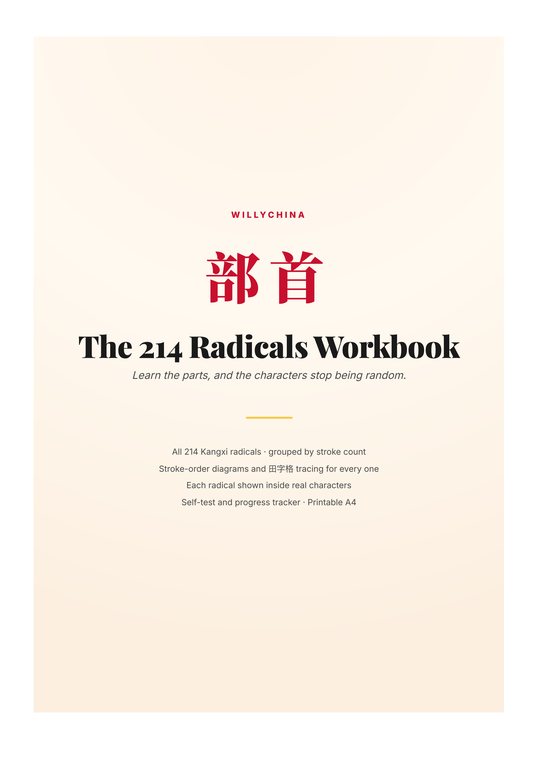
The 100 are free. The parts they are built from are the shortcut.
The 214 Radicals Complete Pack
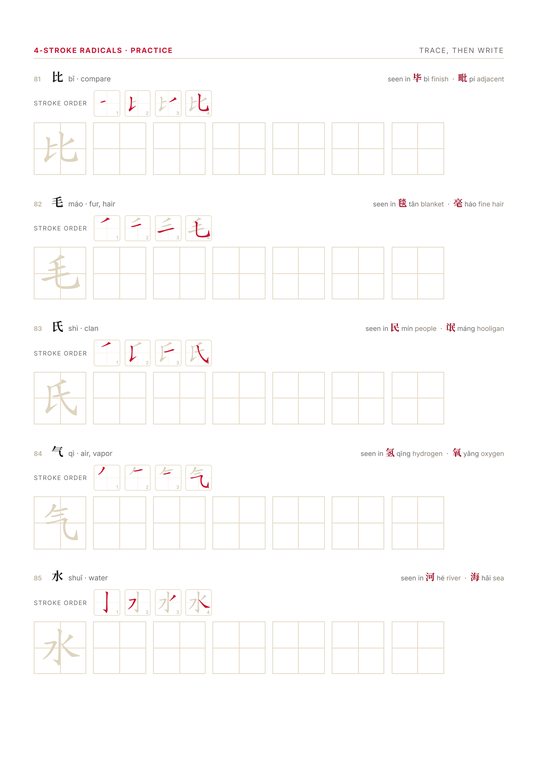
Nearly every character on this list is assembled from a much smaller set of pieces. The 214 Radicals Complete Pack covers all 214 of them — a 69-page workbook with stroke order and 田字格 tracing, each radical shown inside real characters, 830 audio files and three Anki decks.
See what is inside — US$32 →One payment · instant download · yours to keep