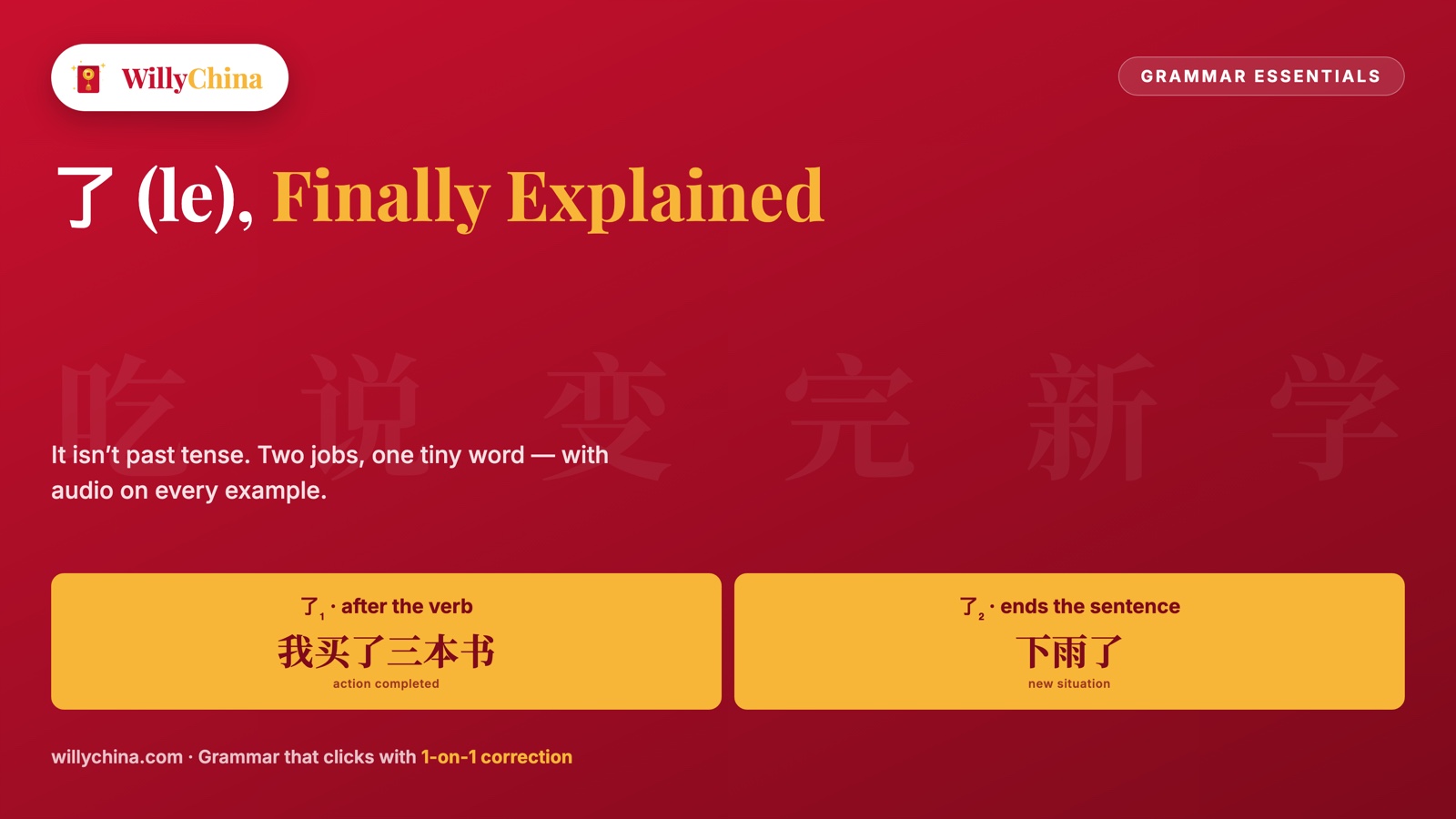
了 (le), Finally Explained
The most-used — and most-misunderstood — word in Mandarin. It isn’t past tense, there are two of them, and once you hear the difference, you’ll never confuse them again. Audio on every example.
What does 了 (le) actually mean? Not “past tense” — Mandarin doesn’t have tense. 了 does two jobs: placed after a verb it marks an action as complete; placed at the end of a sentence it announces a new situation. Every confusing textbook example unravels into one of those two. Let’s take them in turn, with audio. For an even larger bank of examples, the Chinese Grammar Wiki is an excellent reference.
First, unlearn the past-tense myth
English builds time into its verbs (eat, ate, eaten); Mandarin leaves verbs alone and lets context, time words and particles do the work. Proof that 了 isn’t past tense comes in both directions. You can use 了 about tomorrow: 明天我吃了饭就去机场 — “tomorrow, once I’ve finished eating, I’ll head to the airport”. And you must drop 了 for things that happened repeatedly in the past: 我以前每天都喝咖啡 — “I used to drink coffee every day”, no 了 anywhere, because nothing is being marked as a single completed event. Once you stop reaching for 了 every time English would say “-ed”, half of all 了 errors disappear on the spot.
了₁ — the completion marker (verb + 了)
Directly after a verb, 了 stamps the action as done — bounded, completed, countable. It loves a quantified object: how many, how long, which one. That’s why textbooks drill 我买了三本书 (“I bought three books”) rather than 我买了书 — a bare object after 了 often leaves the sentence sounding unfinished, like saying “having bought books, I…” and then trailing off. Complete the thought or quantify the object, and the sentence stands.
了₂ — the change-of-state marker (sentence + 了)
At the end of a sentence, 了 means the situation is new: something is true now that wasn’t before, and the speaker is flagging the update. It attaches to whole states, not single actions — which is why it pairs beautifully with adjectives and why it’s everywhere in daily speech: the weather turned, you got hungry, prices went up, the baby can walk now.
Both at once — the “…and counting” pattern
The two 了s combine in one of Mandarin’s most useful sentences: 我学中文学了两年了 — “I’ve been learning Chinese for two years now”. The verb-了 bounds the quantity (two years of it), the sentence-了 declares it still true at this moment. Drop the final 了 (我学了两年中文) and the two years might be finished history. Keep both and you’re mid-journey — which is also why this pattern is the polite-conversation workhorse for “how long have you…?”
When NOT to use 了
Four reliable no-了 zones. Negation with 没: 没 already means the action didn’t complete, so 了 would contradict it — 我没吃早饭, never 没吃了. Habitual or repeated actions: 我以前每天都跑步 — routines aren’t single completed events. Mental and stative verbs: 我喜欢中国菜, 我是老师 — liking and being aren’t completable actions (是…了 only appears with a genuine change: 他是爸爸了, he’s a father now). Verb series where the first verb is just the method: 我坐飞机去了上海 — the 了 lands on the main verb 去, not on 坐.
The five classic mistakes, corrected
| ✗ The error | ✓ The fix | Why |
|---|---|---|
| 我喜欢了这部电影 | 我喜欢这部电影 | Stative verb — liking isn’t a completable event |
| 我没看了那本书 | 我没看那本书 | 没 and 了 cancel each other — pick one |
| 昨天我学了中文 | 昨天我学了两个小时中文 | Bare object after 了₁ feels unfinished — quantify it |
| 我以前住了北京 | 我以前住在北京 | Ongoing past state, not a completed event |
| 下雨 (as it starts) | 下雨了 | New situation demands 了₂ — without it you’re stating a timeless fact |
Three rules of thumb that actually hold
One: if English wants “-ed”, pause — ask instead “is this one completed event?” If yes, verb-了; if it’s a routine, a state or a description, no 了. Two: if you could naturally add “now” or “oh, look —” to the English, it’s sentence-了. Three: when in doubt with verb-了, quantify the object (numbers, duration, 一下) and the sentence will almost always come out grammatical. These three cover the daily-conversation cases; the exotic corners can wait until they actually appear in your reading — around HSK 3, where 了 officially enters the exam’s grammar scope.
Quick check — spot the right 了
Two jobs, one character. Pick the correct answer for each gap:
她买___三本书才离开书店。(She bought three books before leaving the bookshop.)
你看,下雪___!快关窗户!(Look, it’s started snowing! Close the window!)
我学中文学了两年___。(I’ve been studying Chinese for two years — and still am.)
我喜欢了这部电影。Which part makes this sentence wrong?
他会说中文___。(He can speak Chinese now — he couldn’t before.)
FAQs
“I tried other apps and courses before, but nothing clicked until I started with Will. His explanations of tones and grammar are crystal clear, and he pushes me at exactly the right pace.”
Keep going
是…的 construction
The flip side of 了 — when the action is known and you stress when, where or how.
Read the guide →的 / 得 / 地 Explained
One sound, three jobs — possession, degree and manner, untangled with audio.
Read the guide →比 Comparisons
Comparing without “more” or “than” — the shape 比 actually takes.
Read the guide →