越来越 (yuè lái yuè): Saying More and More in Chinese
One small word, 越 (yuè), builds two of the most useful patterns in Mandarin: 越来越 (yuè lái yuè), “more and more”, and 越…越 (yuè… yuè), “the more… the more…”. Here is how each one works, where the subject goes, and the mistakes almost every learner makes at first.
How do you say that something keeps changing in Chinese? The weather is getting colder, your Chinese is getting better, more and more people are learning it. English reaches for “more and more” or “-er and -er”. Mandarin uses one adverb, 越 (yuè), in two patterns that you will hear every day.
The core idea: one word, two patterns
On its own, 越 (yuè) means to cross or go beyond. As a grammar word it means “to a greater degree”, and it always comes in a pair. Chinese dictionaries list this as its sense of a deepening degree: the 汉典 (Hàndiǎn) dictionary entry for 越 gives 越快越好 (yuè kuài yuè hǎo) as its example, the same frame you will meet below.
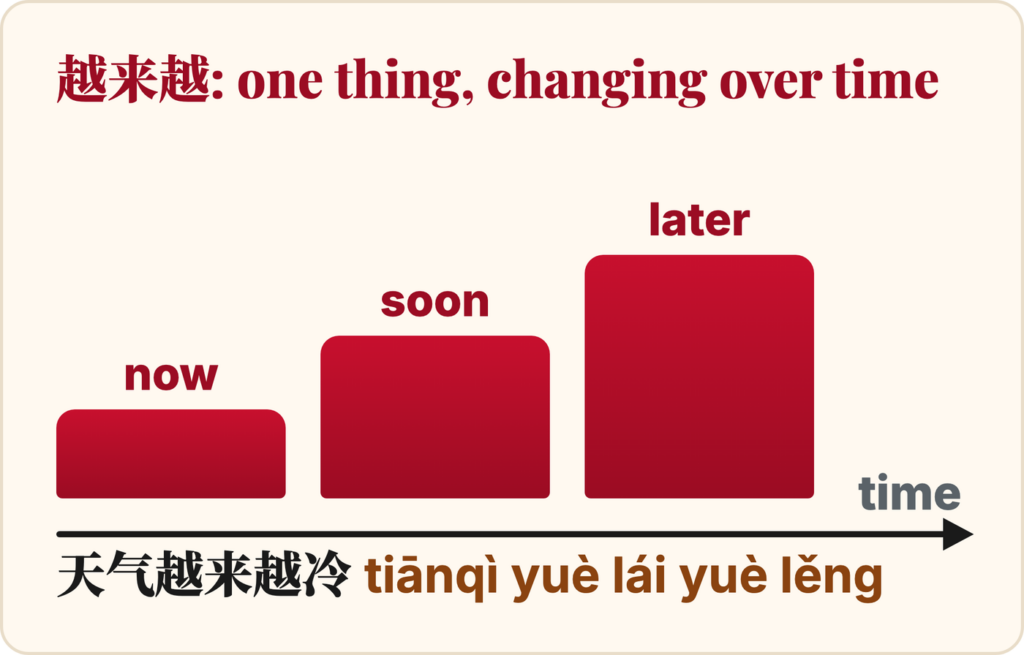
Pair it with time and you get 越来越 (yuè lái yuè), literally “more as time comes, more”. It describes a change that keeps growing: 天气越来越冷 (tiānqì yuè lái yuè lěng), “the weather is getting colder and colder”. The only thing driving the change is time passing.
Pair it with a second idea and you get 越 A 越 B (yuè A yuè B), “the more A, the more B”. Now one thing drives the other: 我越想越生气 (wǒ yuè xiǎng yuè shēngqì), “the more I think about it, the angrier I get”. The thinking causes the anger to grow.

That is the whole difference. 越来越 tracks a single trend over time. 越…越 ties two things together so that as one rises, the other rises with it.
The main patterns
| Pattern | What it means | Example |
|---|---|---|
| Subject + 越来越 + adjective | Something keeps getting more so | 他的中文越来越好 (tā de Zhōngwén yuè lái yuè hǎo) — “his Chinese keeps getting better” |
| Subject + 越来越 + feeling verb | A feeling keeps growing | 我越来越喜欢中文 (wǒ yuè lái yuè xǐhuan Zhōngwén) — “I like Chinese more and more” |
| 越来越多 / 少 + 的 + noun | More and more (or fewer and fewer) of something | 越来越多的人 (yuè lái yuè duō de rén) — “more and more people” |
| Subject + 越 A 越 B | The more A, the more B (one subject) | 雨越下越大 (yǔ yuè xià yuè dà) — “the rain keeps getting heavier” |
| Subject 1 越 A,Subject 2 越 B | The more A, the more B (two subjects) | 你越说,他越不听 (nǐ yuè shuō, tā yuè bù tīng) — “the more you talk, the less he listens” |
| 越 A 越好 | The more A, the better | 越早越好 (yuè zǎo yuè hǎo) — “the earlier the better” |
越来越 and 越…越 in everyday sentences
Tap Hear on any card to listen. The first four use 越来越 for a change over time; the last four use 越…越 to tie two things together.
越 A 越 B: where everything goes
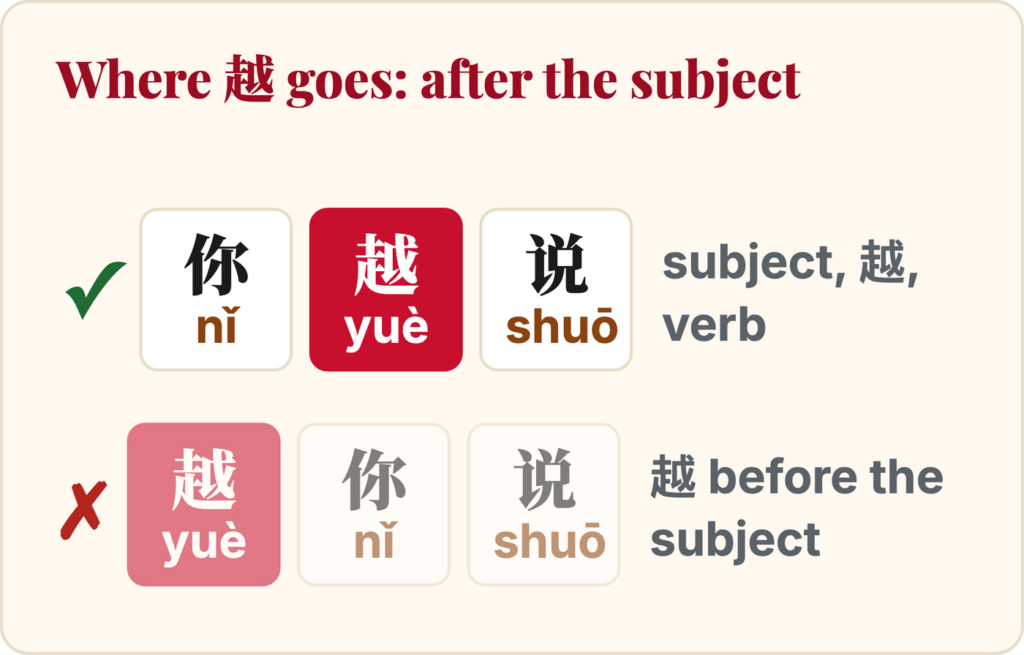
Because 越 (yuè) is an adverb, it follows the same rule as 很 (hěn) or 也 (yě): it sits after the subject and directly before the verb or adjective. That one rule settles almost every word-order question.
With one subject, the subject appears once, at the front, and both halves describe it:
他越说越快 (tā yuè shuō yuè kuài) — “the more he talks, the faster he goes”
这本书我越看越喜欢 (zhè běn shū wǒ yuè kàn yuè xǐhuan) — “the more I read this book, the more I like it”
With two subjects, each half has its own subject, and each subject comes before its own 越. A comma usually separates the halves:
天气越热,人越少 (tiānqì yuè rè, rén yuè shǎo) — “the hotter the weather, the fewer people there are”
你越练习,说得越好 (nǐ yuè liànxí, shuō de yuè hǎo) — “the more you practise, the better you speak”
The second example also shows how to use action verbs. An action verb like 说 (shuō, to speak) cannot be “more” by itself, so the degree goes into a complement with 得 (de): 说得越好, “speak better and better”. Our guide to 的, 得 and 地 explains that 得 in full.
Some 越 A 越 B phrases are fixed and worth learning whole: 越快越好 (yuè kuài yuè hǎo), “the sooner the better”; 越多越好 (yuè duō yuè hǎo), “the more the better”; and 越便宜越好 (yuè piányi yuè hǎo), “the cheaper the better”.
越来越 vs 更: a trend, not a comparison
Learners often reach for 更 (gèng, even more) when they mean 越来越, and the two are not interchangeable. 更 compares two fixed points. 越来越 describes movement with no fixed point at all:
今天比昨天更冷 (jīntiān bǐ zuótiān gèng lěng) — “today is colder than yesterday” (two days compared)
天气越来越冷 (tiānqì yuè lái yuè lěng) — “it keeps getting colder” (an ongoing trend)
This is also why 越来越 never appears in a 比 (bǐ) sentence. 比 sets up a comparison between two things; 越来越 describes how one thing changes. Choose one: 他比我高 (tā bǐ wǒ gāo), “he is taller than me”, or 他越来越高 (tā yuè lái yuè gāo), “he is getting taller and taller”. For comparisons in depth, see our guide to 比 comparisons.
Three rules that make 越 click
- 越 already says “how much”. So it never sits next to another degree word: no 很 (hěn), 非常 (fēicháng), 太 (tài) or 更 (gèng). 越来越好 (yuè lái yuè hǎo) is complete as it is.
- The subject comes before 越, every time. 我越来越忙 (wǒ yuè lái yuè máng), “I am getting busier and busier”, never 越来越我忙.
- 了 at the end is natural. Adding 了 (le) marks the new situation: 天气越来越冷了 (tiānqì yuè lái yuè lěng le). It is common in speech, and our guide to 了 (le) shows why.
Five common mistakes, fixed
- Adding a degree adverb: ✗ 越来越很冷 (yuè lái yuè hěn lěng) → ✓ 越来越冷 (yuè lái yuè lěng)
- Putting 越 before the subject: ✗ 越你说,他越不听 (yuè nǐ shuō, tā yuè bù tīng) → ✓ 你越说,他越不听 (nǐ yuè shuō, tā yuè bù tīng)
- Mixing 越来越 with 比: ✗ 他比我越来越高 (tā bǐ wǒ yuè lái yuè gāo) → ✓ 他越来越高 (tā yuè lái yuè gāo)
- Using 越来越 with a plain action verb: ✗ 他越来越说中文 (tā yuè lái yuè shuō Zhōngwén) → ✓ 他中文说得越来越好 (tā Zhōngwén shuō de yuè lái yuè hǎo)
- Dropping the second 越: ✗ 越快好 (yuè kuài hǎo) → ✓ 越快越好 (yuè kuài yuè hǎo)
If you are unsure whether a word can follow 越来越, ask whether it can take 很 (hěn). 冷 (lěng, cold), 喜欢 (xǐhuan, to like) and 忙 (máng, busy) all can, so they all work. 说 (shuō, to speak) cannot, so it needs the 得 (de) complement instead. You can also look up 越来越 in our Chinese dictionary for more example sentences.
Quick check — 越来越 and 越…越
Pick the best answer for each. Instant feedback below every question:
“The weather is getting colder and colder.” 天气___冷了。 (tiānqì ___ lěng le)
Which sentence is correct?
“The more you practise, the better you speak.” ___练习,说得越好。 (___ liànxí, shuō de yuè hǎo)
Which sentence is correct?
“The sooner the better.” 越快___。 (yuè kuài ___)
FAQs
“I tried other apps and courses before, but nothing clicked until I started with Will. His explanations of tones and grammar are crystal clear, and he pushes me at exactly the right pace.”
Keep going
Word order
Subject, time, place and verb: the order that every sentence follows.
Read the guide