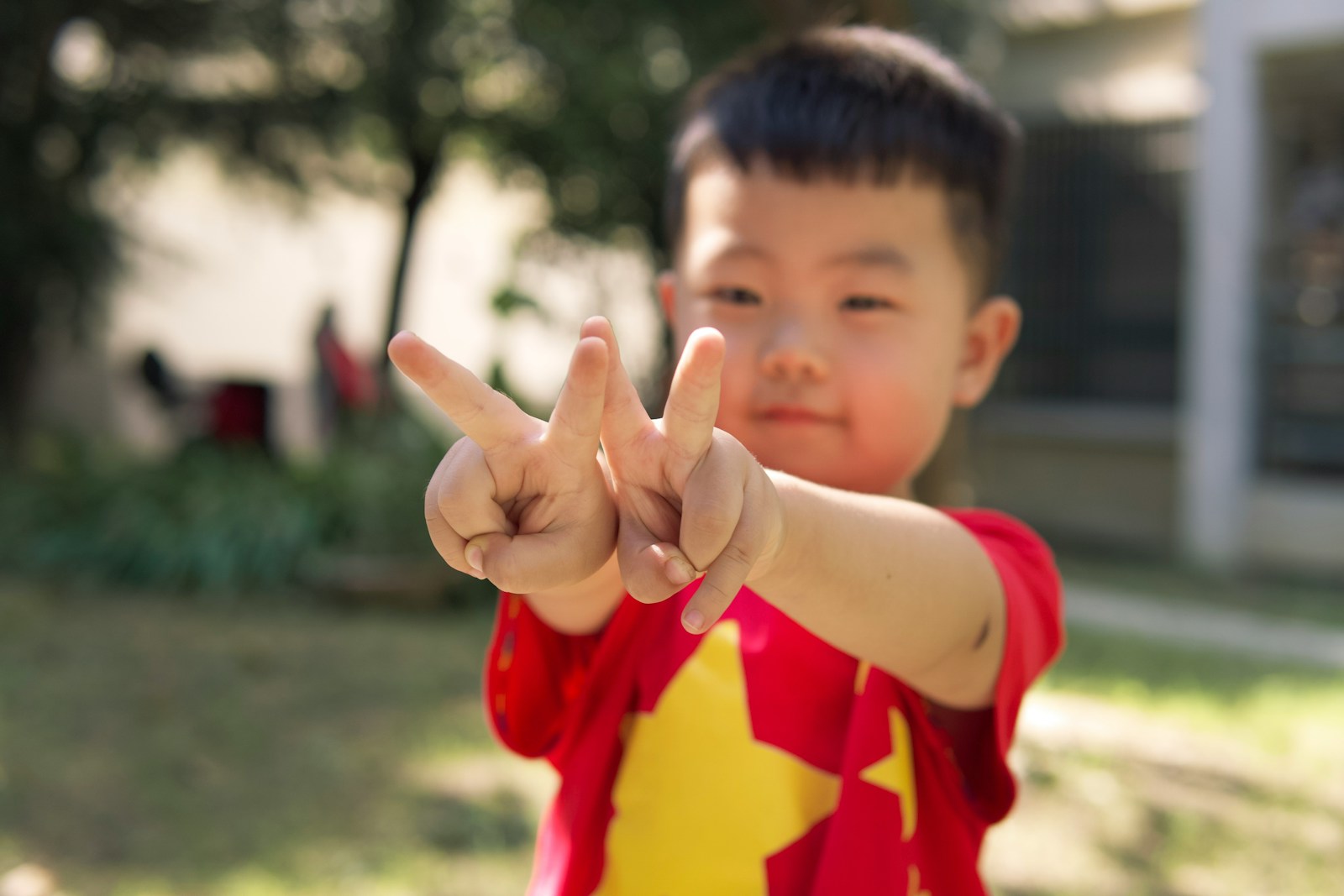
A Chinese name for a boy is a wish carried in characters. In just one or two characters it can hold a hope for strength or wisdom, an upright character, or a future as vast and open as the sky — every character chosen on purpose, for what it means.
This guide gathers 150 strong Chinese names for boys, grouped by theme, with the characters, pinyin, meanings and free audio so you can hear each one said correctly. Below them you’ll find the characters that appear most often in boys’ names, and a simple guide to choosing one of your own.
Anatomy of a name
Which half is the family name?
This is the thing that catches everyone out, and it changes how you choose. In Chinese the family name comes first — written the other way round it reads as a mistake, the way “Smith John” does in English.
Family name · first
Wáng
One character, almost always — and the single most common surname in China.
Given name · second
Zhìqiáng
One or two characters, chosen for what they mean. Two is the modern default; one is shorter and blunter.
王志强Wáng Zhìqiáng — the family name Wáng, and a given name meaning strong-willed and determined
Say the whole thing aloud before you decide anything. Three syllables all on the same tone fall flat to a native ear — a name with some movement in it carries better.
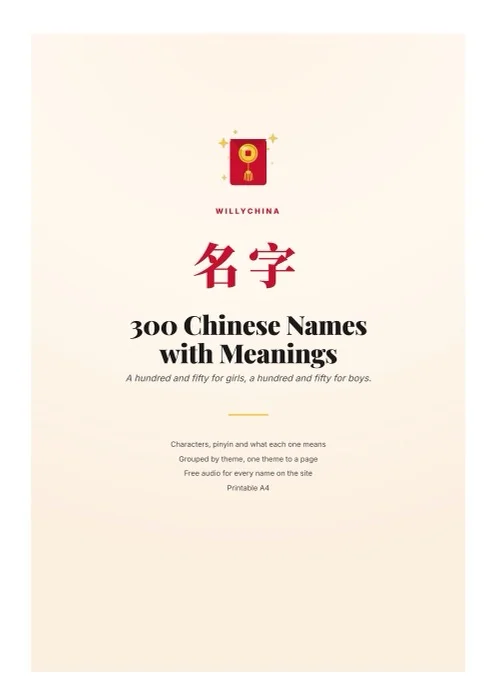
Free printable
All 300 names on one printable sheet
A hundred and fifty for boys and a hundred and fifty for girls, grouped by theme — one theme to a page — with the characters, pinyin and what each one means, plus the three tests worth applying before you settle on one.
⤓ Download the PDFTwelve pages · A4 · free
 WillyChina
Those three tests, in full.
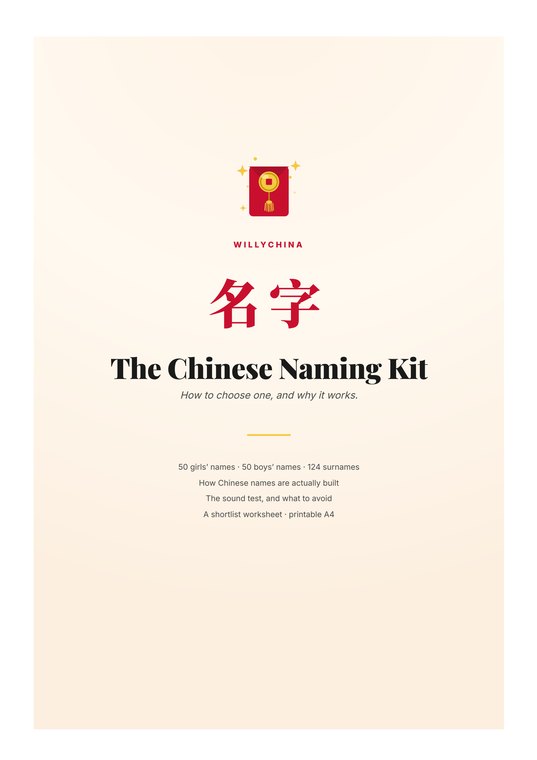
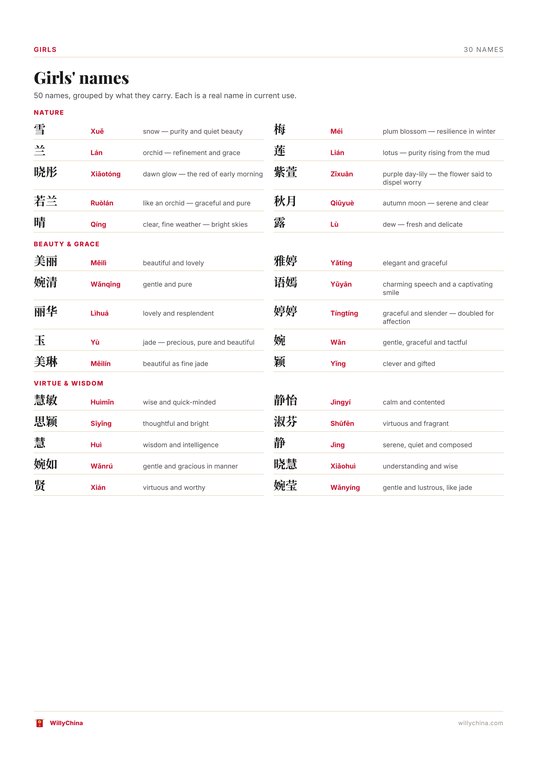
The Chinese Naming Kit
Meaning, sound and authenticity are the whole of it — and each takes more than a paragraph. The list above gives you the names; the kit is how you choose between them: the way a Chinese name is built, the sound test against your own surname, the four ways a name goes wrong, all 124 surnames with audio — which the free sheet does not carry — and a worksheet for getting to the name your son will carry.
See what is insideNow free with Your Chinese Name
Want your own?
These are a hundred and fifty names that already exist. Yours doesn’t.
Browse the list by all means. But a name built around your name — matched to its sound, with characters chosen for what they mean — is a different thing entirely.
Make my Chinese nameFree · takes about thirty seconds
Want all 300 in one place? The complete Chinese names list puts the boys’ and girls’ names on a single searchable page, with a printable PDF.
How Chinese Boys’ Names Work
Unlike English, Chinese names aren’t drawn from a fixed canon. A given name can be built from almost any of the language’s thousands of characters, and parents pick them for meaning, sound and the hopes they carry — so most names are unique and personal.
- Surname first. The family name comes before the given name, so a boy named 王浩然 is “Wang” (family) plus “Haoran” (given).
- One or two characters. Two-character given names are the most common today; a single strong character like 伟 (Wěi, “great”) is also a fine choice.
- Chosen for meaning. Boys’ names traditionally evoke strength, ambition, virtue, wisdom and vastness — though modern taste increasingly loves sky, light and nature imagery too.
- Sometimes a generation name. In some families the brothers and cousins of one generation share a character (字辈) that marks their place in the family line.
Popular Characters in Boys’ Names
A handful of characters appear again and again in boys’ names, each carrying a quality parents wish for. Tap ▶ to hear any of them:
150 Strong Chinese Names for Boys
A hundred and fifty names across five themes — strength, ambition, virtue, wisdom and vision. Search by character, pinyin or meaning, filter by theme, and tap ▶ on any card to hear it.
No name matches that search. Try a character, a pinyin spelling (e.g. hao), a meaning (e.g. strong), or a theme.
A name’s feel depends on the family name it sits with and how the tones flow together — say your favourites aloud to hear which ring true.
How to Choose a Chinese Name for Your Son
There’s no single right answer, but a good name balances three things at once — and getting all three is what makes it feel real rather than translated:
- Meaning. Start from a quality or image you hope for — strength, wisdom, an open horizon — and choose characters that carry it.
- Sound. Say the full name aloud with the surname. The tones and rhythm should flow; avoid awkward or comical-sounding combinations.
- Authenticity. A powerful-looking character isn’t always a natural name. A native ear knows which characters read like real names and which feel strange.
Those three tests worked through properly — with all 124 surnames, audio at natural speed and slowed, and a shortlist worksheet — are in The Chinese Naming Kit.
Get a Chinese Name for Your Son
You don’t have to guess. Our free Chinese Name Generator creates a real, meaningful Chinese name in seconds — with the characters, pinyin and what each one means — and you can turn it into a beautifully presented name certificate to keep or gift.
It’s the easy, authentic way to find a name as strong as the ones above. Generate a free Chinese name
FAQs
How do Chinese boys’ names work?
A Chinese name puts the family name first and the given name second. The given name is usually one or two characters chosen for their meaning — not from a fixed list as in English — so boys’ names are personal, and traditionally lean on strength, ambition, virtue, wisdom and a vast, open spirit.
What are popular Chinese names for boys?
Well-loved choices include 浩然 (Hàorán, “vast upright spirit”), 子轩 (Zǐxuān, “refined and dignified”), 俊杰 (Jùnjié, “outstanding talent”), 宇航 (Yǔháng, “to voyage the cosmos”) and the single-character 睿 (Ruì, “wise”). Our list above has 150, with audio.
Should a Chinese name be one or two characters?
Either works. Two-character given names are the most common today and let you pair two ideas, but a single strong character — like 伟 (Wěi, “great”) or 杰 (Jié, “outstanding”) — is perfectly authentic.
What is a generation name?
In some families, all the boys of one generation — including cousins — share a character in their two-character name, marking their place in the family line. Called a 字辈 (zìbèi), it’s an old tradition that has faded in modern China but is still used by some.
How do I choose a Chinese name for my son?
Start from a quality you hope for — strength, wisdom, an upright character — pick characters that carry it, then check the syllables sound good together. A native eye helps — or use our free Chinese Name Generator to get a real, meaningful name in seconds.
Further reading: how Chinese given names are formed (Wikipedia). See also our guides to how Chinese names work and Chinese names for girls, and how to choose a Chinese name.
Photograph by 绵绵.
Free PDF
Where should I send it?
Tell us a little about you and the PDF is yours — it lands in your inbox straight away.
All fields are required. I’ll send new resources now and then, the odd note on learning Mandarin properly, and occasionally news about my workbooks. Unsubscribe any time. Privacy policy
Sent. Check your inbox — your download is starting now.