How to Tell the Time in Mandarin (几点了?)
Telling time in Mandarin is refreshingly simple once you know a handful of words. Learn 点 (o’clock), 分 (minutes), 半 (half past) and 刻 (quarter), set any time on the interactive clock below, and hear it spoken by a native voice.
The Mandarin Clock
Drag the minute hand or use the steppers. Choose a time of day, then press play to hear it in Mandarin.
Six words unlock the clock
Telling time in Mandarin comes down to six words. Learn them and you can say almost any time of day.
点 diǎn — o’clock
The hour word. Put the number in front, then 点: 三点 = three o’clock. For a round hour you can add 钟 zhōng → 三点钟.
分 fēn — minutes
Add the minutes after the hour, then 分: 三点二十分 = 3:20. For minutes one to nine, slot in 零 líng → 三点零五分.
半 bàn — half past
For the half hour, add 半 after the hour: 九点半 = 9:30 — literally “nine o’clock half”, with no number needed.
刻 kè — quarter
One 刻 is fifteen minutes: 一刻 is quarter past, 三刻 three-quarters past. So 两点一刻 = 2:15 and 两点三刻 = 2:45.
差 chà — to (before the hour)
差 chà means “lacking”, used for minutes to the hour: 差一刻八点 = quarter to eight — literally “lacking a quarter, eight”.
两 vs 二 liǎng / èr
For two o’clock say 两点, never “二点”. Minutes still keep 二, though: 两点二十分 = 2:20 — the classic beginner slip.
Three more time words worth knowing
Small words that make you sound natural and precise once the basics of telling time in Mandarin click.
整 zhěng — on the dot
For an exact hour, add 整 after 点: 八点整 = eight o’clock sharp. It marks a round, precise time.
小时 xiǎoshí — hours (length)
点 marks a clock time; 小时 counts how long: 三个小时 = three hours long. Casual speech also uses 钟头.
左右 zuǒyòu — give or take
Add 左右 after a time for “around”: 三点左右 = about three o’clock. Handy when you’re not being exact.
Say which part of the day
Mandarin leads with the time of day, then the clock time — 下午三点 = 3 in the afternoon. Tap the sky to follow the sun and hear each one.
Build a natural time phrase
Pick a part of the day and an hour to hear the full expression — the way it’s really said.
点 in speech, 时 in writing
Everyday conversation uses 点. Timetables, notices and official writing switch to 时 shí with the 24-hour clock — the same moment, a different register.
Asking about the time
The key question word is 几 jǐ (“how many”). These four lines cover almost every situation where telling time in Mandarin comes up.
Telling time in Mandarin, in real sentences
Three situations where the clock actually comes up — a departure, an appointment and opening hours.
Six phrases that come with the clock
Once you have telling time in Mandarin down, these are the words you will reach for next.
Three common mistakes
Three slips that trip up almost everyone learning to tell the time in Mandarin — worth fixing early.
Using 二 for two o’clock
✗ 二点
✓ 两点 — two o’clock is always 两点 liǎng diǎn; minutes still use 二 (二十 = 20).
Mixing 分 with 分钟
✗ 三点二十分钟
✓ 三点二十分 — a clock time takes 分; 分钟 is a duration (“20 minutes long”).
Dropping 零 in single minutes
✗ 六点五分
✓ 六点零五分 — single-digit minutes take 零 líng (“oh”), like “six oh-five”.
Quick clock quiz
Five questions. Read the Chinese, pick the right time.
Nicely done!
Free cheat sheet (PDF)
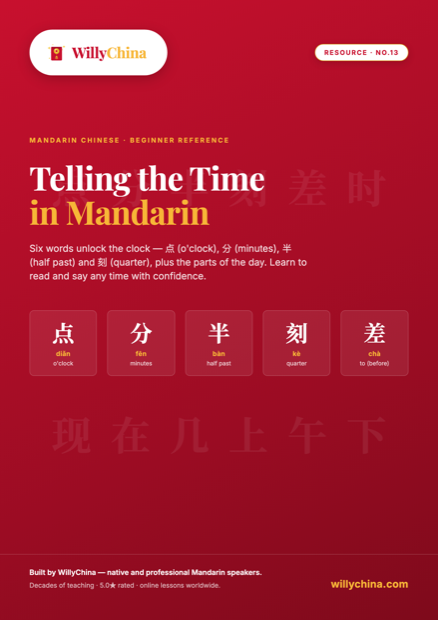
One clean page with everything you need for telling time in Mandarin: the six words, the number line, times of day, and worked examples — print it or keep it on your phone.
Free · no email required · PDF
Telling time in Mandarin — FAQ
Say 现在几点? (xiànzài jǐ diǎn?) — literally “now, how many o’clock?”. You can add 了 le for a natural spoken feel: 现在几点了?. The word 几 jǐ means “how many” and is the standard way to ask for a number under about ten.
Mandarin uses 两 liǎng instead of 二 èr before most measure words and counters, including 点 for the hour. So 2 o’clock is 两点 liǎng diǎn. Minutes, however, keep 二 — 2:20 is 两点二十分 (liǎng diǎn èrshí fēn).
For clear numbers you can drop it in casual speech (三点二十 for 3:20), but including 分 is standard and always correct. For single-digit minutes, keep 零 líng: 3:05 is 三点零五分. Note that 分钟 fēnzhōng is different — it means a duration of minutes, not a point on the clock.
点 diǎn is the everyday spoken word for the hour. 时 shí is more formal and written — you’ll see it on timetables and official notices, often with the 24-hour clock: 二十时 = 20:00. In conversation, stick with 点.
A quarter is 一刻 yí kè (15 minutes). Quarter past three is 三点一刻. For “quarter to”, use 差 chà (“lacking”): quarter to eight is 差一刻八点 (chà yí kè bā diǎn). You can also just say the minutes: 7:45 is 七点四十五分.
Both are used. Daily conversation prefers the 12-hour clock with a time-of-day word (晚上八点 = 8 pm). Transport schedules, TV listings and official documents use the 24-hour clock (二十点 / 二十时 = 20:00). Learning the spoken 12-hour system first will serve you in almost every real conversation.
Use 从 cóng (from) and 到 dào (to): 从九点到五点 (cóng jiǔ diǎn dào wǔ diǎn) = from nine to five. The same pattern covers any span — 从早上八点到晚上六点 = from 8 am to 6 pm. Printed opening hours often use a dash instead, but in speech 从…到… is the natural way to say it.
Half an hour is 半个小时 (bàn ge xiǎoshí), often shortened to 半小时. An hour and a half is 一个半小时 (yí ge bàn xiǎoshí). These are durations — don’t confuse them with the half-hour on the clock, which uses 半 after the hour: 九点半 = 9:30.
What to study next
Related WillyChina resources
Free PDF
Where should I send it?
Pop your email in and the PDF is yours — it lands in your inbox straight away.
I’ll send new resources now and then, and the odd note on learning Mandarin properly. Unsubscribe from any email.
Sent. Check your inbox — your download is starting now.