Type any Chinese characters — or just the pinyin — and get a printable tracing worksheet with stroke order, 田字格 (tián zì gé) practice grids, pinyin and meaning. Free, no sign-up, no watermark.
Checked by a native teacherBorn in China, 10+ years teaching
Free browser toolNo sign-up, nothing to install
No Chinese keyboard? Type pinyin like ni hao and pick the characters you meant.
Pick a character
Include
Stroke data from the Make Me a Hanzi project, used under the Arphic Public Licence. Readings and meanings from CC-CEDICT.
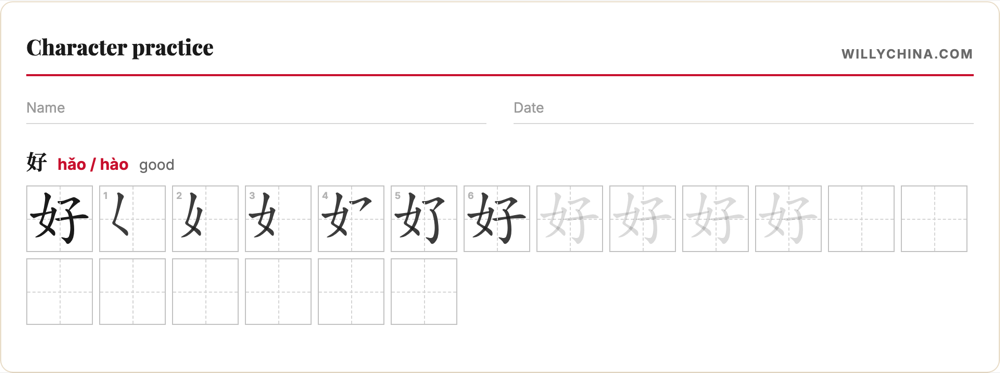
A sheet straight from the generator: the character solid, then its stroke order numbered, then faded guides and blank grids to work into.
How to use the Chinese character worksheet generator
Step oneSay the character out loud as you write it. Writing in silence builds a hand that knows the shape and a mouth that doesn’t. The pinyin is printed on every row for exactly this reason.
Step twoTrace the faded guides first, then cover them. The blank cells are the ones that count — recall is what moves a character into memory, not copying.
Step threeCome back tomorrow, not in ten minutes. One sheet revisited across three days beats three sheets in one sitting.
Why stroke order actually matters
Stroke order looks like etiquette. It isn’t — it is the thing that makes a character legible at speed. Written in the correct order, the strokes fall into proportions a reader recognises instantly. Written in your own order, the same character comes out cramped or lopsided, and a native reader has to stop and work it out.
It also unlocks the rest of the language. Dictionaries, handwriting input on a phone, and stroke-count indexes all assume the standard order. Get it right early and every later character is faster, because the rules repeat: top before bottom, left before right, horizontal before crossing vertical, outside before inside, and the box closes last.
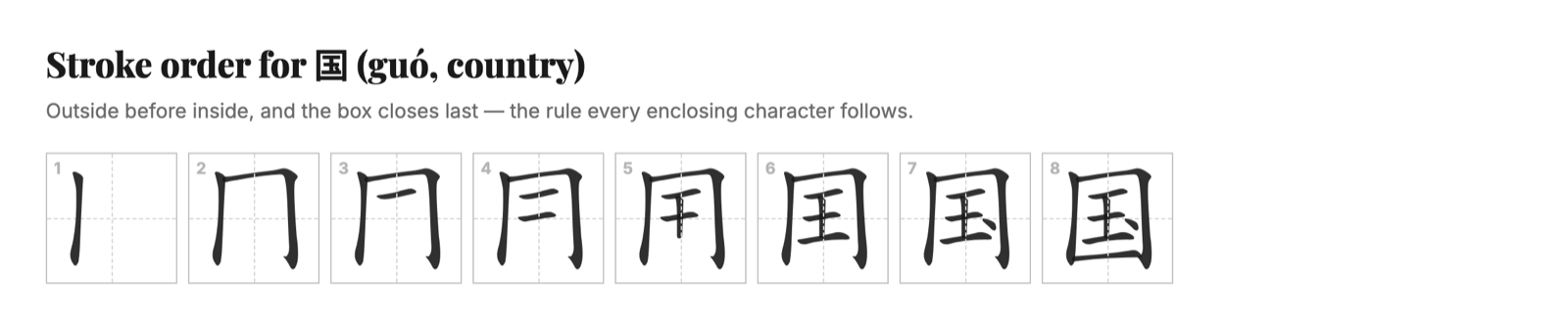
Try it on 国 (guó, country). The outer box opens, the contents go in, and only then does the bottom line seal it. Every enclosing character in Chinese behaves the same way.
What the 田字格 (tián zì gé) grid is for
The grid on this worksheet is a 田字格 (tián zì gé) — literally a “field character grid”, named after 田 (tián, field), which is what the four-square shape looks like. Chinese children learn to write inside it for a reason: a Chinese character is not written on a line, it is balanced inside a square.
The dotted cross marks the centre. Components should sit either side of it in proportion — a left-right character like 好 (hǎo, good) puts 女 in the left half and 子 in the right, neither one crowding the other. Without the guide, most beginners drift: the first component grows, the second gets squashed into the remaining space, and the character looks wrong even though every stroke is correct.
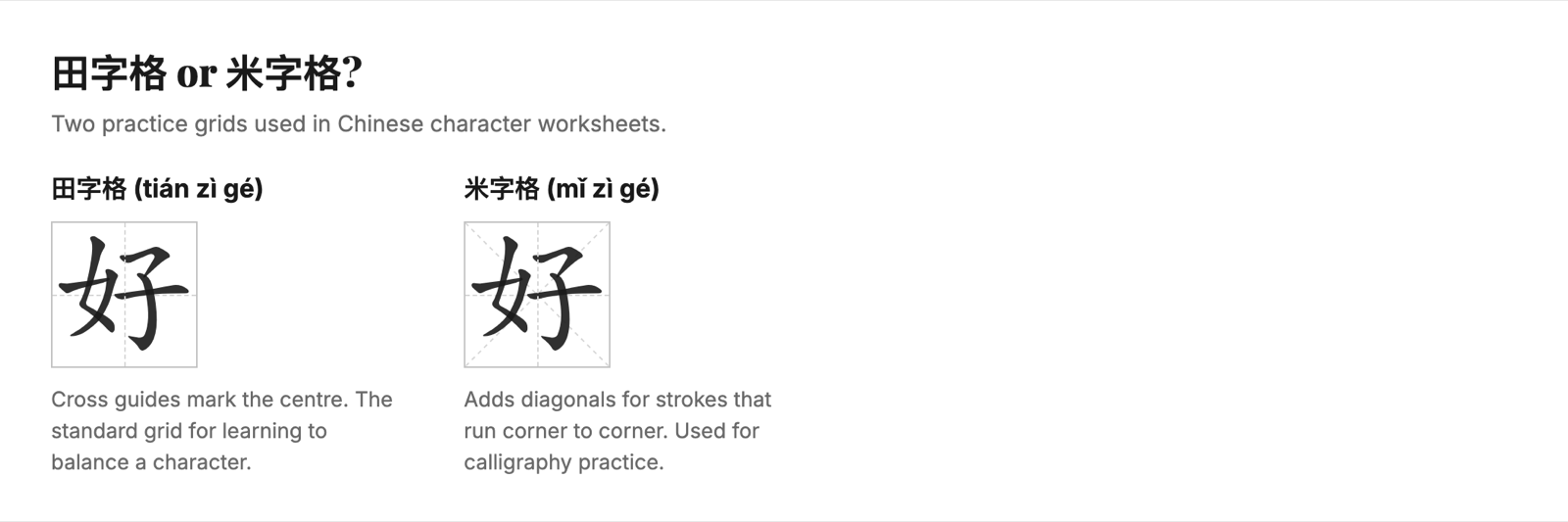
The same character in both grids. 田字格 (tián zì gé) marks the centre; 米字格 (mǐ zì gé) adds diagonals for corner-to-corner strokes.
If you want more guidance, switch the grid style above to 米字格 (mǐ zì gé), which adds diagonals. It is the grid used for calligraphy practice, and it helps with characters whose strokes run corner to corner.
How much practice is enough
Twelve repetitions of one character in a single sitting is close to useless by itself. What works is spacing: write it today, again tomorrow, again in three days, again next week. That is why this generator prints a row rather than a page per character — you are meant to come back to the sheet, not exhaust it.
A realistic target for a beginner is five to eight new characters a week, properly revisited, alongside reading the same characters in context. If you are working through a syllabus, our HSK 1 vocabulary list and HSK 2 list give you the order to learn them in, and the 214 radicals chart explains the building blocks that keep reappearing.
Pronunciation is the other half. A character you can write but not say is half-learned, so check the tones as you go with the Mandarin tones cheatsheet and the complete pinyin chart, both of which have native audio.
The seven stroke order rules, with examples
Almost every character you will ever write is covered by seven rules. They interact, and when two conflict the earlier one usually wins — but once you have written a few hundred characters you stop thinking about them at all.
1. Top to bottom
Work down the character. 三 (sān, three) is written as three horizontals from the top down, never bottom-up. The same logic governs stacked characters like 思 (sī, to think): the top component is finished before the heart beneath it is begun.
2. Left to right
Within a level, move left to right. 明 (míng, bright) is 日 then 月. This is why left-hand radicals are always written first — the 氵 water radical in 河 (hé, river) comes before anything on the right.
3. Horizontal before crossing vertical
十 (shí, ten) is the horizontal first, then the vertical through it. Get this one wrong and the cross sits off-centre, which is the single most common reason a beginner’s handwriting looks unbalanced.
4. Outside before inside
Build the frame, then fill it. 同 (tóng, same) starts with the outer enclosure before the mouth inside it.
5. Close the box last
When a character is fully enclosed, the bottom line comes last of all. 国 (guó, country) is written as three sides of the box, then everything inside, then the base to seal it. Writing the box first and squeezing the contents in afterwards is the classic beginner error.
国 (guó, country) built stroke by stroke: three sides of the frame, the contents, then the base seals it.
6. Centre before wings
In symmetrical characters the middle comes first. 小 (xiǎo, small) is the central stroke, then left, then right — which is what keeps it symmetrical.
7. Right-to-left diagonals last
A falling stroke to the right is usually the last thing you write, and minor dots often come last of all. In 我 (wǒ, I, me) the small dot at the top right closes the character.
Three mistakes worth avoiding
Drawing instead of writing. A character is a sequence of movements, not a picture to copy. If you find yourself retracing a stroke to thicken it, you are drawing.
Practising without sound. Every row on this sheet prints the pinyin. Say it aloud on every repetition or you will build a character you can write and cannot use.
Filling the whole sheet in one sitting. The last four cells of a row of twenty teach you almost nothing. Stop while it is still slightly effortful and come back tomorrow.
Where this worksheet generator gets its data
The Chinese character worksheet generator draws on two open datasets. Stroke order comes from the Make Me a Hanzi project, an open dataset derived from the Arphic fonts and released under the Arphic Public Licence. Readings and meanings come from CC-CEDICT, the open Chinese-English dictionary, with our own HSK readings taking precedence where the two differ — a learner should see the reading their syllabus teaches.
Characters with more than one reading show all of them, because a worksheet that prints 行 as only háng teaches a beginner something they will later have to unlearn.
FAQs
Do I need a Chinese keyboard to use this?
No. Type the pinyin — ni hao, xie xie — and a row of matching characters appears under the box. Tap the one you meant and it is added. The most common characters are listed first.
Is it really free, and is there a watermark?
The Chinese character worksheet generator is free, with no sign-up, no email required and no watermark. Print as many sheets as you like, including for a classroom.
How do I save it as a PDF instead of printing?
Press Print / Save as PDF and choose “Save as PDF” as the destination in your browser’s print dialogue. On an iPhone or iPad, tap the share icon in the print preview and choose Save to Files.
Can I use these worksheets with my class?
Yes. Teachers are welcome to print and distribute them. Tick the name and date line before printing and you have a sheet ready to hand out.
Which characters can it handle?
Around 10,000 simplified characters have stroke data, which covers everything in HSK 1 to 6 and far beyond. If a character has no data, the sheet still prints the practice grid for it and tells you how many were found.
Traditional or simplified?
The generator is built for simplified characters, which is what mainland China uses and what HSK tests. Many characters are identical in both, so a good number of traditional forms will work, but coverage is not complete.
Want the whole set, already built?
Every HSK character, traced, heard and drilled
This generator makes one sheet at a time. The Complete Packs are the finished article: a printed workbook with stroke order and tracing grids for every word in the level, native audio for each entry, and Anki decks in both directions.