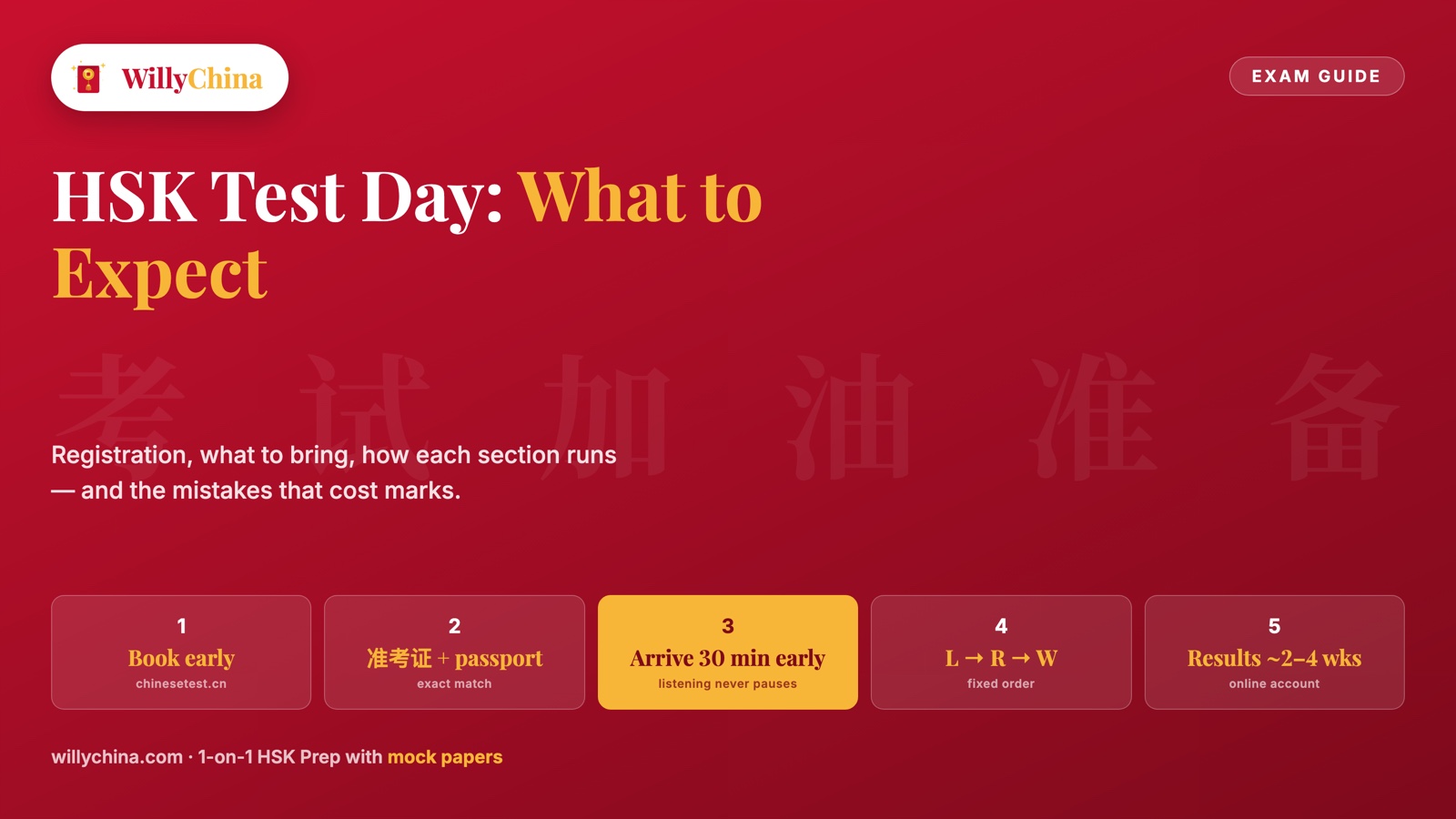
HSK Test Day: What to Expect
Registration, what to bring, how each section runs, and the avoidable mistakes that cost marks — everything between you and a calm exam morning.
What actually happens on HSK test day? You register weeks ahead on chinesetest.cn, arrive thirty minutes early with your passport and admission ticket, and sit a tightly timed exam that always runs listening first. Here’s the whole day, from booking to results.
Booking and the weeks before
Register on chinesetest.cn for a centre and date — popular sittings fill weeks out, so book early, especially around university application season. Your registration ID must exactly match the document you’ll bring on the day. Closer to the date, download and print your admission ticket (准考证); treat it like a boarding pass. The final fortnight belongs to mock papers under real timing — at this stage, exam technique earns more marks than new vocabulary.
The format, level by level
| Level | Sections | Duration | Score · pass |
|---|---|---|---|
| HSK 1 | Listening + Reading (with pinyin) | ~40 min | 200 · pass 120 |
| HSK 2 | Listening + Reading (with pinyin) | ~55 min | 200 · pass 120 |
| HSK 3 | Listening + Reading + Writing | ~90 min | 300 · benchmark 180 |
| HSK 4 | Listening + Reading + Writing | ~105 min | 300 · benchmark 180 |
| HSK 5 | Listening + Reading + Writing | ~125 min | 300 · benchmark 180 |
| HSK 6 | Listening + Reading + Writing (incl. summary) | ~140 min | 300 · benchmark 180 |
Not sure which level to book? The levels guide maps the ladder, and our free placement test gives you a ten-minute answer. For how long the preparation realistically takes, see the level-by-level timelines.
The day before: a ten-minute checklist
Exam eve is for logistics, not study — a final mock paper the morning before is fine, but the evening belongs to this list:
- Print the admission ticket (准考证) — physically, even for computer-based tests; phones are sealed away.
- Passport check — the exact document from registration, in your bag now, not tomorrow.
- Route and arrival time — find the building entrance on a map, plan to be there 30 minutes early, then add buffer.
- Paper test kit — two sharpened 2B pencils and an eraser; pens are for the signature only.
- Water and a snack — there’s no break at most levels, but you’ll want both immediately after.
- Ten minutes of listening — not study, just tuning: any Mandarin audio over breakfast warms your ear up before the section that starts cold.
Inside each section
Listening (听力)
Always first, always relentless. At HSK 1–2 you match recordings to pictures and judge true/false statements; from HSK 3 you’re choosing answers to dialogues, and by HSK 5–6 the clips are monologues — news items, anecdotes, opinions — played once at the top levels. The audio sets the pace, not you: if a question gets away, abandon it instantly and be ready for the next clip. Marks are lost in pairs by dwelling. Train with our word lists’ native audio at natural speed, not slowed playback — the exam doesn’t slow down.
Reading (阅读)
The most time-pressured section at every level. Early levels test word-picture matching and sentence completion; HSK 4 introduces ordering jumbled sentences (the question type most underestimated by candidates); HSK 5–6 demand skimming full passages at speed — roughly a question per minute. The discipline that saves you: do every easy question first, mark the hard ones on your ticket, and return only if time remains. An unanswered easy question costs exactly as much as a hard one.
Writing (书写) — HSK 3 and up
HSK 3 asks you to arrange words into sentences and write characters from pinyin prompts; HSK 4 adds sentence construction from given words and picture prompts; HSK 5 requires short composition; HSK 6 closes with the famous summary task — read a 1,000-character narrative for ten minutes, surrender the text, and retell it in 400 characters. At every level, simple-but-correct beats ambitious-but-wrong: examiners reward accurate structures, not vocabulary showing off.
The day itself
Arrive thirty minutes early. ID checks and seating take time, and latecomers aren’t admitted once the audio starts. Phones are surrendered or sealed; for the paper test bring 2B pencils and an eraser (the answer sheet is machine-read).
Listening always comes first — and never pauses. Each clip plays a fixed number of times and moves on. The single best technique: pre-read the answer options during the instructions so you know what to listen for. Reading follows under a strict clock — answer easy questions first, mark and return. Writing (HSK 3 up) closes the session; at HSK 5–6 budget firm minutes for the essay and summary tasks rather than letting reading overrun.
Results and what comes after
Scores appear in your chinesetest.cn account — typically around two weeks for the internet-based test, around a month for paper. Universities generally accept the online score report, with the printed certificate following. Results are commonly treated as valid for two years for admissions. If the result disappoints: there’s no retake limit and no waiting penalty — diagnose the weak section, train it specifically, and rebook.
Test centre or home test?
If your region offers both, the trade-offs are real. The test centre gives you certainty: invigilated conditions universities never question, working equipment that isn’t your problem, and no environment checks. The home-based online test saves travel and sometimes offers more dates, but brings stricter rules — a bare desk, a quiet room, a wired connection, camera requirements, and software checks that are worth a full rehearsal days before. Technical failure mid-exam is rare but stressful in a way a test centre never is. Our advice: first-time candidates and anyone testing for a university deadline should prefer the centre; experienced re-takers chasing a score upgrade are the natural home-test users.
One forward note: from July 2026 the exam moves to the nine-band HSK 3.0 format — handwriting from Band 1 and integrated speaking from Band 3 — so if your test date falls after the switch, train for the new structure.
FAQs
Keep going
The HSK levels, explained
Word counts, CEFR equivalents and which level you need.
Read the guide →