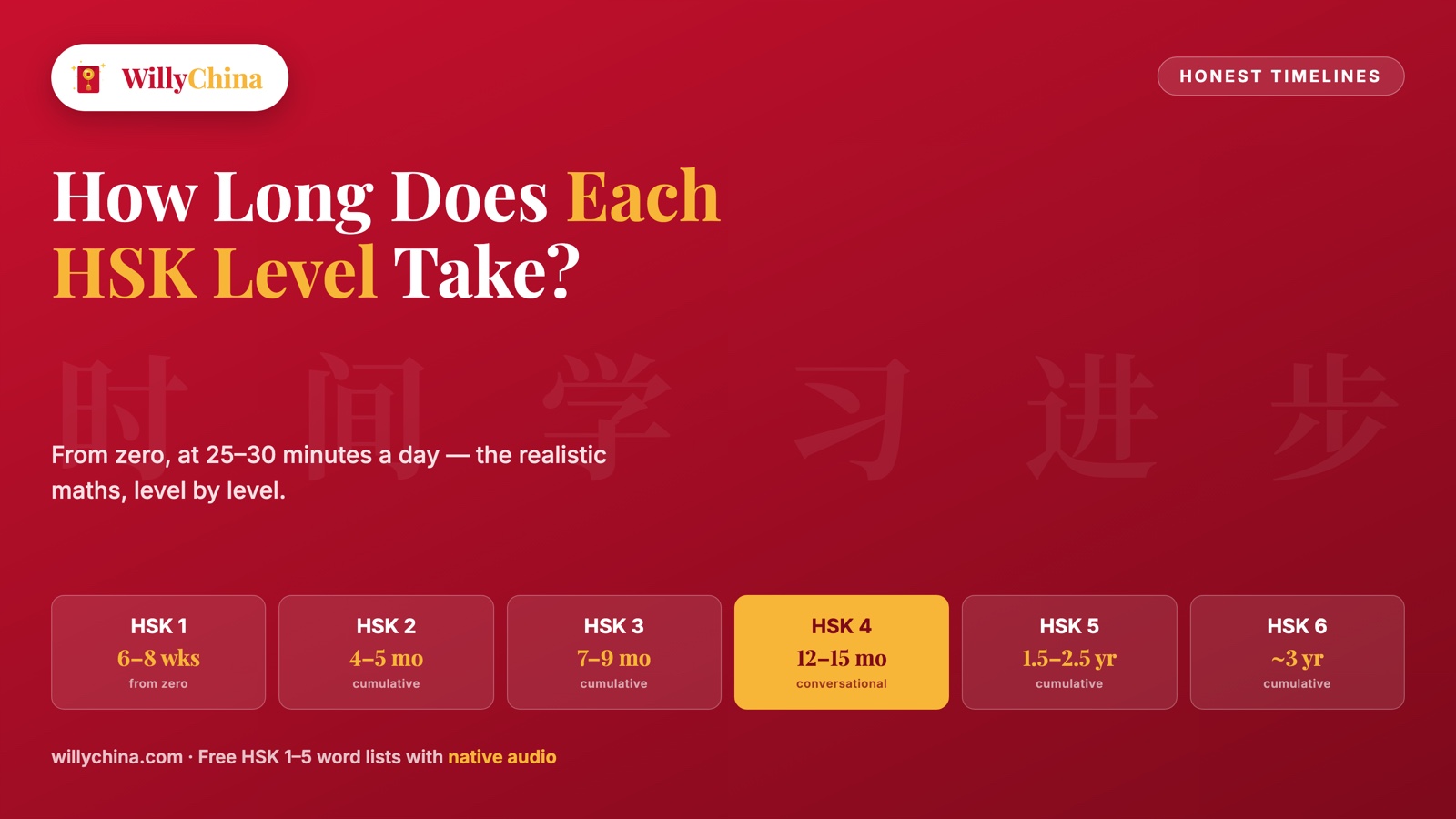
How Long Does Each HSK Level Take?
Real numbers for every level — at a pace working adults actually sustain. From six weeks for HSK 1 to the multi-year summit of HSK 6, here’s the honest maths.
How long does the HSK take? At a sustainable pace — 25–30 minutes of study a day plus a weekly live lesson — expect roughly two months to HSK 1, a year to HSK 4, and two or more years to HSK 5. Here’s the level-by-level maths, and the variables that genuinely change it.
The timelines, level by level
| Level | New words | Time at this level | Cumulative from zero |
|---|---|---|---|
| HSK 1 | 150 | 6–8 weeks | ~2 months |
| HSK 2 | 150 | 2–3 months | ~4–5 months |
| HSK 3 | 300 | 3–4 months | ~7–9 months |
| HSK 4 | ~600 | 4–6 months | ~12–15 months |
| HSK 5 | ~1,300 | 6–12 months | ~1.5–2.5 years |
| HSK 6 | ~2,500 | 12–18 months | ~3 years |
Two honest caveats. First, these are medians for consistent learners, not records — see the FAQ for the intensive path. Second, “passing the level” means the full skill set: the word list alone moves faster (our HSK 4 vocabulary takes most learners 8–12 weeks), but listening speed, reading and — from HSK 3 — writing are what the exam actually measures.
What changes the maths
Speaking practice is the multiplier. Learners who speak weekly with correction consistently outpace flashcard-only study — vocabulary sticks when it’s used under pressure. Characters are the silent cost: from HSK 3 the exam drops pinyin support, so reading speed becomes study time most people forget to budget. Your language background matters less than you’d think — Mandarin is roughly equidistant from English and most European languages — but prior experience learning any language helps. And the 3→4 wall is real: vocabulary doubles and turns abstract, which is why our timeline gives HSK 4 four to six months on its own.
What each stage of the climb feels like
HSK 1–2: the sprint (months 0–5)
Progress is fast and visible — every week adds phrases you can actually deploy. The work is sound-first: tones, pinyin, and ear training with the HSK 1 and HSK 2 audio lists. The danger at this stage isn’t difficulty, it’s false confidence: 300 words recognised on flashcards is not 300 words available in conversation. Speak from week two, badly and often.
HSK 3–4: the climb (months 5–15)
The terrain changes: pinyin support disappears, characters carry the load, and grammar becomes an engine rather than a list. This stage decides who reaches conversational Mandarin — it’s where the HSK 3 and HSK 4 two-week circuits earn their keep, and where weekly corrected speaking stops being optional. Expect weeks where nothing seems to improve; that’s consolidation, not failure.
HSK 5–6: the long ridge (year 2 onward)
No more tricks — just volume. Reading shifts to articles and stories, listening to single-play natural speech, and the HSK 5 list’s 1,300 new words reward systems over sprints. The learners who summit are the ones who made Mandarin a daily habit rather than a project.
Why learners stall — and the fixes
Three patterns account for most abandoned ladders. The flashcard plateau: vocabulary keeps growing but conversation doesn’t — fixed by moving half your study time to output (speaking and writing) the moment recognition outruns recall. The character debt: postponing reading until HSK 3 forces it, then drowning — fixed by reading something tiny every day from month one. The schedule collapse: heroic two-hour Sundays that quietly become zero — fixed by shrinking the unit until it’s unmissable; twenty honest minutes daily beats any weekend binge. If you recognise yourself in one of these, that — more than any technique — is your timeline lever.
Choosing your pace
The 25–30 minute daily baseline is deliberate: it’s the pace that survives busy weeks, and consistency beats intensity over a year. If you have a deadline — university admission, a posting to China — the intensive route (2–3 hours daily) roughly halves every number in the table, and our 1-on-1 HSK Preparation course adds the exam-specific technique that pure study hours don’t buy. Wondering about overall fluency rather than certificates? That’s a different question — covered in How Long Does It Take to Learn Mandarin?
One more thing: from July 2026 the HSK moves to nine bands with bigger word lists at the bottom rungs — the principles in this guide hold, but budget the new Band 1 more like the old HSK 2.
Counting in hours, not months
Months mislead when schedules differ, so here’s the same ladder in study hours — the currency that transfers between any routine. On our baseline (25–30 daily minutes plus a weekly lesson), HSK 1 represents roughly 60–80 hours of total contact with the language, HSK 2 around 150–180 cumulative, HSK 3 about 280–330, HSK 4 in the region of 550–650, and HSK 5 comfortably past the thousand-hour mark. These are our working estimates from teaching, not laboratory figures — but they explain the most useful planning trick we know: to halve your calendar, you don’t need talent, just double the daily minutes. The hours don’t negotiate; the calendar does. It’s also why “I studied Mandarin for two years” tells you almost nothing — two years at ten distracted minutes a day and two years at an honest hour are different languages by the end. And it cuts the other way too: if you can only find fifteen minutes a day this season, take them — the hours still accumulate, the ladder just stretches. A slower climb that continues beats a faster one that stops, every single time.
FAQs
Keep going
The HSK levels, explained
What each level means, word counts and CEFR equivalents.
Read the guide →Find your starting rung
Ten minutes, instant placement on the HSK ladder.
Mandarin Level Test →