Tangyuan — glutinous rice balls with a molten black sesame centre, eaten at the winter solstice and again at the Lantern Festival.
“The roundest food in China, eaten on the nights a family is supposed to be whole.”
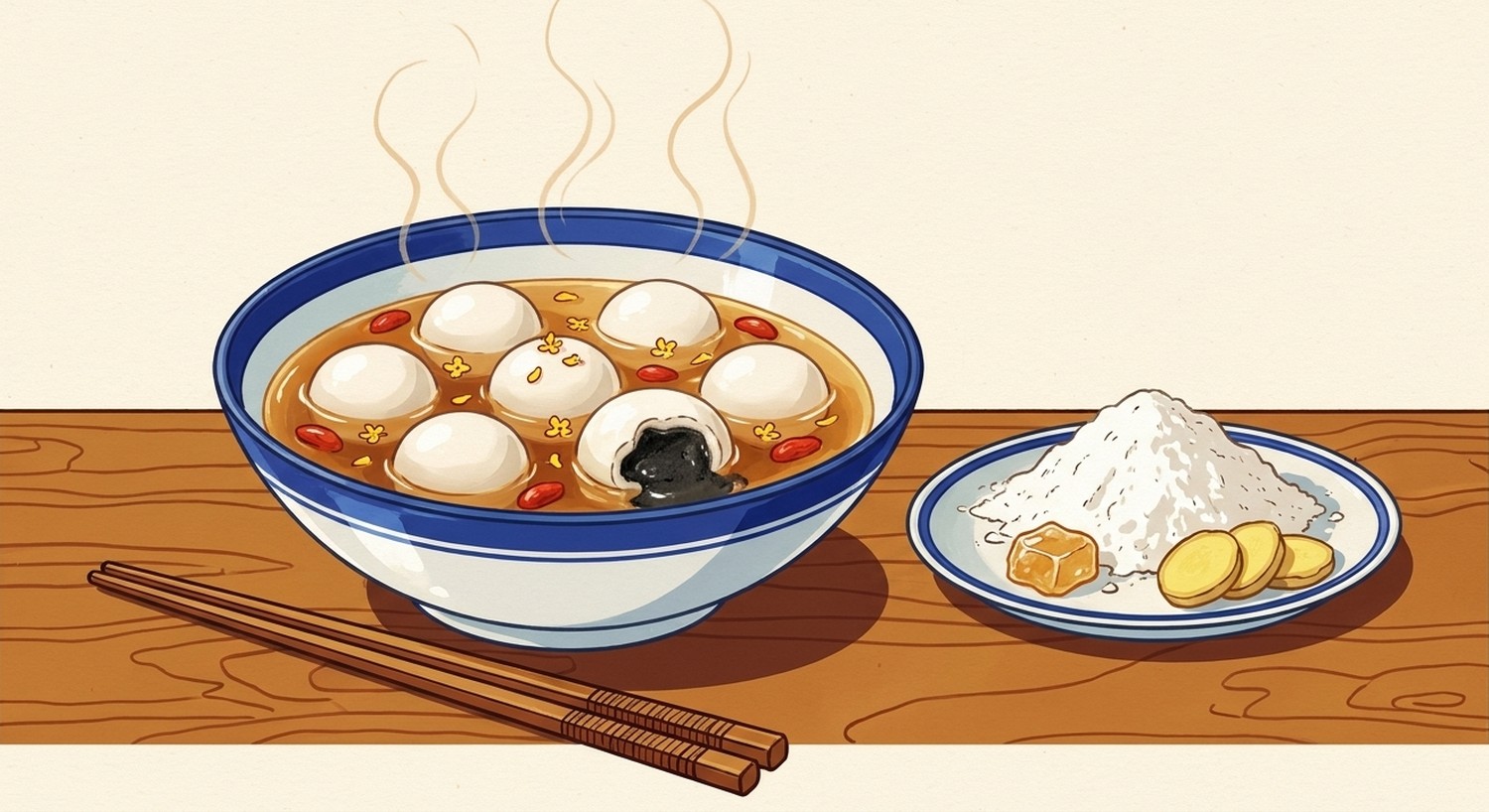
The roundest food in China
Tangyuan (汤圆) are balls of glutinous rice dough, usually filled, simmered in water or a light sweet soup and eaten from a bowl with a spoon. The classic filling is black sesame ground with sugar and lard, which sets firm in the fridge and turns to a hot dark liquid the moment the ball is cooked. Bite one carefully. The inside is molten.
They belong to two nights in particular. At 冬至 (dōngzhì, the winter solstice) families through much of the south eat tangyuan — in Jiangnan they are often called 冬至团 — while the north eats dumplings instead. Then at 元宵节 (yuánxiāojié, the Lantern Festival), on the fifteenth night of the first lunar month, the whole country eats glutinous rice balls — but the north calls them 元宵 and builds them a different way, which is worth a section of its own further down.
The shape is the point. A round ball, a round bowl, a round moon, and a family sitting round a table. The word for that last one is 团圆 (tuányuán), reunion, and the name of the dish echoes it — not quite a homophone, but close enough to be heard. In the Wu dialect of Ningbo, home of the black sesame version, they are called 汤团 (tāngtuán), where the echo is near-exact. The association is old: a poem by the Southern Song writer Zhou Bida, on boiling rice balls at the Lantern Festival, opens 今夕知何夕,团圆事事同 — what night is tonight? A night when everything is round, and together.
Black Sesame Tangyuan
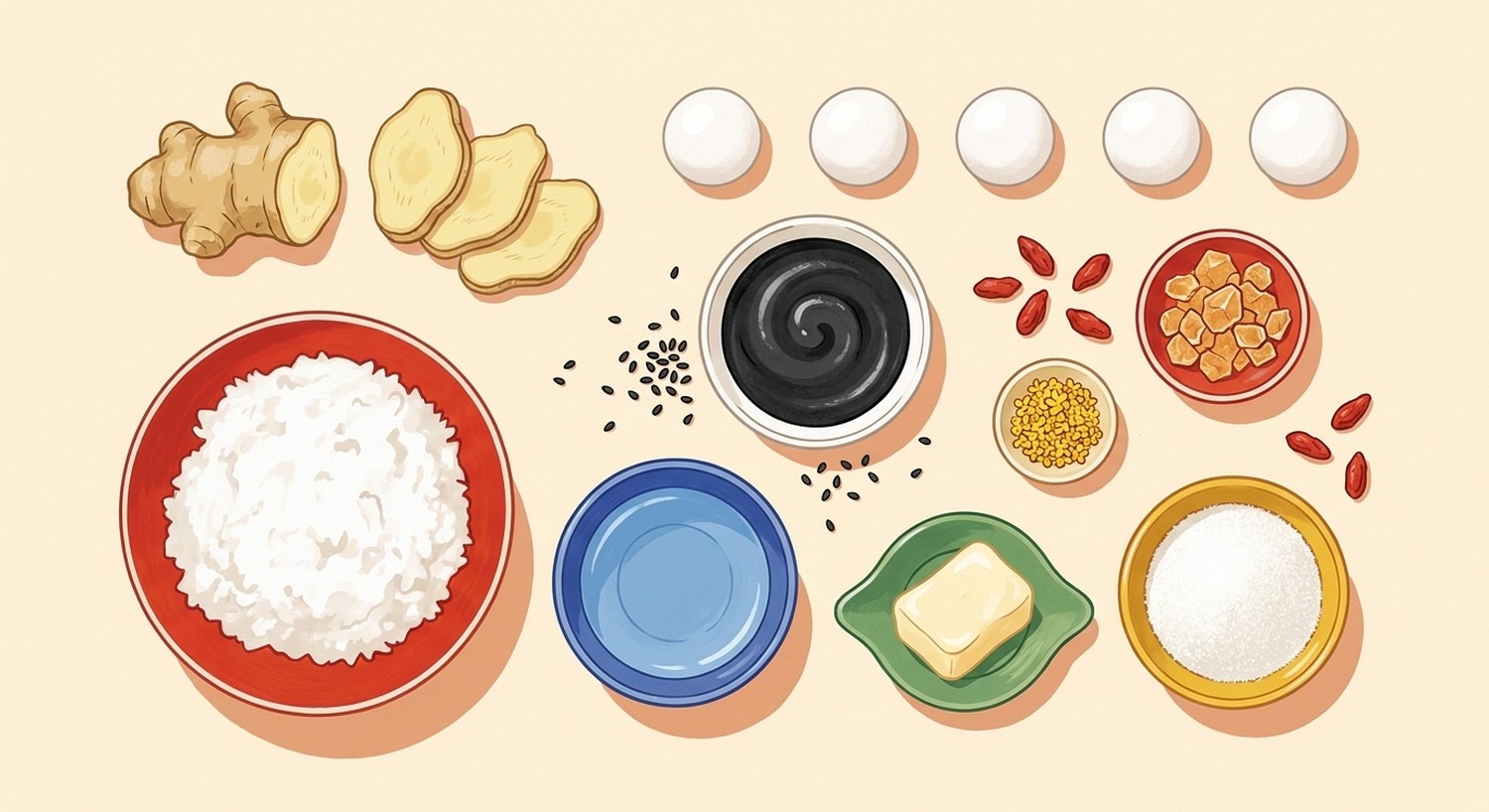
For the filling
- 100 g black sesame seeds — 黑芝麻
- 80 g caster sugar — 糖
- 70 g leaf lard, softened (or unsalted butter) — 猪板油
For the dough
- 200 g glutinous rice flour, plus extra for dusting — 糯米粉
- 180 ml hot water, plus 3 tbsp boiling — see step 3
For the ginger soup
- 4 thick slices of fresh ginger — 姜
- 30 g rock sugar (or 2 tbsp caster sugar) — 冰糖
- 1 tsp dried osmanthus blossom, optional — 桂花
- 1 litre water
Method
- Toast and grind the sesame. Toast the black sesame in a dry pan over medium heat for three or four minutes, shaking constantly, until they smell nutty and start to pop. Let them cool, then grind to a coarse, oily powder in a spice grinder or a mortar. Toasting is not optional — raw sesame tastes of almost nothing.
- Make the filling and freeze it. Mix the ground sesame with the sugar and the softened lard until it comes together as a dark paste. Roll into 20 balls of about 12 g — roughly a heaped teaspoon each — and freeze them on a lined tray for at least 30 minutes, until hard. This is the step that makes the recipe possible. A soft filling cannot be wrapped.
- Make the dough. Measure the glutinous rice flour into a bowl and lift out three tablespoons of it into a second, smaller bowl. Stir three tablespoons of boiling water into that small portion to make a thick, translucent paste, and let it cool for a minute — this scalded starter is what gives the dough its stretch. Now add the rest of the water, hot from the kettle, to the main bowl in three or four goes, stirring with chopsticks; tip in the starter and knead for two minutes until smooth, with the feel of an earlobe. If it cracks, wet your hands and knead again; if it sticks, dust with a little flour. Keep it covered — it dries out fast.
- Wrap. Divide the dough into 20 pieces and keep them covered. Roll one into a ball, then press it into a disc about 6 cm across, thicker in the middle than at the edge. Sit a frozen filling ball in the centre, cup the disc in your palm and push the dough up around it, turning as you go, until the filling disappears. Pinch the seam shut, then roll gently between your palms until smooth. No seam, no crack, no leak.
- Make the soup. Simmer the ginger, rock sugar and a litre of water for ten minutes, until the sugar has dissolved and the ginger has given up its heat. Keep it hot. Add the osmanthus at the very end, off the heat, or its perfume cooks away.
- Boil until they float — then a little longer. Bring a separate wide pan of water to a rolling boil, slide the tangyuan in and stir once so they do not catch on the base. They will sink. When they rise to the surface, pour in half a cup of cold water, drop the heat to a bare simmer and give them four or five minutes more. They are ready when they are floating freely, smooth-skinned and slightly swollen. Floating on its own is not done — that is the skin, and the filling needs the extra time. Lift them out with a slotted spoon straight into bowls of the hot ginger soup, and warn whoever you hand it to.
Per serving (approx., 4 servings of five): 550 kcal · 7 g protein · 28 g fat · 66 g carbs. A rough guide only.
Freeze the filling, and mind the water
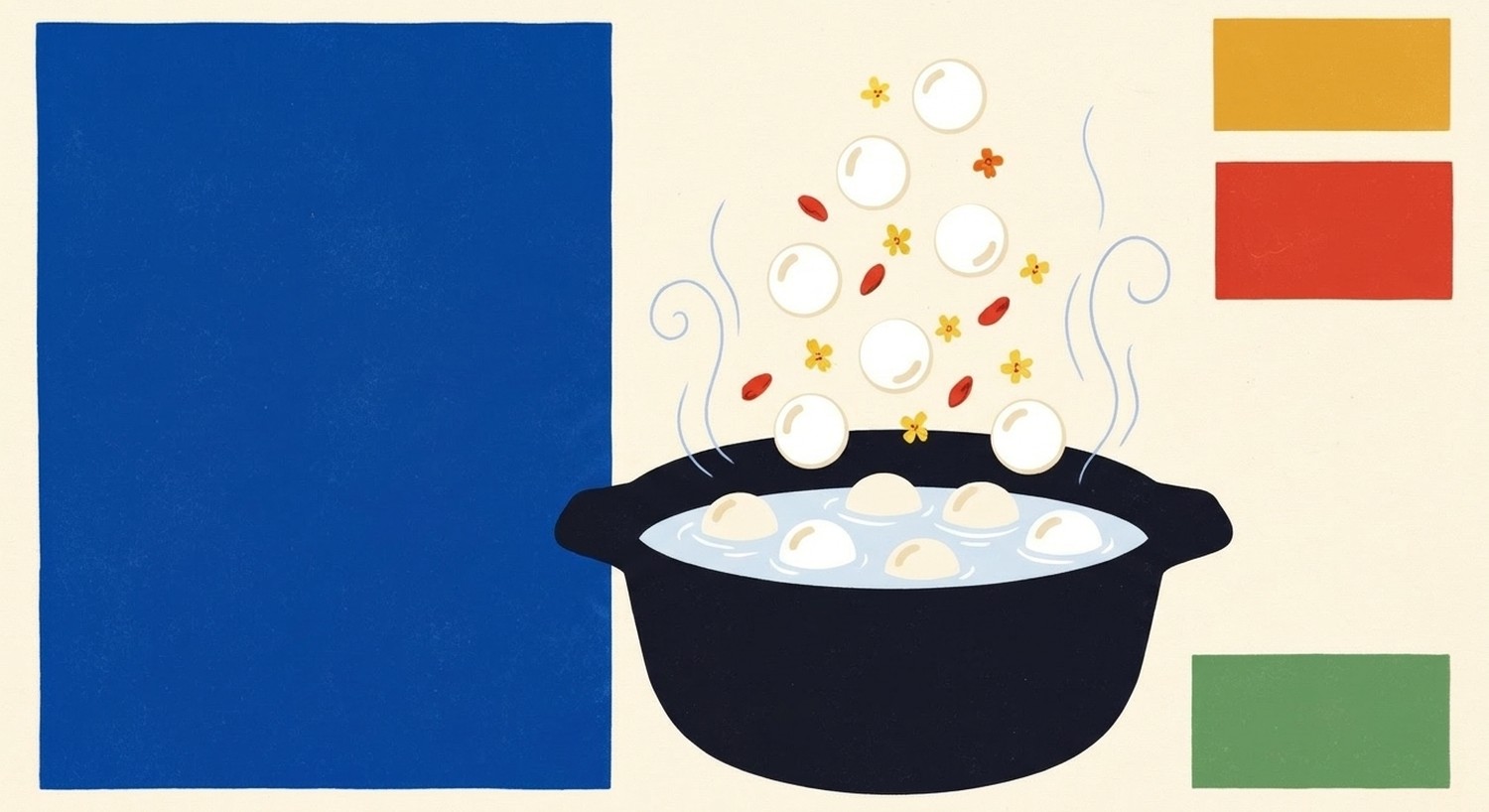
Two things decide whether this works, and neither is the wrapping.
The first is a frozen filling. Sesame, sugar and lard at room temperature is a paste, and you cannot wrap a paste — it smears into the dough and tears it from the inside. Half an hour in the freezer turns each ball into a solid marble you can pick up in your fingers, and the dough closes around it cleanly. By the time the water is boiling the filling has softened again; by the time it is cooked, it is liquid. This is the reason cooks reach for leaf lard (猪板油) rather than oil: it is hard at fridge temperature, which is the whole job the fat is doing.
The second is the water you mix the dough with — and here the traditional answer is that the question does not arise. The Ningbo method never mixes flour with water at all: the rice is soaked and wet-milled to a slurry (水磨), the water pressed out, and the damp paste used as it is. Working from a packet of glutinous rice flour you have to reproduce that pliability yourself. Glutinous rice flour has no gluten, so nothing holds the dough together but gelatinised starch, and cold water gives you a dough that crumbles as you wrap. Cooks differ on the remedy — some use hot water throughout, some scald a portion of the flour and finish with cool. The method above takes the second route, because an all-hot-water dough goes slack and loses its shape in the pot.
Everything after that is patience. Work in small batches, keep the rest covered, and accept that the first two will be ugly.
汤圆 are not 元宵
They look almost identical in the bowl, and plenty of menus use the two names interchangeably. They are not the same thing, and the difference is not simply regional vocabulary — it is two different ways of building the ball.
Tangyuan are wrapped. 包 (bāo) is the verb: you make a wet dough, flatten a piece in your palm, sit the filling in it and close the dough over the top. That is the recipe on this page, and it is the southern name and the southern method.
Yuanxiao are rolled. 滚 (gǔn) is the verb: you start with a firm cube of filling, dampen it, and tumble it in a wide flat basket of dry glutinous rice flour. The flour clings, you dip it in water and tumble it again, and a coat builds up in layers, the way a snowball grows. That is the northern name and the northern method.
You can taste the difference, and see it. A rolled yuanxiao has a thicker skin, so it needs noticeably longer in the pot, and between the loose flour it carries and the extra boiling it leaves the water cloudy. A wrapped tangyuan has a thinner, smoother skin, cooks faster and leaves its soup much clearer. If your soup goes milky, that is not a mistake — that is what yuanxiao do.
One honest caveat: this crisp division is how the two words are used today, and Chinese state media state it plainly. It is not ancient. The words were once synonyms, and in Fujian they still split along a different axis entirely — there 汤丸 are the sweet ones and 元宵丸 the savoury, north and south having nothing to do with it.
Say it in Chinese
The dish, what goes in it, and the word behind the whole tradition — tap to hear each one.
Tips & variations
- Other fillings. Peanut (花生) ground with sugar works exactly like sesame. Red bean paste (豆沙) is softer and needs a longer freeze. In parts of the south you will also meet savoury tangyuan filled with minced pork and spring onion, served in broth rather than sweet soup.
- The Ningbo original. The lard-and-black-sesame version is Ningbo’s, and it is taken seriously there: 宁波汤团制作技艺 — the craft of making them — was listed as Zhejiang provincial intangible cultural heritage in 2012. The filling in that tradition is leaf lard, white sugar and black sesame, and the flour is wet-milled rather than bought dry.
- Leave them empty. Small unfilled balls, about the size of a pea, are simmered in sweet fermented rice to make 酒酿圆子 (jiǔniàng yuánzi) — much quicker, and the usual answer when nobody has time to wrap.
- Freeze them raw. Wrapped tangyuan freeze beautifully. Space them on a floured tray until solid, then bag them. Cook from frozen, straight into boiling water, and give them an extra minute or two. Do not thaw them first — they slump.
- If one splits, take it out. A leaked ball will cloud the whole pot and the rest will taste of sesame water. Lift it out and eat it yourself; that is the cook’s portion.
- No lard? Unsalted butter works and tastes good, though it sets a little softer. Coconut oil is the best vegan swap, since it is hard at fridge temperature — which is the whole job the fat is doing.
FAQs
Learn to say it — and to cook it — in Mandarin
Food is the tastiest way into a language. Practise real Mandarin, dish by dish, with a native speaker who grew up eating it.
Book a Free Intro Call